Key takeaways
- AI search platforms (ChatGPT, Perplexity, Google AI Mode, Claude) each use fundamentally different citation logic — optimizing for one doesn't automatically help you on the others.
- Only 11% of domains are cited by both ChatGPT and Perplexity, meaning platform-specific strategies matter more than generic "AI SEO."
- Google AI Mode queries are now 3x longer than traditional searches, and 93% end without a click — brand visibility inside the answer is the new conversion surface.
- Traditional SEO rankings no longer predict AI citations: only 38% of top-10 Google rankers appear in AI Overviews, down from 76% in mid-2025.
- Tracking AI visibility requires different tools than traditional rank trackers — platforms like Promptwatch are built specifically to monitor and improve how brands appear across multiple AI engines.
Why this matters more than traditional SEO right now
Google AI Overviews now appear in roughly 50% of all searches. ChatGPT handles over 200 million weekly active users. Perplexity has become the default research tool for analysts and technical buyers. When these platforms answer a question, they cite a small handful of sources — and everyone else is invisible.
Here's the uncomfortable part: being ranked #1 on Google no longer guarantees you'll appear in AI-generated answers. A 2026 analysis found that only 38% of top-10 Google rankers are cited in AI Overviews — down from 76% just 12 months earlier. The SEO-to-AI-citation correlation has essentially collapsed.
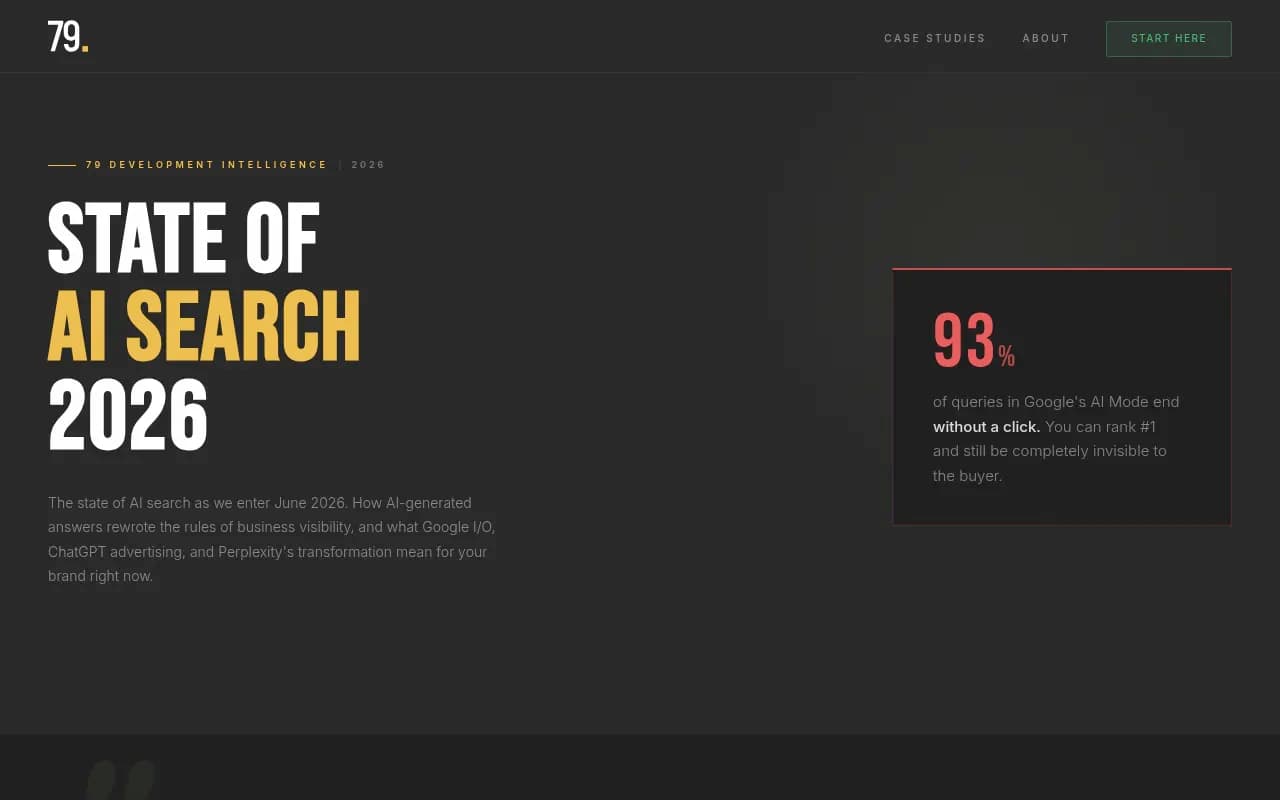
And 93% of queries in Google's AI Mode end without a click. You can hold position one and still be completely invisible to the buyer who asked the question.
This is why AI search visibility has become its own discipline. It's not a subset of SEO. It has different signals, different content requirements, and different measurement tools.
The four major platforms and how they actually work
The biggest mistake brands make is treating AI search as a single channel. An analysis of 680 million citations found that only 11% of domains are cited by both ChatGPT and Perplexity. These platforms have different architectures, different training data, and different sourcing philosophies. Here's what's actually happening under the hood.
ChatGPT
ChatGPT Search runs on a two-layer system. The base layer is its training data — static, vast, built from web content crawled before the model's cutoff. The retrieval layer is Bing-powered, activated primarily for commercial and time-sensitive queries.
What this means in practice: ChatGPT heavily favors sources it already "knows" from training. Wikipedia is its single most-cited source, accounting for 7.8% of all citations. Established domains with long publication histories and consistent topical authority tend to outperform newer sites, even if the newer content is technically better.
Brand citation rates on ChatGPT are notably low — one 2026 study of 34,234 AI responses found ChatGPT cited brands just 0.59% of the time. It's not that ChatGPT ignores brands; it's that it prioritizes encyclopedic, neutral sources over commercial ones.
To get cited by ChatGPT: build topical depth over time, earn citations from authoritative reference sites, and make sure your brand has a clear, factual presence on Wikipedia and similar reference sources. Structured data and clear entity definitions help the model recognize who you are.
Perplexity
Perplexity behaves very differently. It's built as a real-time research engine, and its citation logic reflects that. Reddit is its top cited source at 6.6% of citations — nearly three times higher than Reddit's share in Google AI Overviews.
Brand citation rates on Perplexity are dramatically higher than ChatGPT: 13.05% vs 0.59% in the same study. Grok came in even higher at 27%. This tells you something important: recency and community discussion matter far more on Perplexity than on ChatGPT.
Perplexity users tend to be researchers, analysts, and technical buyers. They're asking specific, multi-part questions and expecting sourced answers. Content that directly answers those questions — with clear claims, cited data, and specific recommendations — performs well here.
To get cited by Perplexity: publish content that answers specific research-intent queries, maintain an active presence in community discussions (Reddit, forums, review sites), and update your content regularly. Freshness is a real signal.
Google AI Overviews and AI Mode
Google's AI systems are the most complex to optimize for, partly because they sit on top of the world's largest existing index and partly because Google keeps changing how they work.
AI Overviews now reach 2.5 billion monthly users (confirmed at Google I/O May 2026). AI Mode has separately crossed 1 billion monthly active users. These are not niche features — they're the default experience for most users.
Google's sourcing philosophy sits between ChatGPT and Perplexity: Reddit is its top cited source at 2.2%, reflecting a mix of social and professional content. Google AI systems weight E-E-A-T signals (experience, expertise, authoritativeness, trustworthiness) heavily, and they're more likely to cite content that already performs well in traditional search — though that correlation is weakening.
AI Mode queries are now 3x longer than traditional searches, and follow-up queries are up 40% month over month. People are having conversations with search, not typing keywords. Content structured to handle multi-part, conversational queries performs better than content optimized for single-keyword searches.
To get cited by Google AI: maintain strong E-E-A-T signals, structure content to answer follow-up questions, use schema markup, and keep your Google Business Profile and entity information accurate and complete.
Claude
Claude (from Anthropic) is increasingly used as a research and writing assistant, and its citation behavior differs from the others in one key way: it's more conservative about citing specific sources unless it's using a retrieval-augmented mode or the user explicitly asks for sources.
Claude tends to synthesize information from its training data rather than pull live web results. This makes it harder to "optimize" for in the traditional sense. What matters most is whether your brand and content appear in the training data — which means being cited by other authoritative sources, having a clear Wikipedia presence, and being discussed in high-quality publications.
As Claude expands its web browsing capabilities, the citation patterns will likely shift closer to Perplexity's model. For now, the best strategy is building the kind of brand authority that gets you mentioned in the sources Claude already trusts.
The six signals that drive AI citation across all platforms
Despite the platform differences, there are common factors that improve your chances of being cited across all AI search engines.
1. Retrieval-ready content structure
AI models don't read pages the way humans do. They extract answers. Content that's structured to answer specific questions — with clear headings, direct answers near the top, and logical information hierarchy — is more likely to be pulled into an AI response.
This means FAQ sections, definition blocks, comparison tables, and numbered lists all help. Not because they're magic, but because they make it easier for an AI to extract a clean, citable answer.
2. Topical authority and depth
A single great article rarely gets you cited consistently. AI models favor sources that demonstrate deep, consistent coverage of a topic over time. If you have 40 articles on a subject and your competitor has one, you're more likely to be treated as the authoritative source — even if their single article is well-written.
3. Third-party validation
Being mentioned in other sources matters enormously. Reddit discussions, YouTube videos, review sites, industry publications, and even forum threads all contribute to how AI models perceive your brand's credibility. This is the AI equivalent of backlinks — but the signals are broader and harder to game.
4. Recency (platform-dependent)
Perplexity weights this heavily. Google AI Overviews weight it moderately. ChatGPT weights it least (for training-data-based responses). If you're targeting Perplexity, publishing frequency and content freshness are real levers. If you're targeting ChatGPT, depth and authority matter more than recency.
5. Entity clarity
AI models work with entities — named things (brands, people, products, concepts) that they can recognize and reason about. If your brand isn't clearly defined as an entity — with consistent naming, clear descriptions, and mentions across authoritative sources — you're harder for AI models to cite accurately.
Structured data (Schema.org markup) helps here, as does having a clear, factual Wikipedia entry and consistent NAP (name, address, phone) information across the web.
6. Platform-specific content signals
Reddit presence matters for Perplexity. E-E-A-T signals matter for Google. Training-data depth matters for ChatGPT. You can't ignore the platform-specific factors and expect a one-size-fits-all approach to work.
How to measure your AI search visibility
You can't improve what you can't measure. But traditional rank trackers don't tell you whether you're being cited in AI responses — they track Google positions, not AI citations.
The right approach is to track:
- Which AI platforms mention your brand and how often
- Which specific prompts and queries trigger citations of your content
- Which pages on your site are being cited (and which aren't)
- How your citation rate compares to competitors
- Whether AI crawlers are actually visiting and indexing your pages
Several tools have been built specifically for this. Promptwatch monitors across 10 AI models (ChatGPT, Perplexity, Google AI Overviews, Claude, Gemini, Grok, DeepSeek, Copilot, Meta AI, and Mistral) and includes crawler log analysis so you can see when AI bots visit your pages and when those visits lead to citations.

Other tools worth knowing about:
Otterly.AI tracks brand mentions across ChatGPT, Perplexity, and Google AI Overviews with a clean monitoring interface.
Otterly.AI

Profound is an enterprise-focused platform that tracks brand mentions across 9+ AI search engines with strong reporting features.
Profound

Peec AI offers AI search visibility tracking aimed at marketing teams, with a focus on prompt monitoring.

LLM Pulse tracks brand visibility across ChatGPT, Perplexity, and other models with a straightforward dashboard.
Platform comparison: what each AI engine prioritizes
| Platform | Top cited source | Brand citation rate | Key ranking signals | Content that works |
|---|---|---|---|---|
| ChatGPT | Wikipedia (7.8%) | 0.59% | Training-data depth, entity authority | Long-form, authoritative, evergreen |
| Perplexity | Reddit (6.6%) | 13.05% | Recency, community discussion, specificity | Research-intent, frequently updated |
| Google AI Overviews | Reddit (2.2%) | Varies by query | E-E-A-T, structured data, traditional SEO | Comprehensive, well-structured |
| Google AI Mode | N/A (same index) | N/A | Conversational intent, follow-up coverage | Multi-part Q&A, conversational |
| Claude | Training data | Low (no live retrieval by default) | Third-party citations, Wikipedia presence | Authoritative, widely referenced |
| Grok | Real-time X/Twitter | 27% | Social discussion, recency | Trending topics, social proof |
Common mistakes brands make
Treating AI search like traditional SEO. The signals are different. Keyword density, meta descriptions, and even backlinks matter less than entity clarity, topical depth, and third-party mentions in the right places.
Optimizing for one platform only. If you're only thinking about Google AI Overviews because it has the most users, you're ignoring Perplexity's dramatically higher brand citation rates and the fact that Perplexity users convert at roughly 11 times the rate of traditional organic search visitors.
Ignoring offsite signals. Your website is only part of the picture. Reddit threads, YouTube videos, review site listings, and industry forum discussions all influence what AI models say about your brand. Many brands focus entirely on their own content and ignore the offsite ecosystem.
Not tracking AI crawlers. If you don't know whether AI bots are crawling your pages — and whether those crawls are resulting in citations — you're flying blind. Some pages get crawled but never cited. Others get cited from content that's months old. You need crawler-level data to understand what's actually happening.
Publishing generic content. AI models are trained on enormous amounts of generic content. To stand out, your content needs to answer specific questions with specific data, examples, and perspectives that aren't already everywhere. Generic "what is X" articles rarely get cited when the model already has 10,000 similar articles in its training data.
A practical starting point for 2026
If you're starting from zero on AI visibility, here's a reasonable sequence:
-
Audit your current AI presence. Ask ChatGPT, Perplexity, and Claude about your brand and your key product categories. What do they say? Do they mention you? What sources do they cite instead?
-
Map the gaps. Identify the specific questions and prompts where competitors are being cited but you're not. These are your content priorities.
-
Fix your entity foundation. Make sure your brand is clearly defined across Wikipedia, Wikidata, your Google Business Profile, and major review sites. Consistent, accurate entity information is table stakes.
-
Publish content that answers specific questions. Focus on research-intent queries in your category. Be specific, cite data, and structure content so AI models can extract clean answers.
-
Build offsite presence. Engage in relevant Reddit communities, pursue coverage in industry publications, and make sure your brand appears in the listicles and comparison articles that AI models frequently cite.
-
Track and iterate. Use a dedicated AI visibility tool to monitor your citation rates across platforms. Track which pages are being cited, which prompts trigger your brand, and how your visibility changes over time.
The brands that figure this out early will hold a significant advantage. AI-mediated search is already the default for nearly half of consumers — 43% use AI search tools daily according to the Yext Consumer Search Behaviors Report 2026. That number will only go up.
The question isn't whether AI search matters for your brand. It's whether you're visible when it does.