Key takeaways
- AI search visibility measures how often your brand is cited in AI-generated answers from tools like ChatGPT, Perplexity, and Google AI Overviews -- it's different from traditional search rankings.
- 37% of searches now start on AI platforms, and ChatGPT alone has over 910 million weekly active users. If you're not tracking AI visibility, you're blind to a massive discovery channel.
- AI engines don't rank pages -- they synthesize answers and pick sources. Getting cited requires a different strategy than getting ranked.
- You can start tracking AI visibility today with dedicated tools, even if you have no technical background.
- Monitoring alone isn't enough. The brands winning in AI search are the ones finding gaps and creating content that fills them.
If you've noticed your website traffic behaving strangely in 2026 -- fewer clicks despite decent Google rankings, or leads mentioning they "asked ChatGPT" before finding you -- you're not imagining things. Something fundamental has shifted in how people find information online, and most marketing teams are still measuring the wrong thing.
This guide is for anyone starting from zero. No jargon, no assumptions. Just a clear explanation of what AI search visibility is, why it matters right now, and how to start tracking it.
What is AI search visibility?
Traditional SEO visibility answers one question: where do you rank in Google's blue-link results? Position 1, position 5, page 2 -- that's the game most marketers have been playing for two decades.
AI search visibility is different. It answers a different question: when someone asks ChatGPT, Perplexity, Google AI Overviews, or another AI assistant a question relevant to your business, does your brand get mentioned?
AI engines don't return a list of links. They synthesize an answer -- drawing on training data, live web crawling, and indexed sources -- and sometimes cite specific pages or brands as sources. Being cited in those answers is AI search visibility. Not being cited means you're invisible to anyone using those platforms to research a purchase, compare products, or look for expert advice.
Here's a concrete example. Someone types "what's the best project management tool for remote teams?" into Perplexity. Perplexity generates a paragraph-form answer naming three or four tools, with citations. If your product is one of them, you have AI visibility for that query. If it's not, you don't -- regardless of where you rank on Google.
Why this matters right now
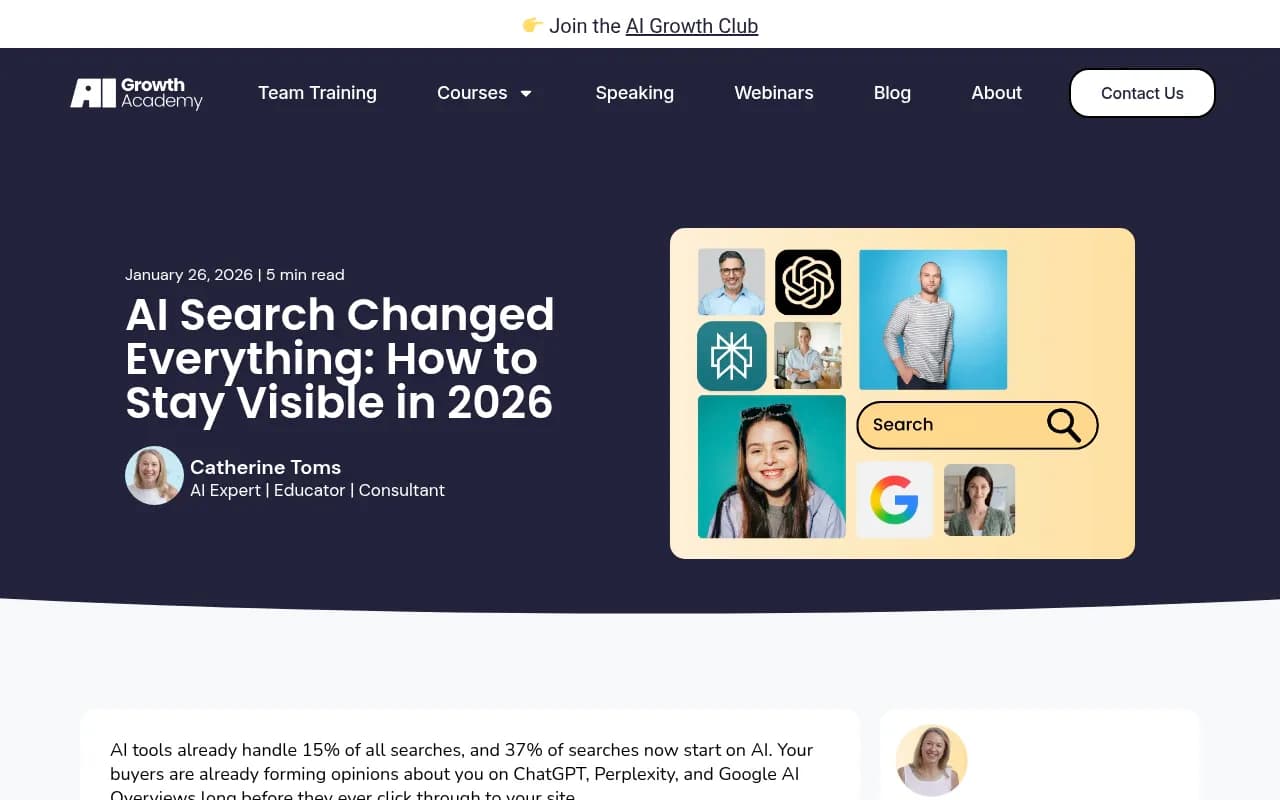
The numbers are hard to ignore. ChatGPT has over 910 million weekly active users. Google AI Overviews now reach 2 billion monthly users across 200+ countries. Perplexity grew 50-66% year-over-year. And according to AI Growth Academy, 37% of searches now start on AI platforms.
That's not a niche trend. That's a meaningful chunk of the discovery funnel that traditional analytics tools can't see.
The deeper problem: buyers are forming opinions about your brand on AI platforms before they ever visit your website. If ChatGPT consistently recommends a competitor when someone asks about your product category, that's a brand perception problem -- and you won't see it in your Google Search Console data.
Traditional SEO isn't dead. But treating it as your only visibility metric in 2026 is like only measuring TV ad performance while your audience has moved to streaming.
How AI engines decide what to cite
This is where most beginners get confused. AI engines don't work like search engines. They don't crawl the web and rank pages by authority alone. They generate answers, and the sources they cite depend on several factors:
Content that directly answers the question. AI models favor sources that clearly and specifically address what the user asked. Vague, keyword-stuffed content gets ignored. Detailed, structured answers to real questions get cited.
Entity recognition. AI models build mental models of brands, products, and people. If your brand is well-represented across multiple authoritative sources -- your own site, third-party reviews, industry publications, Reddit discussions -- the model is more likely to recognize you as a relevant entity and surface you.
Freshness and crawlability. AI crawlers (GPTBot, ClaudeBot, PerplexityBot, etc.) need to actually reach and read your pages. If your site blocks these crawlers, or if your JavaScript-heavy pages don't render properly for bots, you're invisible by default.
Third-party citations. It's not just about your own website. AI models pull from Reddit threads, YouTube videos, review sites, and industry listicles. A brand mentioned positively in a top-ranked Reddit discussion has a real shot at appearing in AI answers -- sometimes more than the brand's own homepage.
Topical authority. Covering a topic comprehensively, across multiple angles and related questions, signals to AI models that you're a credible source on that subject.
AI visibility vs. traditional SEO: the key differences
| Dimension | Traditional SEO | AI search visibility |
|---|---|---|
| What you're measuring | Keyword rankings (positions 1-100) | Citation frequency in AI-generated answers |
| Who decides | Google's ranking algorithm | LLM training data + live crawling + entity models |
| Where it shows up | Google SERP blue links | ChatGPT, Perplexity, Gemini, AI Overviews, etc. |
| Click behavior | Users click through to your site | Often zero-click; brand mentioned in the answer |
| Key signals | Backlinks, on-page SEO, Core Web Vitals | Content quality, entity recognition, third-party mentions |
| Tools to track it | Google Search Console, Semrush, Ahrefs | Dedicated AI visibility platforms |
| How fast it changes | Weeks to months | Can shift within days as models update |
The zero-click point is worth dwelling on. When Perplexity answers a question and cites your brand, the user may never click your link -- but they've still encountered your brand in a positive context. That's brand exposure you can't measure with traditional analytics. It influences purchasing decisions. And right now, most companies have no idea whether it's happening or not.
How to start tracking AI visibility
The good news: you don't need to be technical to get started. Here's a practical approach.
Step 1: identify the prompts that matter to your business
Think about the questions your potential customers ask when they're in research mode. Not keywords -- questions. "What's the best CRM for small businesses?" "How do I reduce customer churn?" "Which accounting software is easiest for freelancers?"
These are the prompts you want to track. Start with 10-20 that represent your core product categories and use cases.
Step 2: manually test a few prompts
Before investing in a tool, do a quick manual audit. Open ChatGPT, Perplexity, and Google AI Overviews. Type in your most important prompts. Note:
- Is your brand mentioned at all?
- If yes, is it mentioned positively or neutrally?
- Which competitors are being cited?
- What sources are being cited (your site, third-party reviews, Reddit, etc.)?
This takes 30-60 minutes and gives you an immediate sense of where you stand. The problem is that manual testing doesn't scale. AI responses vary by session, by phrasing, by model version. You'd need to run hundreds of tests to get statistically meaningful data -- which is why dedicated tools exist.
Step 3: choose a tracking tool
This is where most beginners get stuck, because the market for AI visibility tools has exploded in 2026. Here's a breakdown of the main options:
Promptwatch is the most comprehensive option available. It tracks your brand across 10 AI models (ChatGPT, Perplexity, Claude, Gemini, Google AI Overviews, Grok, DeepSeek, Copilot, Meta AI, Mistral), shows you which prompts competitors are visible for that you're not, and -- critically -- helps you create content to close those gaps. It's the only platform that covers the full loop from tracking to optimization to content generation.

For teams that want monitoring without the full optimization suite, there are several lighter options:
Otterly.AI

Otterly.AI tracks brand mentions across ChatGPT, Perplexity, and Google AI Overviews. It's a solid monitoring tool for getting started, though it doesn't offer content generation or crawler log analysis.
Profound

Profound covers 9+ AI search engines and is popular with enterprise teams. Strong on monitoring, less focused on helping you act on the data.

Peec AI is a straightforward monitoring tool for marketing teams that want to track AI search visibility without a steep learning curve.
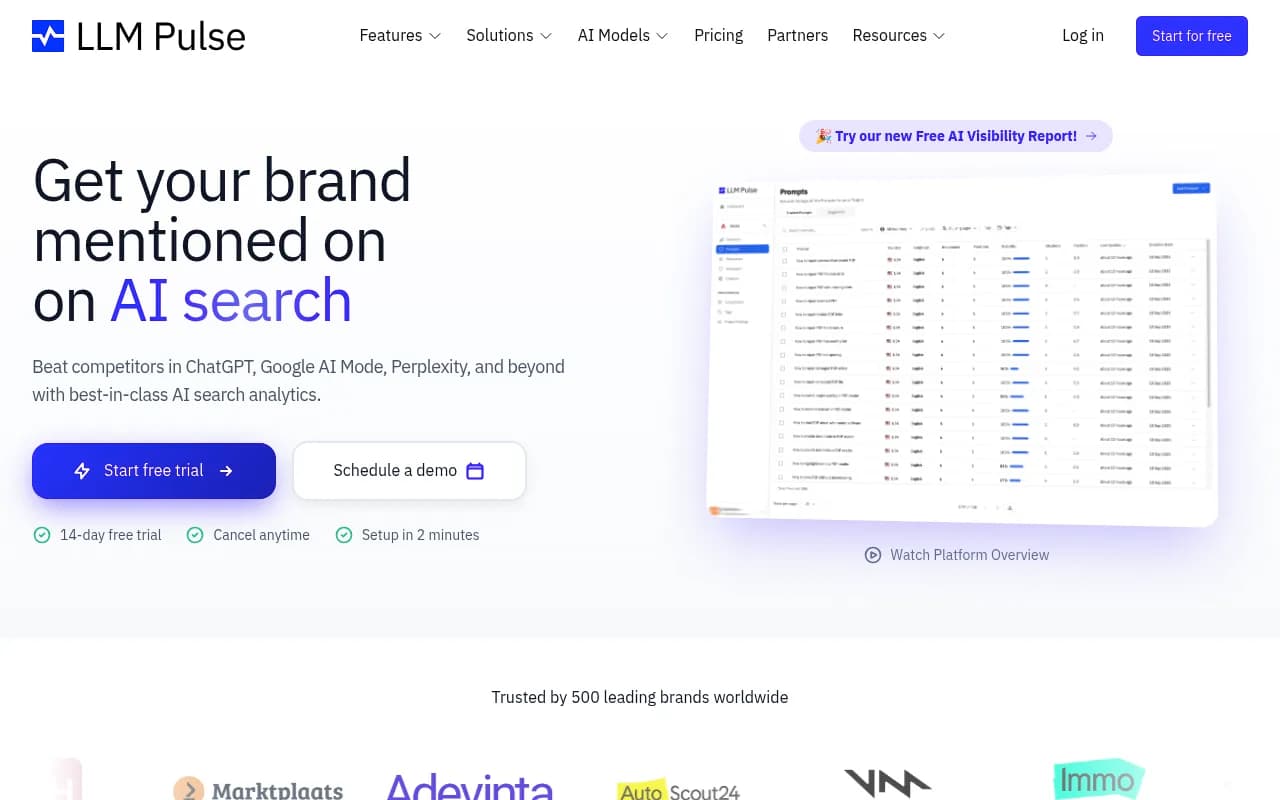
LLM Pulse tracks brand visibility across ChatGPT, Perplexity, and other models. Good for getting a quick read on where you stand.

Rankshift focuses specifically on ChatGPT and Perplexity tracking, with a clean interface that's easy for beginners to navigate.
Here's a quick comparison of entry-level options:
| Tool | AI models tracked | Content generation | Crawler logs | Starting price |
|---|---|---|---|---|
| Promptwatch | 10 | Yes (Content Agents) | Yes | $99/mo |
| Otterly.AI | 3 | No | No | Freemium |
| Profound | 9+ | No | No | Higher tier |
| Peec AI | Multiple | No | No | Freemium |
| LLM Pulse | Multiple | No | No | Freemium |
| Rankshift | 2 | No | No | Freemium |
Step 4: set up your prompt tracking
Once you've chosen a tool, you'll configure it with:
- Your brand name and key product names
- The prompts you identified in step 1
- Your main competitors (so you can benchmark against them)
- Your target geography and language (AI responses vary significantly by region)
Most tools will then run these prompts on a scheduled basis -- daily or weekly -- and track whether your brand appears, how prominently, and in what context.
Step 5: understand what you're looking at
The core metrics you'll see in any AI visibility platform:
- Mention rate: what percentage of relevant prompts include your brand in the response
- Citation rate: how often your specific pages or URLs are cited as sources
- Share of voice: your visibility relative to competitors across the same set of prompts
- Sentiment: whether mentions are positive, neutral, or negative
A mention rate of 0% on your core product prompts is a clear signal. A mention rate of 40% with a competitor at 80% tells you where the gap is. These numbers give you something concrete to work toward.
What to do with what you find
Tracking is just the beginning. The brands making real progress in AI search visibility are the ones treating the data as a content roadmap.
If you find that a competitor is consistently cited when someone asks "how to [solve problem your product solves]" and you're not, that's a content gap. The AI model doesn't have a good reason to cite you for that query -- probably because you don't have a clear, authoritative piece of content that answers it.
The fix is to create that content. Not generic blog posts stuffed with keywords, but specific, well-structured answers to the exact questions AI models are fielding. Think FAQ pages, comparison guides, how-to articles, and topic deep-dives that directly address the prompts you're tracking.
Tools like Promptwatch take this further with Content Agents that generate articles grounded in real prompt data, citation analysis, and competitor research -- so you're not guessing what to write, you're filling specific gaps the data has identified.
Beyond your own site, pay attention to third-party sources. If AI models are citing a Reddit thread or a review site listicle that doesn't mention you, that's a signal to engage with those communities, reach out to the publication, or create content that earns a spot on those lists.
Common beginner mistakes
Tracking too few prompts. Ten prompts feels like a lot when you're starting out, but AI visibility varies enormously by phrasing. "Best CRM for startups" and "top CRM tools for small teams" can produce completely different results. Cast a wider net.
Only tracking your brand name. Brand name tracking tells you whether people asking specifically about you get accurate information. But most of your potential customers aren't asking about you by name -- they're asking about their problem. Track category and problem-based prompts, not just branded ones.
Ignoring the competitor data. The most actionable insight in any AI visibility report is usually "here's what your competitor is being cited for that you're not." That's your to-do list.
Treating AI visibility as a one-time audit. AI models update constantly. A page that gets cited today might not get cited next month. Visibility needs to be tracked continuously, not checked once and forgotten.
Blocking AI crawlers. Some site owners, worried about AI scraping their content, have added rules to their robots.txt that block GPTBot, ClaudeBot, and PerplexityBot. If you want to be cited, you need to be crawled. Check your robots.txt and make sure you're not accidentally blocking the crawlers that could be driving your AI visibility.
A realistic timeline
Week 1-2: manual audit of your top 20 prompts across ChatGPT, Perplexity, and Google AI Overviews. Document what you find.
Week 3-4: set up a tracking tool. Configure your prompts, competitors, and brand terms. Let it run for at least two weeks before drawing conclusions.
Month 2: review your first real dataset. Identify your biggest gaps -- the prompts where competitors are visible and you're not. Prioritize 3-5 content pieces that directly address those gaps.
Month 3: publish the content, monitor whether AI crawlers pick it up, and track whether your citation rate improves. Adjust based on what you see.
This isn't a fast process. AI models don't update in real time. But brands that started this work six months ago are already seeing measurable improvements in their AI visibility scores -- and the gap between them and brands that haven't started is widening every month.
The bottom line
AI search visibility isn't a future concern. It's a present one. If 37% of searches are starting on AI platforms and you have no idea whether your brand appears in those answers, you're operating with a significant blind spot.
The good news is that getting started is genuinely straightforward. Pick 20 prompts that matter to your business, test them manually, and then set up a tracking tool to monitor them consistently. From there, the data will tell you what to do next.
The brands that figure this out in 2026 will have a meaningful head start. The ones that wait will spend 2027 playing catch-up.