Key takeaways
- Yotpo Discover, Alhena AI, Ranketta and Naridon all try to do more than track mentions. Each also tries to fix product data or content, but they go about it very differently.
- Naridon is the cheapest way in for a Shopify store ($49/mo). Ranketta starts at EUR 29/mo. Alhena starts at $199/mo for paid plans. Yotpo Discover pricing wasn't public in what I found.
- Nearly all the comparison content online is vendor-written and each vendor ranks itself first. Treat rankings as marketing and test with a trial.
- Per Promptwatch Data (Sep 28 to Oct 4, 2026), product pages are the most cited content type in ChatGPT at 22.4%, so your catalog pages matter more than blog posts for many buying prompts.
- Prompt limits, credits and conversations are not comparable across these tools. Compare on workflow fit, not on headline numbers.
Why ecommerce AI SEO is its own problem
Generic AI visibility tools ask "was my brand mentioned?" Ecommerce teams have a different question: "did the AI recommend this specific product, with the right price, and send the buyer to a page that sells it?"
That is a catalog problem as much as a content problem. Shopping agents only recommend what they can confidently identify, price and route a buyer to. Ranketta's documentation says almost exactly that, and it matches what I'd expect from how these systems work. If your feed is thin, your schema is incomplete or your prices drift, you lose the recommendation to a competitor with cleaner data.
The four tools here all pitch themselves at that problem. Yotpo and Alhena come from established ecommerce platforms. Ranketta and Naridon are narrower specialists. I haven't tested them side by side, and I couldn't find any independent head-to-head, so what follows is based on vendor documentation, a Shopify App Store listing and one independent pricing review. Where a claim is a vendor's own, I say so.
What the citation data says about ecommerce
Before picking a tool, it helps to know what AI engines actually cite. Promptwatch Data's ChatGPT content type report (Sep 28 to Oct 4, 2026) breaks it down:
- Product pages: 22.4% of classified citations
- Landing pages: 16.8%
- Listicles: 13.6%
- Documentation: 7.5%
- Comparisons: 5.9%
- Reviews: 1.7%
For commercial prompts, which is where buyers live, product pages climb to 26.0%, landing pages to 20.6%, listicles to 15.0%, and comparisons to 7.9%. Those four types make up almost 70% of commercial citations. For branded prompts, reviews rise to 5.6%, over three times their overall share.
Two practical conclusions. First, product and category page quality is the main lever. Second, third-party reviews matter most when someone already knows your name and is checking you out.
One more caveat from Promptwatch's ChatGPT shopping data: shopping features like product cards appear on only a low single-digit share of web-search responses overall, concentrated in commercial and transactional prompts. The rate moves in steps, which suggests OpenAI keeps tuning it. Don't build a strategy around product cards alone. That report is dated November 2025, so check how current the numbers are.
The four tools at a glance
| Tool | Origin | Main angle | Engines | Starting price |
|---|---|---|---|---|
| Yotpo Discover | Reviews and loyalty platform | Three automated agents, native catalog sync and Yotpo Reviews | Claude, ChatGPT, Perplexity, Gemini | Not public |
| Alhena AI | Ecommerce AI assistant platform | SKU-level tracking, rendering analysis, revenue attribution | ChatGPT, AI Overviews, Perplexity, Gemini | Free, then $199/mo |
| Ranketta | Agentic commerce specialist | Best Sellers view, feed enrichment, MCP server | 4 to 9+ models by plan | EUR 29/mo |
| Naridon | Shopify app | Auto-fix suggestions, copilot chat, social mentions | Up to 7+ models at top tier | $49/mo |
Yotpo Discover
Yotpo is best known for reviews and loyalty, and Discover is built on that data. Its pitch is a closed loop: identify where you're missing in AI answers, then let three automated agents work on on-site readiness, AI-ready content and related actions. It has native catalog sync at the SKU level and plugs directly into Yotpo Reviews.
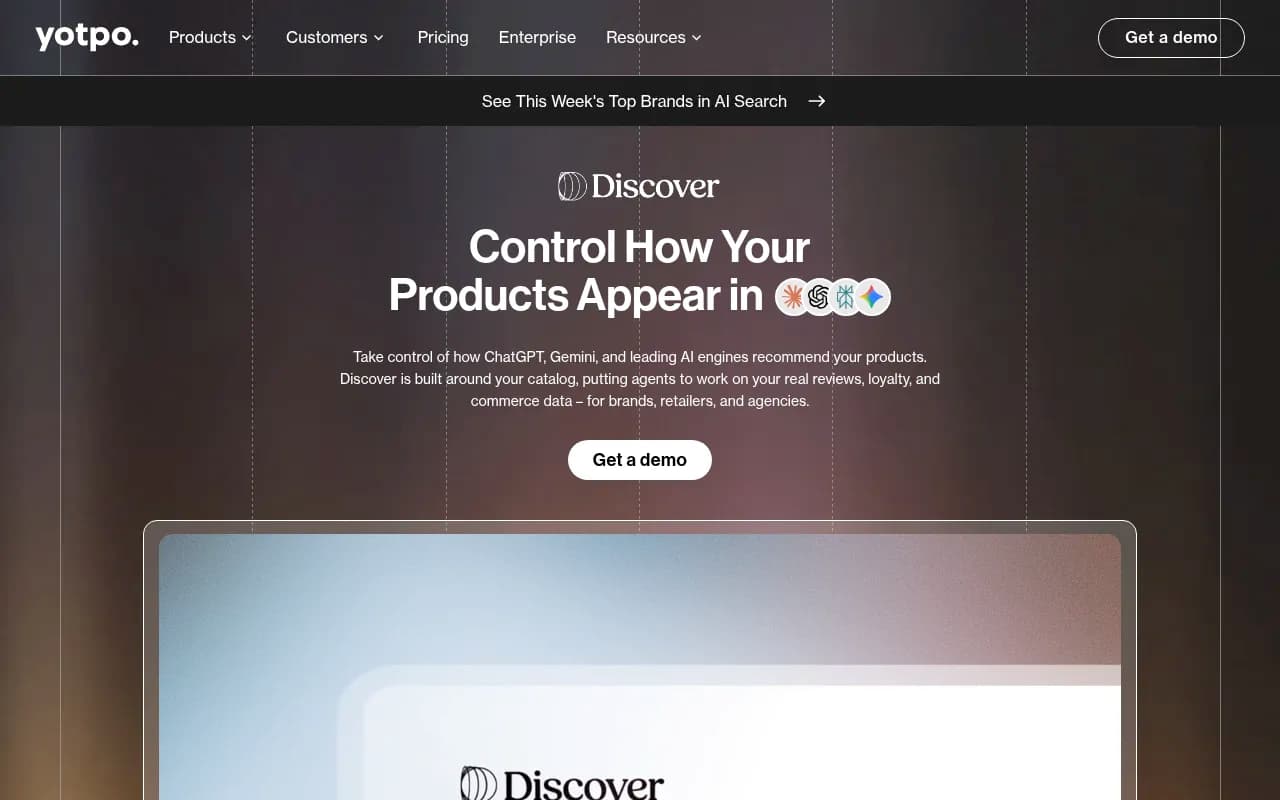
The part I find most interesting is competitor discovery. Discover says it surfaces your real AI competitors, including brands that appear ahead of you but aren't on your usual radar. In ecommerce that is often true: the brand that beats you in ChatGPT's answer may be a marketplace or a retailer, not the rival your sales team worries about.
Customers named on the page include Stanley, David Protein, Beekman and Aetrex. The page shows results like +62% and +33% without clear context in the text I could see, and also +16% #1 product placements and +20% awareness-stage shopper visibility. I'd ask for the methodology before repeating any of those.
Who it suits: DTC brands already on Yotpo Reviews, since the integration is the real advantage. If you use a different reviews provider, that advantage shrinks. Note that Yotpo's own comparison posts rank Discover first, so they are self-promotional. I found no public pricing, so expect a demo call.
Alhena AI
Alhena AI Visibility is a module inside a wider ecommerce platform that includes an AI shopping assistant, a support concierge and voice AI. The company was founded in 2022 and rebranded from Gleen AI in February 2025.
What it claims for the visibility side:
- SKU-level tracking across ChatGPT, Google AI Overviews, Perplexity and Gemini
- Rendering analysis, which checks whether a product card showed price, ratings and images or whether your brand was only named in passing
- Integrations with Shopify, WooCommerce, Magento and Salesforce Commerce Cloud
- Attribution of AI visibility to SKU-level revenue by engine
- A 0 to 100 visibility score, auto-discovered competitors, a fan-out tab and a content "fix engine"
Rendering analysis is a smart idea. A mention is not the same as a product card with a price, and most trackers flatten the two together.
Pricing needs care. Alhena's own published visibility pricing is Free (5 prompts, one engine), Essentials $199/mo (25 prompts), Growth $499/mo (75 prompts, weekly refresh), Scale $999/mo (150 prompts, daily refresh) and custom Enterprise. An independent review (checked Sep 24, 2026) lists the plans by conversations instead: Essentials $199 billed annually or $239 monthly with 200 conversations, Growth $499 or $599 with 550, Scale $999 or $1,199 with 1,200, and overage at $1.20 per conversation. The conversation limits exist because the same plans cover the shopping assistant. So prompt limits and conversation limits come from different sources and you should confirm both before buying.
Alhena's case-study numbers (3x conversion and 38% higher AOV at Tatcha, 20% AOV lift at Victoria Beckham) come from the wider platform, not the visibility tool, and are unverified.
Who it suits: stores that also want an on-site shopping assistant and would value one vendor for both. If you only want visibility, you're paying for a platform you may not use.
Ranketta
Ranketta positions itself for "agentic commerce". Its Shopping module tracks which products AI recommends in your category, with a Best Sellers view ranked by share of voice, and helps you fix the catalog you ship to AI agents.
The feed enrichment agent is the standout. You can review each change by hand or set an auto-approval threshold so high-confidence edits ship without review and only borderline ones land in a queue. It also has an MCP server, so an analyst can ask their own AI agent for top prompts by visibility over 30 days without opening the dashboard, and it uses UI scraping to see what real users see.
Pricing (vendor-published, in euros):
| Plan | Price | Includes |
|---|---|---|
| Tracker | EUR 29/mo | Tracking |
| Starter | EUR 79/mo | Adds product data enrichment |
| Growth | EUR 199/mo | 4 models, 100 prompts, 15,000 enrichment credits, 6 articles, 2 websites, 3 countries |
| Scale | EUR 449/mo | 5 models, 300 prompts, 45,000 credits, 15 articles, 5 websites, 10 countries |
| Enterprise and Agency | Custom | 9+ models, 1,000+ prompts |
Ranketta's blog says it is the only platform covering all four of its criteria. Those criteria are its own, so read that line with a raised eyebrow. Still, the feed-first approach is distinct from the others here and makes sense if you sell through marketplaces and shopping agents.
Who it suits: retailers and marketplaces with large catalogs where product data quality is the bottleneck.
Naridon
Naridon is a Shopify app for SEO and GEO optimisation, with a 7-day free trial and a free tier listed on the App Store. Its own site describes a credit-based model with a free-forever tier of 150 credits a month.
Shopify App Store pricing:
| Plan | Monthly | Annual | Highlights |
|---|---|---|---|
| Starter | $49 | $468 | 25 prompts, daily runs, 3 competitors, 100 auto-fix suggestions, 750 copilot chats, 25 social mentions |
| Growth | $249 | $2,388 | 100 prompts, 10 competitors, 500 auto-fix suggestions, 3,000 copilot chats, 200 social mentions, reports |
| Top tier | $899 | $8,724 | 500+ prompts, 100+ competitors, 2,000+ auto-fix suggestions, 7+ models, account manager, API |
Naridon claims it is 5 to 20x cheaper than an AI-focused SEO agency, putting agencies at $2,000 to $10,000 a month, and says its $249 plan breaks even with 104 extra AI-referred visitors. Those are the vendor's assumptions, not measured results.
Who it suits: small and mid-size Shopify merchants who want a low-cost entry with fix suggestions built in. It is Shopify-only in spirit, so if you run Magento or a custom stack, look elsewhere.
How they compare on what matters
| Question | Yotpo Discover | Alhena AI | Ranketta | Naridon |
|---|---|---|---|---|
| Fixes product data? | Catalog sync plus agents | Content fix engine | Feed enrichment agent with auto-approval | Auto-fix suggestions |
| Reviews integration | Native Yotpo Reviews | Not stated | Not stated | Not stated |
| Revenue attribution | Not confirmed | SKU-level by engine (vendor claim) | Not confirmed | Not confirmed |
| Platform fit | Yotpo customers | Shopify, WooCommerce, Magento, SFCC | Retailers, marketplaces | Shopify |
| Public pricing | No | Yes | Yes | Yes |
| Entry cost | Demo | $199/mo | EUR 29/mo | $49/mo |
Cautions before you buy
Prompt counts don't line up. Naridon counts prompts and credits, Alhena counts prompts and conversations, and Ranketta counts prompts, credits and models. A "100 prompt" plan from one vendor is not the same workload as another's.
Currencies differ too: Ranketta bills in euros, the others in dollars. And pricing pages change often. The checks behind this article date from September and October 2026, so confirm on each vendor's site.
Finally, ask each vendor how they collect data. Interface-level tracking and API-level tracking can return different answers, and for a store those differences show up as different recommended products.
Where a general AI visibility platform fits
If your catalog is not the main problem, or you sell more than products (software, services, content), a general platform can be a better base. Promptwatch is one: it tracks real ChatGPT, AI Overviews, Gemini and Perplexity interfaces, shows IP-verified AI crawler logs so you can see whether bots can read your product pages, and has a Content Agent that publishes to Webflow, Framer or WordPress. It also tracks ChatGPT Shopping and Alexa product results. That said, if you live inside Shopify and want fixes at the catalog level, the specialists above are closer to that workflow.

For a wider look at the category, the GEO software directory lists more options, and other trackers in our catalog include Otterly.AI and Peec AI.
Otterly.AI


If you want an SEO platform you may already pay for, Semrush and Ahrefs both added AI tracking, though with fixed prompt sets and shallower AI data.
A practical way to choose
- Start with your stack. Heavy Yotpo Reviews user? Look at Discover first. Pure Shopify with a tight budget? Naridon. Large catalog or marketplace presence? Ranketta. Want an on-site assistant too? Alhena.
- Run the same 20 to 30 buyer prompts through each trial. Use real commercial questions like "best X under $Y for Z".
- Check whether the tool tells you why a competitor wins, not just that it does.
- Fix the basics in parallel: complete Product schema, accurate price and availability, a clean merchant feed, comparison pages, an FAQ and reviews on trusted sites. Promptwatch's ecommerce guidance for ChatGPT says the same.
- Measure traffic and conversions from AI referrals in your analytics. A rising visibility score means little if buyers aren't arriving.
Content also ages at different speeds. Promptwatch Data's content half-life report found that landing pages and docs stay cited for months while news lost half its cited pages in about 36 days. For a store, that favors evergreen product and category pages over chasing news.
Bottom line
None of these four is a clear winner, and anyone who tells you otherwise is probably selling one. Naridon is the cheapest way to learn what AI says about a Shopify store. Ranketta has the most interesting feed workflow. Yotpo Discover makes the most sense if reviews are already your data engine. Alhena makes sense if you want visibility and a shopping assistant from the same vendor. Pick two, run the same prompts through both trials, and let your own results decide.