Key takeaways
- These four tools are not interchangeable. Article Forge and Autoblogging.ai sell draft volume, AutoPublish sells a quality gate and wide CMS coverage, and SEO.AI sells a managed, agent-style service at a much higher price.
- Entry prices run from $9/month (AutoPublish) to $149/month (SEO.AI). Autoblogging.ai starts around $19/month and Article Forge at $27/month billed monthly.
- The real difference shows up an hour after the draft: keyword validation, sources, internal links, review gates and where the post gets published.
- ChatGPT does not mostly cite generic blog posts. In Promptwatch Data, product pages and landing pages out-cite most editorial formats, so mass-produced filler is a weak bet.
- Test with three to five real keywords and an editor before you switch on bulk publishing.
What autoblogging means in 2026
The old version was scraping other people's content and republishing it. Nobody serious does that now. Modern autoblogging tools research a keyword, write an original article with a language model, and push it to your CMS on a schedule.
The gap between tools is how much they own around the writing. A tool that only produces text is an AI article writer. A tool that also handles keyword choice, outlines, citations, internal links, a review step and publishing is closer to real automation. Keep that distinction in mind, because the four tools here sit at different points on it.
One warning before the comparison. Most of the competitive claims floating around are written by competitors. TheSEOAgent ranks itself first in its own roundup, and AutoPublish's comparison page about Autoblogging.ai is a vendor page. I use those sources below for facts and label them where it matters, and I haven't independently verified any of the four tools' output quality.
The four tools at a glance
| Tool | Starting price | Free option | Publishing | Best for |
|---|---|---|---|---|
| Autoblogging.ai | From $19/mo | Free tier with Quick Mode | WordPress auto-post, 10+ integrations | Bulk article batches from a known keyword list |
| AutoPublish | From $9/mo | 3 free credits, no card | 8+ CMSs incl. WordPress, Ghost, Shopify, HubSpot | Teams that want a quality gate and multi-CMS output |
| Article Forge | $27/mo monthly, $13/mo annual | 5-day trial | Auto-post to blogs, API | Long, one-click articles at volume |
| SEO.AI | $149/mo single site | 7-day trial | WordPress, Webflow, Wix, Squarespace, Shopify, Magento | Businesses that want a managed AI agent with human spot checks |
Prices come from each vendor's pricing page or comparison page and change often. Confirm on the vendor site before you buy.
Autoblogging.ai
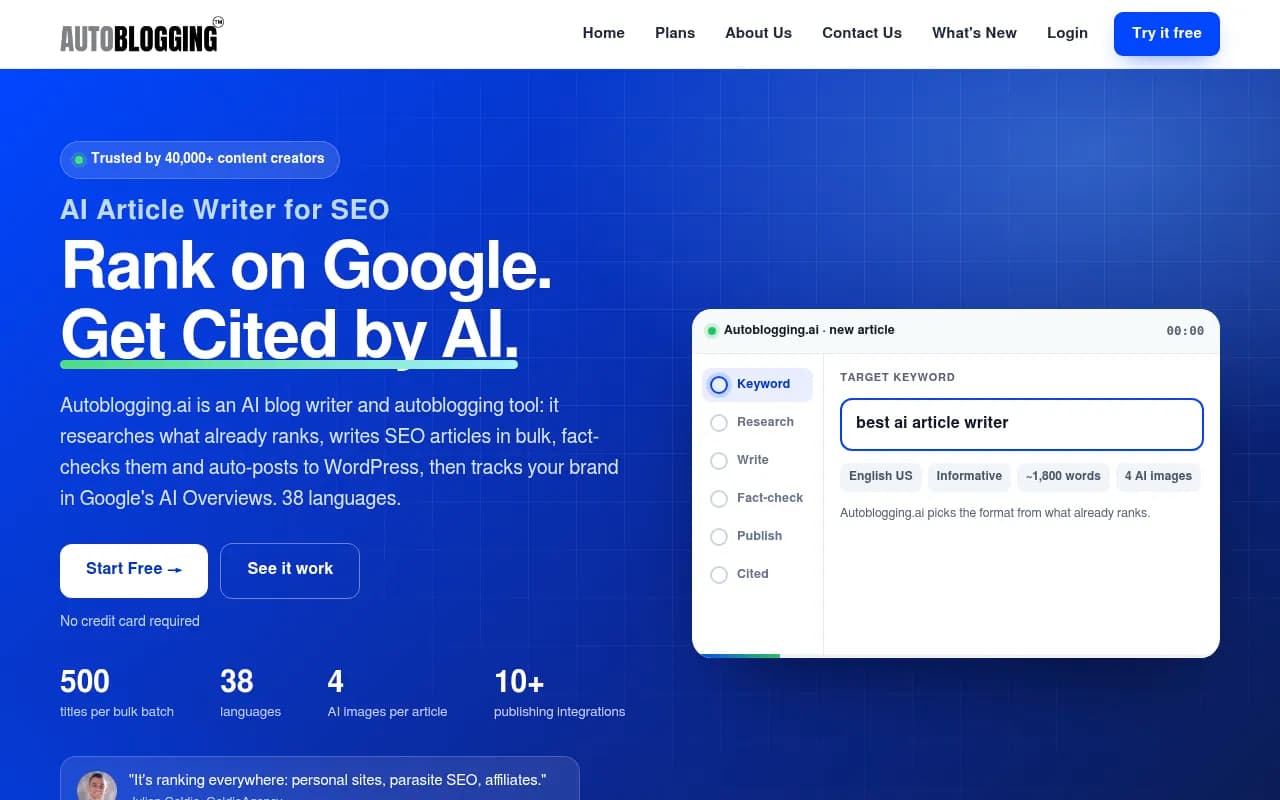
Autoblogging.ai is the most literal autoblogger of the group. You paste up to 500 titles per batch (Starter plans and above), pick language, length and tone, and it generates and posts to WordPress. It supports 38 languages, adds up to four AI images per article, and lists 10+ publishing integrations. The vendor claims 40,000+ users, which I can't verify.
The feature list has grown past plain generation. Godlike Mode (Starter and up) adds SERP analysis, LSI keywords and entities. There is also News Mode, a Site Optimizer for existing WordPress posts, a 21-point semantic SEO analysis, Topical Maps on Regular and above, a free Fan Out Queries tool, GEO Optimization, fact-checking, and a tracker for Google AI Overviews visibility.
Pricing starts at $19/month with a free tier. One search snippet mentioned a plan from $250/month, but I couldn't confirm it, so read the full table on the pricing page.
Where it's weak is not the tool, it's how people use it. A Reddit r/SEO thread reports sites that published unedited bulk output got hammered. That's anecdotal, but it matches common sense. The vendor's own tutorial says to turn internal linking on before a bulk run or the batch publishes with nothing tying it together. Even TheSEOAgent, a rival, says it works best when you already trust the keyword list and have an editor checking output. I'd agree with that.
AutoPublish claims Autoblogging.ai's base plans lack live SERP research and an SEO quality gate. That conflicts with the vendor's own feature claims for higher plans, so treat it as a biased point and check what your specific plan includes.
AutoPublish
AutoPublish is the cheapest entry here, from $9/month, with 3 free credits and no card. The vendor says you get a first article in about 8 minutes.
Its pitch is control. Every article runs through a 14-signal quality gate with a default pass threshold of 70 out of 100, which adds one to two minutes per article. It also injects internal links from your sitemap, has a topic cluster mode, CSV bulk mode, webhooks for Slack, Zapier and Make, and per-client brand voice. It supports BYOK (bring your own AI key) with zero markup on token costs, which matters if you generate a lot and want to see what the model actually costs.
It publishes to 8+ CMSs including WordPress, Ghost, Shopify and HubSpot, so it suits people who are not on WordPress.
The caveat: almost everything I know about AutoPublish comes from its own comparison page. I did not verify its full paid tiers or find independent reviews. It is the newest name of the four and has the thinnest outside evidence. Interestingly, the same vendor page says Autoblogging.ai is best for affiliate and niche-site operators publishing 100+ articles a month. That's a fair read.
If you want to wire autoblogging into other systems, automation platforms like Zapier and Make pair naturally with webhook-based tools.

Article Forge
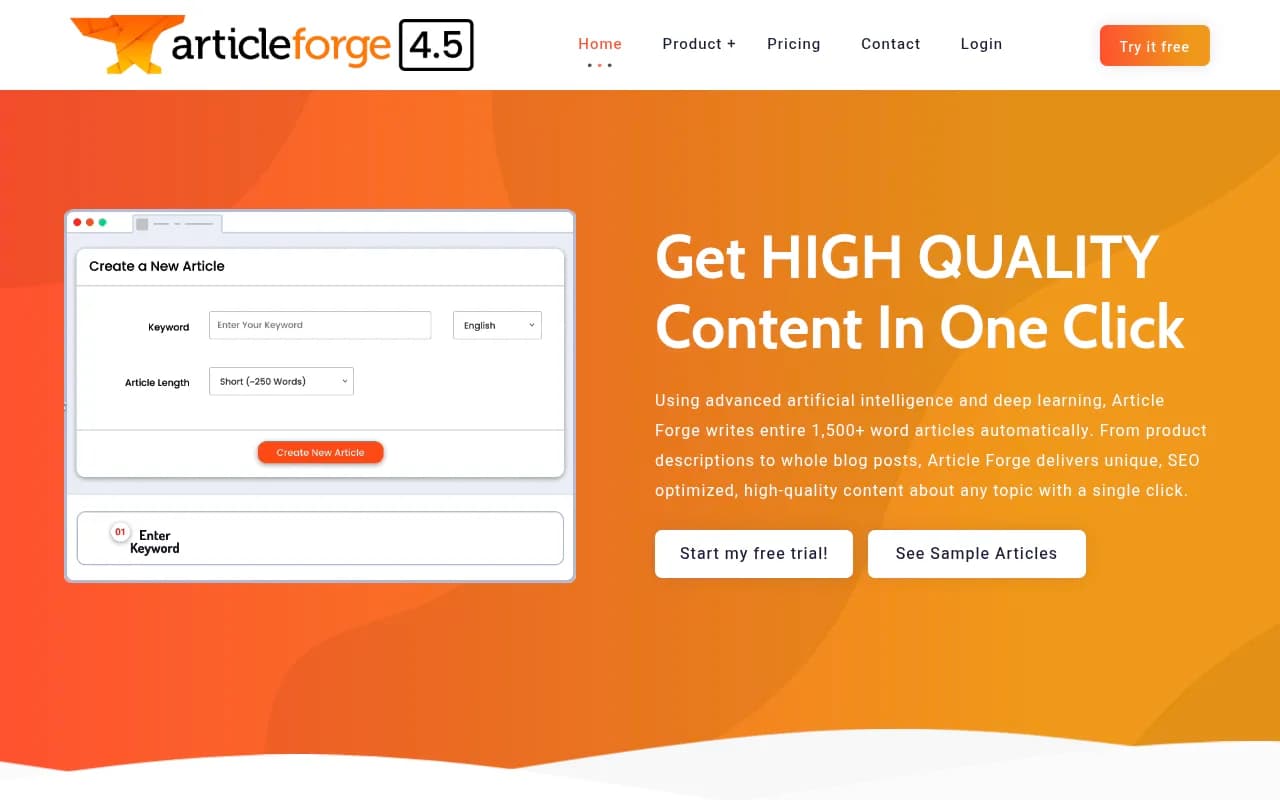
Article Forge is the old guard. The Standard plan is $27/month billed monthly or $13/month billed annually, with 25,000 words per month and one user. It generates 1,500+ word articles, says they pass Copyscape, posts automatically to blogs, and supports bulk generation and API access. The Business plan is custom, starting at 500,000+ words with a dedicated account manager.
There is a 5-day free trial and a 30-day money-back guarantee, but the refund only applies if you have created fewer than 10 articles. Read that twice. It's easy to burn through ten articles while testing.
I didn't check Article Forge's current model or output quality, and the pricing page looks unchanged for a while. That's the honest state of my knowledge. The tool's appeal is simplicity: enter a keyword, get a long article, post it. What it doesn't pitch is SERP-aware planning, citation checks or an AI-visibility tracker, so you carry more of the editorial work yourself.
SEO.AI
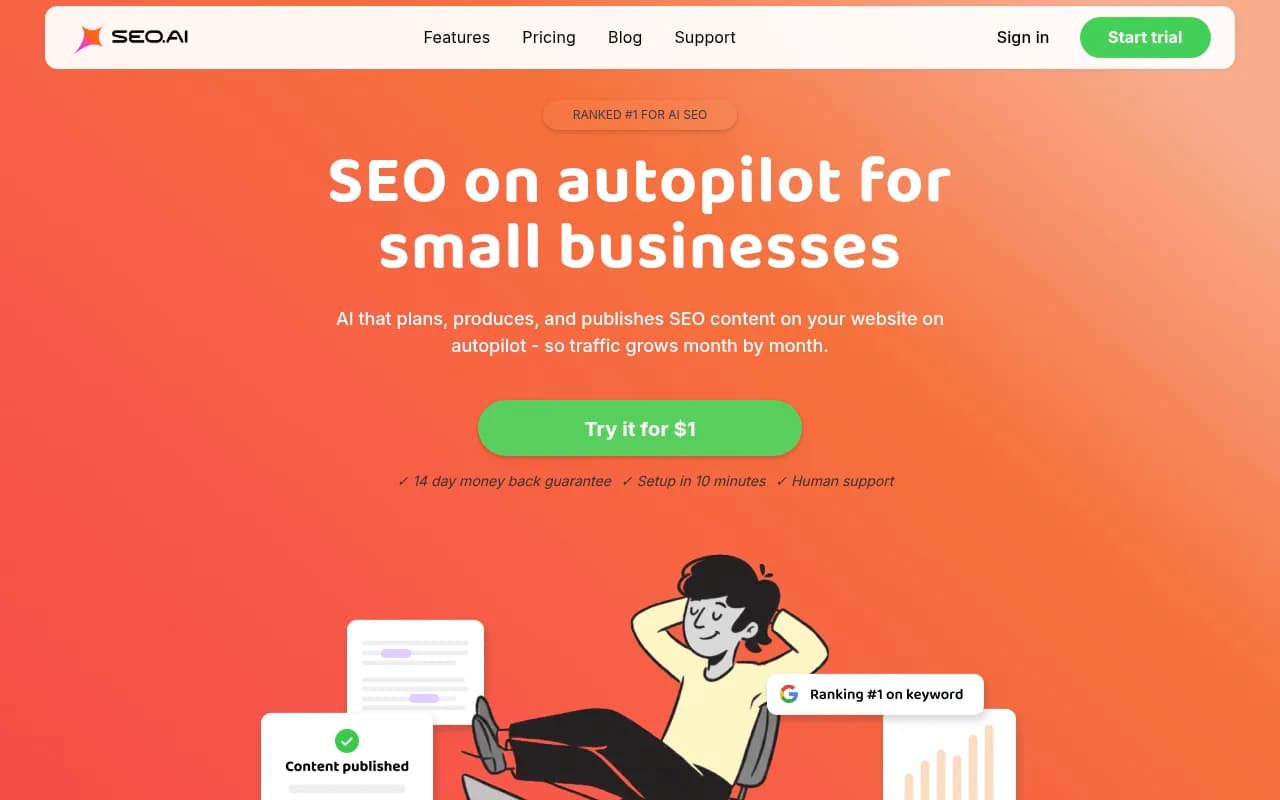
SEO.AI plays in a different price bracket. Single Site is $149/month for one website in one language, and Multi Site is $299/month for up to three websites or languages. Annual payment saves 25% and prices exclude VAT.
It calls itself an AI agent rather than a writer. It writes pages and articles, builds backlinks from what it describes as real, non-spammy websites, builds and optimizes Google Ads, monitors performance and targets visibility in Google and ChatGPT. On content approval you can choose automatic publishing, drafts, or review in the platform, and it emails content before publishing. Human SEO specialists spot-check output, which is the main thing none of the others offer.
It connects to WordPress, Webflow, Wix, Squarespace, Shopify, Magento and others. There's a 7-day trial and no contract on monthly plans, though annual plans are binding. The vendor says most users see traffic growth after one to two months, a claim I'd treat as marketing until you see your own numbers.
This is the one to look at if you want someone else's process more than a faster text box. It costs ten times the entry price of AutoPublish, so the question is whether the backlinks, ads and human review are worth it to you.
Side-by-side on what matters
| Capability | Autoblogging.ai | AutoPublish | Article Forge | SEO.AI |
|---|---|---|---|---|
| Bulk generation | Up to 500 titles per batch | CSV bulk mode | Yes | Managed, not bulk-first |
| SERP-aware planning | Godlike Mode (Starter+) | Topic cluster mode | Not advertised | Yes, agent-based |
| Quality or fact check | Fact-checking, 21-point SEO analysis | 14-signal gate, 70/100 default | Copyscape claim | Human specialist spot checks |
| Internal linking | Toggle, must be switched on | Injected from your sitemap | Not advertised | Not specified |
| Review before publish | Review step in the workflow | Quality gate | Limited | Auto, draft, or review; emails first |
| Languages | 38 | Not verified | Not verified | One per site on Single Site |
| Extras | AI Overviews tracker, Site Optimizer | BYOK, webhooks, brand voice | API | Backlinks, Google Ads |
Draft speed versus publish readiness
Every one of these will give you a good-looking first draft. What matters is what happens next. Someone has to check the keyword, find sources, rewrite vague sections, add internal links, format the CMS entry and decide whether the post should go live at all.
That is why I'd rank tools on how much of that work they take on, not how fast the first draft appears. By that measure AutoPublish and SEO.AI do the most around the writer, Autoblogging.ai does a lot if you turn the right options on, and Article Forge leaves the most to you.
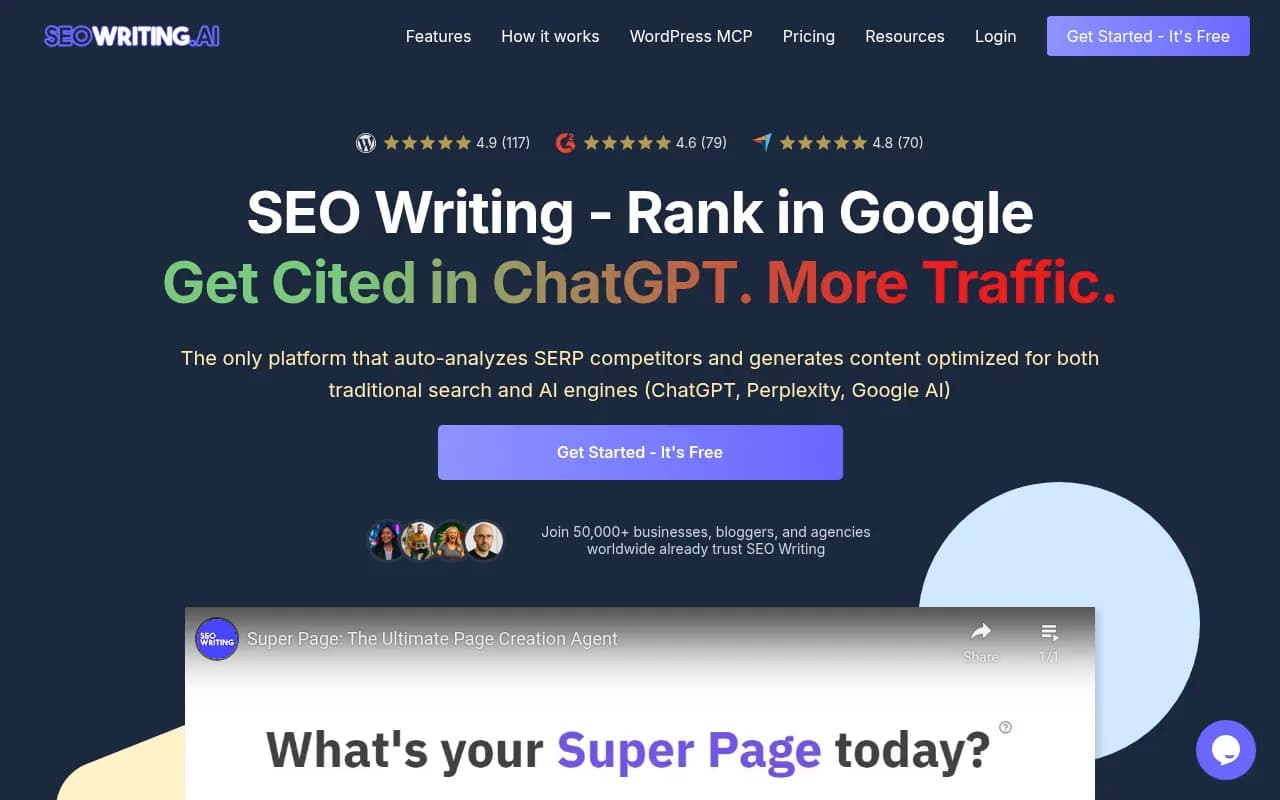
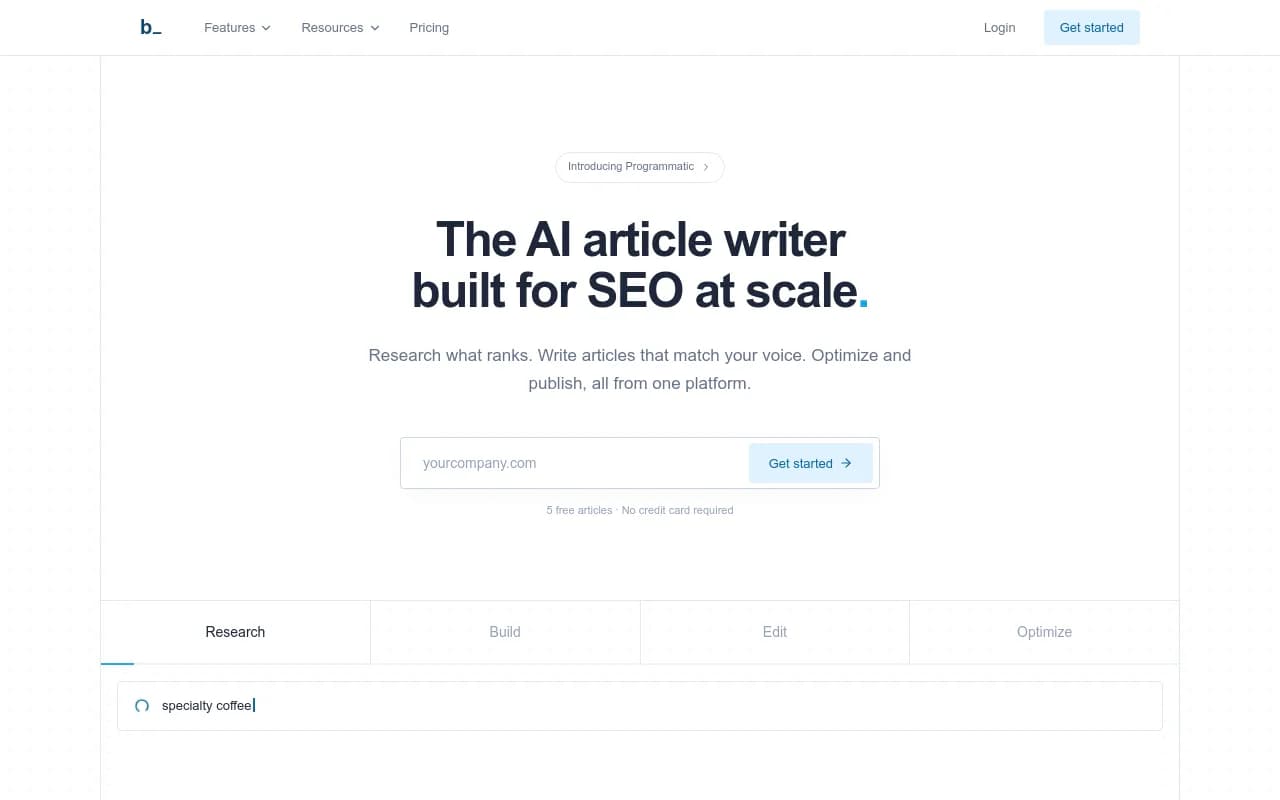
If none of these fit, other approaches in the same category are worth a look. SEO Writing AI, Byword and Agility Writer appear in the same rival roundups, and Outrank targets autopilot SEO content. The agentic SEO tools directory lists more.
Will AI search cite autoblogged content?
This is the part people skip. If your goal includes being cited by ChatGPT, volume of generic blog posts is a weak plan. Promptwatch Data's report on which content types ChatGPT cites most (Sep 28 to Oct 4, 2026) shows product pages at 22.4% of classified citations and landing pages at 16.8%. Listicles are 13.6%, documentation 7.5%, how-tos 8.7%, general articles 6.1%, comparisons 5.9% and news 5.7%. For commercial prompts, product pages jump to 26.0% and landing pages to 20.6%.
So the pages that win are the ones that describe a product or service, plus structured formats like listicles, comparisons and how-tos. A tool that pumps out 500 undifferentiated informational articles is not aiming at that.
Shelf life matters too. In Promptwatch's content half-life data, news pages lose half their citations within about 36 days, while landing pages and docs last for months. If you publish on a calendar, put more of your schedule into durable page types.
To see whether any of this publishing shows up in AI answers, you need a tracker. Tools like Promptwatch can show which of your pages get cited in ChatGPT and other AI engines, which tells you whether the autoblogging is earning anything.

For more options, the GEO software directory covers the visibility side.
Which one should you pick?
- You have a trusted keyword list, an editor, and want volume: Autoblogging.ai, with internal linking and SERP analysis turned on.
- You want a gate before publish, non-WordPress CMS support, or the lowest entry cost: AutoPublish, with the caveat that its evidence is mostly vendor-supplied.
- You want long single articles with little setup: Article Forge, and budget your own editing time.
- You want a managed service with backlinks and human review, and can pay for it: SEO.AI.
A test plan before you scale
- Pick three to five real keywords where you know the SERP. Include one commercial and one informational.
- Run the same keywords through each trial. Free options exist on most of these. Remember Article Forge's refund only covers fewer than 10 articles.
- Read each draft as an editor. Check every statistic and source claim against the cited page. Cut anything unsupported.
- Check internal links and formatting in the CMS preview, not in the tool.
- Publish a small batch, not 100. Watch indexing and impressions in Google Search Console for several weeks.
- Decide on the schedule only after that. Keep a human review step even once you trust the output.
If you'd rather hand the strategy to people than tune a tool, a specialist agency such as 1001 SEO Media does the content strategy and GEO work that these tools only partially cover. For more software in this space, browse the Surferstack directory.
The short version: the cheapest tool is only cheap if you don't have to rewrite everything it produces.