Key takeaways
- A quarterly AI SEO review needs two layers: your usual Google metrics (traffic, conversions, rankings) plus AI visibility metrics (citation rate, share of voice, per-engine mix, AI referral traffic).
- Review per engine and per content type. Promptwatch Data shows ChatGPT and Google AI Overviews now cite very different sources, so one blended number hides the real picture.
- Content ages differently by type. Refresh product pages and how-tos every quarter, and treat news as a short burst of visibility.
- Use a 10-line scorecard, a fixed prompt set, and the same method every quarter. Consistency matters more than which tool you pick.
- Close every review with three to five dated actions, not a slide deck.
Why a quarterly cadence works
Weekly AI visibility numbers are noisy. Answers change run to run, models get updated, and a single prompt can swing from cited to missing for no reason you can control. Monthly is better but still twitchy. Quarterly is long enough for content changes to show up and short enough that you can still act on what you find.
It also matches how the ground shifts. In the last three months alone, ChatGPT's social citations collapsed, its search behavior changed, and Meta started crawling aggressively. A review every 90 days catches those changes before they become a year-old blind spot.
One caution about the generic advice floating around. A LinkedIn post on running an AI quarterly review suggests tracking adoption, output and ROI. That is fine for reviewing how your team uses AI internally. It is not the same thing as reviewing how AI search engines treat your brand, which is what this guide covers.
What changed in Q4 2026 that your review must reflect
Before you pull any data, know what moved since your last review. Based on Promptwatch Data:
- ChatGPT started using the site: operator at scale on August 8, 2026. Those queries went from about 0.4% to about 17% of fanout queries overnight, and searches per response nearly doubled. See the site: operator fanout report.
- reddit.com's share of ChatGPT citations fell from about 4% to 0.5% on August 14. Details are in Promptwatch's Reddit citation report.
- Meta-WebIndexer grew from about 2% to nearly 38% of tracked AI crawler requests between mid-July and August 9, per the Meta-WebIndexer report.
If your Q3 plan leaned on Reddit seeding for ChatGPT, this is where you find out it stopped working. I would put that in the review document in plain words, because it will come up in a budget meeting.
Step 1: Fix your prompt set before you measure anything
Every AI visibility number is only as good as the prompts behind it. Build a set of 30 to 100 prompts and freeze it for the quarter. The HOTH suggests 20 to 50 as a manual starting point, and that is reasonable if you are tracking by hand in ChatGPT, Perplexity and Google AI Mode.
Split the set three ways:
- Commercial prompts ("best X for Y", comparisons, alternatives)
- Informational prompts (how-tos, definitions)
- Branded prompts (your name, your competitors' names, your product)
This split matters because the sources AI cites differ by intent. In Promptwatch's ChatGPT content type data for Sep 28 to Oct 4, 2026, product pages and landing pages together made up 39% of all citations, and almost 70% of commercial citations came from just four types: product pages, landing pages, listicles and comparisons.
Add or retire no more than 10 to 15% of prompts per quarter, and note which ones changed. Otherwise you cannot tell whether visibility moved or your yardstick did.
Step 2: Pull the two layers of metrics
Layer 1: classic search metrics
Do not drop these. AI visibility sits on top of them.
- Organic sessions and conversions, segmented by page type
- Impressions, clicks and average position from Google Search Console and Bing Webmaster Tools
- Branded search volume trend (a rising brand curve with flat traffic is often an AI-influence signal)
- Technical health: crawl errors, indexation, broken links, orphaned pages
Google Search Console and Google Analytics cover most of this for free.
Layer 2: AI visibility metrics
These are the ones most reports are missing.
- Citation rate: share of your tracked prompts where your domain is cited
- Mention rate: share where your brand is named, with or without a link
- Share of voice against a fixed set of competitors
- Position within the answer (first mention versus afterthought)
- Sentiment and accuracy of what the model says about you
- AI referral traffic and conversions from ChatGPT, Perplexity, Gemini and others
- AI crawler activity on your site, and which pages bots actually read
Read them together. Low share of voice is a coverage problem. Late position is a prominence problem. Mentions without citations of your own pages usually point to a content or crawlability problem.
On conversion value, a Semrush study cited by The HOTH found AI search visitors converting at 4.4 times the rate of traditional organic visitors. Treat third-party numbers like that as directional and check your own analytics, because AI traffic is small enough in most accounts that your segment will be noisy.
Step 3: Review per engine, not in aggregate
This is the part I would argue most teams get wrong. A single blended "AI visibility score" averages away the differences that tell you what to do.
Take social platforms. From Sep 28 to Oct 4, 2026, Promptwatch Data on social citations by AI model shows:
| Engine | Social share of citations | Notable detail |
|---|---|---|
| ChatGPT | 0.46% | LinkedIn is now the top social platform at 0.3%; Reddit fell to 0.09% |
| Google AI Overviews | 12.2% | YouTube 4.28%, Facebook 2.38%, Reddit 2.15% |
| Perplexity | 2.7% | LinkedIn and Reddit tie at 0.86% |
That is roughly a 26x gap between AI Overviews and ChatGPT. A "post more on Reddit" tactic that looked smart in the spring now does close to nothing for ChatGPT, while YouTube is a real lever for Google surfaces. Your review should have one row per engine for your key prompts, with citation rate and the top five cited domains.
Also look at how many sources each answer pulls. Promptwatch's unique domains report found almost half of ChatGPT responses cite 10 or more unique domains (Sep 28 to Oct 4, 2026). That is good news for mid-sized brands: the answers are crowded, so there is room to get in.
On authority, August 2026 data on citation share by domain rank showed sites with domain rank 46 to 75 earning almost half of ChatGPT citations, while DR 91 to 100 fell to about 3%. If you have been told you need enterprise-level authority first, this is worth bringing to the meeting.
Step 4: Audit content by type and age
Once you know which engines cite you, look at which pages. Sort your cited URLs by content type and compare to the benchmark.
From Promptwatch's ChatGPT content half-life study, which tracked pages cited on July 6, 2026 for 90 days:
| Content type | What happened over time |
|---|---|
| Landing pages | 78% still cited at 30 days, 69% at 60 |
| Docs | 76% at 30 days, 67% at 60 |
| Comparisons | 72% at 30 days, 63% at 60 |
| Product pages, reviews, how-tos | About 55% at 60 days, half-life of 74 to 77 days |
| Listicles | About 60% at 60 days |
| News | Half-life of 36 days, 41% still cited at day 60 |
The study notes that landing pages, docs, comparisons and listicles only cross 50% in the final week because the window ends, so their real half-life is probably 90 days or longer.
Practical read: refresh product pages and how-tos at least every quarter. Treat news and press as a burst, not an asset. Pricing pages count as landing or product pages, so they sit in the durable group, which is a good reason to keep them accurate.
Also check your own content mix against the citation mix. If product and landing pages earn 39% of ChatGPT citations and your site is 90% blog posts, you have found your Q1 priority.
Step 5: Check crawlability and the third-party layer
Two checks that regularly explain "why are we not cited":
- Can AI bots reach and read the pages? Look at server logs or a crawler analytics tool for GPTBot, OAI-SearchBot, ClaudeBot, PerplexityBot and Meta-WebIndexer. Look for 403s, 5xx errors and JavaScript-only content that bots cannot render. Promptwatch's AI crawler traffic report gives weekly verified request benchmarks to compare against.
- Who else is talking about you? Emarketed, citing position.digital, claims brands are 6.5x more likely to be cited via third-party sources than their own domains. I would not quote that number to a client without checking it, but the direction matches what most practitioners see: review sites, directories, press and comparison pages feed the answers. List the third-party pages that AI cites for your category and note whether you appear on them.
The same Emarketed piece says 44.2% of LLM citations come from the first 30% of a page's text. Again, treat it as a hypothesis, but it is cheap to act on: put the direct answer near the top.
Step 6: Choose tools for the job
You can run a first review by hand: 30 prompts, three engines, one spreadsheet. It takes a day and teaches you a lot. Past that, a tool saves you from running the same prompts and copying screenshots every quarter.
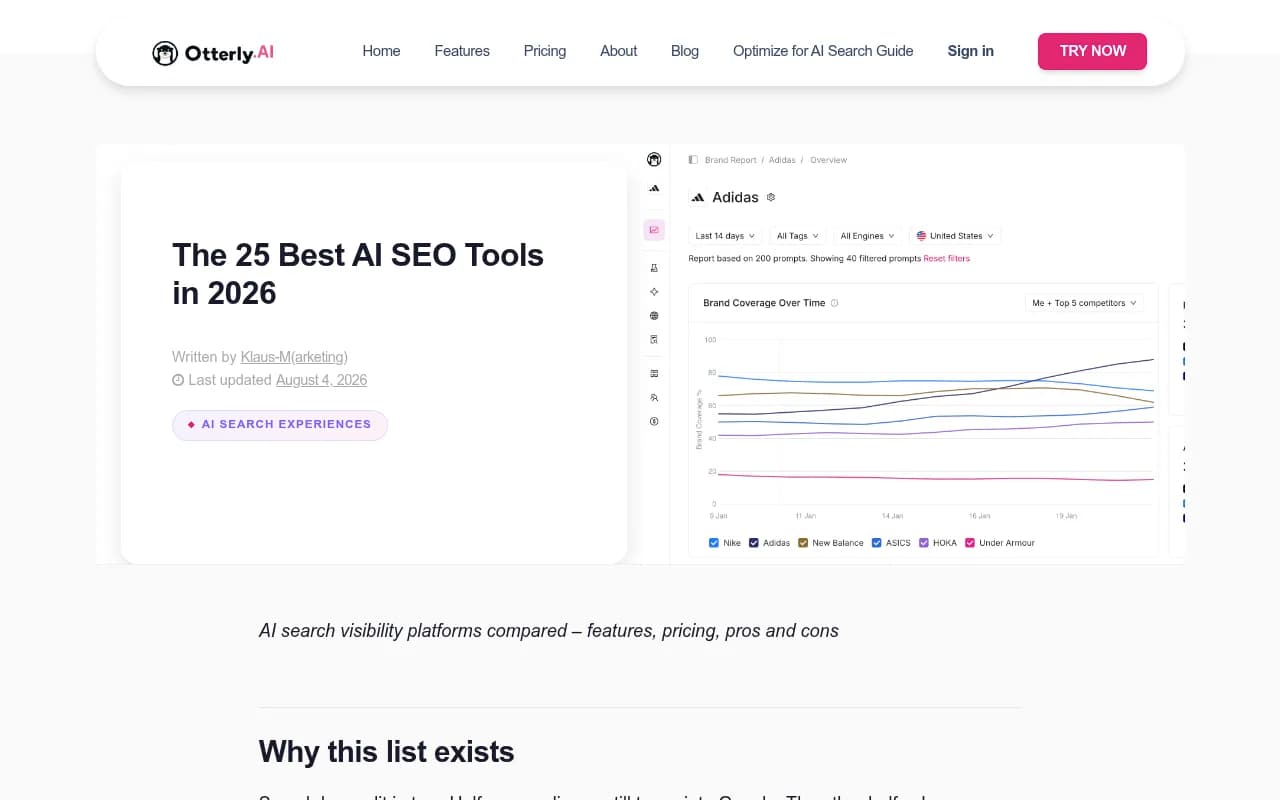
The market is crowded. Otterly's list of 25 tools runs from $19 a month indie options to $5,000 a month enterprise platforms, and most are monitors. The real question is whether you need monitoring only, or monitoring plus a way to act on it.
| Need | Tool type | Examples |
|---|---|---|
| Full loop: tracking, crawler logs, traffic, content fixes | Optimization platform | Promptwatch |
| Prompt tracking on a budget | Monitor | Otterly.AI, Peec AI, LLM Pulse |
| Enterprise brand monitoring | Monitor | Profound, Scrunch |
| AI tracking inside your existing SEO suite | Suite add-on | Semrush, Ahrefs Brand Radar, SE Ranking |
| Technical crawl and log checks | Crawler | Screaming Frog, Sitebulb |
Promptwatch is the one I would reach for when the review needs to end in actions rather than a chart. It tracks real ChatGPT, AI Overviews, AI Mode, Gemini and Perplexity interfaces, shows IP-verified AI crawler logs and AI visitor traffic, and its Action Board turns gaps into a prioritized to-do list that the Content Agent can draft and publish against. That covers most of the steps above in one place.

For monitoring-first setups, Otterly.AI is priced from $29 a month and is aimed at marketing teams and agencies.
Otterly.AI

Peec AI is another common pick, particularly for European agencies running many client workspaces.

If you already live in a suite, Semrush and Ahrefs Brand Radar add AI visibility modules, though with fixed prompt sets and less AI-specific depth than dedicated platforms.

For enterprise programs, Profound is the usual name in the shortlist.
Profound

A wider list lives in the GEO software directory at bestgeosoftware.com, and AI-specific rank trackers are collected at ai-rank-tools.com.
The simple scorecard
Ten lines. Fill in last quarter, this quarter, and a one-word verdict (up, flat, down). Use the same prompts and the same competitors each time.
| # | Metric | Where it comes from | Question it answers |
|---|---|---|---|
| 1 | Organic sessions and conversions | GA4, Search Console | Is the base channel healthy? |
| 2 | Branded search trend | Search Console, Bing | Is awareness growing? |
| 3 | Citation rate (all prompts) | AI visibility tool or manual run | Are we cited at all? |
| 4 | Citation rate by engine | Same | Which engines cite us? |
| 5 | Share of voice vs 3 to 5 competitors | Same | Are we gaining or losing ground? |
| 6 | Average position in answer | Same | Are we prominent or buried? |
| 7 | Sentiment and accuracy | Manual read plus tool | Is the model describing us correctly? |
| 8 | AI referral visits and conversions | GA4 or visitor analytics | Does it drive revenue? |
| 9 | AI crawler health | Server logs or crawler analytics | Can bots read us? |
| 10 | Content freshness by type | CMS, citation data | What is decaying? |
Score each line green, amber or red. Two or more reds in lines 3 to 6 means a visibility problem. Reds in 9 and 10 mean a technical or content-maintenance problem. A red in 8 with greens above it means you are visible but not converting, which is a landing page conversation, not an SEO one.
Step 7: Turn the review into actions
A review that ends with a deck is a review that gets forgotten. End with three to five actions, each with an owner and a date.
Useful patterns I see over and over:
- Content gap: a high-volume prompt where competitors are cited and you are not. Brief a page that answers it directly, near the top.
- Format gap: your pages are mostly articles, but the engine cites product pages and comparisons for commercial prompts. Build or fix those.
- Refresh: product pages and how-tos older than 90 days that earlier earned citations.
- Source gap: a third-party page AI keeps citing for your category that does not mention you. Pitch it or earn a place on it.
- Engine mix: shift social effort away from Reddit for ChatGPT, toward LinkedIn, and consider YouTube if Google surfaces matter to you.
- Technical: any bot blocked by robots.txt, a WAF rule or a rendering issue.
Then write down what you expect to change by next quarter. That is how you learn whether your judgment is any good.
A one-day review schedule
- Morning: freeze the prompt set, export last quarter's numbers, pull Search Console and analytics data.
- Midday: run or export AI visibility results per engine, record top cited domains and your position.
- Early afternoon: audit cited pages by content type and age, check crawler logs.
- Late afternoon: fill the scorecard, pick actions, write a half-page summary.
If you would rather hand the program to specialists, 1001 SEO Media runs AI search and GEO work alongside technical SEO and content for teams that do not want to build the process in-house.
Common mistakes
- Changing prompts every quarter and then comparing trends.
- Reporting one blended AI score and missing that engines behave differently.
- Treating a single run as truth. Look at multiple runs and trend lines.
- Counting mentions as wins without checking whether the model's claims are accurate.
- Ignoring traditional SEO. Emarketed notes that brands cited in AI Overviews see higher organic click-through, which is a reminder the two layers feed each other.
The bottom line
A quarterly AI SEO review is a fixed prompt set, ten scorecard lines, an engine-by-engine view, a content-age audit and a short list of dated actions. Run the manual version once this quarter, learn where the gaps are, and then decide whether a platform is worth paying for. Check current pricing on any tool's own site before you commit, since plans change often.
For reference data to benchmark against, start at the Promptwatch Data hub.