Key takeaways
- Being indexed gets you into the candidate pool. Being cited requires a page that answers a specific prompt cleanly and sits on a source the engine trusts.
- Promptwatch Data (Sep 28 to Oct 4, 2026) shows product pages and landing pages take about 39% of ChatGPT citations. Generic informational blog posts are not the main citation surface.
- Nearly half of ChatGPT responses cite 10 or more domains, so you often earn a place through third-party listicles, reviews and comparisons, not only your own site.
- Content type decides how long a citation lasts. Landing pages and docs hold on for months. News fades in weeks.
- ChatGPT, Google AI Overviews and Perplexity do not share sources. Write one strong foundation, then check each engine separately.
Indexed is not the same as cited
Most teams still treat AI content like classic SEO content. Publish a 2,000-word post, get it indexed, wait for rankings. Then they notice ChatGPT recommends three competitors and never mentions them.
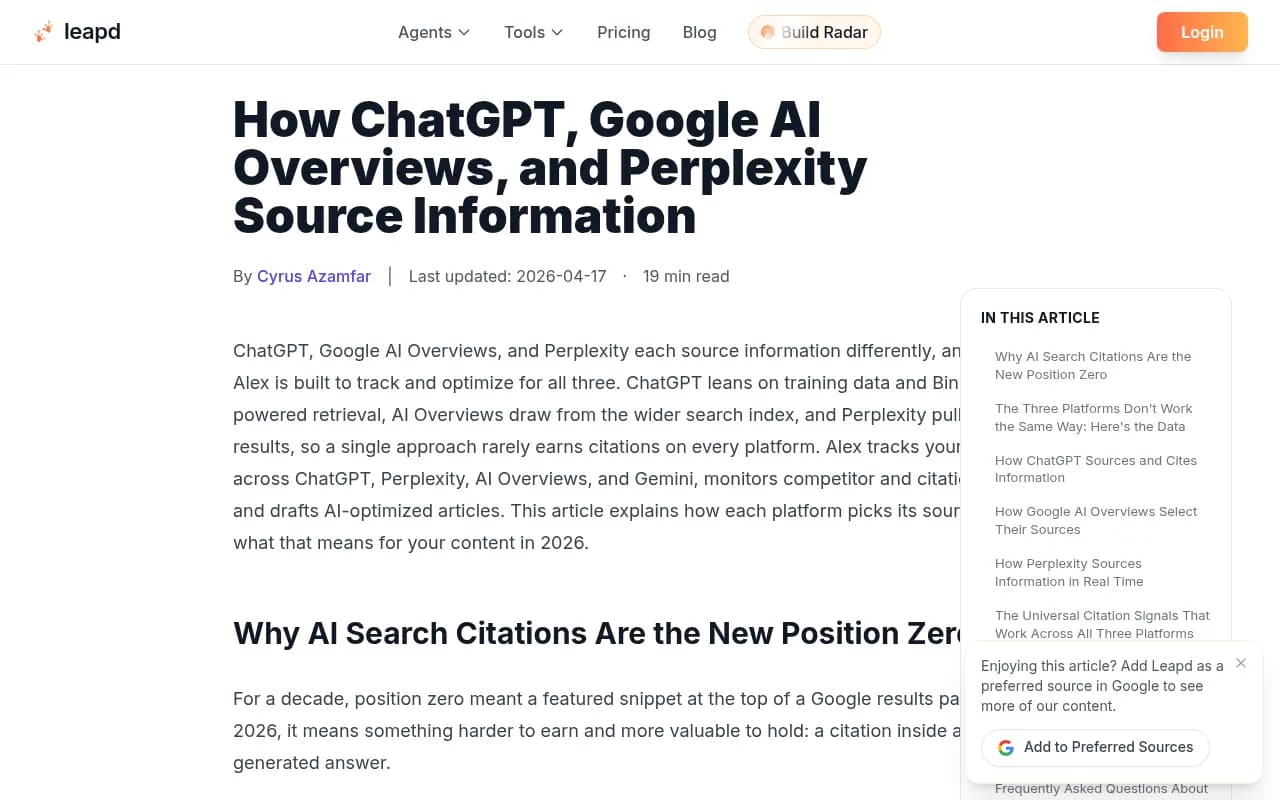
Indexing only means a crawler found your page. Citation means a model retrieved it, judged it useful for a specific question, and put it in the source list. One third-party analysis (Leapd) claims ChatGPT retrieves many candidate pages per query but cites only about 15% of what it retrieves. I haven't verified that number, but the direction matches what I see: retrieval is cheap, citation is selective.
The selection is also fragmented. The HOTH's July 2026 guide points out that ChatGPT, Gemini, Claude and Perplexity lean on different indexes, so a citation in one is not a citation in all. Leapd's analysis of 680 million citations reports only 11% domain overlap between ChatGPT and Perplexity. Treat these as secondary figures, but the practical lesson is solid: don't assume one win transfers.
What actually gets cited: the page types
Here is the part that changes how you plan content. Promptwatch's ChatGPT citation share by content type report (Sep 28 to Oct 4, 2026) classified every citation:
| Content type | Share of ChatGPT citations |
|---|---|
| Product pages | 22.4% |
| Landing pages | 16.8% |
| Listicles | 13.6% |
| How-tos | 8.7% |
| Documentation | 7.5% |
| General articles | 6.1% |
| Comparisons | 5.9% |
| News | 5.7% |
| FAQ | 3.3% |
| Reviews | 1.7% |
Product and landing pages together are 39%. Editorial formats combined are about 43%. So the uncomfortable truth: the typical "what is X, 10 tips for X" blog post is not where most citations land.
Intent matters too. For commercial prompts, product pages hit 26.0%, landing pages 20.6%, listicles 15.0% and comparisons 7.9%, almost 70% combined. For informational prompts, product pages still lead at 19.1%, but how-tos (10.7%), docs (8.5%) and articles (7.7%) all do better than average. For branded prompts, reviews jump to 5.6%, more than three times their overall share.
Write for the prompt intent, not for a keyword.
Step 1: Map content to prompts, not keywords
Start with the questions people actually put to AI engines. Prompts are longer than keywords, and ChatGPT often splits them into several searches behind the scenes (query fan-out). Promptwatch Data on ChatGPT query fan-outs tracks how many web searches a response triggers. Since August 8, 2026, ChatGPT has also leaned on the site: operator heavily, going from about 0.4% to about 17% of fan-out queries in Promptwatch's report. That means it increasingly looks inside specific domains, which is one more reason your own pages need to be clean and findable.
A simple mapping:
- Commercial prompts (best X for Y, X vs Z): product pages, comparison pages, a strong landing page
- Informational prompts (how do I...): step-by-step how-tos and documentation
- Branded prompts (is X any good): reviews, FAQ, an honest pricing page
For research, free tools like AlsoAsked and AnswerThePublic surface real question phrasing, and Google Search Console shows queries you already rank for.
Step 2: Lead with the answer
AI engines extract. If the answer to the question is buried in paragraph six, a competitor's page that states it in the first two sentences gets used instead.
Practical rules:
- Put a direct, self-contained answer under every heading. Two to four sentences.
- Make each section make sense if lifted out of the page. Avoid "as mentioned above".
- Use headings phrased like the question or the entity being described.
- State specifics: prices, specs, limits, dates, named integrations. Vague copy can't be quoted.
Product pages deserve special attention given the data. Promptwatch's own advice from that report is to keep specs, prices and positioning complete and factual. A product page that says "flexible pricing, contact us" gives a model nothing to cite.
Step 3: Add evidence the model can attribute
Princeton's original GEO research, as summarized by Bradlee Bartlett, found that adding statistics, quotations and named sources can raise AI visibility by up to 40%. I'd treat the exact figure cautiously, but the mechanism is believable: a claim with a number and a source is easier for a model to reuse than an opinion.
What to do:
- Publish original data, even a small survey or internal benchmark. Proprietary numbers can only be cited from you.
- Name the source and date of every statistic.
- Attribute quotes to real people with titles.
- Update stale figures. A 2023 stat in a 2026 article reads as neglected.
Tools like Frase and Clearscope help check topic coverage and gaps, though neither will tell you whether an AI engine will cite the result.

Step 4: Get into the lists you don't own
This is the step most content teams skip. According to Promptwatch's unique domains report (Sep 28 to Oct 4, 2026), 47.6% of cited ChatGPT responses cite 10 or more domains, and 66.1% cite at least 8. For organic prompts, 52.5% cite 10 or more. Only 6% cite three domains or fewer.
You are sharing almost every answer. Often the way in is a third-party listicle, review roundup or comparison that names you. So part of your content plan is earning those mentions:
- Pitch inclusion in relevant roundups and comparison articles
- Collect reviews on trusted review sites
- Run digital PR that produces citable data
- Keep your product facts consistent everywhere, so a model that sees you on five sites reads the same story
The domain mix is also not what you'd guess. Promptwatch's August 2026 domain rank report shows sites with domain rank 46 to 75 earned almost half of ChatGPT citations, while DR 91 to 100 fell to about 3%. You do not need a giant domain. You need a relevant, specific page.
Step 5: Match format to longevity
Not all citations last. Promptwatch's content half-life study tracked every page ChatGPT cited on July 6, 2026 for 90 days.
| Content type | Still cited after 30 days | Still cited after 60 days |
|---|---|---|
| Landing pages | 78% | 69% |
| Docs | 76% | 67% |
| Comparisons | 72% | 63% |
| Listicles | n/a | 60% |
| Product pages, reviews, how-tos | n/a | 55% (half-life 74 to 77 days) |
| News | about half gone by day 36 | 41% |
A quarter of news pages were never cited again after day zero. So treat landing, docs and pricing pages as long-term assets, refresh product pages and how-tos every couple of months, and use news and press for short bursts only. Don't build your whole AI strategy on trend posts.
Step 6: Fix the technical basics
A model can't cite a page it can't read. Check these before you write anything new:
- Content renders without JavaScript. If your site is client-rendered, a prerender service such as Prerender.io can help.
- robots.txt doesn't block the AI crawlers you want (GPTBot, OAI-SearchBot, ClaudeBot, PerplexityBot).
- Documentation is public and crawlable, not behind a login.
- Pages are in your sitemap and internally linked.
- Schema markup describes products, FAQs and organizations accurately. WordLift focuses on structured data and entities.
Don't bother publishing markdown copies of pages for AI search. Promptwatch's markdown report found markdown files are only 0.05% of AI search citations. They serve AI agents, not AI search.
A crawl log tells you more than any guess. The AI crawler traffic report shows how much IP-verified traffic comes from OpenAI, Anthropic, Google, Perplexity and Mistral. Meta-WebIndexer alone jumped from about 2% to nearly 38% of tracked crawler requests between mid-July and August 9, 2026, per Promptwatch Data, so the crawler mix shifts quickly.
Step 7: Tune per engine
The foundation is the same. The emphasis changes.
| Engine | What to watch |
|---|---|
| ChatGPT | Product, landing and comparison pages; third-party listicles; Bing visibility. Social is nearly absent: 0.46% of citations (Sep 28 to Oct 4, 2026) |
| Google AI Overviews | Strong Google rankings and topical authority; social platforms supply 12.2% of citations in the same period |
| Perplexity | Live web retrieval, so fresh and clearly structured pages matter |
The social numbers come from Promptwatch's October 2026 social citations report. Related: reddit.com's share of ChatGPT citations collapsed from about 4% to 0.5% on August 14, 2026, per Promptwatch's Reddit report. If your plan was "seed Reddit so ChatGPT cites us", that plan is out of date. Reddit and YouTube still matter more for AI Overviews.
The HOTH also notes that a single answer has only about two to seven visible citation spots, far fewer than ten blue links. That squeezes marginal pages out entirely.
Step 8: Measure citations, then close gaps
Without measurement you are guessing. You want to know which prompts you appear in, which pages get cited, which competitors take your spot, and whether AI visitors convert.
There are plenty of trackers. Some only answer "was I mentioned?" Fewer connect that to crawler activity, traffic and content actions. Promptwatch tracks the real interfaces of ChatGPT, AI Overviews, AI Mode, Gemini and Perplexity, shows which pages get cited, and its content gap analysis points to prompts competitors win that you don't. Its Content Agent can then draft and publish to your CMS.

Other options for monitoring include Otterly.AI, Peec AI, Profound, and AirOps if you want content engineering workflows. Most of these focus on tracking, so check whether they also surface crawler logs or content gaps before you commit. For a wider list, the GEO software directory at bestgeosoftware.com compares options.
Otterly.AI


Profound

A simple gap-closing loop
- Pick 25 to 50 prompts that reflect real buying and research questions.
- Record which ones cite you and which cite competitors.
- For each miss, decide: create a page, update an existing one, or earn a mention elsewhere.
- Publish, then check crawl and citation after two to four weeks.
- Repeat monthly. Models change. ChatGPT's average citations per response dropped around the GPT-5.3 rollout on March 4, 2026 (Promptwatch Data), and any such shift changes what "normal" looks like.
Using AI to write this content without sounding generated
AI drafting tools like Claude, ChatGPT, Jasper or Writesonic are fine for outlines and first drafts. The risk is generic copy: the same phrasing every other site has. A model has no reason to cite a page that says what a thousand pages already say.
What I'd do instead:
- Feed the draft your own data, product specs and customer quotes
- Have a subject expert add the parts a model can't know
- Cut filler, hedging and padded intros
- Keep a brand book so tone and facts stay consistent
Publishing 50 thin AI articles a week is a faster way to get indexed. It is not a way to get cited.
A quick checklist
- Each page targets a specific prompt intent
- Answer appears in the first two sentences of every section
- Specs, prices and claims are concrete and dated
- At least one original data point or named source
- Public, crawlable, server-rendered
- FAQ and review presence on trusted sites
- Refresh schedule based on content type
- Citation tracking per engine
Bottom line
Indexing is table stakes. The pages that get cited are specific, factual, easy to extract from, and often sit on commercial page types, not generic blog posts. Build that foundation, earn mentions on the third-party lists that share each answer, and check every engine separately. For more on citation data, browse the full set of reports at Promptwatch Data.