Key takeaways
- AthenaHQ, Scrunch, and Search Party are primarily monitoring-focused platforms -- they show you where you stand in AI search but offer limited tools to actually improve it.
- Promptwatch is the only platform in this comparison rated as a "Leader" across all categories in a 2026 review of 12 GEO tools, largely because it closes the loop from gap discovery to content creation to traffic attribution.
- For agencies managing multiple clients, the differences in white-labeling, prompt volume limits, and content generation capabilities matter enormously.
- Pricing varies widely: Scrunch and AthenaHQ skew toward enterprise; Promptwatch has transparent self-serve tiers starting at $99/month with a free trial.
- If your team needs to show clients a clear path from "you're invisible in AI search" to "here's the content we published to fix it," only one platform in this comparison actually supports that workflow end to end.
Why this comparison matters right now
AI search isn't a trend anymore. ChatGPT, Perplexity, Claude, and Google's AI Mode are now real referral sources for brands -- and the agencies managing those brands are scrambling to prove they can optimize for this new channel.
The problem is that the tooling market has exploded faster than anyone can evaluate it. In the past 18 months, dozens of "AI visibility" platforms have launched, and most of them look similar on the surface: a dashboard, some prompt tracking, a few charts showing citation rates. But the differences underneath matter a lot, especially if you're running an agency and need to deliver actual results, not just reports.
This guide compares four platforms that come up repeatedly in agency conversations: AthenaHQ, Promptwatch, Scrunch, and Search Party. Each takes a meaningfully different approach. Here's what that looks like in practice.
What we're actually comparing
Before getting into each tool, it helps to agree on what "AI visibility" work actually involves. There are three distinct jobs:
- Monitoring -- knowing when and where your brand (or a client's brand) appears in AI-generated responses
- Analysis -- understanding why competitors appear more often, which prompts you're missing, and what content gaps exist
- Optimization -- creating or updating content so AI models start citing you more
Most platforms do job one reasonably well. Job two is where things start to diverge. Job three is where most platforms stop entirely.
AthenaHQ

AthenaHQ positions itself as a brand perception platform for AI search. The core idea is that AI models form a kind of "opinion" about your brand based on the content they've been trained on and continue to crawl -- and AthenaHQ helps you understand and influence that perception.
The platform tracks brand mentions across major AI engines and gives you sentiment analysis alongside citation data. It's genuinely useful for understanding how your brand is framed in AI responses, not just whether it appears.
Where AthenaHQ gets interesting is its focus on brand narrative -- it goes beyond "you appeared in X% of responses" to ask "what are AI models actually saying about you?" That's a real differentiator from pure citation trackers.
The limitations are also real. AthenaHQ is monitoring-first. There's no built-in content generation, no crawler log access, and no direct path from "here's your gap" to "here's how to fix it." For agencies that need to show clients a clear optimization workflow, that's a meaningful gap.
Pricing isn't publicly listed, which usually means it skews toward enterprise budgets. That limits accessibility for smaller agencies or teams managing mid-market clients.
Best for: Brand and communications teams that care deeply about narrative and sentiment in AI responses, and have separate content resources to act on the insights.
Scrunch
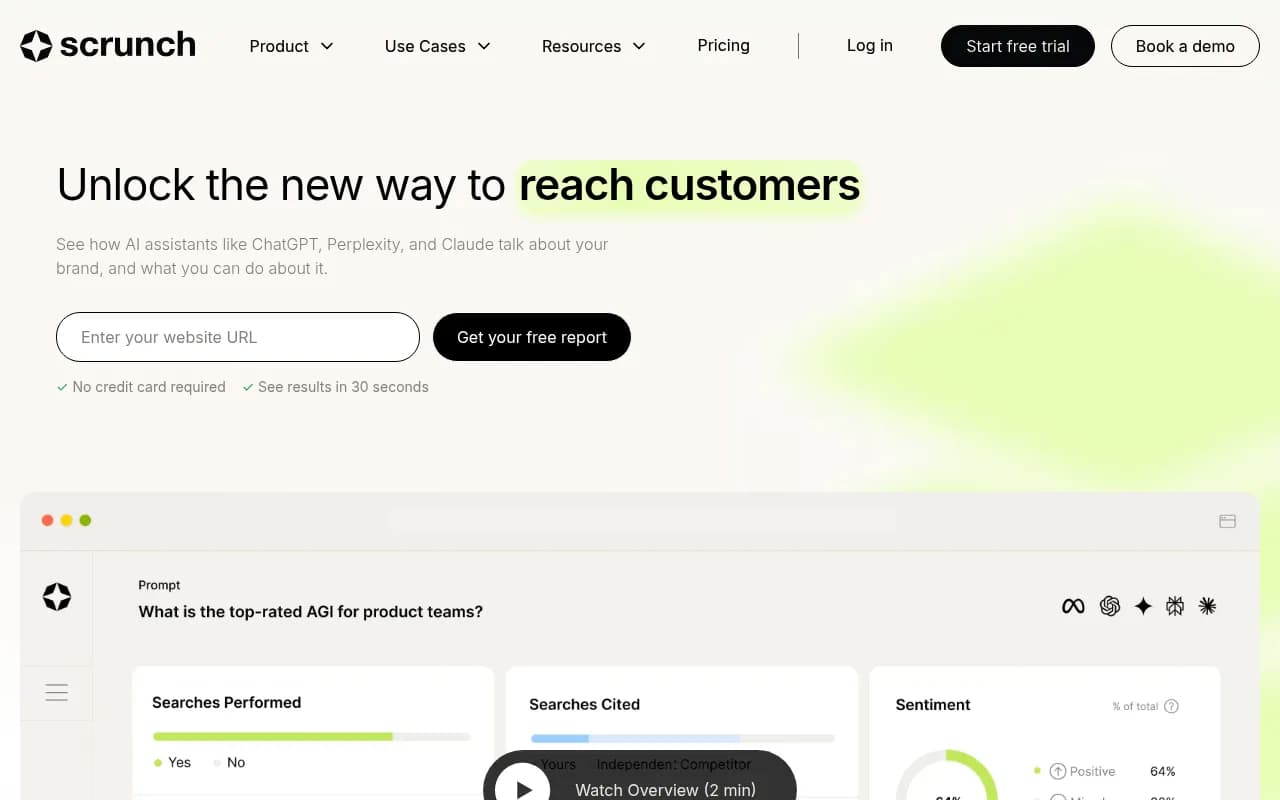
Scrunch (scrunch.com) is an Australian-founded platform that's built a solid reputation in the AI visibility monitoring space. It tracks brand mentions across ChatGPT, Perplexity, Claude, Gemini, and others, with a reasonably clean interface and good multi-brand support.
The platform's strength is its breadth of LLM coverage and its competitive benchmarking features. You can see how your brand stacks up against named competitors across different AI engines, which is useful for agency reporting.
Scrunch also has some content analysis features -- it can surface the sources AI models are citing in your category, which gives you a starting point for content strategy. But it stops short of actually helping you create that content or tracking whether new content you publish starts getting cited.
A few things worth noting from the agency perspective: Scrunch's pricing is not transparent (enterprise-oriented), and the platform lacks Reddit and YouTube tracking, which are increasingly important because those sources heavily influence what AI models cite. It also doesn't have AI crawler log access, so you can't see which pages AI bots are actually reading on your clients' sites.
Best for: Agencies that need solid multi-brand monitoring and competitive benchmarking, and are comfortable doing content strategy and creation in separate tools.
Search Party
Search Party
Search Party takes a different angle. It's less of a self-serve SaaS platform and more of an AI automation consultancy -- it builds custom workflows and helps agencies operationalize AI search optimization. The pitch is that instead of giving you a dashboard to stare at, they help you build systems.
That's a legitimate value proposition, but it comes with tradeoffs. Custom engagements mean longer onboarding, higher costs, and less flexibility for agencies that want to spin up a new client quickly. There's no self-serve free trial, and the platform's prompt metrics and content gap analysis capabilities are more limited compared to dedicated GEO platforms.
For agencies that are early in their AI visibility practice and want someone to hold their hand through building a process, Search Party can be useful. For agencies that already have a methodology and need a tool to execute it at scale, the fit is weaker.
Best for: Agencies looking for a consultancy-style engagement to build out their AI visibility practice from scratch, rather than a scalable self-serve platform.
Promptwatch
Promptwatch is the platform that most directly addresses all three jobs -- monitoring, analysis, and optimization -- in a single workflow. It's the one that comes up most often when agencies ask "which tool actually helps us do something with the data?"

The core difference is what Promptwatch calls the "action loop": find gaps, create content, track results. Most platforms stop at the first step.
Finding gaps
Promptwatch's Answer Gap Analysis shows you exactly which prompts competitors are appearing for that you're not. You see the specific topics, angles, and questions where AI models want an answer but can't find one on your client's site. This isn't a vague "you're missing coverage in X category" -- it's specific prompts with volume estimates and difficulty scores, so you can prioritize what to fix first.
The Prompt Intelligence features also show query fan-outs: how one prompt branches into related sub-queries. That's genuinely useful for content planning because it helps you understand the full cluster of questions around a topic, not just the surface-level keyword.
Creating content
This is where Promptwatch separates itself most clearly. The built-in AI writing agent generates articles, listicles, and comparisons grounded in real citation data -- 880 million+ citations analyzed. It's not generic AI content; it's content engineered around what AI models actually cite in your category.
For agencies, this means you can go from "here's a gap we found" to "here's a draft article targeting that gap" without leaving the platform. That's a meaningful workflow improvement.
Tracking results
Page-level tracking shows which specific pages are being cited, how often, and by which AI models. Traffic attribution connects AI visibility to actual website traffic and revenue through a code snippet, Google Search Console integration, or server log analysis.
That last piece -- closing the loop between AI citations and actual business outcomes -- is something almost no other platform in this comparison does.
Other capabilities worth mentioning for agencies
Promptwatch has AI crawler logs that show which pages ChatGPT, Claude, Perplexity, and others are actually reading on your clients' sites, and what errors they're encountering. Most competitors don't have this at all. It also tracks Reddit and YouTube discussions that influence AI recommendations -- a channel that's easy to overlook but genuinely matters for citation patterns.
For agencies with international clients, multi-language and multi-region monitoring with customizable personas is available. ChatGPT Shopping tracking is also included, which matters for e-commerce clients.
Pricing
Promptwatch has transparent, self-serve pricing: Essential at $99/month (1 site, 50 prompts, 5 articles), Professional at $249/month (2 sites, 150 prompts, 15 articles, plus crawler logs and state/city tracking), and Business at $579/month (5 sites, 350 prompts, 30 articles). Agency and enterprise plans are available with custom pricing. There's a free trial.
Best for: Agencies that need to show clients a complete workflow -- from identifying AI visibility gaps to publishing content that fixes them to proving the impact on traffic and revenue.
Head-to-head comparison
| Feature | AthenaHQ | Scrunch | Search Party | Promptwatch |
|---|---|---|---|---|
| AI engine coverage | Major LLMs | ChatGPT, Perplexity, Claude, Gemini + others | Varies by engagement | 10 AI models incl. Grok, DeepSeek, Mistral |
| Brand monitoring | Yes | Yes | Yes | Yes |
| Competitor benchmarking | Yes | Yes | Limited | Yes (heatmaps) |
| Content gap analysis | Limited | Limited | Limited | Yes (Answer Gap Analysis) |
| Built-in content generation | No | No | No | Yes (AI writing agent) |
| AI crawler logs | No | No | No | Yes |
| Reddit/YouTube tracking | No | No | No | Yes |
| ChatGPT Shopping tracking | No | No | No | Yes |
| Traffic attribution | No | No | No | Yes (snippet, GSC, server logs) |
| Prompt volume/difficulty scores | No | No | No | Yes |
| Query fan-outs | No | No | No | Yes |
| Transparent pricing | No | No | No | Yes ($99-$579/mo) |
| Free trial | No | No | No | Yes |
| Self-serve onboarding | Limited | Yes | No | Yes |
| Multi-language/region | Limited | Yes | Varies | Yes |
Which platform should agencies actually use?
The honest answer depends on what your agency needs to deliver.
If your clients are primarily asking "how are we perceived in AI search?" and you have a separate content team to act on insights, AthenaHQ's sentiment and narrative focus is genuinely useful. It's a different lens than pure citation tracking.
If you need solid multi-brand monitoring and competitive benchmarking in a relatively clean interface, Scrunch works. Just know you'll need other tools for the optimization side.
If you're building an AI visibility practice from scratch and want strategic guidance rather than a self-serve platform, Search Party's consultancy model might fit. It's not a scalable SaaS solution, but it's not trying to be.
If you need to show clients a complete picture -- here's where you're invisible, here's the content we created to fix it, here's the traffic impact -- Promptwatch is the only platform in this comparison that supports that workflow without stitching together multiple tools. The transparent pricing and free trial also make it easier to onboard new clients without a lengthy procurement process.
For most agencies in 2026, the pressure isn't just to monitor AI visibility -- it's to improve it and prove the improvement. That's the workflow gap that separates Promptwatch from the rest of this field.
A note on what to watch
This category is moving fast. Several platforms in this space have added features in the past six months that didn't exist when they launched. The gap between monitoring-only tools and optimization platforms is narrowing, but it's not closed.
The thing to watch is traffic attribution. Right now, most platforms can tell you that AI models are citing your content, but very few can connect that to actual website visits and conversions. As agencies face pressure to justify AI visibility work in terms of business outcomes, the platforms that solve attribution will have a significant advantage. Promptwatch already has this; others are still working on it.
The other thing worth watching is content generation quality. Generic AI content doesn't get cited by AI models -- they've seen it all before. The platforms that ground their content generation in real citation data (what's actually being cited in your category, by which models, for which prompts) will produce content that performs. That's a harder technical problem than it looks.