Key takeaways
- AI search engines like ChatGPT, Perplexity, and Google AI Overviews now influence B2B buying decisions before prospects ever visit your website -- product marketing teams need visibility into what these models say about them.
- Most AI visibility tools are monitoring-only dashboards: they show you where you're missing but don't help you fix it. The best platforms close the loop from gap identification to content creation to traffic attribution.
- Hallucination detection matters more than mention counts -- being visible with wrong information (bad pricing, wrong features, misattributed integrations) can cost deals.
- For product marketing teams specifically, the most valuable features are: prompt intelligence tied to buyer journey stages, competitor share-of-voice comparisons, content gap analysis, and traffic attribution back to pipeline.
- Promptwatch is the only platform in 2026 rated as a "Leader" across all evaluation categories, largely because it moves beyond tracking into optimization and content generation.
Why product marketing teams need to care about AI visibility right now
Here's something that's easy to miss: your buyers are already using AI search to research your category. They're asking ChatGPT "what's the best [your category] tool for [use case]?" before they ever hit your website. And if you're not in the answer, you're not in the consideration set.
Google's AI Overviews now appear in roughly 47% of all searches, according to Search Engine Journal. ChatGPT usage has grown to the point where it's a legitimate research channel for B2B buyers. Perplexity has carved out a niche as the go-to for technical and professional research queries.
The problem for product marketers is that traditional SEO metrics don't tell you any of this. You can rank #1 for your main keyword and still be completely absent from the AI-generated answers your buyers are reading. Worse, you might be mentioned but with outdated pricing, wrong feature descriptions, or confused with a competitor -- which is arguably worse than being invisible.
One founder who built an AI visibility tracker described exactly this scenario: prospects showing up to demo calls citing ChatGPT's pricing for their product, which was $30 higher than the actual price. They ranked #3 organically. The AI accuracy problem was invisible to them until it started costing deals.
This is the gap AI visibility platforms are designed to fill. But not all of them fill it equally well.
What "AI visibility" actually means for product marketing
Before picking a tool, it helps to be precise about what you're measuring.
AI visibility is your brand's presence in the responses that AI search engines generate when users ask questions relevant to your category. That includes:
- Whether your brand is mentioned at all in responses to buyer research queries
- Whether the information about you is accurate (pricing, features, use cases, integrations)
- Which sources the AI is citing when it does mention you
- How your share of voice compares to competitors across different prompts
- Whether you appear in product recommendation carousels (like ChatGPT Shopping)
For product marketing teams, the most relevant prompts are usually mid-to-bottom funnel: "best [category] tools for [use case]", "[your brand] vs [competitor]", "how does [your product] handle [specific feature]", and "what do customers say about [your brand]".
These are the queries where buyers are actively making shortlist decisions. Being present, accurate, and well-positioned in those responses directly affects pipeline.
What to look for in an AI visibility platform
The market has exploded. There are now 27+ tools claiming to track AI visibility, ranging from free browser extensions to enterprise platforms costing thousands per month. Here's how to cut through the noise.
Prompt monitoring across the right models
At minimum, a platform should track responses from ChatGPT, Perplexity, Google AI Overviews, and Claude. Those four cover the majority of B2B buyer research. Bonus points for Gemini, Grok, DeepSeek, and Meta AI -- but don't let coverage of obscure models distract you from depth on the ones that matter.
Buyer-journey prompt design
Generic prompts like "what is [brand]?" are not useful for product marketing. You need prompts that mirror actual buyer research: comparison queries, use-case queries, objection-handling queries. The best platforms either help you build these or have prompt libraries organized by buyer journey stage.
Competitor share-of-voice
You need to know not just whether you appear, but how often you appear relative to competitors. A platform that only shows your own visibility score is missing half the picture.
Content gap analysis
This is where most tools fall short. Knowing you're invisible for a prompt is step one. Knowing why you're invisible -- what content is missing, what topics your site doesn't cover -- is what lets you actually fix it.
Traffic and revenue attribution
AI visibility without revenue attribution is a vanity metric. The best platforms connect AI mentions to actual website visits and pipeline, either through a tracking snippet, Google Search Console integration, or server log analysis.
Accuracy / hallucination detection
This is underrated and underbuilt. Most tools count mentions without checking whether the information is correct. For product marketing teams, inaccurate mentions can be actively harmful.
The best AI visibility platforms for product marketing teams in 2026
Here's a comparison of the top platforms worth evaluating, with honest notes on where each one excels and where it falls short.
| Platform | Monitoring | Content gap analysis | Content generation | Traffic attribution | Best for |
|---|---|---|---|---|---|
| Promptwatch | 10 models | Yes (Answer Gap) | Yes (AI writing agent) | Yes (snippet/GSC/logs) | Full-funnel optimization |
| Profound | 9+ models | Limited | No | Limited | Enterprise reporting |
| Otterly.AI | 5 models | No | No | No | Budget monitoring |
| Peec AI | 4 models | Basic | No | No | Quick setup |
| AthenaHQ | 6 models | Limited | No | No | Monitoring-focused teams |
| Semrush AI Toolkit | 5 models | No | Partial | No | Existing Semrush users |
| Ahrefs Brand Radar | 4 models | No | No | No | Existing Ahrefs users |
| ZipTie | 4 models | No | No | No | Deep analysis/reporting |
| ScrunchAI | 5 models | No | No | No | Mid-market monitoring |
| SE Ranking AI Tracker | 4 models | No | No | No | SEO teams |
Promptwatch -- the full action loop
Promptwatch is the platform I'd recommend first for product marketing teams that want to do more than monitor. The core difference from every other tool on this list: it's built around an action loop rather than a dashboard.
The Answer Gap Analysis shows you exactly which prompts competitors are visible for that you're not -- and what content your site is missing. From there, the built-in AI writing agent generates articles, comparisons, and listicles grounded in real citation data (880M+ citations analyzed). Then page-level tracking shows whether those new pages are getting cited, by which models, and how often. Traffic attribution closes the loop by connecting AI visibility to actual revenue.
For product marketing specifically: prompt intelligence with volume estimates and difficulty scores means you can prioritize which buyer queries to target first. Reddit and YouTube tracking surfaces the discussions that actually influence AI recommendations -- a channel most competitors ignore. ChatGPT Shopping tracking matters if you're in a category where ChatGPT recommends products directly.
It monitors 10 AI models: ChatGPT, Perplexity, Google AI Overviews, Google AI Mode, Claude, Gemini, Meta/Llama, DeepSeek, Grok, Mistral, and Copilot. Pricing starts at $99/month for the Essential plan (1 site, 50 prompts), with Professional at $249/month adding crawler logs and city-level tracking.

Profound -- enterprise-grade monitoring
Profound is the go-to for larger teams with dedicated analysts. It covers 9+ AI models with strong reporting and share-of-voice comparisons. The data depth is impressive, and it's one of the few platforms that enterprise teams consistently recommend in practitioner communities.
The limitation: it's primarily a monitoring platform. There's no content generation, no built-in gap analysis that tells you what to create, and attribution is limited. If your team has the bandwidth to take the data and act on it independently, Profound works well. If you need the platform to help you close the loop, you'll hit a wall.
Profound

Otterly.AI -- the affordable starting point
Otterly.AI is consistently recommended as the most accessible entry point for teams new to AI visibility tracking. Setup is fast, pricing is low, and it covers the core models. It's a good choice if you're trying to get buy-in internally before committing to a larger platform.
The honest limitation: it's monitoring-only. No content gap analysis, no traffic attribution, no crawler logs. You'll outgrow it quickly if AI visibility becomes a real priority.
Otterly.AI

Peec AI -- smart suggestions on a budget
Peec AI sits between Otterly and the enterprise tools. It covers ChatGPT, Perplexity, Claude, and a few others, and it offers some basic suggestions for improving visibility. The interface is clean and the setup is genuinely fast.
Like Otterly, it doesn't have content generation or deep attribution. But for a small product marketing team that wants to track a handful of key prompts without a large budget, it's a reasonable choice.

AthenaHQ -- monitoring with some optimization signals
AthenaHQ covers more models than the entry-level tools and has a cleaner interface for tracking brand sentiment across AI responses. It's monitoring-focused but does surface some optimization signals -- more than Otterly or Peec, less than Promptwatch.
No content generation, no traffic attribution. Good for teams that want a step up from basic monitoring without committing to a full optimization platform.

Semrush AI Toolkit -- for teams already in Semrush
If your team is already paying for Semrush, the AI Toolkit is worth turning on. It adds AI visibility tracking to the existing SEO workflow, which reduces tool sprawl. The limitation is that it uses fixed prompts rather than custom ones, which makes it less useful for product-specific buyer journey queries.
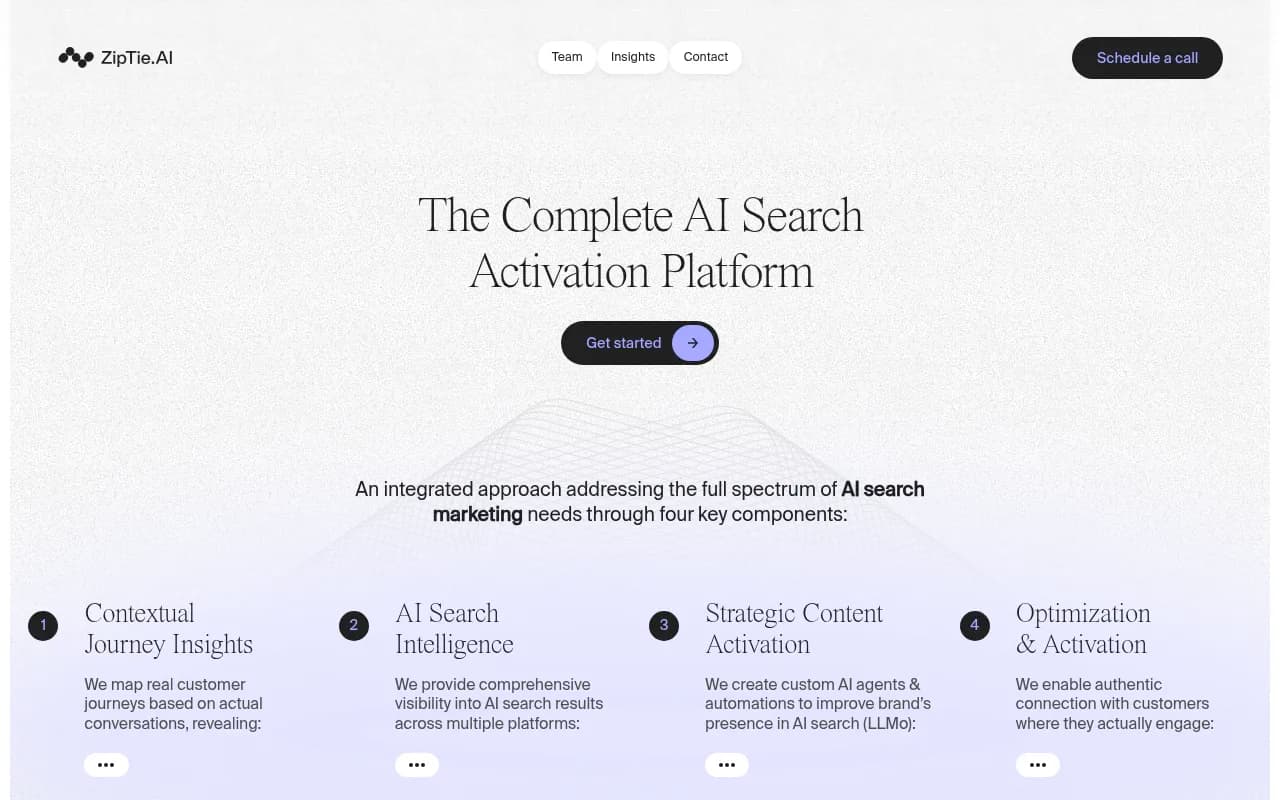
ZipTie -- deep analysis and reporting
ZipTie is built for teams that want to go deep on analysis rather than act quickly. The reporting is detailed, and it's useful for competitive benchmarking. If your job is producing AI visibility reports for stakeholders rather than executing on them, ZipTie is worth a look.
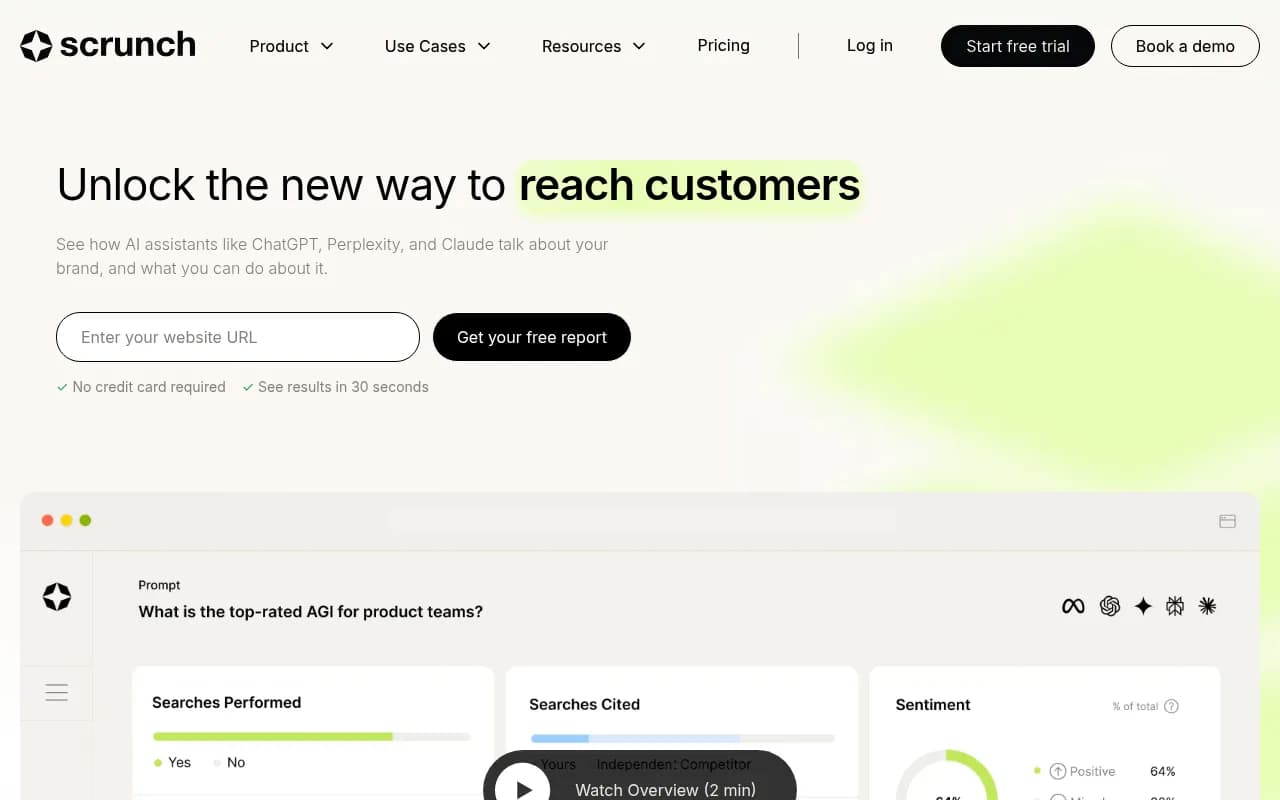
ScrunchAI -- mid-market monitoring
ScrunchAI covers the major AI models and has a reasonable interface for tracking brand mentions. It's positioned at mid-market teams and has stronger reporting than the entry-level tools. Like most monitoring platforms, it stops at showing you the data.
How product marketing teams should actually use these platforms
Picking a tool is the easy part. Here's how to get value from it.
Start with buyer journey prompt mapping
Before you set up any tracking, map out the prompts your buyers actually use. Think about:
- Category discovery: "what are the best tools for [use case]?"
- Comparison: "[your brand] vs [competitor A] vs [competitor B]"
- Validation: "what do customers say about [your brand]?"
- Feature-specific: "does [your brand] support [specific integration/feature]?"
- Objection: "is [your brand] worth the price?"
These are the prompts that matter for pipeline. Track them first.
Use competitor share-of-voice as your baseline
Before you can improve, you need to know where you stand relative to competitors. Run your top 20-30 prompts and see who's winning. This tells you where the biggest gaps are and which competitors' content strategies you should be studying.
Prioritize gaps by prompt volume and buyer intent
Not all gaps are equal. A prompt with high volume and strong buyer intent (like "[category] tools for [specific use case]") is worth more than a low-volume informational query. Platforms like Promptwatch give you volume estimates and difficulty scores to help prioritize.
Create content engineered for AI citation, not just Google ranking
This is the shift most product marketing teams are still making. Content that gets cited by AI models tends to be:
- Specific and factual (concrete numbers, named features, real comparisons)
- Structured clearly (headers, lists, direct answers to questions)
- Authoritative on a narrow topic rather than broadly covering everything
- Published on domains that AI models already trust and cite
Generic SEO content optimized for keyword density doesn't perform the same way in AI search. You need content that directly answers the questions AI models are being asked.
Track which pages are getting cited -- and which aren't
Once you've published new content, page-level tracking tells you whether it's working. If a page isn't getting cited despite covering the right topic, that's a signal about either the content quality, the domain authority, or how the AI models are interpreting it.
Connect visibility to revenue
This is non-negotiable for getting continued investment in AI visibility work. Whether you use a tracking snippet, GSC integration, or server log analysis, you need to show that AI-driven traffic converts. Without this, AI visibility stays a "nice to have" in budget conversations.
The hallucination problem product marketers can't ignore
One thing most AI visibility platforms don't address well: what happens when AI models say something wrong about you.
The LLMClicks founder's experience (mentioned earlier) is not unusual. AI models pull information from training data that may be months or years old. They confuse similar products. They hallucinate integrations. They cite outdated pricing.
For product marketing teams, this creates a specific risk: a prospect researches your product via ChatGPT, gets wrong information, and either disqualifies you based on false data or shows up to a sales call with incorrect expectations.
The fix isn't just monitoring -- it's ensuring that accurate, current information about your product is published in places AI models trust and cite. That means your own site, but also third-party review sites, industry publications, Reddit threads in relevant communities, and YouTube content. Platforms that track which external sources AI models are citing (like Promptwatch's citation and source analysis) help you identify where to publish and what to optimize.
Choosing the right platform for your team's stage
Not every product marketing team needs the same thing. Here's a rough framework:
Early stage / limited budget: Start with Otterly.AI or Peec AI to get baseline visibility data. Run your top 10 buyer journey prompts manually in ChatGPT and Perplexity to understand the landscape. Use the data to build internal buy-in.
Growing team / ready to act on data: Move to a platform with content gap analysis and generation. Promptwatch's Professional plan ($249/month) covers 2 sites, 150 prompts, and 15 articles per month -- enough to run a real optimization program.
Enterprise / multiple products or markets: Look at platforms with multi-language, multi-region support, API access, and custom reporting. Promptwatch's Business plan ($579/month) or custom Enterprise tier handles this. Profound is also worth evaluating at this stage for its reporting depth.
The honest advice: don't stay on a monitoring-only platform once you've validated that AI visibility matters for your pipeline. The value of knowing you're invisible is zero if you can't act on it.
The bottom line
AI search is already part of your buyers' research process. Product marketing teams that treat AI visibility as a "future problem" are already behind. The good news: the tools to track, optimize, and win buyer research queries exist now, and the playbook is becoming clearer.
The distinction that matters most when choosing a platform: monitoring vs. optimization. Most tools show you the problem. A few help you fix it. For product marketing teams with pipeline targets, the difference between those two categories is the difference between an interesting dashboard and a genuine competitive advantage.