Key Takeaways
- Most AI visibility tools only monitor: They show you where you're invisible in ChatGPT, Perplexity, and other AI engines, but leave you stuck figuring out what to do about it
- The best platforms close the action loop: They identify content gaps, generate optimized content, and track results—turning visibility data into actual improvement
- Promptwatch leads the category: It's the only platform rated as a "Leader" across all categories in a 2026 comparison of 12 GEO platforms, combining Answer Gap Analysis with an AI writing agent that creates citation-worthy content
- Content recommendations vary widely: Some platforms offer basic keyword suggestions, while others provide full content briefs, competitor analysis, and AI-generated drafts grounded in real citation data
- Integration matters: The most effective platforms connect visibility tracking with content creation, crawler logs, and traffic attribution in a single workflow
Why AI Visibility Tracking Alone Isn't Enough
Your brand's reputation now lives inside a new algorithm—one powered by ChatGPT, Claude, Gemini, Perplexity, and other AI search engines. When potential customers ask these models for recommendations, does your brand get mentioned? If not, you're losing visibility to competitors who do.
Traditional SEO focused on Google rankings. Generative Engine Optimization (GEO) focuses on AI citations. And here's the problem: most AI visibility platforms stop at monitoring. They'll show you that your brand appears in only 12% of relevant prompts, that competitors are dominating key queries, and that your visibility score is dropping. Then they leave you with a dashboard full of data and no clear path forward.
The gap between knowing you're invisible and actually fixing it is where most brands get stuck. You need more than tracking—you need actionable content recommendations that tell you exactly what to create, optimize, or fix.
What Makes a Great AI Visibility Platform with Content Recommendations
The best platforms in 2026 share several critical capabilities:
1. Answer Gap Analysis
They identify the specific prompts where competitors are visible but you're not. More importantly, they show you the exact content your website is missing—the topics, angles, and questions AI models want answers to but can't find on your site.
2. AI-Powered Content Generation
They don't just tell you what's missing—they help you create it. The most advanced platforms include AI writing agents that generate articles, listicles, and comparisons grounded in real citation data, prompt volumes, persona targeting, and competitor analysis.
3. Citation Intelligence
They analyze which pages, domains, Reddit threads, and YouTube videos AI models actually cite in their responses. This reveals where to publish and what to optimize.
4. Prompt Intelligence
They provide volume estimates and difficulty scores for each prompt, plus query fan-outs that show how one prompt branches into sub-queries. This helps you prioritize high-value, winnable prompts instead of guessing.
5. Page-Level Tracking
They show exactly which pages are being cited, how often, and by which models. This closes the loop between content creation and visibility improvement.
The Top AI Visibility Platforms with Built-In Content Recommendations
Promptwatch: The Complete Action Loop
Promptwatch stands out as the only platform that combines comprehensive visibility tracking with powerful content optimization tools. In a 2026 comparison of 12 GEO platforms (Search Party, Otterly.AI, Peec.ai, Profound, AthenaHQ, Scrunch, Brandlight.ai, Bluefish, Searchable, Semrush, Ahrefs Brand Radar), Promptwatch earned "Leader" status across all categories.

What makes Promptwatch different is its action-oriented approach:
Answer Gap Analysis shows exactly which prompts competitors are visible for but you're not. You see the specific content your website is missing—the topics, angles, and questions AI models want answers to but can't find on your site.
AI Writing Agent generates articles, listicles, and comparisons grounded in 880M+ citations analyzed, prompt volumes, persona targeting, and competitor analysis. This isn't generic SEO filler—it's content engineered to get cited by ChatGPT, Claude, Perplexity, and other AI models.
Citation & Source Analysis reveals exactly which pages, Reddit threads, YouTube videos, and domains AI models cite in their responses. Know where to publish and what to optimize.
AI Crawler Logs provide real-time visibility into AI crawlers (ChatGPT, Claude, Perplexity, etc.) hitting your website—which pages they read, errors they encounter, how often they return.
The platform monitors 10 AI models: OpenAI/ChatGPT, Perplexity, Google AI Overviews, Google AI Mode, Claude, Gemini, Meta/Llama, DeepSeek, Grok, Mistral, and Copilot. Pricing starts at $99/month for the Essential plan (1 site, 50 prompts, 5 articles), with Professional ($249/month) and Business ($579/month) tiers offering expanded capabilities.
Profound: Enterprise-Grade Visibility with Agency Mode
Profound earned a 92/100 AEO score in a 2026 ranking of AI visibility platforms, tracking 10+ AI engines with 400M+ prompt insights. The platform is SOC 2 Type II certified and built for enterprise needs.
Profound

Profound's Agency mode includes brand configurations, pitch environments, and white-label reporting—making it ideal for marketing agencies managing multiple clients. The platform provides competitive analysis, prompt tracking, and visibility scoring across major AI engines.
While Profound excels at monitoring and competitive intelligence, its content recommendation capabilities are more limited compared to platforms with built-in AI writing agents. You'll get insights into what's working for competitors, but you'll need to create the actual content elsewhere.
Peec AI: Smart Suggestions for Content Optimization
Peec AI focuses on tracking brand visibility across ChatGPT, Perplexity, and Claude while providing smart suggestions for content optimization.

The platform analyzes your existing content and compares it to what AI models are actually citing. It then suggests specific improvements—topics to cover, questions to answer, and content gaps to fill. However, Peec AI doesn't generate content for you; it provides the roadmap and you handle the execution.
Peec AI is particularly strong at identifying sentiment and context around brand mentions, helping you understand not just whether you're being cited, but how you're being portrayed.
Writesonic: All-in-One Content Generation with AI Visibility
Writesonic offers a unique combination: mature content generation tools paired with AI visibility tracking. This makes it an ideal choice for teams that want both capabilities in a single platform.

The platform's AI writer can generate blog posts, articles, and marketing copy optimized for both traditional SEO and AI search. The visibility tracking component monitors how your content performs in AI-generated responses.
Writesonic's strength is its content creation capabilities—it's been refining its AI writing tools for years. The AI visibility tracking is newer and less comprehensive than dedicated GEO platforms, but the integration between content creation and visibility monitoring is seamless.
Searchable: Built-In Content Generation for AI Search
Searchable positions itself as an "AI Search Visibility Platform with Built-In Content Generation," directly addressing the gap between monitoring and action.
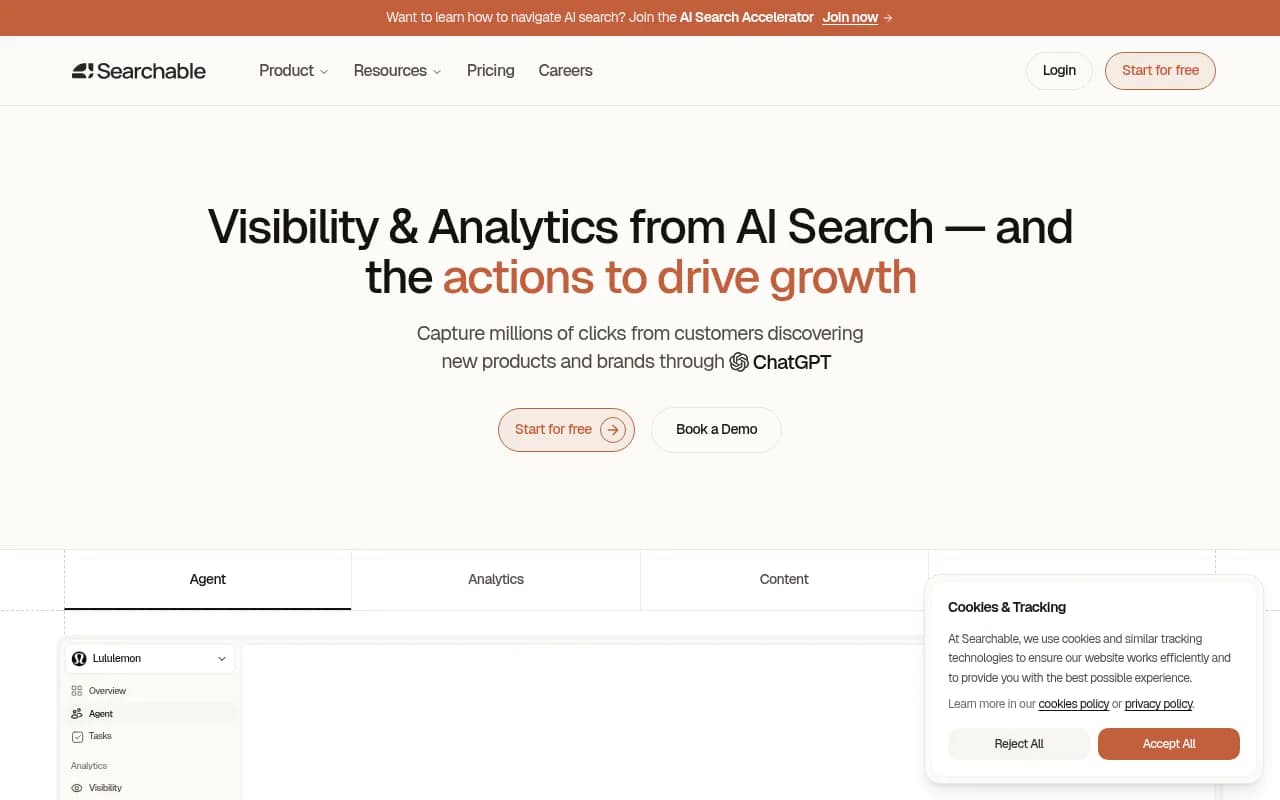
The platform tracks brand mentions across multiple AI engines and provides content generation tools to help improve visibility. Searchable's approach focuses on creating content that AI models want to cite, using analysis of successful citations to inform content recommendations.
While Searchable offers content generation capabilities, the depth of citation analysis and prompt intelligence is less extensive than platforms like Promptwatch that have processed over 1.1 billion citations.
Semrush: Traditional SEO Platform with AI Visibility Add-On
Semrush, the established SEO platform, has added AI visibility tracking to its suite of tools. This makes it convenient for existing Semrush users who want to monitor AI search without switching platforms.
Semrush's AI visibility tracking uses fixed prompts rather than custom prompt sets, which limits flexibility. The platform doesn't offer AI traffic attribution or content generation specifically for AI search optimization. However, Semrush's traditional content optimization tools (like the Writing Assistant) can be applied to content intended for AI visibility.
For teams already invested in the Semrush ecosystem, the AI visibility add-on provides basic monitoring capabilities. For dedicated GEO work with content recommendations, specialized platforms offer more depth.
Ahrefs Brand Radar: Basic Monitoring Without Content Tools
Ahrefs, another traditional SEO powerhouse, offers Brand Radar for tracking brand mentions in AI search. Like Semrush, it uses fixed prompts and lacks AI traffic attribution.
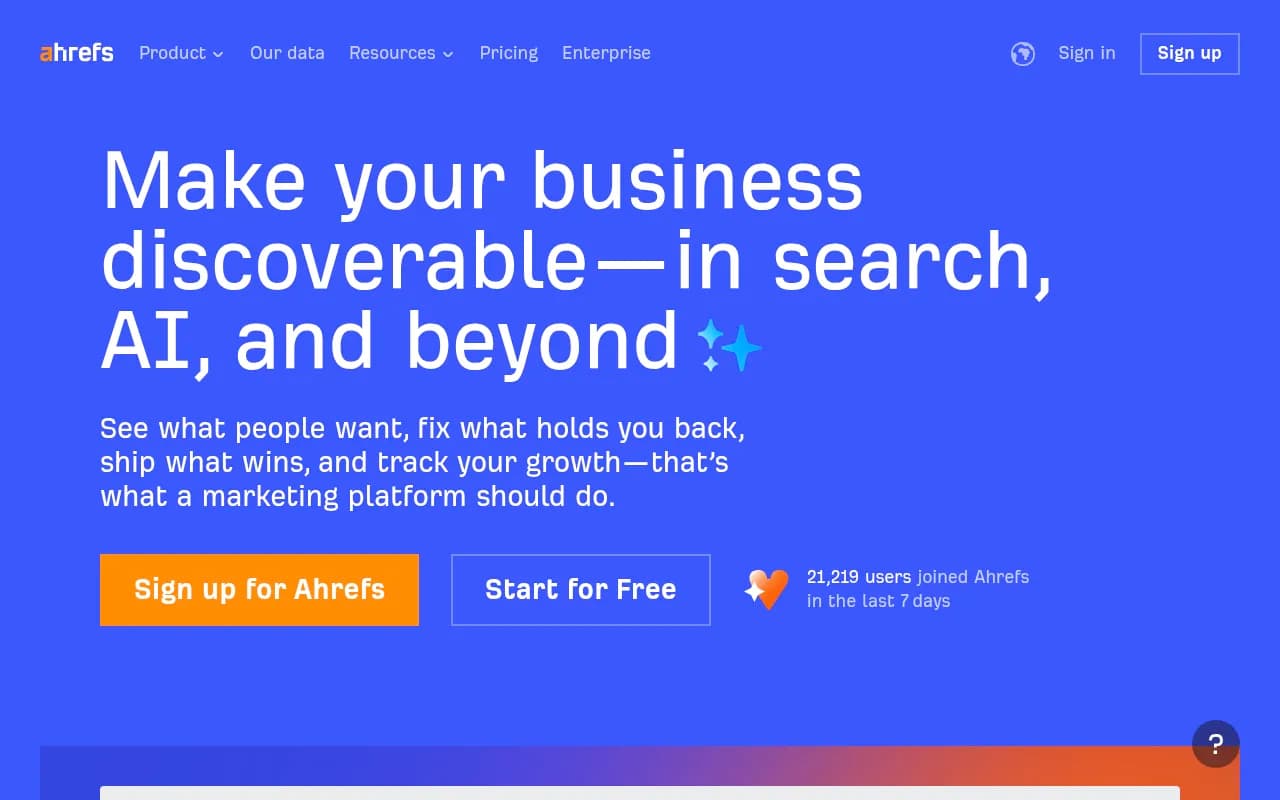
Ahrefs doesn't provide content generation or optimization recommendations specifically for AI visibility. You'll get monitoring data, but you're on your own for creating content that improves your citations.
For teams using Ahrefs for traditional SEO, Brand Radar adds basic AI visibility tracking. For comprehensive GEO with content recommendations, you'll need a dedicated platform.
The Monitoring-Only Platforms: What They're Missing
Several platforms offer solid AI visibility monitoring but lack content recommendation capabilities:
Otterly.AI
Otterly.AI comes highly recommended in SEO circles and stands out as one of the most affordable tools for getting started. It tracks brand mentions across ChatGPT, Perplexity, and Google AI Overviews.
Otterly.AI

However, Otterly.AI is monitoring-only—no crawler logs, no visitor analytics, no content generation. You'll see where you're invisible, but you won't get guidance on what to create or optimize.
AthenaHQ
AthenaHQ provides monitoring-focused tracking across AI search engines. The platform lacks content optimization and generation capabilities, positioning it as a visibility dashboard rather than an optimization tool.

Search Party
Search Party is agency-oriented with limited prompt metrics and no content gap analysis. It's designed for monitoring client brands rather than optimizing them.
Search Party
How to Choose the Right Platform for Your Needs
Your choice depends on where you are in your GEO journey:
If you need the complete action loop (find gaps, create content, track results), Promptwatch is the clear choice. It's the only platform that combines deep citation analysis with AI-powered content generation and comprehensive tracking.
If you're an enterprise or agency managing multiple brands and need white-label reporting, Profound offers strong monitoring and competitive intelligence with agency-specific features.
If you're already using Semrush or Ahrefs for traditional SEO and want to add basic AI visibility monitoring, their add-on tools provide convenient integration—but expect limited content optimization capabilities.
If you want content generation first and AI visibility tracking second, Writesonic offers mature writing tools with newer visibility monitoring.
If you're just starting and want affordable monitoring to understand the landscape, Otterly.AI provides basic tracking at a low price point—but you'll need to figure out content optimization on your own.
The Content Recommendation Gap: Why It Matters
Most AI visibility platforms can tell you that your brand appears in only 15% of relevant prompts. They can show you that competitors are dominating key queries. They can track your visibility score over time.
But they can't tell you what to do about it.
The platforms that include content recommendations—especially those with AI-powered content generation—close this gap. They turn visibility data into actionable tasks: "Create an article about X topic," "Optimize your existing page for Y prompt," "Add Z information that AI models are looking for."
This is the difference between a dashboard and a platform. A dashboard shows you problems. A platform helps you solve them.
The Future of AI Visibility Platforms
As AI search continues to evolve, expect these platforms to become more sophisticated:
Deeper integration between monitoring and content creation: The line between visibility tracking and content optimization will blur further. Platforms will automatically generate content briefs based on visibility gaps and citation analysis.
Real-time optimization recommendations: Instead of monthly reports, platforms will provide real-time alerts when competitors gain visibility or when new content opportunities emerge.
Attribution to revenue: More platforms will connect AI visibility to actual traffic and conversions, proving ROI beyond citation counts.
Multi-modal optimization: As AI engines incorporate images, videos, and audio, visibility platforms will expand beyond text to optimize all content formats.
Automated content deployment: The most advanced platforms will not just generate content but automatically publish and optimize it based on visibility data.
Getting Started with AI Visibility and Content Optimization
If you're new to GEO and AI visibility:
-
Start with monitoring: Choose a platform that tracks your brand across major AI engines (ChatGPT, Perplexity, Claude, Gemini, Google AI Overviews).
-
Identify your biggest gaps: Use Answer Gap Analysis or competitive tracking to see where competitors are visible but you're not.
-
Prioritize high-value prompts: Focus on prompts with high volume and difficulty scores that match your target audience.
-
Create citation-worthy content: Use AI-powered content generation or manual creation to fill the gaps. Focus on authoritative, comprehensive content that answers specific questions.
-
Track the results: Monitor how your visibility scores improve as AI models start citing your new content. Use page-level tracking to see which content is working.
-
Close the loop with attribution: Connect visibility improvements to actual traffic and revenue using code snippets, Google Search Console integration, or server log analysis.
The brands that master this cycle—find gaps, create content, track results—will have an unfair advantage in AI search. The ones that stop at monitoring will watch competitors steal visibility they didn't know they were losing.
Conclusion: From Monitoring to Optimization
AI visibility platforms have evolved beyond simple monitoring dashboards. The best platforms in 2026 don't just show you where you're invisible—they help you fix it with content recommendations, gap analysis, AI-powered writing, and optimization tools.
Promptwatch leads this category by combining comprehensive visibility tracking across 10 AI models with Answer Gap Analysis and an AI writing agent that generates citation-worthy content. It's the only platform that closes the complete action loop from visibility data to content creation to results tracking.
For teams serious about AI search optimization, choose a platform that does more than monitor. Choose one that helps you take action, create content, and improve your visibility where it matters most: in the AI-generated answers your customers are reading right now.