Key takeaways
- AI visibility tracking has split into two categories: monitoring-only dashboards and full optimization platforms. The gap between them is significant.
- Competitor analysis in AI search means knowing which prompts your rivals appear for, which AI engines cite them, and what content is driving those citations.
- Most tools (Otterly.AI, Peec.ai, AthenaHQ) stop at monitoring. A smaller number -- led by Promptwatch -- close the loop by helping you create content that actually fixes the gaps.
- Pricing ranges from free tiers to $579/month for multi-site professional use, with enterprise custom pricing above that.
- The most useful differentiator isn't how many AI engines a tool monitors -- it's whether it tells you why competitors are winning and what to do next.
Why competitor analysis in AI search is different from traditional SEO
In traditional SEO, competitor analysis means checking who ranks above you on a SERP and reverse-engineering their backlinks. It's a relatively well-understood game.
AI search doesn't work that way. There's no position 1 through 10. There's a generated answer, and either your brand is cited in it or it isn't. The factors that determine citation -- content authority, topical coverage, how well a page answers the specific question being asked -- are harder to reverse-engineer from the outside.
That's what makes AI visibility competitor analysis genuinely tricky. You need to know:
- Which prompts your competitors appear for that you don't
- Which AI engines (ChatGPT, Perplexity, Claude, Gemini, etc.) are citing them
- What content is being cited -- specific URLs, not just domains
- Whether the citation is positive, neutral, or a recommendation
Most tools on the market can answer the first two questions. Very few answer the third and fourth. And almost none help you do anything about it.
This guide covers 7 platforms that go beyond basic monitoring to give you real competitive intelligence in AI search -- what rivals are winning, where, and how to close the gap.
The 7 best AI visibility platforms with competitor analysis
1. Promptwatch -- best for closing the gap, not just finding it
Promptwatch is the platform that's hardest to categorize alongside the others, because it's doing something fundamentally different. Most tools show you a dashboard of where you're invisible. Promptwatch shows you the same thing, then gives you the tools to fix it.

The competitor analysis workflow starts with Answer Gap Analysis: you see the specific prompts where competitors are being cited and you're not. Not just "competitor X is more visible than you" -- but the actual questions, the AI engines generating those answers, and the content gaps on your site that explain why you're missing.
From there, the built-in AI writing agent generates content designed to fill those gaps. It's grounded in citation data from 880M+ citations analyzed, so the output isn't generic SEO filler -- it's content engineered to match what AI models actually cite. Then page-level tracking shows whether the new content starts getting picked up.
A few other things worth knowing: Promptwatch monitors 10 AI engines (ChatGPT, Perplexity, Claude, Gemini, Google AI Overviews, DeepSeek, Grok, Mistral, Meta AI, Copilot), has real-time AI crawler logs that show which pages each AI bot is reading, and tracks Reddit and YouTube as citation sources -- two channels most competitors ignore entirely.
Pricing starts at $99/month (Essential: 1 site, 50 prompts, 5 articles), $249/month (Professional: 2 sites, 150 prompts, crawler logs), and $579/month (Business: 5 sites, 350 prompts). A free trial is available.
Used by 6,700+ brands and agencies including Booking.com and Center Parcs.
2. Profound -- best for enterprise-scale monitoring
Profound

Profound is a strong enterprise option with solid coverage across 9+ AI engines and good prompt organization features. It's built for larger teams that need structured workflows around AI visibility data.
Where it falls short relative to Promptwatch is on the action side. Profound is primarily a monitoring and reporting platform -- it shows you competitive gaps well, but the path from "we're invisible here" to "here's the content that will fix it" isn't built in. Teams using Profound typically need to take the data somewhere else to act on it.
That said, for enterprise teams with dedicated content operations already in place, Profound's data quality and reporting depth are genuinely good.
3. Otterly.AI -- best for quick brand monitoring on a budget
Otterly.AI

Otterly.AI is one of the more polished monitoring-only tools. It tracks brand mentions across ChatGPT, Perplexity, and Google AI Overviews, surfaces competitor comparisons, and presents data cleanly. For teams that just need to know whether their brand is showing up and how often, it works.
The limitation is that Otterly.AI stops at the monitoring layer. There's no content gap analysis, no AI writing tools, no crawler logs. If you want to understand why a competitor is winning a particular prompt, you'll need to do that analysis manually. It's a good starting point, but teams that outgrow basic monitoring will hit a ceiling quickly.
4. AthenaHQ -- best for structured prompt tracking

AthenaHQ takes a prompt-first approach to AI visibility. You define a set of prompts, it tracks how your brand and competitors appear across those prompts over time. The interface is clean and the competitive comparison views are useful.
Like Otterly.AI, it's monitoring-focused. The platform doesn't have content generation or gap analysis tools built in, so the workflow is: see the data, figure out what to do, go do it somewhere else. For teams that have that process figured out, AthenaHQ is a solid tracker. For teams looking for an end-to-end workflow, it's incomplete.
5. Scrunch AI -- best for tracking AI search alongside traditional SEO
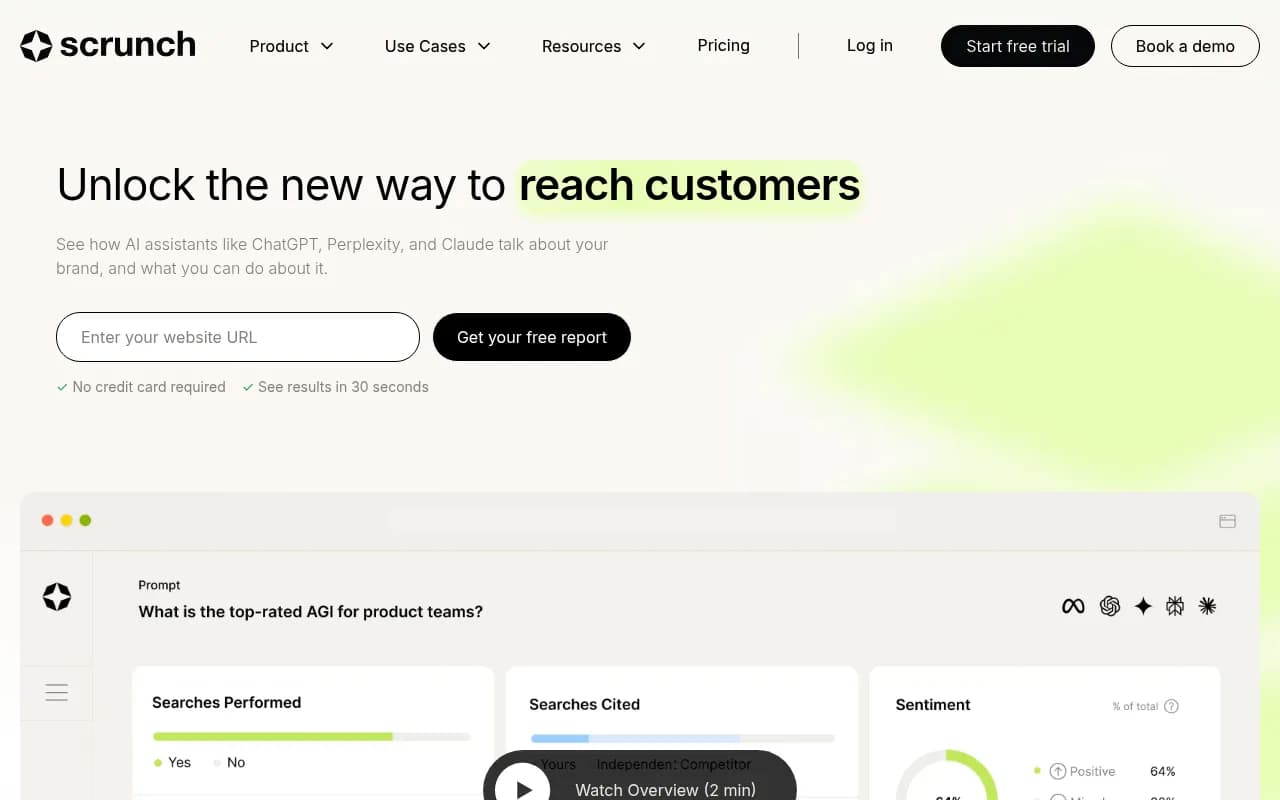
Scrunch AI sits at the intersection of traditional SEO tracking and AI visibility monitoring. It's useful if you want a single platform that covers both Google rankings and AI engine citations, rather than running two separate tools.
The AI visibility features include competitor tracking and citation analysis. The competitive intelligence isn't as deep as dedicated GEO platforms -- you won't get the prompt-level gap analysis or content recommendations you'd get from Promptwatch -- but for teams that want consolidated reporting, the trade-off can make sense.
6. SE Ranking (SE Visible) -- best for teams already in the SE Ranking ecosystem
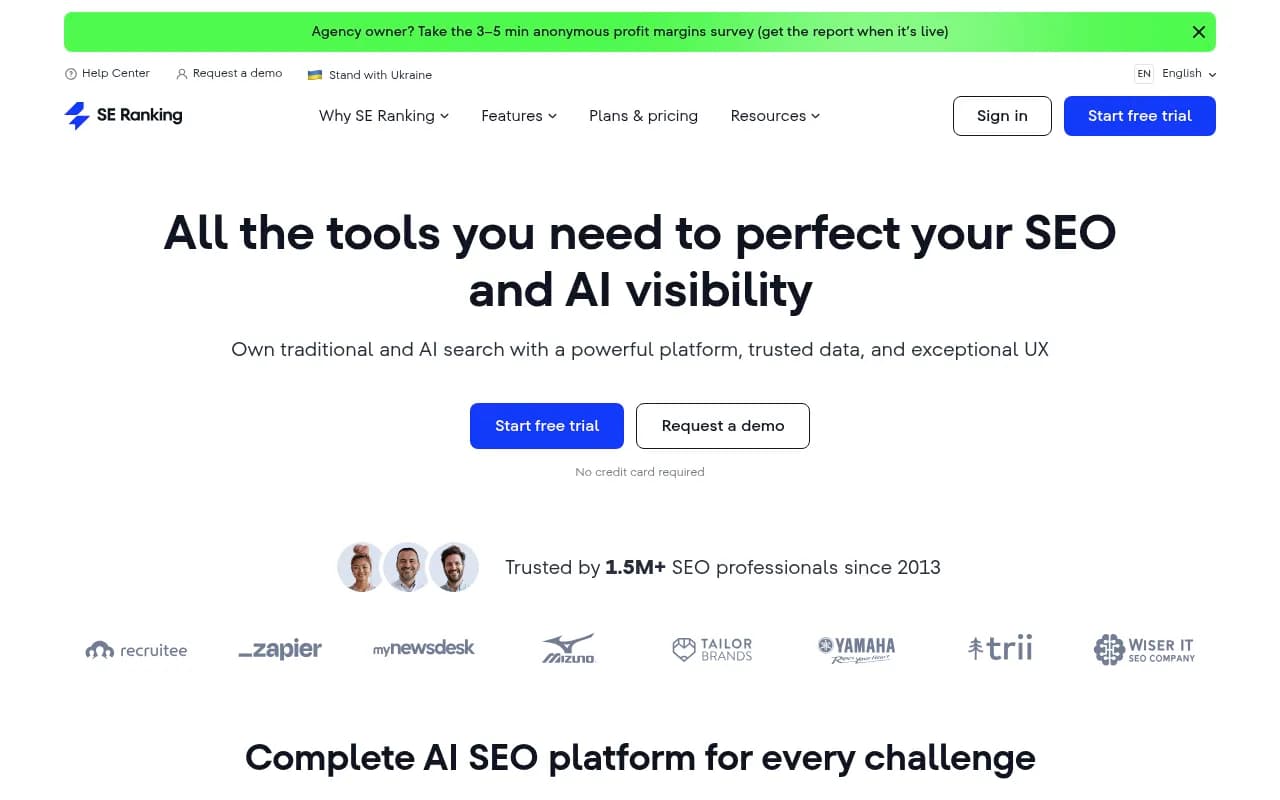
SE Ranking launched SE Visible as its AI visibility module, and it integrates naturally with the existing SE Ranking platform. If your team already uses SE Ranking for traditional SEO, adding AI visibility tracking without switching tools is a reasonable choice.
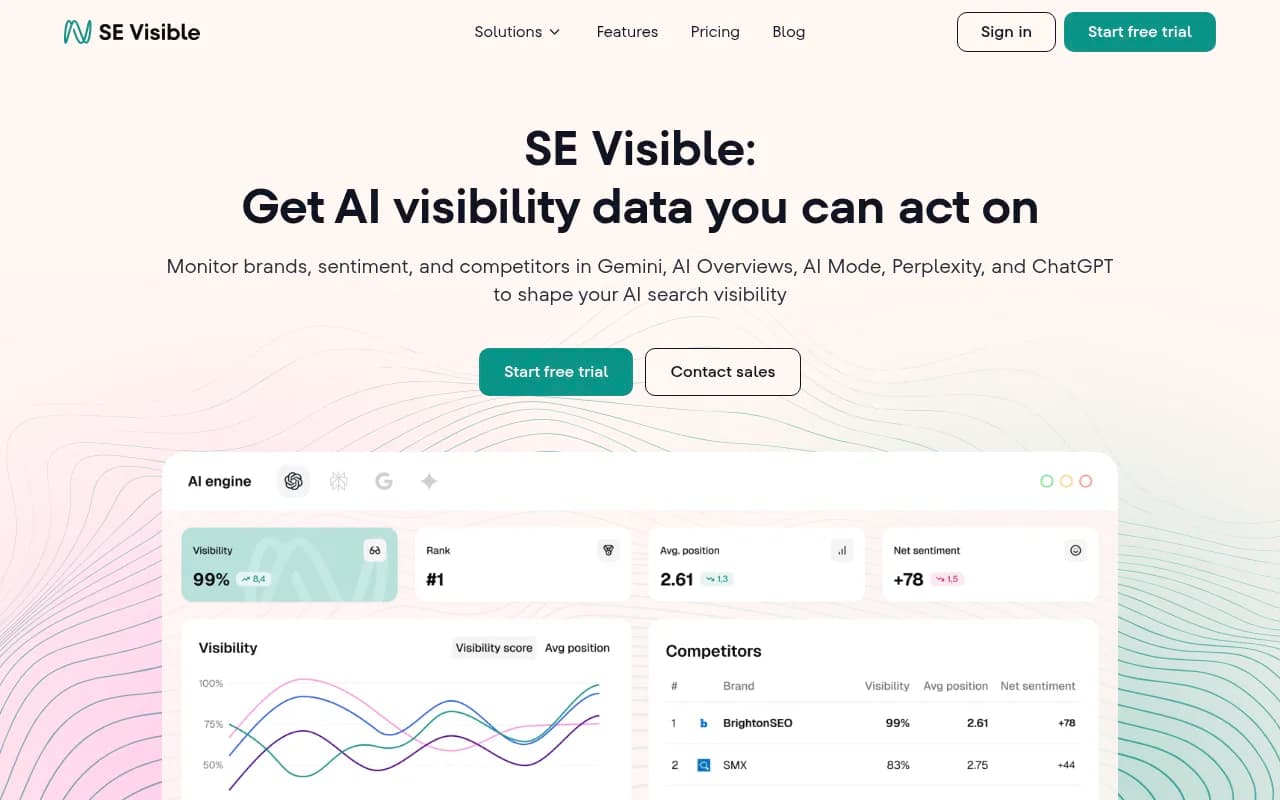
The AI monitoring covers major LLMs and includes some competitive comparison features. The depth of competitor analysis is more limited than dedicated platforms -- you can see that a competitor is appearing more often, but the "why" and "what to do" layers aren't there. Still, for SE Ranking users, it's a low-friction way to start tracking AI visibility.
7. Peec.ai -- best for lightweight multi-engine monitoring

Peec.ai monitors brand visibility across ChatGPT, Perplexity, and Claude with a clean, minimal interface. It's one of the easier tools to get started with -- setup is fast, the dashboards are readable, and competitor comparisons are available.
The trade-off is depth. Peec.ai doesn't have crawler logs, content recommendations, or prompt-level gap analysis. It's a monitoring dashboard, not an optimization platform. For teams in the early stages of AI visibility tracking who want to get a baseline before investing in a more complete platform, it's a reasonable starting point.
Feature comparison table
| Platform | Competitor gap analysis | Content generation | Crawler logs | Reddit/YouTube tracking | Pricing from |
|---|---|---|---|---|---|
| Promptwatch | Yes (Answer Gap Analysis) | Yes (built-in AI writer) | Yes | Yes | $99/mo |
| Profound | Partial | No | No | No | Higher |
| Otterly.AI | Basic | No | No | No | Lower |
| AthenaHQ | Partial | No | No | No | Mid-range |
| Scrunch AI | Basic | No | No | No | Mid-range |
| SE Visible | Basic | No | No | No | Bundled |
| Peec.ai | Basic | No | No | No | Lower |
What to actually look for in an AI visibility competitor analysis tool
The feature lists above matter less than understanding what workflow you're trying to support. Here's how to think about it.
If you just need a baseline
Any of the monitoring-only tools (Otterly.AI, Peec.ai, SE Visible) will show you where you and your competitors stand. They're fine for answering "are we visible in AI search?" but not much more.
If you need to understand why competitors are winning
This is where most tools fall short. Knowing that a competitor appears in 60% of responses for a given prompt category and you appear in 20% is useful. Knowing which specific content is driving those citations, and which prompts you could realistically win, is what actually moves the needle.
Promptwatch's Answer Gap Analysis is the most direct answer to this question. It surfaces the specific prompts where competitors are visible and you're not, with enough context to act on it.
If you need to fix the problem, not just diagnose it
This is the clearest differentiator. Most platforms stop at diagnosis. Promptwatch is built around the full loop: find the gaps, generate content to fill them, track whether it works.
For teams with limited content resources, having an AI writing agent that generates articles grounded in real citation data (not generic SEO content) is a meaningful advantage. You're not starting from a blank page -- you're starting from "here's the prompt you're missing, here's what the AI models want to see, here's a draft."
If you're an agency managing multiple clients
Multi-site tracking, white-label reporting, and API access matter a lot at agency scale. Promptwatch's Business plan ($579/month) covers 5 sites, and custom agency/enterprise pricing is available. The Looker Studio integration and API make it easier to build client-facing reporting workflows.
How AI visibility competitor analysis actually works in practice
It helps to understand the mechanics. These platforms work by running your target prompts against AI engines on a regular schedule -- daily or weekly depending on the tool -- and recording the responses. They parse those responses to identify brand mentions, citation URLs, and sentiment.
For competitor analysis, you add your competitors' brand names and domains to the tracking setup. The platform then shows you side-by-side: for each prompt, who's being cited, how often, and in what context.

The more sophisticated platforms (Promptwatch being the clearest example) go further. They look at the citation data to identify patterns: what types of content get cited, which domains AI models trust, which topics have low competition but meaningful prompt volume. That's what turns raw monitoring data into an actionable content strategy.
Prompt volume and difficulty scoring -- knowing not just that you're invisible for a prompt, but how many people are asking it and how hard it would be to win -- is another layer that separates serious platforms from basic trackers. Promptwatch includes both, which lets you prioritize instead of guessing.
The Reddit and YouTube angle most tools miss
One thing worth calling out specifically: AI models don't only cite brand websites. They cite Reddit threads, YouTube videos, review sites, and forum discussions -- often heavily. A competitor might be winning a prompt not because their website is better, but because a Reddit thread recommending them has been indexed and trusted by multiple AI engines.
Most AI visibility platforms don't surface this. They track domain-level citations and stop there. Promptwatch's Reddit and YouTube tracking shows you which discussions are influencing AI recommendations in your category -- which means you can see when a competitor is winning because of off-site content, and decide whether to engage with those channels.
This matters more in some categories than others (consumer products, software reviews, and local services tend to have heavy Reddit influence), but it's a blind spot worth knowing about.
Putting it together: which tool fits which team
The honest answer is that the right choice depends on where you are in the AI visibility journey.
If you're starting from zero and want to understand the landscape before committing budget, a free trial of Promptwatch or one of the lighter monitoring tools gives you a baseline quickly.
If you're past the "do we need this?" question and into "how do we actually improve?", the monitoring-only tools will frustrate you fast. The gap between seeing a problem and having tools to fix it is where most teams get stuck.
If you're running an agency or managing AI visibility for multiple brands, the economics of a platform that combines monitoring, gap analysis, and content generation are better than paying for three separate tools.
The competitive intelligence in AI search is still early enough that most brands aren't doing this systematically. That's the window. The teams building content strategies grounded in real citation data and prompt gap analysis now are the ones that will be hard to displace once AI search matures further.