Key takeaways
- Supplier research has moved into ChatGPT and Copilot: one UK study found 66% of B2B buyers now use AI tools to evaluate suppliers, and 90% of them trust what the AI recommends — but just five brands typically capture 80% of the recommendations in any category, so this is a winner-take-most game.
- Generic keyword rank trackers won't show you this. You need a dedicated AI visibility / GEO (generative engine optimization) tool that monitors ChatGPT, Perplexity, Gemini, Claude, and Google's AI surfaces directly.
- Mid-authority logistics and freight sites (roughly DR 46-75) are getting cited in ChatGPT almost as often as the giants — Promptwatch's domain-rank data shows DR 46-75 sites pulled in nearly half of all ChatGPT citations in August 2026, so you don't need decades of domain authority to show up.
- Reddit's influence on ChatGPT citations collapsed from ~3.8% to 0.5% in a single week in mid-August 2026, which matters if your GEO plan leans heavily on forum seeding for logistics research queries.
- For logistics and supply chain brands specifically, the tools that matter most combine prompt tracking with content execution — not just a dashboard that tells you you're invisible, but something that helps fix it.
Why logistics and supply chain brands can't ignore AI search
A freight manager used to Google "best LTL carrier for temperature-controlled freight in the Midwest" and click through ten blue links. Now they ask ChatGPT or Copilot the same question and get three names back, with maybe a sentence of reasoning. If your 3PL, freight brokerage, or supply chain software company isn't one of those three names, you don't just lose a click — you never enter the conversation.
The numbers back this up. Forrester's 2026 B2B buyer journey research puts ChatGPT usage among B2B software buyers at 72%, and a Q2 2026 benchmark from Crackle PR found that 51% of B2B tech brands have zero AI citations across ChatGPT, Perplexity, and Gemini combined. That's a big gap, and in a vertical like logistics, where procurement committees are large (Gartner pegs the median B2B buying committee at 8.2 people) and the sales cycle is long, being absent from the AI research phase is expensive in a way that's hard to see on a traditional analytics dashboard.
This is also a vertical with its own research quirks. Logistics buyers lean on load boards, carrier directories, and trade publications (think FreightWaves-style sites) the same way car shoppers lean on Autotrader and Cars.com rather than manufacturer sites. Promptwatch's automotive citation data found that marketplaces and review sites captured nearly 15% of ChatGPT's automotive citations combined, versus under 8% for manufacturer domains directly — a pattern that almost certainly repeats for freight marketplaces, carrier directories, and review sites like G2 or Capterra when the query is about software, or industry publications when the query is about carriers and 3PLs.
What makes AI visibility tracking different for this industry
Most generic AI visibility tools are built for ecommerce or SaaS marketing teams, tracking consumer-style prompts. Logistics and supply chain brands have a different prompt shape: fewer consumer queries, more B2B procurement questions ("who are the top freight brokers for reefer loads," "best TMS for mid-size 3PLs," "is [carrier] reliable for cross-border shipments"), and a heavier reliance on LinkedIn, trade press, and industry directories as trust signals rather than Instagram or TikTok.
That changes what you should look for in a tool:
- Coverage of B2B-heavy AI surfaces, not just ChatGPT. Google AI Overviews and AI Mode matter a lot here because procurement researchers still start in a browser search bar.
- LinkedIn-aware citation tracking. Promptwatch's LinkedIn data from August 2026 shows ChatGPT is now pulling nearly 34% of its LinkedIn citations straight from company pages (up from 24% a few months earlier), plus job listings and help articles — almost half of ChatGPT's LinkedIn mix is now "about the company" content rather than articles. If your LinkedIn company page is thin, that's a visibility gap most logistics marketers haven't noticed yet. Read the full LinkedIn Citation Page Types report.
- Crawler log visibility. Freight and 3PL sites often sit behind aggressive WAF or bot-blocking rules (reasonable, given scraping attempts on rate data), which can accidentally block GPTBot, ClaudeBot, or PerplexityBot too. A tool that shows you actual AI crawler traffic catches this before it tanks your citation rate.
- Content execution, not just scores. Supply chain marketing teams are usually small relative to the complexity of the content needed (route optimization guides, compliance explainers, carrier comparison pages). A tool that can turn a visibility gap into a drafted article saves real headcount.
The best AI visibility tools for logistics and supply chain brands
Promptwatch — best overall for execution, not just monitoring
Promptwatch tracks brand visibility across ChatGPT, Perplexity, Gemini, Claude, Grok, Meta Llama, DeepSeek, Microsoft Copilot, Google AI Overviews, and Google AI Mode from one dashboard, and it's the one tool on this list that goes beyond "here's your score" to actually generate and publish content against the gaps it finds.

For a logistics brand, the practical value shows up in a few specific places. Crawler log analytics (it connects to Cloudflare, Vercel, Fastly, or raw server logs) will tell you if ClaudeBot or GPTBot is actually reaching your rate pages and carrier directory, which matters a lot given how security-conscious freight sites tend to be. Citation trend data breaks down which of your pages, Reddit threads, or YouTube videos are driving mentions, and the content gap analysis turns that into a brief complete with competitor coverage, internal linking suggestions, and brand voice instructions — the Content Agent can then draft and publish the article straight to Webflow, Framer, or WordPress on a schedule. Agent Chat lets a marketing manager ask something like "which competitor carriers are outranking us for reefer freight queries in ChatGPT" and get an answer with charts, not a spreadsheet export to dig through.
Pricing starts at $95/month for Essential (1 project, 50 prompts, all major models tracked) and scales to $245/month for Professional, which adds automated content generation and state/city-level tracking — useful if you're a regional carrier competing on "best trucking company in [state]" queries. It's used by 1,840+ brands and agencies and rated 4.7/5 on G2.
Profound — best for enterprise shippers with budget to match
Profound raised a $180M Series D in mid-September 2026 at a reported valuation that put it among the best-funded players in this space, and its AIM feature (an always-on background agent that scopes visibility gaps into briefs) is genuinely impressive. The catch for logistics brands: Profound removed its self-serve plans around the same funding round, so you're now choosing between a free 10-prompt trial or a custom enterprise contract. That's fine for a Fortune 500 3PL, less fine for a regional carrier or mid-market freight tech vendor.
AthenaHQ — best for mid-market teams that want guided workflows
AthenaHQ sits a notch below Profound in price and ambition. A free Essential tier covers five platforms, and the paid Starter tier (around $295/month, sometimes discounted to $95 for the first month) covers 11 models including AI Mode, Claude, Grok, DeepSeek, Meta AI, and Mistral at 3,600 response credits a month. Its Action Center surfaces prioritized fixes, though independent reviews note the recommendations can feel generic compared to Promptwatch's content-gap-to-published-article workflow.

Ahrefs Brand Radar and Semrush AI Visibility Toolkit — best if you already own the parent platform
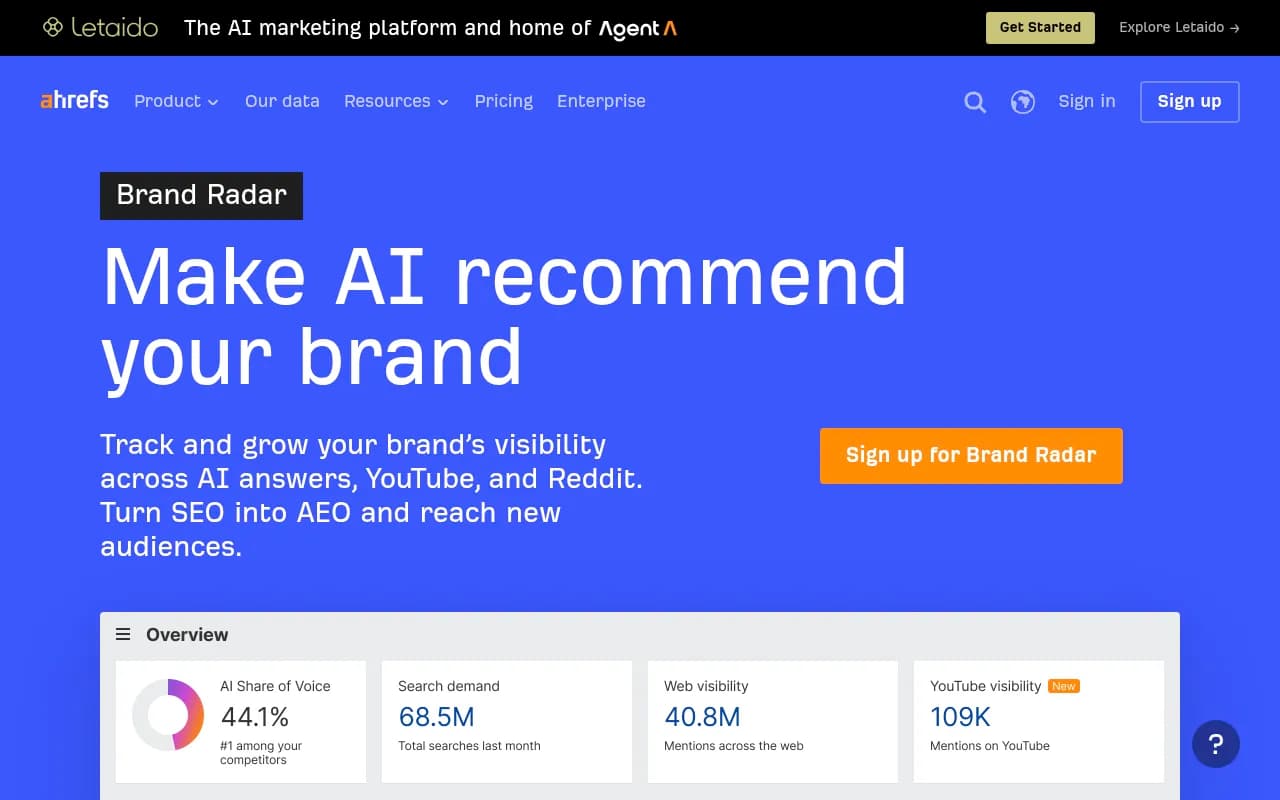
If your team already pays for Ahrefs or Semrush for traditional SEO, both have bolted AI visibility modules onto their existing platforms. Ahrefs Brand Radar runs $199/month for a single AI platform or $699/month for a six-platform bundle — stacked on top of a base Ahrefs plan, that's $828 to $1,148 a month for full coverage, which is steep for anyone outside a large marketing department. Semrush's AI Visibility Toolkit is cheaper standalone at $99/month for 25 tracked prompts across ChatGPT, Google AI, Gemini, and Perplexity. Neither tool was built around AI-specific content generation the way Promptwatch or Profound were; they're closer to an add-on dashboard.
Scrunch AI and Peec AI — leaner trackers worth a look at smaller budgets
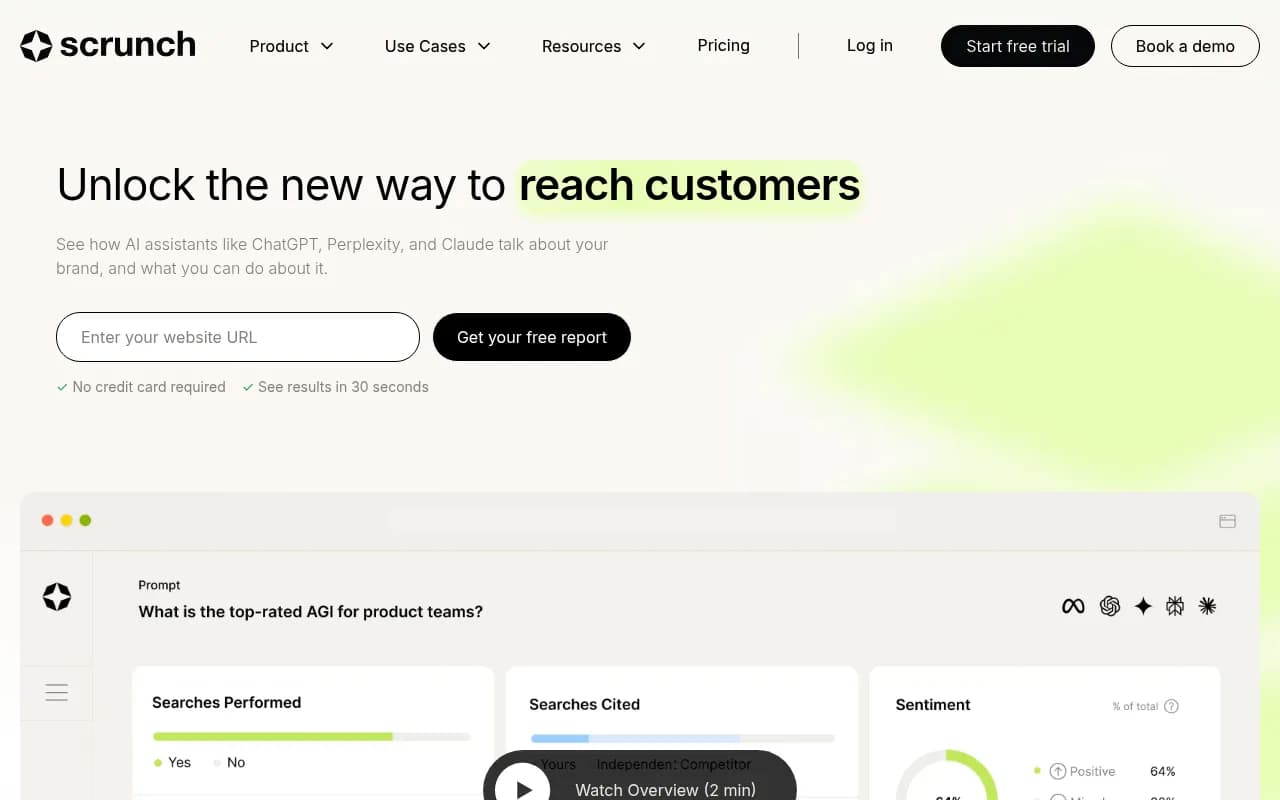
Scrunch AI simplified to two tiers in mid-2026 (Core and Enterprise), with Core running around $250/month for 125 prompts across four models. Peec AI starts around €75-89/month for 50 prompts but only includes three models at entry level — additional model coverage costs extra and scales with your tier, so check the real all-in cost before assuming it's the budget option.

Comparison table
| Tool | Entry price | Models tracked | Content generation | Crawler log analytics | Best for |
|---|---|---|---|---|---|
| Promptwatch | $95/mo | ChatGPT, Perplexity, Gemini, Claude, Grok, Llama, DeepSeek, Copilot, AI Overviews, AI Mode | Yes, Content Agent publishes to CMS | Yes | Mid-market to enterprise logistics teams that want fixes, not just scores |
| Profound | Free trial / custom enterprise | Up to 9 engines | AIM background agent | Yes | Large shippers and enterprise 3PLs with enterprise budgets |
| AthenaHQ | Free / ~$295/mo | 5 free, 11 on paid tier | Action Center recommendations | Limited | Mid-market teams wanting a guided workflow |
| Ahrefs Brand Radar | $199-699/mo (+ base plan) | Up to 6 | No | No | Existing Ahrefs customers |
| Semrush AI Visibility Toolkit | $99/mo | ChatGPT, Google AI, Gemini, Perplexity | No | No | Existing Semrush customers |
| Scrunch AI | ~$250/mo | 4 (Core tier) | No | No | Smaller teams wanting a leaner tracker |
| Peec AI | ~€75-89/mo | 3 at entry, add-on for more | No | No | Budget-conscious startups |
A practical plan for logistics and supply chain marketers
- Start by running your brand name, your top 10 competitors, and 15-20 real buyer questions ("best 3PL for cold chain in the Southeast," "how to choose a freight broker for LTL") through ChatGPT, Perplexity, and Google AI Mode manually. This takes an afternoon and tells you roughly where you stand before you commit to a paid tool.
- Audit your robots.txt and CDN/WAF rules for AI crawlers. Promptwatch's crawler traffic data shows OpenAI's bots still account for roughly 80% of verified AI crawler requests as of early September 2026, down from 95% in June — meaning Anthropic, Google, and Perplexity's crawlers are becoming a bigger share of the traffic you need to allow. Blocking any of them, even by accident, silently removes you from citation consideration.
- Fix your LinkedIn company page before you write a single new blog post. Given how much weight ChatGPT now puts on LinkedIn company pages for B2B citations, an outdated "About" section or missing specialties list is lower-hanging fruit than a new article.
- Prioritize how-to and comparison content over generic landing pages. Promptwatch's ChatGPT citation data for August 2026 shows how-to content's share of citations more than doubled during the month while landing page citations fell by nearly half — a freight brokerage writing "how to choose a reefer carrier" will likely outperform a generic services page.
- Treat Reddit cautiously as a GEO channel for ChatGPT specifically. Its citation share there collapsed by 86% in a single week in August 2026. Google's AI Overviews and AI Mode are still citing Reddit at a much more stable rate, so community content is not dead everywhere, just less reliable as a ChatGPT play right now. Full detail in Promptwatch's Reddit citations report.
Where this fits with your broader marketing stack
AI visibility tracking doesn't replace your TMS vendor's AI agents (RTS Labs, for instance, writes about building custom logistics AI agents for forecasting and routing) or your ERP's embedded intelligence from players like Oracle, Blue Yonder, or Kinaxis — those solve operational problems inside the supply chain itself. GEO tools solve a marketing problem: making sure the right AI assistant recommends your company when a buyer is researching who to hire. They're complementary, not competing, budgets.
If your team is weighing a broader GEO platform search, the directory at bestgeosoftware.com tracks more of these tools side by side, and agenticseotools.com is worth a look if you specifically want agent-driven content execution rather than passive monitoring. For logistics and supply chain brands running lean marketing teams, that execution piece, not just the dashboard, is usually what decides whether the AI visibility project actually moves the needle within a quarter rather than just producing another report nobody acts on.
For agencies or in-house teams that want help building out the actual content and technical GEO work rather than running it themselves, 1001 SEO Media works across technical SEO, content production, and generative engine optimization without long-term contracts, which is worth a conversation if the gap between "we have a visibility score" and "we're actually cited" feels too wide to close with existing headcount.