
Key takeaways
- BrightEdge, Botify and seoClarity are enterprise SEO suites that added AI visibility modules. Evertune is a brand-accuracy specialist. Promptwatch is built around AI search from the start and includes the fixing and measuring steps.
- Only seoClarity publishes pricing (from $2,500 a month). BrightEdge and Botify sell by quote, and Evertune pricing is not public.
- If your problem is crawl and rendering on millions of URLs, look at Botify. If you need executive reporting across many country sites, look at BrightEdge. If a single data source at a known price matters, look at seoClarity.
- Most of the vendor comparisons you will find online are written by competing vendors. Run a pilot on your own prompts before you sign anything.
What an enterprise AEO platform actually needs to do
Answer engine optimization (AEO) is the work of getting your brand mentioned and cited in ChatGPT, Gemini, Perplexity, Google AI Overviews and Google AI Mode. At enterprise scale that is more than a visibility score. You need coverage across markets and languages, security paperwork that survives procurement, and a way to turn findings into shipped pages.
The five platforms in this guide come at the problem from different directions. Three grew out of SEO suites. One grew out of brand research. One was built for AI search from day one. That origin tends to predict both strengths and blind spots.
A caveat on the sources. Several of the comparison pages I read while researching this were published by vendors in the category (Profound, seoClarity, Promptwatch itself). They are useful for facts a vendor would not invent, like feature names, but treat their rankings as marketing. Where I cite G2 numbers, they come from those pages and carry the dates they were checked.
One thing to understand about citations first
Citation behavior differs a lot by engine, so any platform that gives you one blended number is hiding something. According to Promptwatch Data on average sources per response, ChatGPT cites about 5 sources per web-search answer, while Google AI Overviews and Perplexity cite about 10. And citations are fragmented: in Promptwatch's ChatGPT citation share data for November 2026, the 20 most cited sites together earn less than 2% of citations, with the rest spread across hundreds of thousands of domains. Review sites like G2, Gartner, Capterra and Trustpilot hold 5 of the top 10 spots.
Translation: measure each engine separately, and do not assume a few big domains are the whole game.
Comparison at a glance
| Platform | Origin | Best for | Published pricing | AI engines (vendor-stated) | Takes action on findings |
|---|---|---|---|---|---|
| BrightEdge | Enterprise SEO | Global brands, executive reporting | No, by quote | ChatGPT, Perplexity, AI Overviews, AI Mode, Gemini | Agent Edge serves content to AI agents |
| Botify | Technical SEO | Very large sites with crawl and rendering problems | No, by demo | ChatGPT, Perplexity, AI Overviews, AI Mode, Gemini | PageWorkers and SpeedWorkers |
| seoClarity | Enterprise SEO | Teams wanting one data source and known pricing | From $2,500/mo (SEO tiers) | ChatGPT, Gemini, Perplexity, AI Mode, AI Overviews | Content Agents, ClarityAutomate |
| Evertune | Brand research | Brand and reputation teams | Not public | Panel-based brand monitoring | Content Studio for drafts |
| Promptwatch | AI search | End-to-end AEO from tracking to publishing | $95 to $579/mo, Enterprise custom | ChatGPT, Gemini, Claude, Perplexity, AI Overviews, AI Mode, Copilot, Meta AI, Alexa and more | Content Agent, Action Board, CMS publishing |
BrightEdge
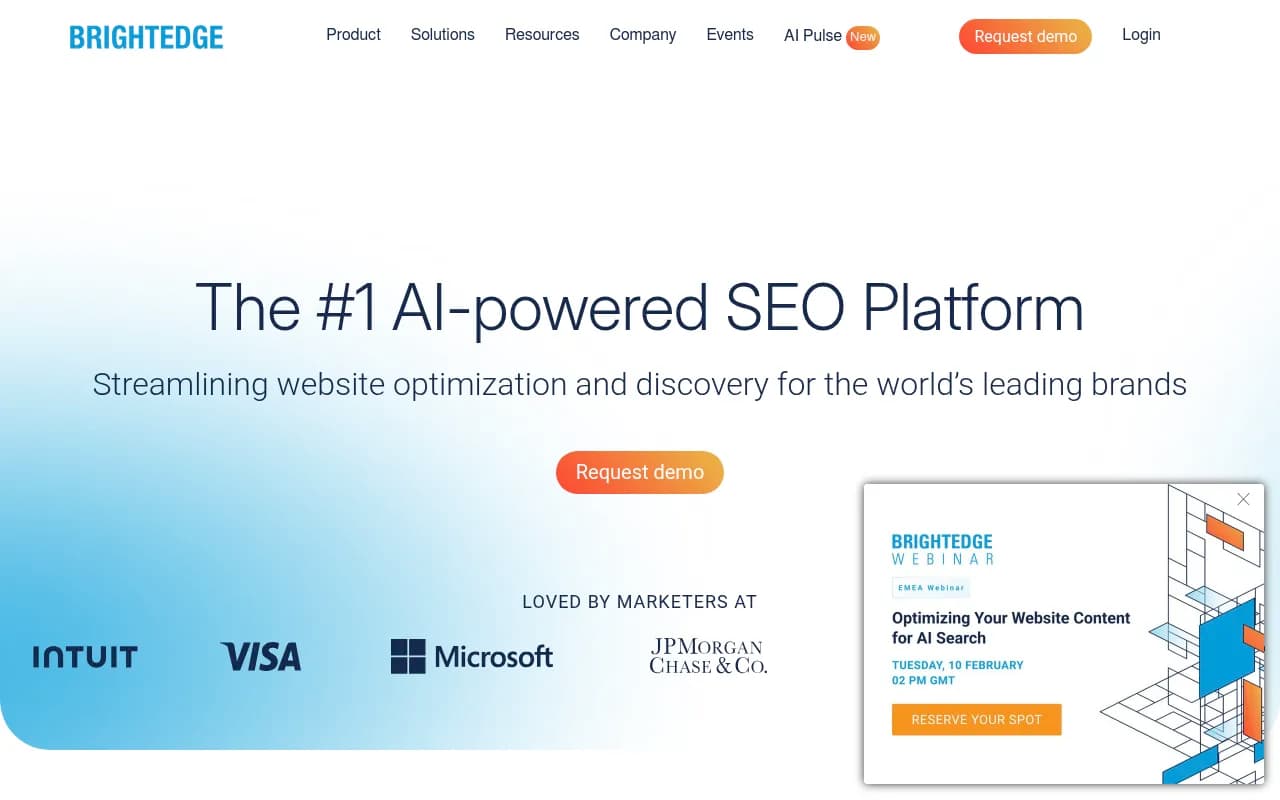
BrightEdge is the incumbent in enterprise SEO. It describes itself as one platform to win across Google, AI Overviews, ChatGPT and Perplexity, and it is built to manage multiple domains from a central place. Keyword research runs on Data Cube X, which BrightEdge says holds over 4 billion data points and 10 years of historical context.
What it does for AEO
AI Catalyst tracks mentions and citations across ChatGPT, Perplexity, Google AI Overviews, AI Mode and Gemini. It rates each answer as positive, neutral or negative for your brand and for each tracked competitor, with the reasoning behind each rating. Agent Edge serves content when AI agents visit your site. Its entity and knowledge graph strength is the thing reviewers keep pointing to as the differentiator.
Where it is weaker
Prompt suggestions lean on SEO data, your site content and historical queries rather than real AI conversations. I could not confirm brand fact-checking in the public materials. Enterprise SEO comparison pages put the annual contract somewhere between $150K and $500K+, though BrightEdge publishes nothing, so treat that as an estimate from a third party. On G2 it sits at 4.4 from 877 reviews (checked September 28, 2026); recurring complaints are the learning curve and slow loading.
Who it fits
Existing BrightEdge customers who want AI visibility reporting inside the subscription they already have. Ask which modules, AI Catalyst included, sit in the base contract and which are separate line items.
Botify
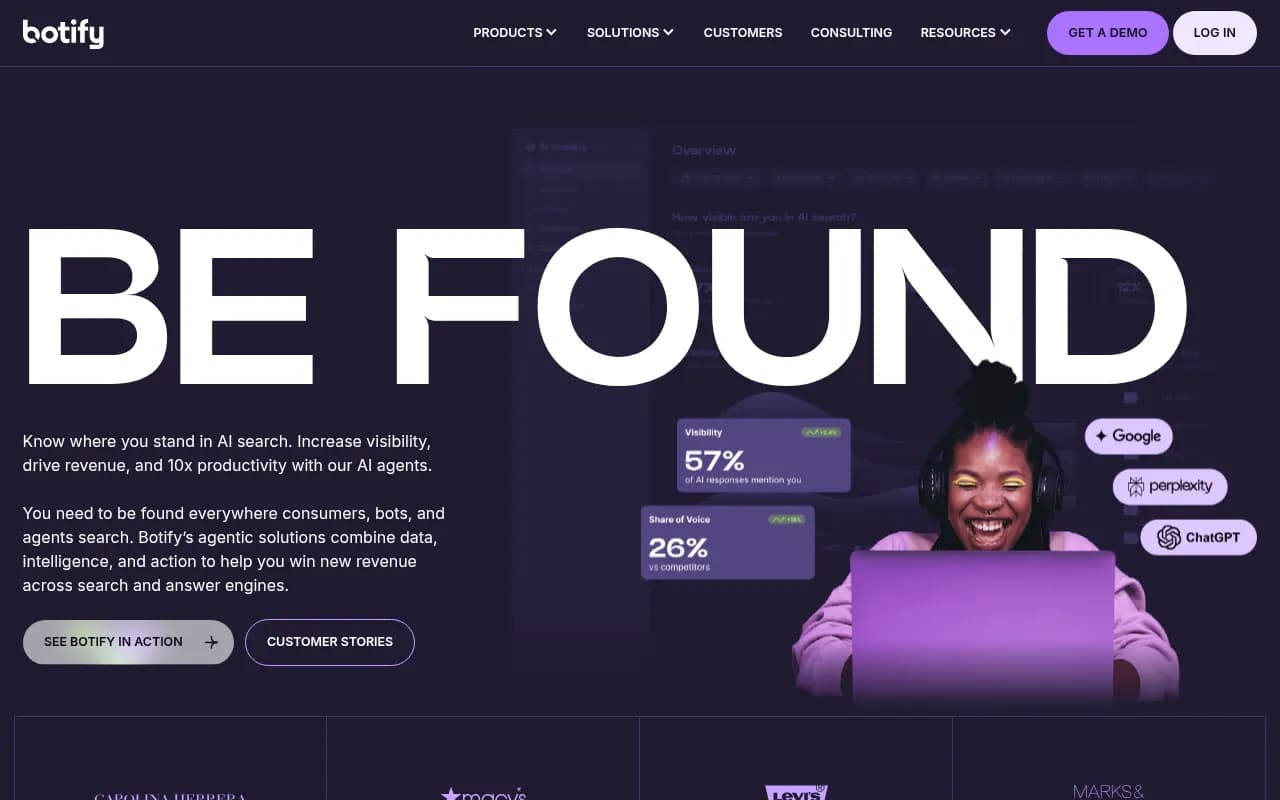
Botify calls itself an AI search optimization platform. Its pitch is aimed squarely at large sites: reviews, prices and promotions are often rendered by JavaScript and invisible to agents, and Botify wants to fix that.
What it does for AEO
The product splits into three parts: AI Readiness (an AI-optimized catalog plus AI agent and bot management), AI Visibility (GEO analytics, plus AI agent and bot analytics) and AI Activation (generated content, automation, cross-platform indexation, internal linking). Prompts are generated automatically from your top Google Search Console keywords and People Also Ask questions, and the data updates weekly. PageWorkers and SpeedWorkers can apply changes for AI bots and serve them rendered versions of pages. Its log analysis is the strongest part of the suite, and it is widely regarded as best in class for crawl-budget work.
Where it is weaker
Weekly refresh is slower than the daily tracking most AI-native tools run. Content strategy and competitive research are thinner than at BrightEdge. Pricing is not published (AI Visibility is an option on all plans), and one third-party estimate puts the annual cost at $100K to $400K. G2 shows 4.4 from 80 reviews (checked September 28, 2026) for the broader platform, with praise for ease of use and integrations and complaints about the learning curve and price. Its MCP server was in early access and I could not confirm its status.
Who it fits
Large e-commerce and technical SEO teams with millions of URLs, where the real bottleneck is what bots can crawl, render and index.
seoClarity
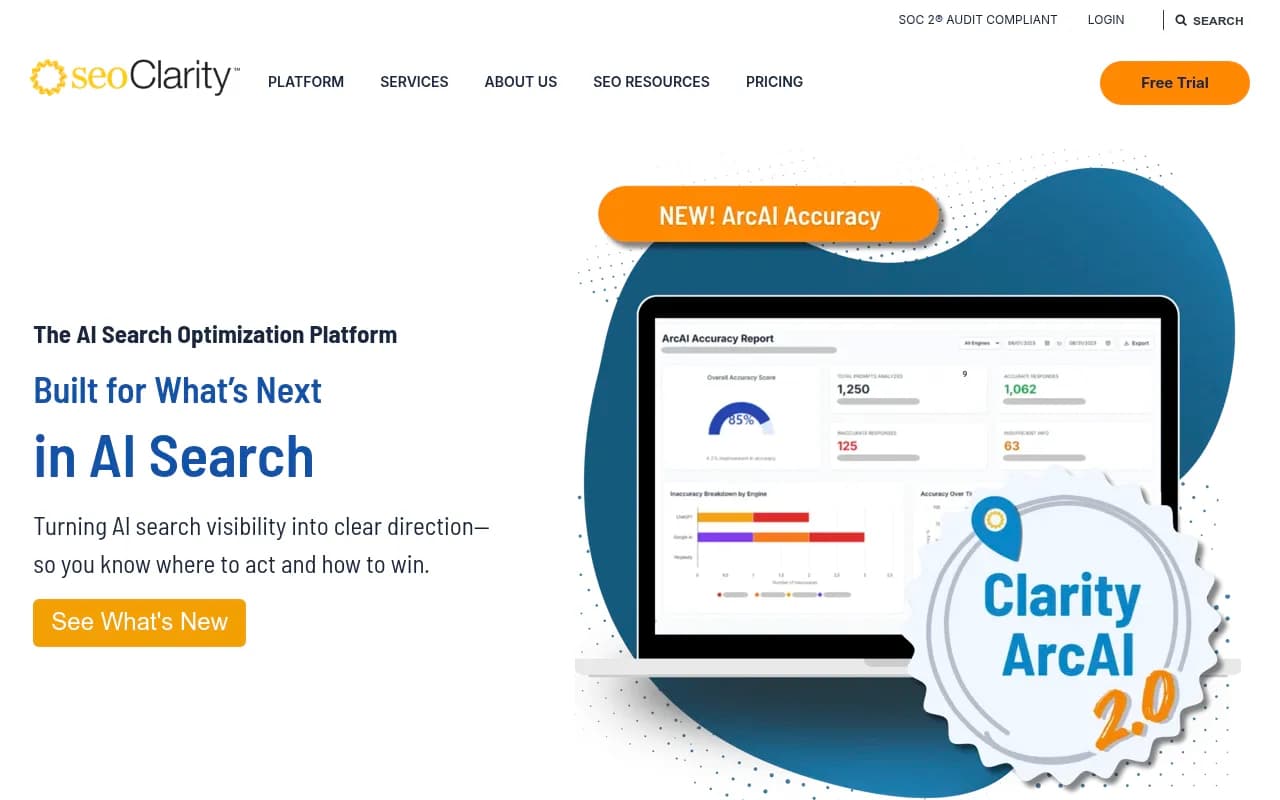
seoClarity is the one suite here that publishes numbers. Its SEO tiers start at $2,500 a month for Research & Content, $3,200 for Technical SEO (unlimited crawl pages and log file analysis) and $4,500 for Enterprise, aimed at global teams with 5,000+ keyword queries and multiple domains. One caveat: another source labels the $2,500 figure as representative as of 2022, so confirm on the current pricing page.
What it does for AEO
The AI product is ArcAI. It counts one prompt on one AI engine in one location as one question query, includes 10 prompts on every plan per the vendor's own comparison, reports mention and citation share of voice, and offers an Accuracy add-on built from your site. The vendor also states ArcAI submits new pages on a verified domain to AI engines and monitors AI crawlers. A free Enterprise AEO Certification Course is included, and the team lists SOC 2.
Where it is weaker
Feature breadth can go underused if your team is small. Because the AI module is tied to the suite, you are paying for SEO tooling whether you need it or not. Treat the vendor's own eight-platform comparison as a vendor document.
Who it fits
Data-driven teams that want rank tracking, technical SEO and AI visibility in one contract with a price they can look up.
Evertune
Evertune is the odd one out, and that is mostly a good thing. It is not an SEO suite. It is a brand-accuracy platform, and its pitch is monitoring how AI describes you using a 25 million person consumer panel, with a built-in Content Studio for drafting posts.
Where it wins
If your worry is factual drift, such as AI getting your product positioning, pricing or reputation wrong, Evertune is built for that question. Brand and reputation teams are the natural buyers.
Where it is weaker
Profound's roundup (a competitor, so salt accordingly) says Evertune clusters by topic rather than prompt-level demand and has no published SOC 2 Type II. I found no public pricing. For an enterprise buyer, the SOC 2 point matters: ask for the current security documentation directly rather than relying on a competitor's claim either way.
Who it fits
Brand and communications teams that want to track narrative accuracy and are willing to pair it with something else for technical and content work.
Promptwatch
Promptwatch is the one platform in this list built specifically for AI search, and the difference shows in the scope. Most tools here stop at reporting. Promptwatch tracks, explains, fixes and then checks whether the fix worked.

What it covers
It monitors the real interfaces of ChatGPT, Google AI Overviews, Google AI Mode, Gemini, Perplexity, Copilot, Amazon Alexa and Meta AI in each country and language you choose, plus API models like Claude, DeepSeek, Mistral and Grok. Real UI data matters because user-facing answers and citations can differ from API output. On top of that:
- IP-verified AI crawler logs show which bots read which pages, where they hit errors, and which crawled pages get cited.
- Visitor analytics measure the traffic and conversions AI search sends.
- Brand Narrative pulls the individual claims AI makes about you into themes with scores, and Fact Check checks those claims against your site and the most-cited third-party pages. This overlaps directly with what Evertune sells.
- The Action Board, Agent Chat and the Content Agent turn gaps into published pages through WordPress, Webflow or Framer.
- Business and above add up to hourly tracking, state and city tracking, local targeting at exact coordinates, ChatGPT Shopping insights and Ads Radar.
Security and scale
Promptwatch is ISO/IEC 27001 certified and GDPR compliant, with data handled by an EU-based company. Enterprise adds SSO, audit logs, a white-label dashboard and a dedicated success manager. It is used by 1,840+ brands and agencies and rated 4.7/5 on G2.
Pricing
Published and monthly: Essential $95, Professional $245, Business $579, with annual billing giving 12 months for the price of 10. Enterprise is custom. Confirm current numbers at promptwatch.com/pricing. Note that Essential has no crawler logs, and the automated Content Agent starts at Business.
Where it is weaker
It is not an SEO suite. It brings in Search Console and Bing data, but it does not replace a rank tracker or a heavy technical crawler for million-page sites. Teams that want to passively watch a dashboard will underuse it, since the value comes from acting on the recommendations. The head-to-head comparisons show the full feature matrix against the other GEO tools.
Who it fits
Marketing, SEO and content teams that want one product covering monitoring, content production and attribution. Start with the 7-day free trial or the free AI visibility report.
Which one should you shortlist?
| Your situation | Start with |
|---|---|
| Millions of URLs, crawl and rendering trouble | Botify |
| Many country sites, board wants one search number | BrightEdge |
| Want one vendor at a published price | seoClarity |
| Worried AI describes your brand incorrectly | Evertune or Promptwatch (Fact Check) |
| Want tracking, content, publishing and traffic attribution together | Promptwatch |
| Already deep in BrightEdge or seoClarity | Their native AI module first, then compare |
The honest pattern: the three suites are strongest when AI visibility is an extension of work you already do inside them. If AI search is the new priority itself, a dedicated platform usually gets you further faster. Plenty of enterprises end up with both: a suite for classic SEO and crawl infrastructure, and an AI-native tool for prompts, citations and content.
How to run a fair pilot
- Write 50 to 100 prompts from real buyer questions, split across brand, category and competitor queries.
- Run the same set in every finalist for at least two weeks and compare engine by engine, not as a blended score.
- Check how prompts are generated. Prompts derived from Search Console keywords behave differently from prompts based on real AI conversations.
- Ask whether data comes from the real chat interface or only from APIs.
- Request security documents (SOC 2 or ISO 27001), SSO and audit log details before the demo ends.
- Test the action step. Ask each vendor to take one content gap from finding to published page, and see who can do it without you leaving the product.
- Ask what is in the base contract and what is a separate line item. Enterprise quotes often hide modules.
For more tools in this category, the GEO software directory at bestgeosoftware.com lists dozens of alternatives, and Promptwatch's Data hub has the underlying citation research if you want to sanity-check any vendor's claims.
Frequently asked questions
Do I need a separate AEO platform if I already use BrightEdge, Botify or seoClarity?
Not necessarily. If the native module covers your engines and markets and you only need reporting, start there. A dedicated platform makes sense when you want daily real-interface tracking, crawler-to-citation analysis, or content production tied to the gaps.
Which of these platforms publishes pricing?
seoClarity publishes SEO tier prices, and Promptwatch publishes its plan prices. BrightEdge and Botify sell by quote, and Evertune does not list pricing publicly.
How should I treat G2 ratings for enterprise suites?
Carefully. The BrightEdge and Botify listings cover the whole platform, not the AI module, so they say little about AEO quality.
What matters most for enterprise procurement?
Security certification (Promptwatch is ISO/IEC 27001 certified, seoClarity lists SOC 2), SSO, audit logs, and clarity on what is included in the base contract.
Is AEO the same as GEO?
In practice yes. AEO, GEO, AI SEO and LLM SEO all describe improving how AI engines mention and cite your brand.