Key takeaways
- In Promptwatch Data's travel report (Sep 28 to Oct 4, 2026), booking and search sites earned 2.42% of all ChatGPT travel citations, more than half of the listed total. Reviews and advice sites earned 0.86%.
- Skyscanner (0.78%) and Going (0.52%) out-cited Tripadvisor (0.49%). Expedia sat at 0.13%, level with Lonely Planet and Time Out.
- The citation tail is long. The 17 top domains together hold only 4.18% of travel citations, so a tool that only tells you "you were mentioned" will not tell you much.
- Pick a GEO tool on four things: real-UI tracking across several engines, source-level citation data, per-market prompt sets, and some way to act on gaps.
- Several vendor comparison pages claim travel answers are "built almost entirely from TripAdvisor and editorial". The first-party data does not back that up.
Start with what ChatGPT actually cites
Most "best GEO tools for travel" lists begin with a comfortable assumption: travelers ask ChatGPT where to stay, ChatGPT pulls from TripAdvisor and Condé Nast Traveler, so go win reviews and listicles. It sounds right. The data is less tidy.
Promptwatch Data's report on ChatGPT travel citations covers organic travel prompts from Sep 28 to Oct 4, 2026. Here is what led:
| Domain | Share of all travel citations |
|---|---|
| Skyscanner (.net and .com combined) | 0.78% |
| Going.com | 0.52% |
| Tripadvisor | 0.49% |
| Kayak | 0.37% |
| Airbnb | 0.27% |
| 0.27% | |
| Expedia | 0.13% |
| Lonely Planet, Time Out | 0.13% each |
A flight-deal service (Going) out-cited Tripadvisor. Expedia, one of the biggest brands in the category, is a rounding error next to Skyscanner. By source type, booking and search sites earned 2.42%, reviews and advice sites (Tripadvisor, Trustpilot, Which?) 0.86%, guides and reference 0.37%, Reddit 0.27%, tours 0.16%.
The number I'd stare at is 4.18%. That is the combined share of all 17 domains in the report. Travel citations are spread across a huge number of sites. If you are a regional hotel group or a tour operator, there is no single "TripAdvisor strategy" that covers you.
A caveat: this report covers organic travel prompts in ChatGPT. It has no breakdown for hotel-specific prompts, and nothing on Gemini, Claude or Perplexity travel answers. Treat it as a strong signal for ChatGPT, not a full map of AI travel search.
What your own pages are worth
The other piece of first-party data worth knowing is the content type breakdown for ChatGPT citations, same week. Across all prompts, product pages are 22.4% of classified citations and landing pages 16.8%. For commercial prompts, the "best X" kind that sit closest to "best hotel in Lisbon", product pages are 26.0%, landing pages 20.6%, listicles 15.0% and comparisons 7.9%. Those four together are almost 70%.
For a travel brand, "product page" mostly means a property page, a room page, a tour page or a route page. Your own pages are the largest single citation surface. That matters because it is the one you fully control.
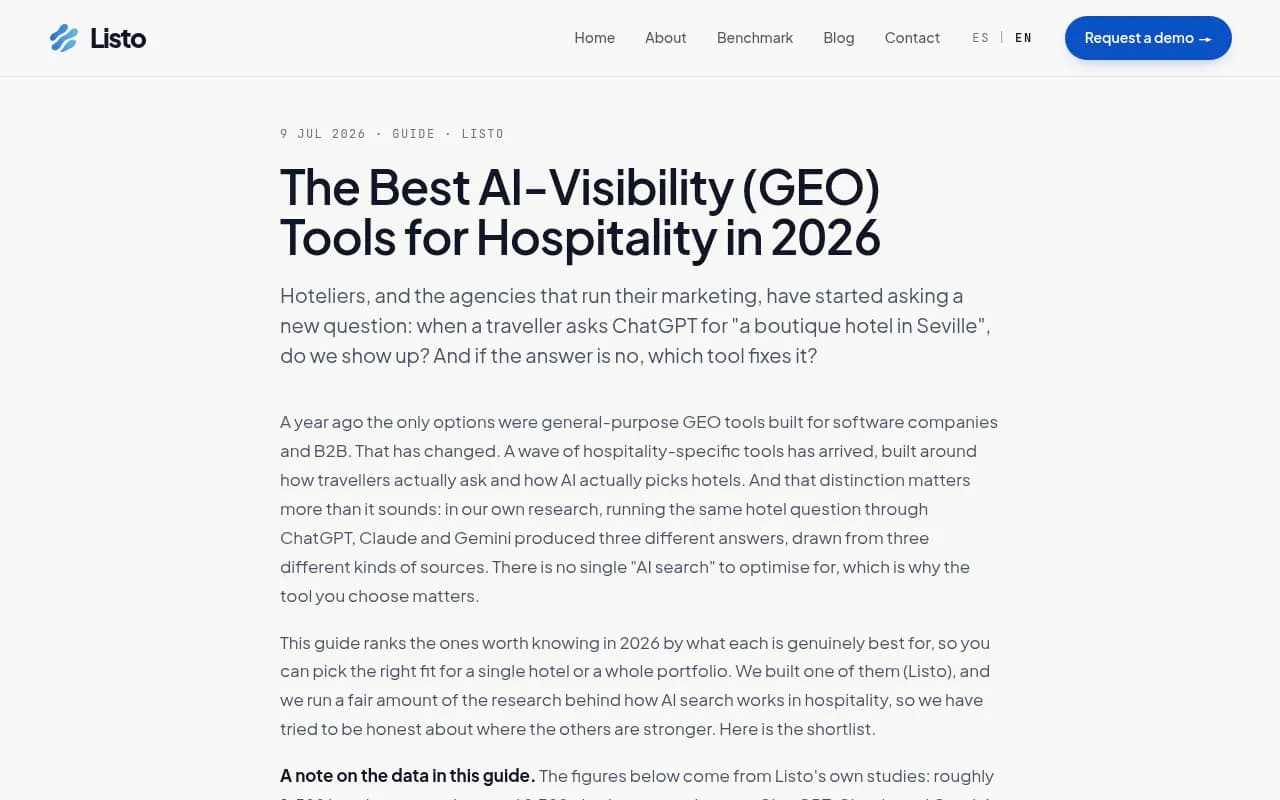
A vendor study muddies this a little. Listo, a hospitality-specific GEO vendor, reports from its own research (about 1,500 hotel conversations and 9,300 citations) that ChatGPT cited hotels' own websites around 65% of the time and that only about 3% of winning pages were "best of" roundups. Promptwatch's data shows listicles at 13.6% of all ChatGPT citations. These do not agree on roundups, and they are measuring different things (hotel conversations versus a broad prompt set), so I would not treat either as the final word. What they share is the direction: your own site matters a lot.
Two things travel marketers should stop doing
Relying on Reddit seeding for ChatGPT
Reddit's share of ChatGPT citations fell from roughly 4% to about 0.5% on August 14, 2026. In the October social media report, seven social platforms together made up just 0.46% of ChatGPT citations, with Reddit at 0.09%. Google AI Overviews is a different story: 12.2% of its citations came from social, led by YouTube (4.28%), Facebook (2.38%), Reddit (2.15%) and Instagram (1.61%). If you have a video or Instagram-heavy destination brand, AI Overviews is where that effort shows up.
Betting on news-style content
Per Promptwatch's content half-life study, landing pages and docs stayed cited longest among pages ChatGPT cited on July 6, 2026, while news lost half its pages within 36 days. Seasonal press-release content is a poor long-term bet next to evergreen destination and property pages.
What to look for in a travel GEO tool
Strip away the marketing and four criteria matter.
- Real-UI tracking across several engines. Travelers plan in ChatGPT, compare in Perplexity and check "best time to visit" in Google AI Overviews or Gemini. API-only tracking can differ from what users see.
- Source-level citation data. You need the actual URLs and domains cited, not just "mentioned: yes/no". Given the long tail above, this is how you find out whether Skyscanner, Kayak, a local guide or your own page is feeding the answer.
- Per-market, per-season prompt sets. A hotel group tracks different cities, languages and property tiers. Listo's test found as little as 40% recommendation overlap across languages on Claude, so language and country tracking is not optional for international brands.
- A route from insight to action. Knowing a competitor's listicle is cited is only useful if you can brief and publish a response.
The tools worth shortlisting
Promptwatch
Promptwatch is where I would start for travel brands that want more than a dashboard. It tracks the real interfaces of ChatGPT, Google AI Overviews, Google AI Mode, Gemini, Perplexity, Copilot and Meta AI by country and language, and shows which domains and pages get cited. Citation Trends classifies every citation by content type and source type (including booking and directory sources), which maps directly onto the travel findings above. Prompt volumes, difficulty scores and query fan-outs help you see which "where to stay in X" prompts are worth chasing.
The parts that matter for travel specifically: local GEO/SEO targeting that pins a monitor to exact coordinates (useful for "near me" and city-level hotel or tour queries, on Business and above), IP-verified AI crawler logs to check whether bots can actually read your property pages, and visitor analytics that connect AI referrals to bookings. When it finds a gap, the Content Agent can plan, write and publish to WordPress, Webflow or Framer, and the Action Board prioritizes what to fix. Its Ads Radar and Shopping insights are handy if your category shows sponsored placements.

Pricing starts at $95/month (Essential) and $579/month for Business, which includes the Content Agent and state/city tracking. Check promptwatch.com/pricing for current numbers.
Profound
Profound is an enterprise-leaning monitoring platform. It suits large OTAs and hotel chains that want panels and original behavior research. Expect a higher price and a monitoring-first approach, with less emphasis on publishing content for you.
Profound

Otterly.AI
Otterly is the cheap, credible choice for a single boutique property or small operator that mostly wants to know whether it is named. It covers ChatGPT, Google AI Overviews, AI Mode, Gemini, Perplexity and Copilot, and includes a free GEO audit. Reported pricing starts around $29/month, but verify that on its site.
Otterly.AI

Peec AI
Peec AI works for agencies managing several properties, with a straightforward prompt-tracking setup and pricing in the upper double digits per month. It is a tracker rather than an optimization platform.

AthenaHQ
AthenaHQ is built around structured competitive sets, which suits brands that think in destination-by-destination rivals. Entry pricing is reported at around $295/month.

Rankscale
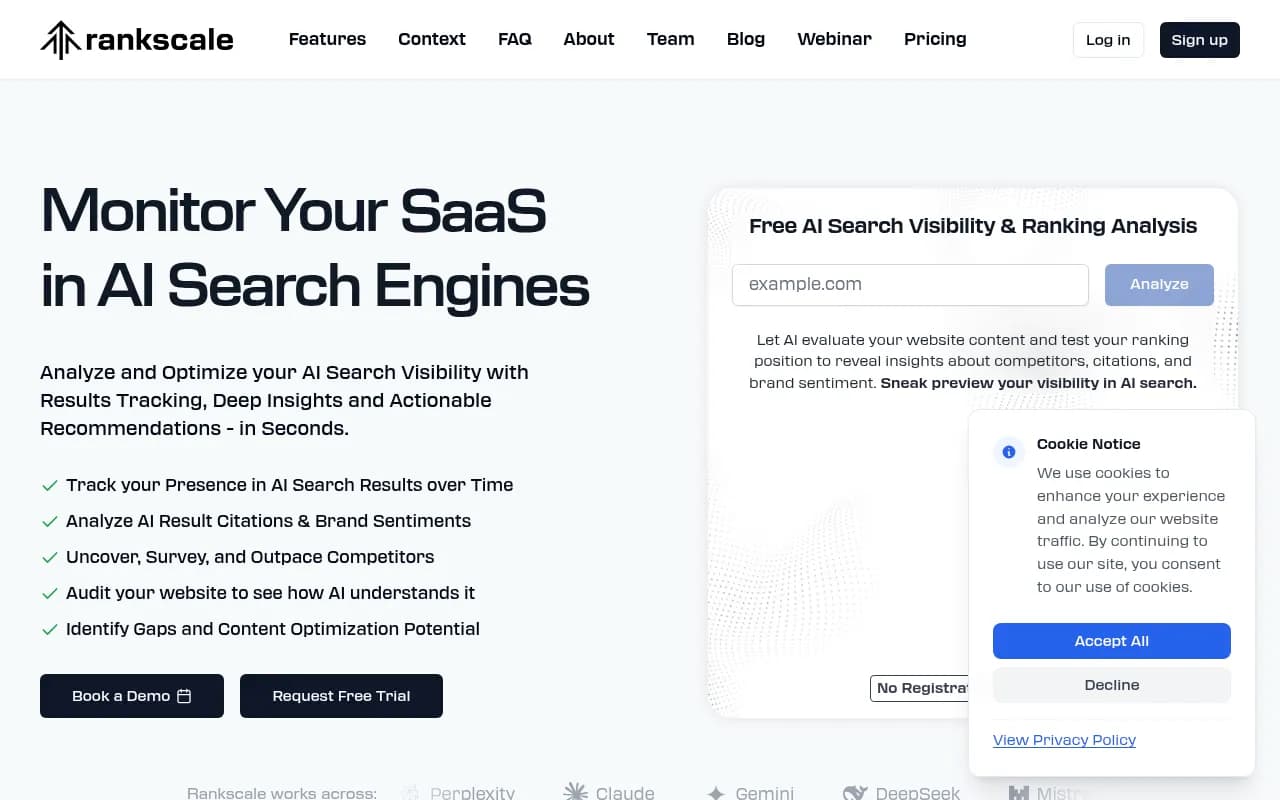
Rankscale pitches wide market and language coverage, which is relevant for global destination marketing. Pricing is not published.
Semrush AI Toolkit
If your team already lives in Semrush, the AI toolkit bolts onto an existing stack. Expect fixed prompt sets and thinner AI-specific data than the dedicated platforms.
Comparison table
| Tool | Best for | Reported entry price | Strength for travel | Limits |
|---|---|---|---|---|
| Promptwatch | Brands that want to track and fix gaps | $95/mo | Real-UI multi-engine tracking, citation classification, local targeting, crawler logs, Content Agent | Content Agent and city tracking start on Business |
| Profound | Large OTAs and hotel chains | ~$99 Starter (reported) | Enterprise panels and research | Monitoring-led, higher tiers get expensive |
| Otterly.AI | Single property or boutique | ~$29/mo (reported) | Cheapest credible monitoring | Basic; no crawler logs or publishing |
| Peec AI | Agencies with several properties | ~$89/mo (reported) | Simple multi-brand tracking | Tracker only |
| AthenaHQ | Competitive-set thinkers | ~$295/mo (reported) | Structured competitor views | Pricier for small operators |
| Rankscale | Global destination marketing | Not published | Market and language breadth | Pricing opacity |
| Semrush AI Toolkit | Existing Semrush teams | ~$99/mo add-on (reported) | Fits current SEO stack | Shallower AI data |
Non-Promptwatch prices come from vendor comparison pages dated July 2026 and were not independently checked. Confirm before buying.
A note on vendor comparison pages
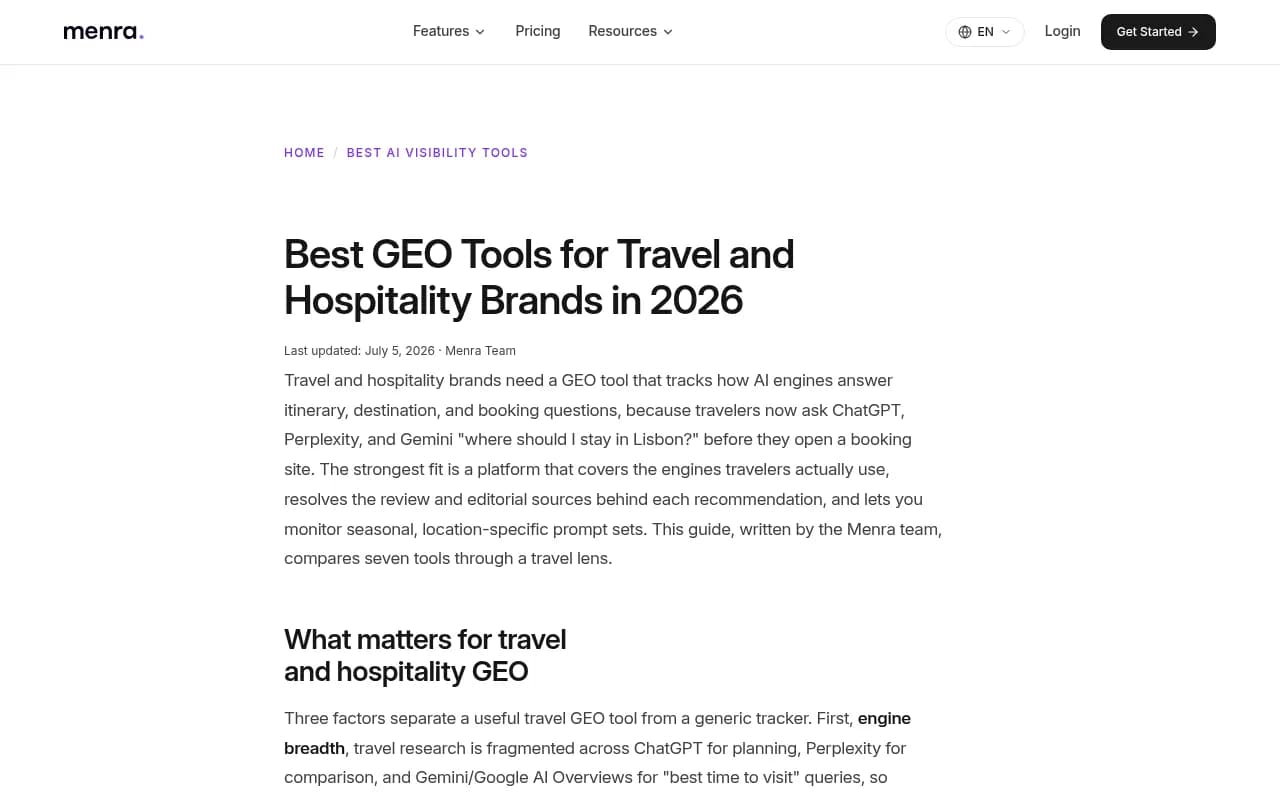
Some of the pages ranking for this topic are written by tool vendors, and it shows. One, from Menra, frames travel answers as "built almost entirely from review platforms (TripAdvisor, Google) and editorial roundups". Promptwatch's ChatGPT data does not support that: booking and meta-search sites outweigh reviews and editorial by a wide margin. Menra is a legitimate tool with deep-URL citation data, and its page is worth reading, but the framing is a sales angle.
The same goes for Listo's guide. It is useful because it has hotel-specific research, but Listo ranks itself first. Read vendor studies for the questions they raise, then check them against data you can reproduce.
A practical setup for a travel brand
- Build prompt sets by market and intent. Destination discovery ("where to stay in Seville"), comparison ("Booking vs direct for boutique hotels"), and amenity-specific prompts ("hotel with rooftop pool and spa"). Add each language you sell in.
- Run them on at least three engines. ChatGPT, Google AI Overviews and Perplexity cover most planning behavior. Add Gemini and Copilot if budget allows.
- Sort citations by source type. Do booking and search sites dominate your prompts? Then listing accuracy on Skyscanner, Kayak, Airbnb and Expedia is your first fix, which is exactly what Promptwatch's report recommends. Do reviews matter in your niche? Collect them on Tripadvisor and Trustpilot.
- Fix your own pages first. Since product and landing pages are the biggest citation surface, make sure property and route pages state facts plainly: location, amenities, pricing context. Check crawler logs to confirm AI bots can fetch them.
- Refresh before peak season. Booking behavior is seasonal. Run sweeps weekly during peak planning windows and refresh evergreen pages ahead of them.
- Measure bookings, not just mentions. A brand can be cited constantly and register nothing in analytics. Tie AI referrals to conversions.
For more options by category, the GEO software directory at bestgeosoftware.com lists many of the tools above plus smaller players.
Which tool should you pick?
- One boutique hotel, tiny budget: Otterly.AI. Accept that it only monitors.
- Agency handling many properties: Peec AI or an agency plan from Promptwatch, depending on whether you need content and crawler data.
- Multi-destination brand wanting to act on gaps: Promptwatch.
- Global chain with enterprise procurement: Profound or Promptwatch Enterprise (ISO/IEC 27001 certified).
- Already deep in Semrush: try the AI Toolkit first, and upgrade when its prompt limits bite.
The larger point is that the data should drive the tool choice, not the other way round. In ChatGPT's travel answers, no single site owns the citations. Your best bet is to get listings right where booking and search sites pull from, publish clear property and destination pages, and use a tool that shows you the sources behind each answer.