Key takeaways
- Setup speed varies wildly: some GEO tools give you a real citation finding in under 10 minutes, others need days of crawler log collection before anything useful shows up
- Free instant audits (no card, no account) are the fastest path to a first data point, but they're shallow by design
- Tools built on real AI-UI monitoring (not simulated API calls) take slightly longer to onboard but give you insight you can actually trust
- The deepest insight, crawler logs showing whether AI bots can even reach your pages, takes the longest to populate but matters more than any prompt score
- Promptwatch and a handful of others balance fast first insight with the depth to act on it
Why speed to insight matters more than feature lists
Most GEO tool reviews rank platforms by feature count. That's backwards. I've signed up for a dozen of these things over the past year, and the thing that actually determines whether a tool gets used again isn't the number of boxes it checks on a comparison chart. It's whether I saw something real and specific within the first session.
If a tool makes me wait three days for a report, or hands me a vague "visibility score" with no explanation of where it came from, I close the tab and don't come back. If it shows me, in the first ten minutes, that ChatGPT is citing my competitor's comparison page instead of mine, I'm hooked. That's the test this guide applies.
One methodology note worth stealing: a Medium reviewer who tested ten GEO platforms scored each one partly on "could I get value in under 30 minutes?" That's a legitimate evaluation axis, not a shortcut. Setup friction is a real cost, especially for a marketing team trying to prove GEO is worth a budget line before committing to a year-long contract.
The tiers, from instant to slow-but-deep
Tier 1: instant, zero-signup scorecards (under 5 minutes)
A handful of vendors offer free, no-card scorecards designed as lead magnets. You paste in a domain, wait a minute or two, and get a surface-level snapshot: is your brand mentioned at all, roughly how often, maybe a readiness score. These are useful for exactly one thing, convincing a skeptical boss that AI search visibility is a real, measurable problem worth addressing. They are not useful for ongoing tracking because they don't run on a schedule and don't show you why a score is what it is.
Treat these the way you'd treat a free credit score check. Good for a gut check, bad for a diagnosis.
Tier 2: prompt trackers with same-day first report (10 minutes to a few hours)
This is where most of the mid-market tools land. You connect your domain, pick a handful of prompts (branded, category, competitor comparisons), and the platform runs them against ChatGPT, Perplexity, Gemini, and a few others. Within a few hours, sometimes less, you get your first real citation data: who's getting cited, how often, and roughly where you rank relative to competitors.
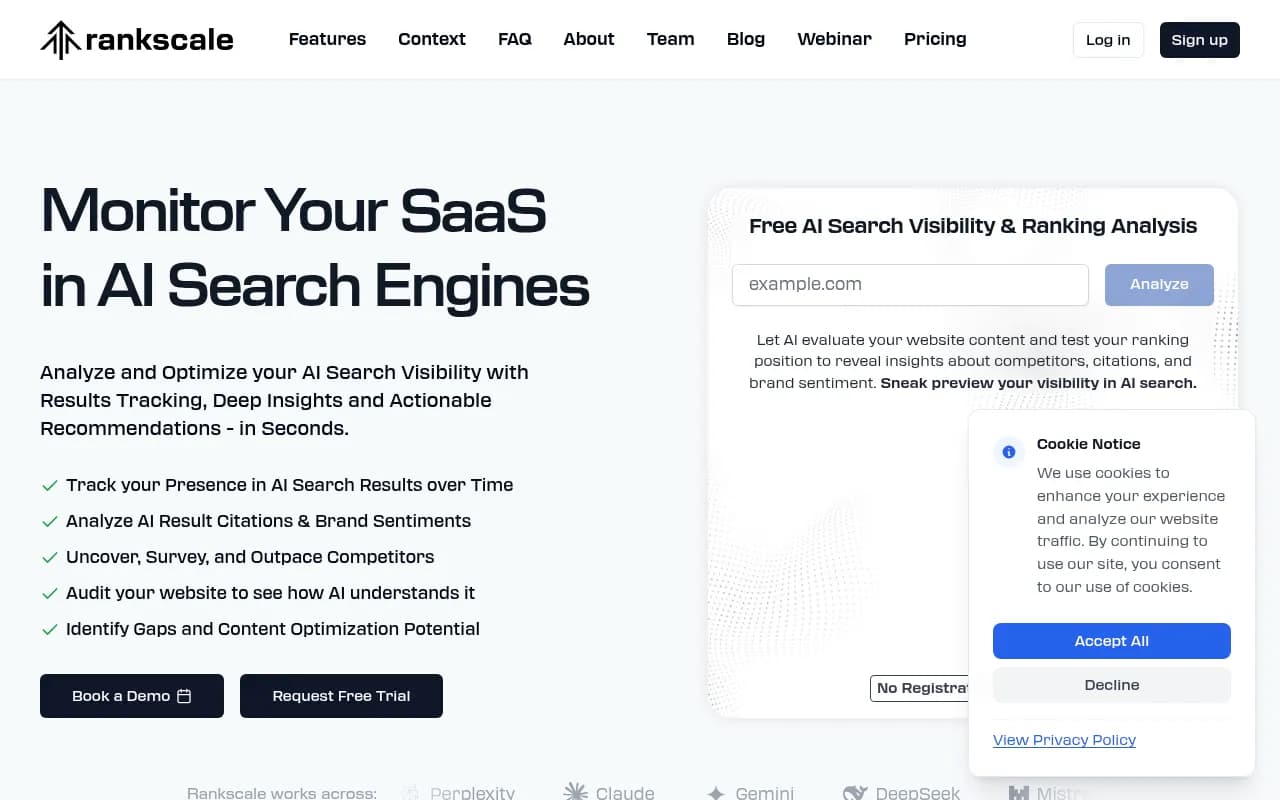
Otterly.AI is the fastest entry point here. Its Lite plan starts at $29/month for 15 prompts, and the setup genuinely takes minutes, which explains why it's become the default "let's just try something" tool for over 40,000 marketers. Rankscale is similarly quick, with a basic plan around $20/month that gets you a visibility score and citation analysis almost immediately. Peec AI deserves a mention too; one G2 reviewer put it well: "setup is extremely fast, you get immediate insights, and you finally get some data to better understand where and how your brand is mentioned in LLMs."
Otterly.AI


The catch with this tier: speed often comes at the cost of depth. You learn that you're not being cited, not why. That's a real limitation if your next move is deciding what content to fix.
Tier 3: free monitoring tiers that need a short warm-up (a day or two)
AthenaHQ's Essential plan is free and includes $25 of credit to start, covering ChatGPT, Perplexity, AI Overviews, Gemini, and Copilot. Because it's free, there's no urgency to rush your first report, but the tradeoff is that meaningful trend data, the kind that tells you whether your citation rate is actually moving, needs a few days of accumulated responses before it means anything. A single snapshot on day one is interesting; a week of snapshots is actionable.

Tier 4: real UI monitoring and crawler logs (slower setup, but the insight is worth trusting)
Here's the thing most speed-focused comparisons miss: a fast insight from a tool that's scraping a simulated API response isn't actually faster, it's just wrong sooner. Several GEO platforms pull citation data from actual API calls rather than the real chat interface users see, and those two things can diverge. ChatGPT's user-facing answers, citations, and shopping recommendations don't always match what the API returns.
Promptwatch is built around monitoring real UI output across ChatGPT, Gemini, Perplexity, Claude, Grok, DeepSeek, Copilot, Mistral, Meta Llama, Google AI Overviews, and AI Mode, which takes a bit longer to configure properly (you're setting up prompt sets, not just typing a domain into a box) but the payoff is data you can trust enough to act on. The platform also layers in something almost no competitor offers out of the box: AI crawler logs. Within a day or two of connecting your CDN (Cloudflare, Vercel, Fastly, and others are supported), you can see whether ChatGPTBot, ClaudeBot, PerplexityBot, and 400+ other crawlers are even reaching your pages, and whether they're hitting errors before they get the chance to cite you.
That's the insight that actually changes what you do next. A citation score tells you the outcome. A crawler log tells you the mechanism. If GoogleOther is 404ing on your product pages, no amount of content rewriting fixes your visibility until that's resolved.

Promptwatch's own data on crawler mix shows why this matters and why it needs regular rechecking: OpenAI's share of verified AI crawler requests dropped from 94.8% in early June 2026 to 79.8% by early September, while Meta-WebIndexer's share jumped from roughly 2% to nearly 38% between mid-July and August 9, 2026 (https://promptwatch.com/data/meta-web-indexer). A one-time crawler check from three months ago is already stale.
Tier 5: enterprise platforms (days to weeks, but built for scale)
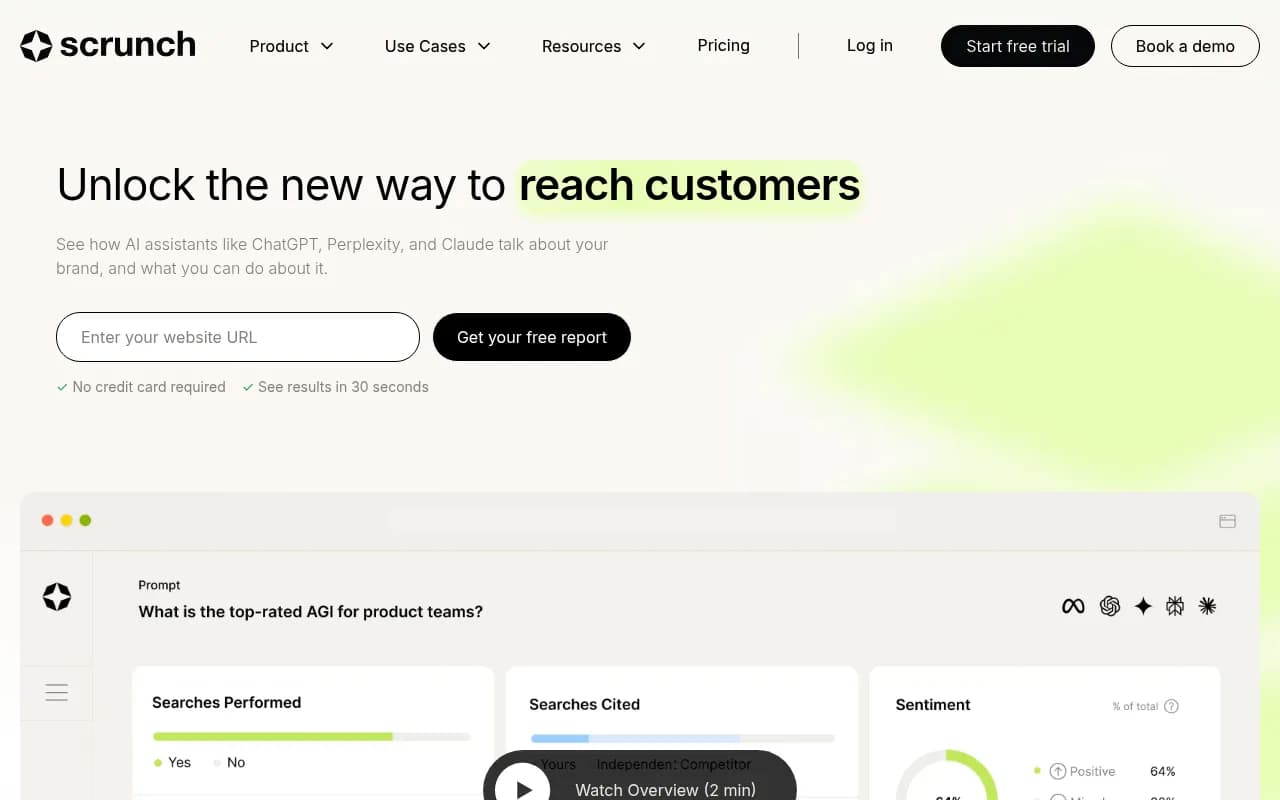
Profound, Scrunch, Evertune, and similar platforms are built for teams managing multiple brands or regions, and the onboarding reflects that. Profound's entry tier at $99/month tracks ChatGPT only; full multi-engine coverage requires the $399/month tier, and setup for a Reddit user described the whole experience as "pretty solid" but "slightly overpriced for the value" with a somewhat clunky interface. Scrunch, now owned by Sitecore, refreshes citation data every three days as standard, which is a deliberate tradeoff toward stability over speed. These tools are not built to deliver value in your first session. They're built to deliver value in your first quarter.
Profound

Comparison table: time to first useful insight
| Tool | Time to first insight | Starting price | What you actually learn first |
|---|---|---|---|
| Free instant scorecards | Under 5 minutes | Free | Rough brand-mention check, no trend data |
| Otterly.AI | 10-30 minutes | $29/mo | Which of 15 prompts cite you vs. competitors |
| Rankscale | Under 30 minutes | ~$20/mo | Visibility score plus basic citation mapping |
| Peec AI | Under 30 minutes | ~$95/mo | Persona-based citation differences by intent |
| AthenaHQ (free tier) | A few hours, meaningful after 2-3 days | Free | Multi-engine citation presence, trend needs time |
| Promptwatch | A few hours for prompts, 1-2 days for crawler logs | $95/mo | Real-UI citation data plus whether AI bots can reach your pages at all |
| Profound | 1-2 days | $99/mo (ChatGPT only) | Deep answer-engine insights once prompts are configured |
| Scrunch | 3+ days (standard refresh cadence) | ~$300/mo | Enterprise-grade AI customer journey mapping |
What "useful" actually means here
A fast insight that doesn't lead anywhere isn't useful, it's just fast. The best first insight tells you one specific, fixable thing: a competitor's how-to page is getting cited where yours should be, a particular crawler is being blocked by an old robots.txt rule, or your product pages have stopped showing up since a model update.
Promptwatch's own research is a good illustration of why content type matters to what you should fix first. In August 2026, product pages accounted for an average 28.7% of ChatGPT citations, with how-to content climbing from 4.3% to 9.1% share over the course of the month (https://promptwatch.com/data/chatgpt-citation-types-over-time-august-2026). Social posts, by contrast, collapsed from 4.4% to under 1% after August 14, the same day Reddit's citation share in ChatGPT fell from roughly 4% to 0.5% in a single day (https://promptwatch.com/data/reddit-citations-are-dropping-in-chatgpt). If your "first insight" is simply "we're under-cited," it doesn't tell you to stop relying on social content and start building comparison pages. A good GEO tool's first report should point at something that specific.
It's also worth knowing how much room there actually is to be cited. ChatGPT cites around 5 sources per web-search answer on average, while Google AI Overviews and Perplexity both cite roughly 10 (https://promptwatch.com/data/average-sources-per-response). That means a missed ChatGPT citation is a bigger loss, proportionally, than a missed AI Overviews one. Microsoft Copilot is the wildcard of the group, with citation counts per response swinging from under 2 to nearly 17 within a few weeks as Microsoft keeps re-architecting retrieval, so judge any Copilot-related insight on a monthly trend, not a single snapshot.
A practical way to choose
If you're testing the waters and need a number to show your boss by Friday, start with a free instant scorecard or Otterly.AI's Lite plan. You'll have something concrete within the hour.
If you're past the proof-of-concept stage and want data you can actually build a content roadmap on, including whether AI crawlers can physically reach the pages you're trying to get cited, Promptwatch is the more complete next step. The setup takes a bit longer because you're configuring real prompt sets and (ideally) connecting crawler logs, but the first useful insight you get back is the kind that tells you what to fix, not just that something's broken.
For agencies managing several client brands at once, the agency tiers from the mid-market players (Otterly.AI, Peec AI, Promptwatch's agency plans starting at $199/month) tend to get everyone to a usable dashboard faster than the enterprise suites, which are optimized for scale and governance rather than quick wins.
If you want to browse more options before committing, the GEO software directory at bestgeosoftware.com breaks down a wider set of platforms by use case, and the rank-tracking-focused tools at ai-rank-tools.com are worth a look if prompt tracking alone, without the content execution layer, is all you need right now.
The honest caveat
None of these tools replace manually checking ChatGPT, Perplexity, and AI Overviews yourself for a small set of real customer questions. Nathan Gotch, CEO of Rankability, made this point well in a recent discussion: a saved response is an observation at that moment, not proof of what every customer will see. Before you subscribe to anything, spend twenty minutes running your five most important customer questions through the actual interfaces. That manual pass is still the fastest, cheapest first insight there is. Everything above is for when you need to do that at scale, repeatedly, and turn it into something you can act on.