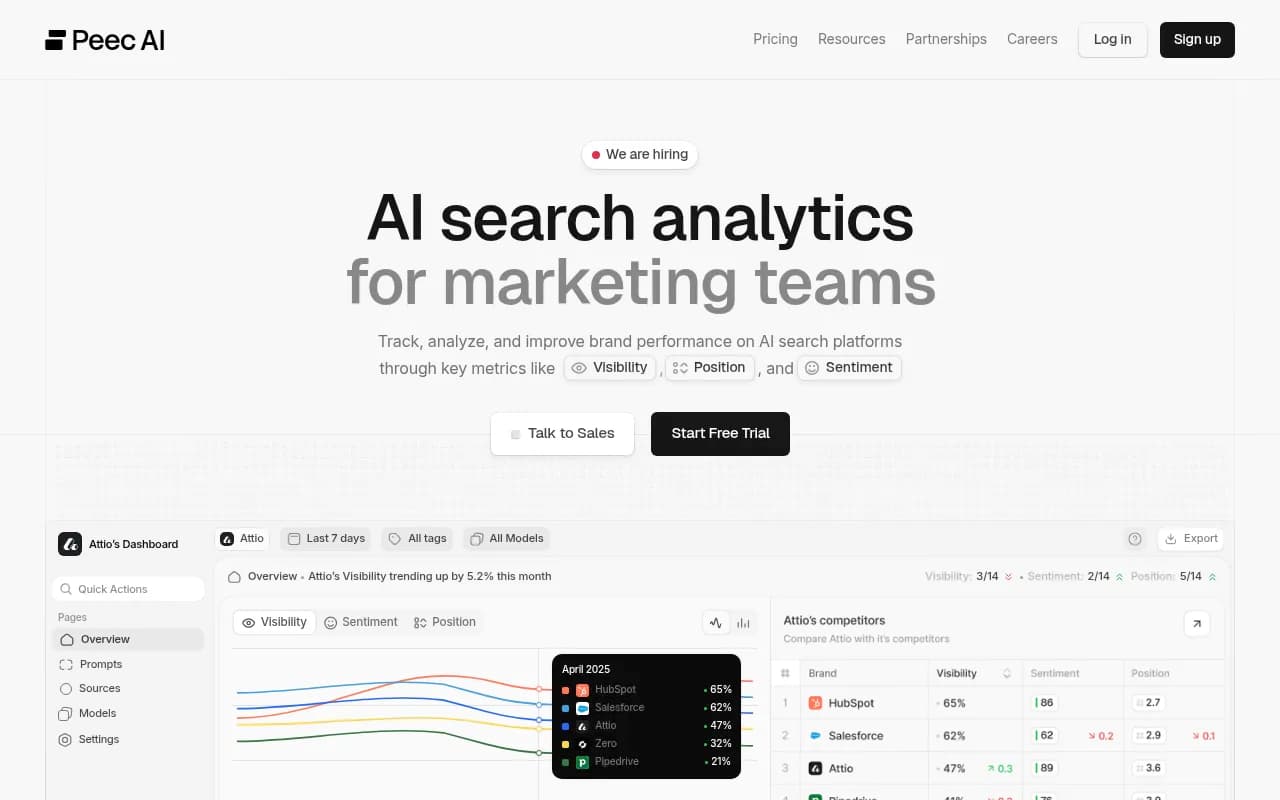
Key takeaways
- Peec AI is a solid entry-level GEO tracker, but it lacks the content optimization, crawler logs, and traffic attribution that enterprise teams need.
- Promptwatch is the strongest all-round alternative -- it monitors AI visibility across 10+ models and actually helps you create content that gets cited.
- Evertune and Relixir are purpose-built for Fortune 500 and large enterprise use cases with white-glove support and custom workflows.
- Profound and Bluefish are worth considering for specific needs (entity tracking and brand narrative respectively), but both have notable gaps.
- The biggest differentiator in 2026 isn't monitoring breadth -- it's whether the platform helps you act on what you find.
Peec AI had a good run. When it launched, it was one of the few tools that could tell you how often your brand appeared in ChatGPT, Perplexity, and Gemini responses. For a lot of teams, that was enough.
But the GEO space has moved fast. Enterprise marketing teams now need more than a dashboard showing citation counts. They need to know why they're invisible for certain prompts, what content would fix it, and whether that content actually worked after publishing. Peec AI doesn't do any of that.
This guide covers five alternatives that enterprise teams are seriously evaluating in 2026: Promptwatch, Evertune, Profound, Relixir, and Bluefish. I've ranked them, explained the tradeoffs, and included a comparison table so you can make a fast decision.
Why enterprise teams are moving away from Peec AI
Peec AI's core limitation is that it's a monitoring tool. It shows you share of voice, prompt-level rankings, and citation data. That's useful, but it's the starting point, not the finish line.
The issues enterprise teams run into most often:
- No content gap analysis -- you can see you're invisible for a prompt, but the tool won't tell you what's missing from your site
- No built-in content generation -- you have to take the data somewhere else to act on it
- No AI crawler logs -- you can't see which pages the AI bots are actually reading (or ignoring)
- No traffic attribution -- there's no way to connect AI visibility improvements to actual revenue
- Pricing scales steeply for large prompt sets
For a solo marketer or a small startup, these gaps are manageable. For an enterprise team running 500+ prompts across multiple brands and regions, they become real blockers.
The five best Peec AI alternatives for enterprise teams
1. Promptwatch -- best overall for teams that want to act, not just monitor
Promptwatch is the platform that comes up most often when enterprise teams outgrow Peec AI, and for good reason. It's the only tool in this comparison that closes the full loop: find gaps, create content, track results.

The Answer Gap Analysis feature is what sets it apart. It shows you the specific prompts where your competitors are getting cited but you're not -- and more importantly, it shows you what content your site is missing that would change that. Most platforms stop at "you're not visible here." Promptwatch tells you what to do about it.
The built-in AI writing agent generates articles, listicles, and comparison pages grounded in real citation data. Promptwatch has analyzed 880M+ citations, so the content recommendations aren't generic -- they're based on what AI models actually cite when answering specific types of prompts.
For enterprise teams specifically, a few features stand out:
- AI Crawler Logs: Real-time logs showing which pages ChatGPT, Claude, Perplexity, and other crawlers are visiting, how often, and what errors they're hitting. This is something most competitors don't offer at all.
- Multi-language and multi-region tracking: Monitor AI responses in any language, from any country, with persona customization that matches how your actual customers search.
- Traffic attribution: Connect AI visibility to actual revenue via a code snippet, Google Search Console integration, or server log analysis.
- ChatGPT Shopping tracking: Monitor when your brand appears in ChatGPT's product recommendation carousels -- a channel that's growing fast for retail and e-commerce brands.
Promptwatch monitors 10 AI models (ChatGPT, Perplexity, Claude, Gemini, Google AI Overviews, Google AI Mode, Grok, DeepSeek, Meta AI, Copilot, Mistral) and has been used by 6,700+ brands including Booking.com and Center Parcs.
Pricing starts at $99/month (Essential), with the Professional plan at $249/month covering crawler logs and state/city tracking. Enterprise and agency pricing is custom.
2. Evertune -- best for Fortune 500 brands with complex governance needs
Evertune is built specifically for large enterprise accounts. If your team has strict data governance requirements, needs custom SLAs, or is running AI visibility programs across dozens of markets simultaneously, Evertune is worth a serious look.
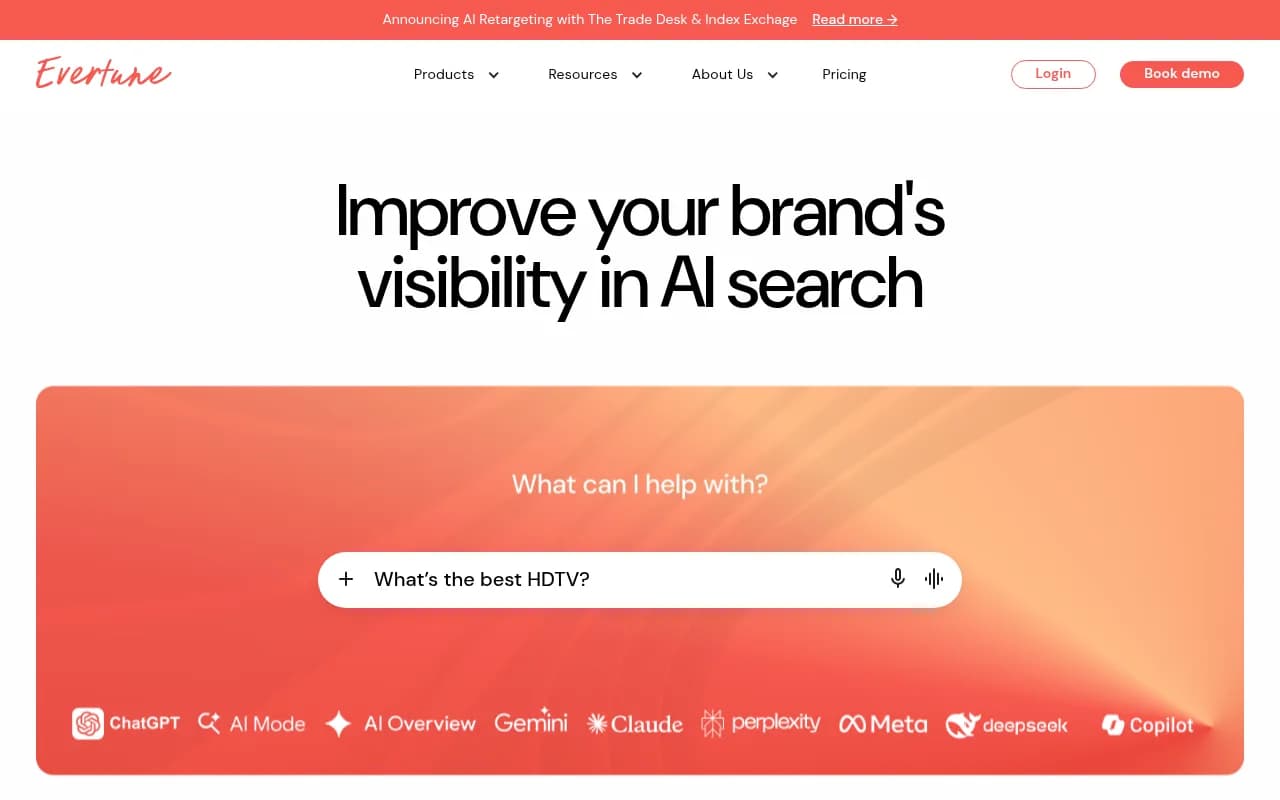
The platform focuses on brand narrative control -- not just whether you appear in AI responses, but how you're described. For brands where tone, accuracy, and brand safety in AI-generated content matter as much as citation frequency, that's a meaningful distinction.
The tradeoff is that Evertune is a monitoring and analysis platform, not an optimization one. It doesn't generate content or tell you what to publish. You'll need a separate workflow for that. It also skews heavily toward enterprise pricing, so it's not the right fit for teams under a certain size.
3. Profound -- best for entity-driven SEO teams
Profound has built a strong reputation for precise AI Overview tracking and entity extraction. If your team is doing serious entity-based SEO work -- mapping brand entities, tracking how AI models describe your products, monitoring competitor entity presence -- Profound's data depth is genuinely impressive.
Profound

It covers 9+ AI search engines and has solid attribution mapping for understanding which content is driving AI citations. The starting price of $99/month is competitive.
Where Profound falls short for enterprise teams: it doesn't generate content, doesn't have AI crawler logs, and doesn't track Reddit or YouTube (which are significant citation sources for AI models). It's a strong monitoring tool, but you'll hit the same wall as Peec AI eventually -- great data, no clear path to acting on it.
4. Relixir -- best for teams that want a managed GEO engine
Relixir positions itself as an end-to-end GEO engine rather than a SaaS dashboard. The distinction matters: Relixir combines platform capabilities with managed services, meaning your team gets both the tracking data and help executing on it.
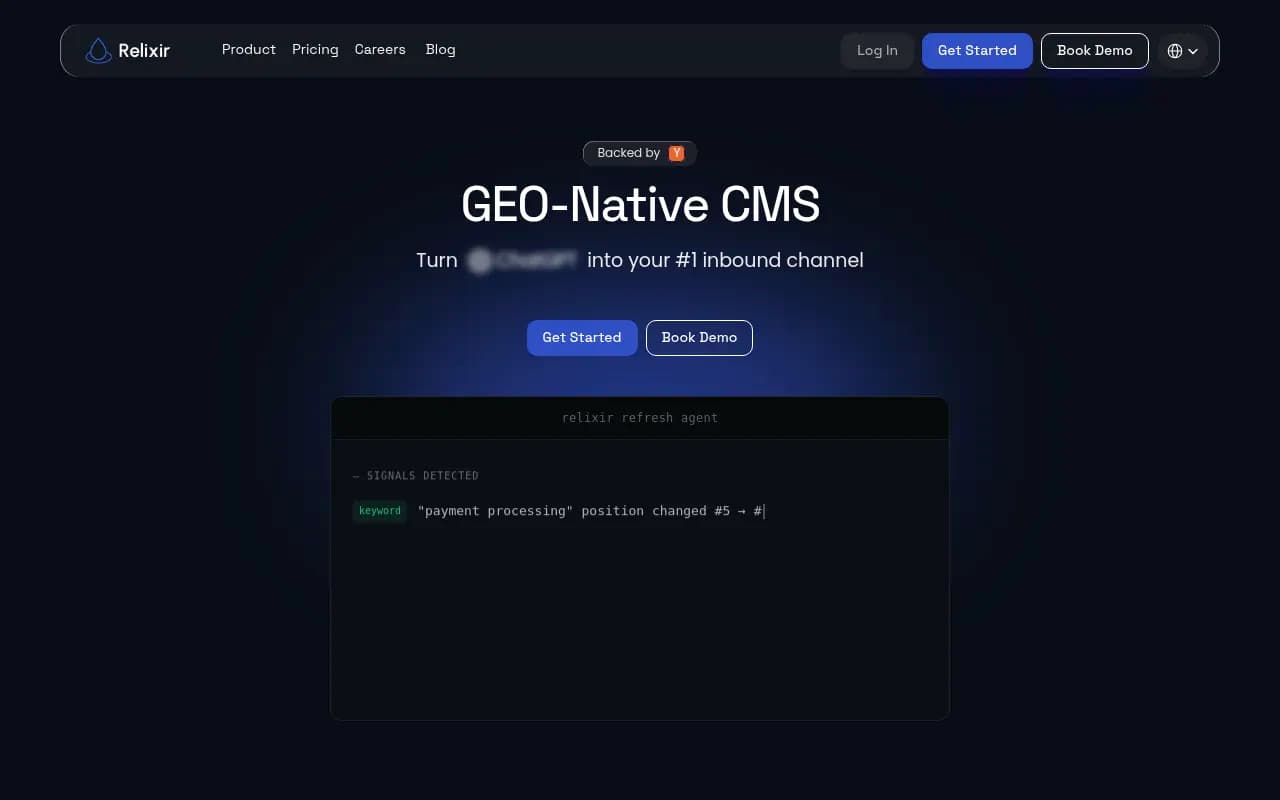
For enterprise teams that don't have dedicated GEO specialists in-house, that's appealing. You're not just buying software -- you're buying expertise. Relixir handles prompt research, content strategy, and optimization workflows as part of the engagement.
The downside is that this model is less flexible than a pure SaaS tool. You're more dependent on Relixir's team and timelines, and the pricing reflects the managed service component. For teams that want full control over their own workflows, Promptwatch or Profound would be a better fit.
5. Bluefish -- best for brand safety and narrative monitoring
Bluefish (Bluefish AI) targets Fortune 500 brands that are primarily concerned with how AI models describe them -- not just whether they appear, but whether the descriptions are accurate, on-brand, and free from hallucinations.
If your brand has been misrepresented in AI-generated content (a real and growing problem for large companies), Bluefish's narrative monitoring and correction workflows are worth exploring. It's one of the few platforms that treats AI hallucination as a first-class problem to solve.
The limitation is scope. Bluefish is narrower than the other platforms here -- it doesn't do prompt volume analysis, content generation, or traffic attribution. It solves one problem well. For teams that need a full GEO stack, it's better as a complement than a replacement.
Feature comparison table
| Feature | Promptwatch | Evertune | Profound | Relixir | Bluefish |
|---|---|---|---|---|---|
| AI models tracked | 10+ | Multiple | 9+ | Multiple | Multiple |
| Content gap analysis | Yes | No | Limited | Yes (managed) | No |
| Built-in content generation | Yes | No | No | Yes (managed) | No |
| AI crawler logs | Yes | No | No | No | No |
| Traffic attribution | Yes | No | Limited | No | No |
| Reddit/YouTube tracking | Yes | No | No | No | No |
| ChatGPT Shopping tracking | Yes | No | No | No | No |
| Multi-language/region | Yes | Yes | Limited | Yes | Yes |
| Hallucination/narrative monitoring | Partial | Yes | No | No | Yes |
| Self-serve SaaS | Yes | No | Yes | No | No |
| Starting price | $99/mo | Custom | $99/mo | Custom | Custom |
| Best for | Full GEO optimization | Fortune 500 governance | Entity SEO teams | Managed GEO programs | Brand safety |
How to choose the right alternative
The decision comes down to what your team actually needs to do next.
If you need to find gaps and fix them yourself: Promptwatch is the clear choice. It's the only platform here that takes you from "I'm invisible for this prompt" to "here's the content that will fix it" to "here's proof it worked." The self-serve model means your team can move fast without waiting on an account manager.
If you're a large enterprise with governance requirements: Evertune or Relixir make more sense. Both are built for complex organizational structures, and Relixir's managed service model is genuinely useful if you don't have GEO specialists in-house.
If entity SEO is your primary focus: Profound's data depth for entity extraction and AI Overview tracking is hard to beat at its price point. Just go in knowing you'll need separate tooling for content creation.
If AI hallucination is your biggest concern: Bluefish is the most specialized tool for brand narrative correction. It's not a full GEO stack, but it's the best option for that specific problem.
What Peec AI does well (and when to stick with it)
To be fair: Peec AI is not a bad tool. Its UI-level scraping approach gives more realistic results than API-based monitoring for some use cases. The 7-day trial is low-friction. And for teams that genuinely just need citation tracking without optimization workflows, it's a reasonable choice at its price point.
The case for staying with Peec AI is strongest if:
- You're a small team with a limited prompt set (under 50)
- You have separate content and SEO workflows that you're happy with
- You don't need traffic attribution or crawler log data
Once you're past those constraints, the platforms above will serve you better.
The bigger picture: monitoring vs. optimization
The GEO tool market in 2026 has a clear split. On one side, you have monitoring dashboards -- tools that show you data about your AI visibility. On the other, you have optimization platforms -- tools that help you improve it.
Peec AI, Profound, and Bluefish sit firmly in the monitoring camp. They're good at showing you what's happening. Promptwatch, Relixir, and (to a degree) Evertune are trying to be optimization platforms -- they want to help you change the outcome, not just observe it.
For enterprise teams with real revenue tied to AI search visibility, the monitoring-only approach has a ceiling. At some point, you need a platform that closes the loop between data and action. That's the core reason teams are moving away from Peec AI in 2026, and it's the lens through which you should evaluate every alternative on this list.