Key takeaways
- Most AI visibility tools are built to track brands, not people. You can usually track an executive by writing prompts that name them, but few tools treat a person as a first-class entity.
- Branded and name-based prompts lean on owned pages. In Promptwatch Data (Sep 28 to Oct 4, 2026), product pages and landing pages were each about 23% of citations for branded prompts, and FAQs, reviews and press releases all rise. Your executive bio, about page and FAQs are the assets you control.
- An executive's own social posts are a minor citation source. Social platforms earned just 0.64% of ChatGPT citations and LinkedIn 0.20% in Promptwatch's Oct 11 to Nov 9, 2026 data.
- A practical stack combines an AI visibility platform (prompt tracking, citations, fact-checking claims) with a classic media monitoring tool for news and social.
- Verify pricing and person-level features with each vendor. This is a young use case and most roundups cover brands only.
Why executive mentions in AI search are their own problem
When a journalist, investor or candidate asks ChatGPT "who is the CEO of [company] and what is their background?", the answer gets assembled from a handful of sources in seconds. Nobody sees a ranking of ten blue links. They see one paragraph, maybe with a few citations, and they believe it.
That paragraph can be wrong. Models mix up people with similar names, repeat outdated job titles, or attach a quote to the wrong spokesperson. I've seen AI answers confidently describe a founder's previous company as their current one. Brand-level monitoring will not catch this unless you deliberately ask about the person.
There are three separate things worth tracking:
- Presence: does the AI mention the executive at all when someone asks about the company, the category, or the topic they speak on?
- Accuracy: are the facts about the person (role, history, quotes, controversies) correct?
- Sources: which pages does the AI cite when it talks about them? Your site, LinkedIn, Wikipedia, a news article from 2019?
Most tools handle the first one reasonably. The second and third are where they differ.
What actually gets cited when AI talks about a person
Before picking a tool, it helps to know which assets move the needle, because that determines what you track.
Promptwatch Data's ChatGPT citation share by content type report (Sep 28 to Oct 4, 2026) looked at which content types ChatGPT cites. For branded prompts, meaning prompts that name a company or product, product pages were 23.3% of citations and landing pages 22.8%. Reviews rose to 5.6%, FAQ pages to 4.8%, social posts to 3.0% and press releases to 2.1%. Name-based queries lean on owned pages, FAQs and press material far more than the average prompt does.
The practical read: executive bio pages, about pages, leadership FAQs and press releases are the controllable assets.
Social is less useful than most comms teams hope. In Promptwatch's social media citations by AI model report (Oct 11 to Nov 9, 2026), social platforms earned 13.16% of Google AI Overviews citations but only 1.94% of Perplexity's and 0.64% of ChatGPT's. LinkedIn was 0.20% of ChatGPT citations, 0.66% on Perplexity and 0.78% on AI Overviews. X was nearly absent at 0.02% on average.
LinkedIn is still worth a look, though. In the LinkedIn citation page types report for August 2026, company pages grew from 13.35% to 18.05% of LinkedIn citations, and on ChatGPT they went from 23.84% to 33.68%. Posts on ChatGPT more than doubled to 26.45% of its LinkedIn citations. Pulse articles fell to 3.65% on ChatGPT. Google AI Overviews gave 5.15% of LinkedIn citations to top-content pages, which go to accounts LinkedIn ranks as leading voices on a topic. That is the one place where an executive's personal profile can matter directly.
One more caution: news decays quickly. Promptwatch's content half-life data shows news pages losing half their citations in roughly 36 days, while landing pages and docs last far longer. A flattering press hit helps for a month. A well-maintained bio page helps for a year.
What to look for in a tool
Because person-level tracking is not a standard feature, judge tools on whether they let you work around that limitation.
- Custom prompts with names. Can you add prompts like "Who is [Name], CEO of [Company]?" and "What has [Name] said about [topic]?" without restriction?
- Mention rules. People share names with other people. You need a way to define what counts as a mention.
- Claim-level analysis. Counting mentions is weak. You want to see the individual statements the AI makes and flag the wrong ones.
- Citation sources. Seeing exactly which URLs feed an answer tells you what to fix.
- Real interface data. Answers from the actual ChatGPT or Google AI Overviews interface can differ from API outputs.
- Multi-market tracking. A spokesperson may be well known in one country and a stranger in another.
- Alerting and reporting. Comms teams want a weekly summary, not another dashboard to babysit.
The best tools, compared
| Tool | Type | Good for executive tracking because | Main limitation |
|---|---|---|---|
| Promptwatch | AI visibility and GEO platform | Custom prompts, claim-level Brand Narrative, Fact Check, citation tracing, real-UI data | No dedicated person entity, you set it up through prompts and Brand Book rules |
| Profound | Enterprise AI visibility | Polished reporting, many engines | Higher price, brand-focused |
| Otterly.AI | Entry-level AI monitoring | Cheap, shows exact cited URLs | Basic, no content or crawler layer |
| Peec AI | AI visibility tracker | Simple prompt tracking for marketing teams | Monitoring only |
| Semrush | SEO suite with AI toolkit | AI visibility next to SEO data | Fixed prompt sets in places, shallow AI-specific data |
| Brand24 | Social and web listening | News, forums, blogs, podcasts mentions | Does not tell you what AI says |
| Meltwater | Media intelligence | Press and social coverage at scale | Different job from AI answer tracking |
| AppearOnAI | Executive AI visibility assessment | Built around executives specifically | Narrower scope, verify depth with the vendor |
Promptwatch
Promptwatch is the one I would start with for this job, mainly because it goes beyond counting mentions. It runs your prompts through the real interfaces of ChatGPT, Gemini, Perplexity, Google AI Overviews, Google AI Mode, Copilot and others, in the country and language you choose, so you see what a journalist in that market would see.

Three features matter for executives:
- Brand Narrative pulls the individual claims AI makes out of every response (for example, "founded the company in 2014" or "previously led a failed acquisition") and groups repeated ones, with the models that say each. It is on every plan.
- Fact Check lets you mark a claim as accurate or inaccurate, then reads the pages crawled from your site to find the ones that state it or its opposite. That tells you which page the AI is learning the wrong thing from. It is available on Business, Agency Scale and Enterprise and uses Agent Credits.
- Brand Book analysis instructions are plain-language rules (up to 1,000 characters) that decide what counts as a mention. That is how you handle a CEO who shares a name with a footballer.
Personas are useful too. You can prompt like an investor, a journalist or a job candidate and compare how the executive appears for each against the general audience.
On the fix side, citation tracing shows which of your pages get cited and where they land in the source list. The Content Agent can publish bio, FAQ and thought leadership pages to WordPress, Webflow or Framer, and Page Tracker then shows whether AI picks them up. Pricing runs from Essential at $95/mo to Business at $579/mo, with a 7-day free trial on monthly billing, so confirm current numbers at promptwatch.com/pricing. If you only want a first look, the free AI visibility report scans how ChatGPT, Gemini and Perplexity talk about your brand with no login.
Honest caveat: Promptwatch tracks brands and prompts, not people as a separate object. You will build a monitor of person-focused prompts yourself. It takes an hour, not a week.
Profound and Scrunch
Profound

Profound is known for client-ready reporting and enterprise coverage across many AI engines. It is a strong monitoring product. The trade-offs are price and, as with most of the category, a focus on brand rather than person. See Promptwatch vs Profound for a direct comparison.

Scrunch sits in the same enterprise tier. Good if your comms and SEO teams already want a large-scale dashboard, less compelling if you need to act on what you find.
Otterly.AI and Peec AI
Otterly.AI

Otterly is the budget entry point. Third-party roundups list it from roughly $29/mo and highlight its link citation analysis, which shows the exact URLs cited. For a small company that wants to know whether the founder's name triggers a mention, that can be enough. Verify the current price on the vendor site.

Peec AI is a clean prompt tracker aimed at marketing teams. It will tell you whether a name appears. It will not help much with fixing why it doesn't.
Semrush and SE Visible
Semrush adds AI visibility tracking to its SEO suite, benchmarking you against named competitors. Useful if the same team owns SEO and comms, and you want one login. For person-level questions, the fixed or limited prompt options are the thing to test during a trial.
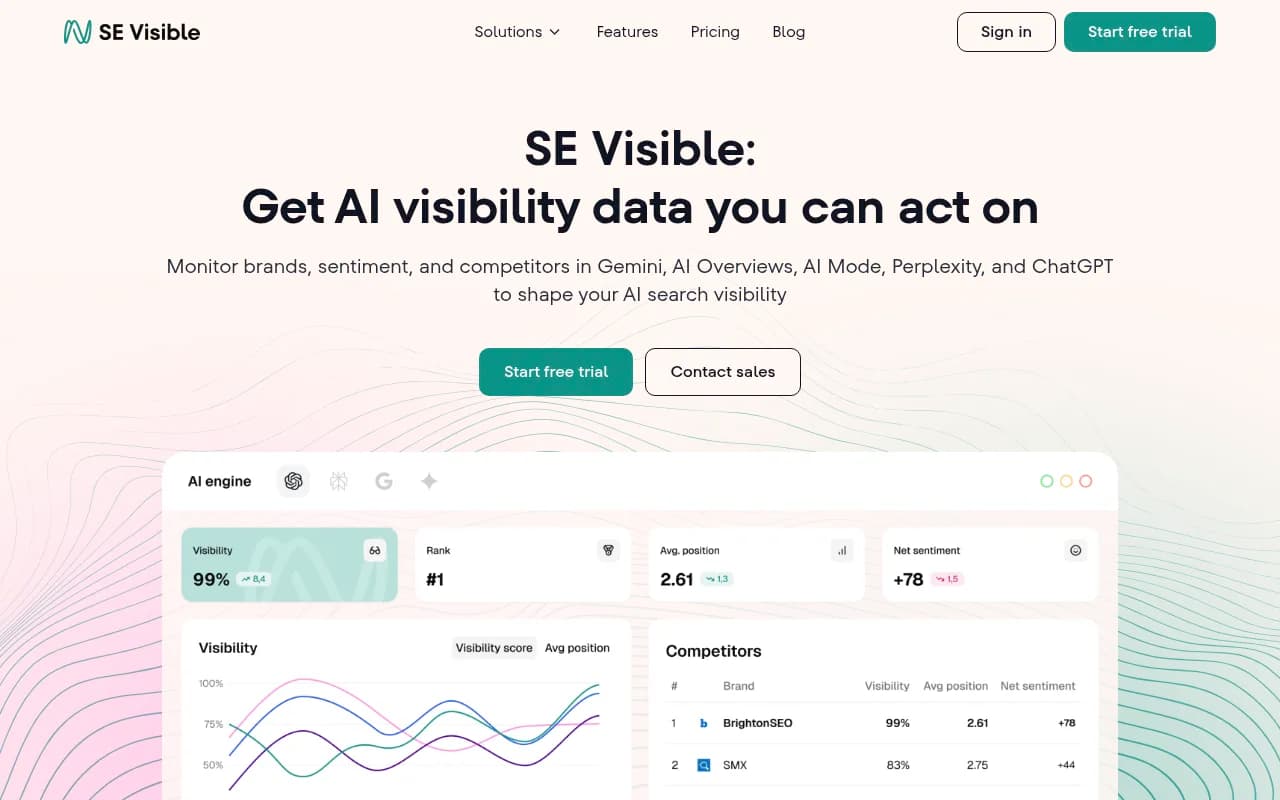
SE Visible from SE Ranking tracks ChatGPT, AI Overviews, AI Mode, Gemini and Copilot, and is pitched at multi-brand agency reporting. Same caveat: monitoring, not fixing.
AppearOnAI
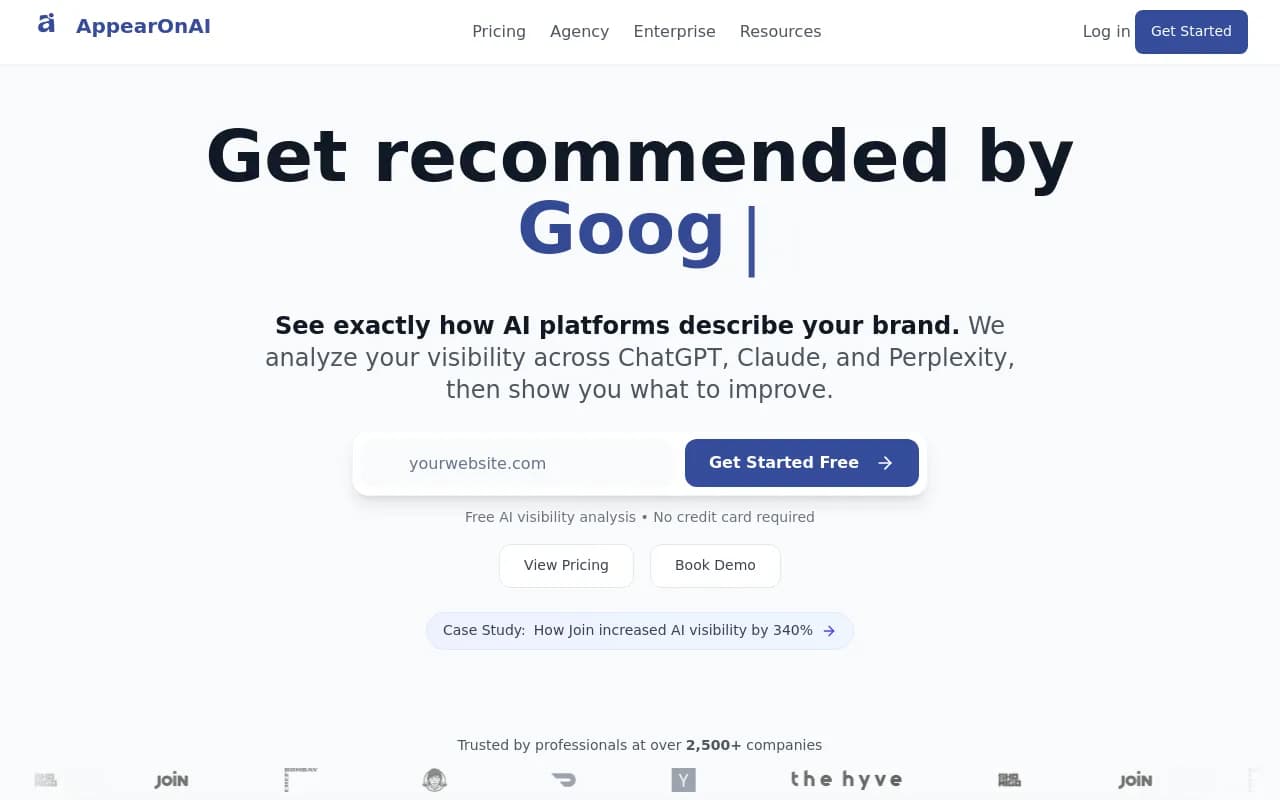
AppearOnAI is listed in our catalog as an executive AI visibility assessment platform. It is the only tool here positioned around executives specifically. I could not verify its depth, pricing or engine coverage, so book a demo and ask what it measures beyond a one-time assessment.
Brand24 and Meltwater for the non-AI side
AI answers are built from the open web, so the coverage that feeds them still matters. Brand24 and Meltwater track news, blogs, forums, podcasts and social posts mentioning your executives. They do not tell you what ChatGPT says. Think of them as the upstream view and an AI visibility platform as the downstream one. Brandwatch and Talkwalker play a similar role at enterprise scale.
For more tools in this space, the directories at bestgeosoftware.com and ai-rank-tools.com list dozens of AI visibility trackers.
The roundup above covers engine coverage and starting prices for several trackers. It is brand-level, but a useful way to shortlist before testing person-focused prompts.
How to set up executive tracking in five steps
This works in any tool that allows custom prompts.
1. Build the prompt list
Write 20 to 40 prompts across four types:
- Identity: "Who is [Name]?", "What is [Name]'s role at [Company]?"
- Reputation: "Is [Name] a good CEO?", "What controversies involve [Name]?"
- Expertise: "Who are the leading voices on [topic]?", "Who should I invite to speak about [topic]?"
- Company link: "Who runs [Company]?", "Who are the spokespeople for [Company]?"
The expertise prompts matter most for thought leadership. Identity prompts only test whether the basics are right.
2. Define what counts as a mention
Add the full name, common variations, nicknames and title combinations. Exclude lookalike names. In Promptwatch this is the Brand Book instruction field. In other tools, you may have to filter results by hand.
3. Run by market and persona
Track every country where the executive speaks or the company sells. Add a journalist and an investor persona if the tool supports them.
4. Log the wrong claims
Make a simple sheet: claim, model, source cited, correct version, page to fix. Fixing the source is almost always the answer, because arguing with a model does nothing.
5. Fix the owned pages, then retest
Update the bio, add an FAQ, publish a press page with dated facts and consistent titles. Then recheck in a few weeks. Because Promptwatch Data shows news-style pages decay in about 36 days, treat this as ongoing maintenance, not a one-off project.
Where social and Reddit fit
Don't overinvest in the executive's X account for AI reasons. Reddit is more complicated: Promptwatch Data shows reddit.com's share of ChatGPT citations fell from about 4% to 0.5% on August 14, 2026, though Google's AI surfaces declined more gradually. If your executive gets discussed in forums, check whether those threads are cited in Google AI Overviews or Perplexity before panicking.
Post on LinkedIn regularly from both the company page and leaders' profiles, as Promptwatch's LinkedIn data suggests, and write posts with a clear claim and supporting numbers. That format does well on Perplexity, where posts were 37.32% of LinkedIn citations in August 2026. Just don't expect it to carry your reputation.
Which setup fits which team
| Situation | Suggested stack |
|---|---|
| Startup, one founder, tight budget | Otterly or Promptwatch Essential, plus Google Alerts-style monitoring |
| Mid-size company, comms plus SEO team | Promptwatch Professional or Business, plus Brand24 |
| Enterprise with many spokespeople | Promptwatch Business or Enterprise (Fact Check, audit log) plus Meltwater or Brandwatch |
| PR or SEO agency managing client executives | Promptwatch agency plans (Kick-off $199/mo and up) |
| Exploring executive-specific products | AppearOnAI demo alongside one of the above |
Agencies can see how this works at scale on the Promptwatch for agencies page. If you would rather hand the work off, 1001 SEO Media runs AI search and GEO programs for brands and uses Promptwatch as its visibility platform.
What I would not rely on
- A single weekly check in ChatGPT by hand. Answers vary by run, country and model, so one screenshot proves little.
- Tools that give a single "visibility score" for a person with no claims or sources behind it. A number without a fix path is a report, not a solution.
- Assuming the model's training data is the problem. For live-search interfaces, the cited pages are usually the cause, and those you can change.
Bottom line
No tool in 2026 does person-level AI tracking perfectly. The workable approach is a prompt set built around your executives, a platform that shows claims and cited sources, and a content routine for the owned pages AI leans on for name-based queries. Promptwatch is the strongest fit if you want to find wrong claims and fix them in the same product. Cheaper trackers like Otterly cover the basic presence check, and Brand24 or Meltwater cover the press and social side. Start by running 20 person-focused prompts through a free trial and look at which URLs get cited. That list alone usually tells you what to fix first.