Key takeaways
- No published head-to-head test of these three tools exists, and we are not going to invent one. This guide gives you a 100-prompt test design plus the verifiable facts on each platform.
- Brandlight is enterprise-only with no public price and a paid pilot. Profound's public page now shows a 7-day trial and a custom Enterprise plan. Promptwatch publishes prices from $95 a month.
- Profound's trial uses a fixed prompt set, so a clean custom 100-prompt test needs an Enterprise demo or sandbox.
- Judge each tool per prompt type (organic, brand-specific, comparison), because ChatGPT cites very different numbers of domains for each.
- Disclosure: this site is run by 1001 SEO Media, which uses Promptwatch. Treat the Promptwatch parts accordingly, and check every claim against the vendor pages.
Why this isn't a results post
The title you may have clicked on promised a head-to-head with scores. The honest version is different. While researching, I found no independent test running identical prompts through Brandlight, Profound and Promptwatch. The comparisons that do exist (from Orchly, cloro, OtterlyAI and the vendors themselves) use different tool sets and are mostly vendor-authored. Borrowing their numbers would be dishonest.
So this guide does something more useful for an enterprise buyer: it tells you what each platform verifiably is, where the facts conflict, and how to run the 100-prompt test yourself in a way that survives a procurement review.
The three platforms in brief
Brandlight
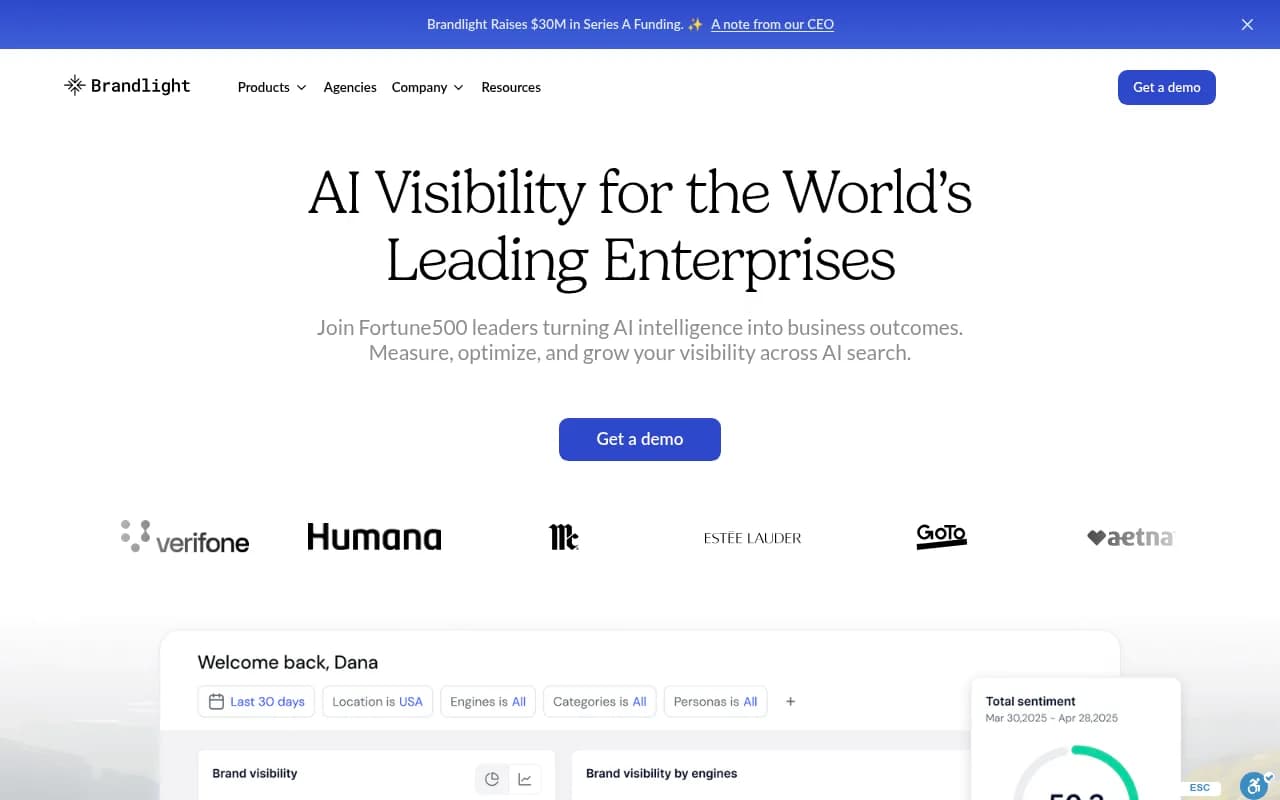
Brandlight is an enterprise AI visibility platform founded in October 2024 by Imri Marcus, Dvir Dvash and Uri Gafni, based in New York and Israel. It raised a $5.75M seed in April 2025 and a $30M Series A on February 11, 2026, led by Pelion Venture Partners. Named customers include Kimberly-Clark, LG, The Hartford and Estee Lauder.
There is no public pricing. Its own agency guide describes a paid pilot, then an annual contract scoped by dashboards, markets and lines of business, and admits it is "priced for enterprise programs". G2 lists roughly two months to implement, though I only saw that in a search snippet.
One claim to treat carefully: Brandlight says roughly 85% of sources AI cites for category questions are third-party or social. That is vendor-sourced. Promptwatch's own data, Social Media Citations by AI Model, October 2026, found ChatGPT drew only 0.46% of its citations from social platforms between Sep 28 and Oct 4, 2026, while Google AI Overviews drew 12.2%. Third-party sites are clearly a big share of citations, but the social part depends heavily on the engine.
Profound
Profound is the self-serve-depth option in most roundups. It announced a $180M Series D on September 15, 2026, led by Sequoia and Kleiner Perkins, for $334.5M raised in total.
Pricing is where sources conflict. Profound's official pricing page now shows two brand plans: a free 7-day Trial (50 prompts daily on ChatGPT, Gemini and Google AI Overviews, prompts not customizable, no history, export or API) and a custom-priced Enterprise plan. Enterprise covers up to nine engines: ChatGPT, Perplexity, Google AI Mode, Gemini, DeepSeek, Claude, Google AI Overviews, Exa Search and Muse Spark. It also includes ChatGPT Shopping, all-time history, CSV and JSON export, API, SSO/SAML and SOC 2.
Third-party pages still list Starter at $99 a month and Growth at $399 a month, both annual-only. Treat those as legacy or unverified. Enterprise estimates of $2,000 to $5,000+ a month are unofficial, so confirm with sales.
Profound

Promptwatch
Promptwatch is an AI visibility and GEO platform that tracks real AI interfaces, then acts on the findings: content gap analysis, a Content Agent that publishes to WordPress, Webflow or Framer, IP-verified AI crawler logs, and visitor analytics. It is ISO/IEC 27001 certified and GDPR compliant, and every plan includes unlimited team seats.
Prices are public: Essential is $95 a month, Professional is $245 and Business is $579, with every engine included at every tier. Verify at promptwatch.com/pricing. Crawler logs start at Professional. The Content Agent, Fact Check, local GEO targeting at exact coordinates and ChatGPT Shopping start at Business.

Side-by-side facts
| Brandlight | Profound | Promptwatch | |
|---|---|---|---|
| Public pricing | No, paid pilot first | Trial free, Enterprise custom | Yes, $95 / $245 / $579 |
| Self-serve start | No | 7-day fixed-prompt trial | 7-day free trial on monthly billing |
| Engines | Vendor lists ChatGPT, AI Overviews, Gemini, Perplexity, Copilot, Claude and more (not verified against product pages) | Up to 9 on Enterprise | All supported models on every plan |
| Takes action on findings | Strategist support, moving toward ads and commerce | Agents on a credit model | Content Agent, Action Board, CMS publishing |
| AI crawler logs | Not verified | Agent Analytics via CDN integrations | IP-verified logs, Professional and up |
| Security | Enterprise contracts | SOC 2, SSO/SAML | ISO 27001, GDPR, SSO on Enterprise |
Treat the Brandlight column as the least verified. It is the vendor that publishes the least.
How to run the 100-prompt test properly
Split the 100 prompts by type
Do not run one pile of 100 and average it. Promptwatch's report on how many unique domains ChatGPT cites per response (Sep 28 to Oct 4, 2026) shows why. Overall, 47.6% of responses cited 10 or more unique domains. But:
- Organic prompts with no brand named: 52.5% cited 10 or more domains.
- Competitor comparison prompts: 49.1% cited 10 or more.
- Brand-specific prompts: only 21.3% cited 10 or more, and the most common count was 5 domains.
A tool that looks strong on organic prompts can look weak on brand prompts purely because the answers are structured differently. A sensible split for 100 prompts is 40 organic category prompts, 30 competitor comparisons and 30 brand-specific questions. Score each bucket separately.
Write prompts like short queries, not essays
Promptwatch's ChatGPT query fanouts data shows average fanout query length falling from about 117 characters in December 2025 to about 53 characters in April 2026. ChatGPT searches the web with short queries, so a test set of long prompts tells you less than you think. Mix in short prompts and note which tools show you the fanout queries.
Define what you are scoring
Before you start, agree on these in writing:
- Mention rate: in how many of the 100 responses does your brand appear?
- Position: where in the answer, and in what order versus competitors?
- Citation: is your own domain a cited source, or are you named only via third parties?
- Accuracy: does the answer state your price, features and positioning correctly?
- Repeatability: run the same prompt on consecutive days and see how much it moves.
Promptwatch's own advice from the domains report applies to any tool: measure across many prompts, track how the brand is described and not only whether it is cited, and expect third-party listicles, reviews and forums to be how a brand gets into the answer.
Fix your access problem before you start
The awkward part is access. Profound's trial cannot take 100 custom prompts, only 50 recommended ones for seven days. Brandlight has no trial at all. To test them fairly you need an Enterprise demo or sandbox from each vendor, so ask for the same prompt set, markets and engines on all three. Write down how access was granted, because a vendor-configured pilot is not the same as a self-serve account.
On the Promptwatch side, the 7-day trial on monthly billing is the fastest way to load a real prompt set. A free AI visibility report is a no-login way to sanity-check your starting position.
Check where the data comes from
Ask each vendor the same questions:
- Are responses collected from the real consumer interfaces or from APIs? User-facing answers and citations can differ from API output.
- Which countries, languages and cities can a monitor be pinned to?
- How often does a prompt run, and can you raise the frequency during a launch?
- Can you export raw responses with brand positions?
Promptwatch collects from the real UIs of ChatGPT, AI Overviews, AI Mode, Gemini, Perplexity, Copilot and others. Ask Brandlight and Profound to document theirs in writing.
Beyond monitoring: what happens after the dashboard
The real enterprise question is not who reports a visibility score. It is who helps you change it. Three things separate platforms here.
First, content execution. Promptwatch writes and publishes pages against the gaps it finds, and tracks whether the live page then gets crawled, cited and clicked. Profound's agents run on credits. Brandlight leans on strategists.
Second, crawler evidence. If AI bots cannot read a page, no content change will help. Crawler logs let you tell an access problem from a content problem. Profound offers Agent Analytics via CDN integrations; Promptwatch includes IP-verified logs from Professional.
Third, content type. Promptwatch's data on which content types ChatGPT cites shows product pages at 22.4% of citations (Sep 28 to Oct 4, 2026), ahead of landing pages and listicles. If a tool's recommendations are only blog posts, ask why.
Which one fits which buyer
| If you are... | Start with |
|---|---|
| A multi-brand Fortune 500 team that wants strategist support and accepts a paid pilot | Brandlight |
| An enterprise that wants up to nine engines, SOC 2 and SSO under a custom contract | Profound |
| A team that wants public pricing, a trial, and agents that publish fixes to your CMS | Promptwatch |
That is my read, not a test result. If you already work with other tools, the GEO software directory at bestgeosoftware.com lists more options, and Promptwatch publishes head-to-head pages such as Promptwatch vs Profound and Promptwatch vs Brandlight. Remember those pages come from the vendor.
Questions to put to every vendor
- What is the total first-year cost for my prompts, markets and seats?
- Can I load my own 100 prompts today, and can I export every raw response?
- Which engines are collected from the real interface?
- How do you detect and fix inaccurate claims about my brand?
- What do I get when the contract ends?
Run the split-by-type test, keep the scoring sheet, and let the numbers from your own prompts decide. A vendor that will not let you do that has already told you something.