Key takeaways
- Most AI visibility tools collect prompts, AI answers, citations and sometimes crawler logs. That is less sensitive than a CRM, but security teams at larger companies still ask for evidence before sign-off.
- A trust center is a public (or gated) page where a vendor lists certifications, reports, subprocessors and policies. Look for it at trust.vendor.com, vendor.com/trust or vendor.com/security.
- "Aligned with" or "compliant with" ISO 27001 or SOC 2 is not a certificate. Read the scope line, the issuer and the dates.
- A SOC 2 Type 2 report older than a year, or one that covers a different product, is a warning sign.
- Ask for a subprocessor list, a DPA and breach-notification terms alongside the certificates. Certificates do not replace them.
Why this question comes up at all
For a long time, SEO tools were bought on a credit card and nobody in security noticed. AI visibility platforms are changing that. Some only track what ChatGPT or Perplexity says about your brand. Others ask for server log access, Search Console and Bing connections, CMS publishing rights, or a CDN integration. Once a tool wants any of that, someone from IT or procurement will show up with a questionnaire.
Security sign-off at larger companies can take several weeks before an AI visibility tool gets connected. Teams that arrive with the vendor's trust documentation already collected usually skip most of that wait. So the practical question is simple: does this vendor have a trust center, and can I read it without a sales call?
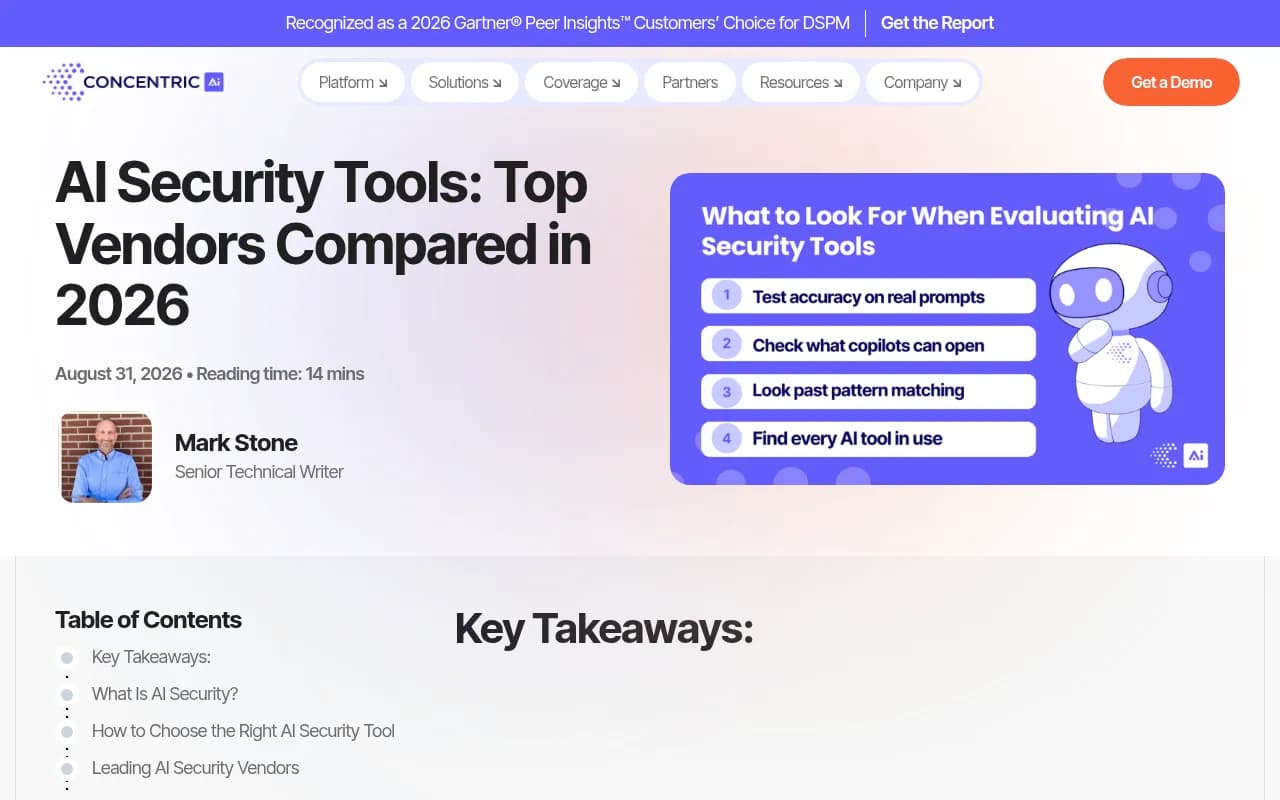
A note on scope. A lot of 2026 content about "AI security" is about something different: governing which AI tools your employees use, what copilots can access, and what gets pasted into chatbots. Concentric AI's 2026 vendor comparison is a good example of that data-governance angle. This guide covers the narrower problem of vetting the vendor you are about to buy from.
What a trust center is, and what it is not
A trust center is a vendor's security and compliance front door. Done well, it holds:
- Certifications and audit reports (SOC 2, ISO 27001, sometimes ISO 42001 or CSA STAR)
- A subprocessor list, ideally with a signup for change notifications
- A data processing agreement (DPA) and breach-notification terms
- A summary of the latest penetration test (usually not the full report)
- A standard security questionnaire, or answers to common ones
- Policies on encryption, access control, retention and incident response
Some of this is public. Some sits behind an NDA or a customer login. That is normal. What is not normal is a security page that is three paragraphs of adjectives and no documents.
GDPR Article 28 is one reason the subprocessor list matters. Processors must get authorization before engaging subprocessors and notify controllers of changes. A list with a change-notification signup is the standard way vendors do this, as BD Emerson's trust center explainer describes.
For a sense of what mature looks like, Anthropic's trust center at trust.anthropic.com lists SOC 2 Type 2, ISO 27001, ISO 42001, CSA STAR and HIPAA, and even has a "Trust Center AI" feature for querying its documentation. Smaller AI-tooling vendors like Promptfoo (trust.promptfoo.dev) and LangWatch (langwatch.ai/trust-center) have their own too. You should not expect a 20-person startup to match Anthropic, but you can expect it to have something real.
Where to look, in order
You can do a first pass in about ten minutes per vendor.
- Try trust.vendor.com and vendor.com/trust. Many vendors use platforms that host these pages on a trust subdomain.
- Check the footer for Security, Trust, Compliance or Legal links.
- Search the docs or help center for "security," "SOC 2," "ISO 27001" and "subprocessors."
- Look at the DPA and privacy policy. The subprocessor list is often linked from there.
- Search a third-party directory or the certification body's public registry if a certificate is claimed but not shown.
- If you find nothing, email the vendor and ask for the security packet. A prepared vendor replies with a link or a zip file. An unprepared one replies with a call invite.
The response itself is information. Speed and specificity tell you how routine this is for them.
How to read a SOC 2 report
SOC 2 is the most common ask from US buyers. The mechanics below come from public checklists, including Scrut's guide to reviewing a vendor SOC 2 report and Warren Averett's SOC report review checklist.
Type 1 vs Type 2
Type 1 is a point-in-time review of whether controls are designed properly. Type 2 covers a period and tests whether the controls actually operated. If a vendor hands you a Type 1 and calls it "SOC 2 certified," that is a start, not a finish. Ask when the Type 2 is expected.
The checklist
- Who issued it? An independent, licensed CPA firm with SOC experience.
- How old is it? A report more than a year old may be stale.
- Does the period cover your needs? If not, ask for a bridge (gap) letter. The vendor issues it, not the auditor, it usually covers no more than three months, and it does not replace the report.
- Which Trust Services Criteria are in scope? Security is the baseline. Availability, processing integrity, confidentiality and privacy should match what the vendor promises you.
- Read the auditor's opinion first. Then confirm the scope covers the product you are actually buying. Reports can cover a different product line.
- Read the exceptions in the Type 2 testing section (typically Section IV) and management's responses.
- Review the Complementary User Entity Controls (CUECs). These are controls your own company has to run. People skip this part constantly.
- Check subservice organizations. "Inclusive" means they were tested in the report. "Carved out" means they were not.
If you only have time for three things, read the opinion, the scope and the exceptions.
How to read an ISO 27001 certificate
ISO 27001 is the international standard for an information security management system (ISMS). The 2022 version has 93 Annex A controls in four themes. Certification follows a Stage 1 documentation audit, then a Stage 2 audit of how things operate. Certificates last three years with annual surveillance audits. The transition period for the 2013 version ended October 31, 2025, so a certificate against the old version should no longer be current. ISO's own survey counted more than 70,000 certificates across 150 countries (ISO 27001 overview).
When you are handed a certificate, check these in order:
- Is the standard version ISO/IEC 27001:2022 (with amendments)?
- Who is the certification body, and is it accredited by a national body? In the Netherlands that would be the RvA, for example.
- What is the scope statement? It covers only the named systems and processes. A certificate for "corporate IT" does not tell you anything about the product you use.
- Is it still valid, and is there evidence of annual surveillance audits?
- Is there a Statement of Applicability you can ask to see?
The pitfall I would flag loudest: "aligned with ISO 27001" and "compliant with ISO 27001" are marketing phrases, not certificates. Neither one means an accredited body has audited anything.
A worked example from the AI visibility category
Worth saying plainly: the following is a vendor's own comparison, so treat it as a claim to verify rather than neutral research.
Promptwatch published a post on October 26, 2026 announcing it was certified to ISO/IEC 27001:2022 + Amd1:2024. The details are the kind you should look for from any vendor: the certification body is ProCertify B.V., accredited by the Dutch RvA (registration C 707); the certificate number is 27001 26102026.2; it is valid until October 26, 2029 with annual surveillance audits; and the scope is the ISMS for development, implementation and customer support of the SaaS platform. The Statement of Applicability is v1.0, dated September 14, 2026, and copies are available on request. Promptwatch says the scope covers prompts, collected AI answers and citations, and crawler log records limited to 10 fields per bot request.

The same post says Promptwatch checked 17 AI visibility, GEO and AEO platforms on October 26, 2026 against their public trust pages and third-party directories, and reports itself as the only AI-native platform with its own ISO 27001 certificate. It lists BrightEdge (certificate on its own trust page), Conductor (on its enterprise pages), Similarweb (found in a third-party security directory) and Ahrefs ("reported" via a third-party case study only). It found no ISO 27001 on Profound's public security pages. The table I could access was cut off, so I cannot vouch for the rest, and a missing public page is not proof a vendor has no certification. It might sit behind a request form.
The useful lesson is not who wins that comparison. It is that the evidence has different strengths: a certificate on the vendor's own page, a mention in a third-party directory, and a case study are three very different levels of proof.
Profound

How the evidence compares
| Evidence type | What it proves | Common weakness | What to ask for |
|---|---|---|---|
| SOC 2 Type 2 report | Controls operated over a period, tested by a CPA firm | Stale, wrong product scope, exceptions buried | Full report, bridge letter if needed |
| SOC 2 Type 1 report | Controls were designed properly at one date | No test of operation | Timeline for Type 2 |
| ISO 27001 certificate | Accredited body audited the ISMS | Narrow scope | Certificate, scope, Statement of Applicability |
| "Aligned with" claim | Nothing verifiable | Marketing language | A real certificate or report |
| Pen test summary | A tester probed the system at a point in time | Summaries hide findings | Date, tester, remediation status |
| Third-party directory listing | Someone recorded a claim | May be outdated or unverified | Confirm on the vendor's own page |
| DPA and subprocessor list | Legal commitments on data handling | Not a security control | Signed DPA, change-notification signup |
What to ask any AI visibility vendor
Beyond the paperwork, AI visibility tools have a few questions specific to the category.
- What data do you collect? Prompts, AI responses and citations are one category. Server logs, visitor analytics and CMS credentials are another, and far more sensitive.
- If you give the tool crawler log access via a CDN, what fields are stored? Fewer fields is better. Ask whether IP addresses are retained.
- Which subprocessors touch my data? AI visibility platforms often rely on LLM APIs, scraping providers and cloud hosting.
- Is my data used to train any model?
- What happens when I leave? One 2026 evaluation of tracking tools read pricing and documentation pages for eight vendors in October and found no plan-level data-retention figure on any of them (Lighthouse's evaluation guide). Ask for retention and deletion terms in days, in writing.
- Do you have an AI-specific governance framework? The NIST AI Risk Management Framework is a common reference point. I found little evidence of ISO 42001 among AI visibility tools, so a vendor with it would stand out.
Tools you might be vetting
The category is crowded, and I have not verified which of these publish trust centers. Treat the list as a starting set of vendors to put through the process above, not a ranking.
| Vendor | Type | Worth checking |
|---|---|---|
| Promptwatch | AI visibility and GEO platform | ISO 27001 certificate and scope, per its own announcement |
| Profound | Enterprise AI visibility | Public security page, SOC 2 status |
| Peec AI | AI search tracking | Trust page, subprocessors |
| AthenaHQ | AI visibility | Trust page, DPA |
| Semrush | SEO suite with AI tracking | Corporate trust documentation, product scope |
| Ahrefs | SEO suite with Brand Radar | Direct certificate, not only case studies |
| Otterly.AI | AI search monitoring | Security page, data handling |


Otterly.AI

If you want to browse more options before shortlisting, the GEO software directory at bestgeosoftware.com is a reasonable place to start.
Red flags that should slow you down
- The security page has no documents, dates or named auditors.
- The certificate scope names a parent company or an unrelated product.
- The SOC 2 report is a Type 1 and has been for years.
- The vendor cannot name its subprocessors.
- The answer to "where is data stored?" is vague.
- Everything requires a sales call, including the DPA.
- The vendor treats a certificate as a substitute for the DPA. It is not one.
None of these is automatically a deal-breaker for a small team tracking 50 prompts. They matter more as the data gets more sensitive and the company gets bigger.
A short process you can reuse
- Classify the data. Prompt tracking only, or logs, analytics and CMS access too?
- Find the trust center, or ask for the security packet.
- Check the certificates: issuer, scope, dates, version.
- Read the SOC 2 opinion, scope and exceptions if there is one.
- Get the DPA and subprocessor list.
- Confirm retention and deletion terms in writing.
- Write down what you verified and what you took on trust. Next year's renewal will be easier.
One more reason to care
A vendor's public trust, docs and FAQ pages are also content AI engines can cite when buyers ask "is this tool secure?" Promptwatch Data's report on which content types ChatGPT cites most (Sep 28 to Oct 4, 2026) found documentation was 7.5% of classified citations and FAQ pages 3.3%, and it advises keeping documentation public and easy to crawl. If a vendor hides everything behind forms, the answer an AI assistant gives about them may come from somewhere else.
The short version: a trust center is not proof of good security, but its absence, or its vagueness, is a fair reason to ask harder questions before you connect anything.