Key takeaways
- NeuronWriter is the cheapest serious optimizer ($23/mo Bronze), and its Gold plan ($69/mo) adds unlimited team members, integrations and API access.
- Frase has moved from a research-and-brief tool toward a publish-and-monitor workflow. Plans start at $39/mo billed yearly ($49 monthly).
- Rankability is built for agencies: unlimited client workspaces, branded reports on every paid tier, and tracking across 11 AI platforms, starting at $97/mo.
- Outranking's pricing is the hardest to pin down. Sources disagree wildly, so confirm at checkout before you commit.
- None of these scores can tell you whether ChatGPT will cite a page. Citation depends heavily on content type and prompt intent, which a term-coverage score does not measure.
What these tools actually do
All four tools do roughly the same core job. You enter a keyword, the tool looks at what ranks, and it tells you which terms, questions, headings and entities your draft is missing. Then it scores you. Most also draft text with AI now.
The differences are in what surrounds that loop. Frase leans toward research, briefs and publishing. NeuronWriter leans toward cheap, deep optimization. Rankability wraps optimization in client reporting and rank/AI tracking. Outranking leans toward workflow, brand style guides and structured drafting.
A caveat on sources: much of the comparison material out there is vendor-written. Rankability's own blog, for example, names Rankability the best pick for agencies. That may be fair for agencies, but treat it as a claim, not a verdict. I haven't hands-on scored any of these tools against each other for ranking outcomes, and nobody should pretend a content score is a ranking forecast.
Quick comparison
| Tool | Entry price (verified) | Best for | AI search tracking | Client reporting |
|---|---|---|---|---|
| Rankability | $97/mo | Agencies running SEO and AEO for many clients | 11 platforms, daily | Branded reports on every paid tier |
| Frase | $39/mo yearly, $49 monthly | Brief-to-publish workflows | ChatGPT and Google AI on Starter; Perplexity, Claude and Gemini on higher tiers | Exportable reports on Scale; white-label is Enterprise only |
| NeuronWriter | $23/mo | Freelancers and budget teams | Add-on from $9/mo; Google, AI Overviews, AI Mode, ChatGPT, Perplexity | Limited |
| Outranking | Unverified (see below) | Teams that want briefs, style guides and workflows | Not a focus | Limited |
Rankability
Rankability is the agency-shaped option. Its content module covers research, brief, outline, AI draft and optimization guidance, and the rest of the platform tracks Google rankings and AI visibility so you can report on both.
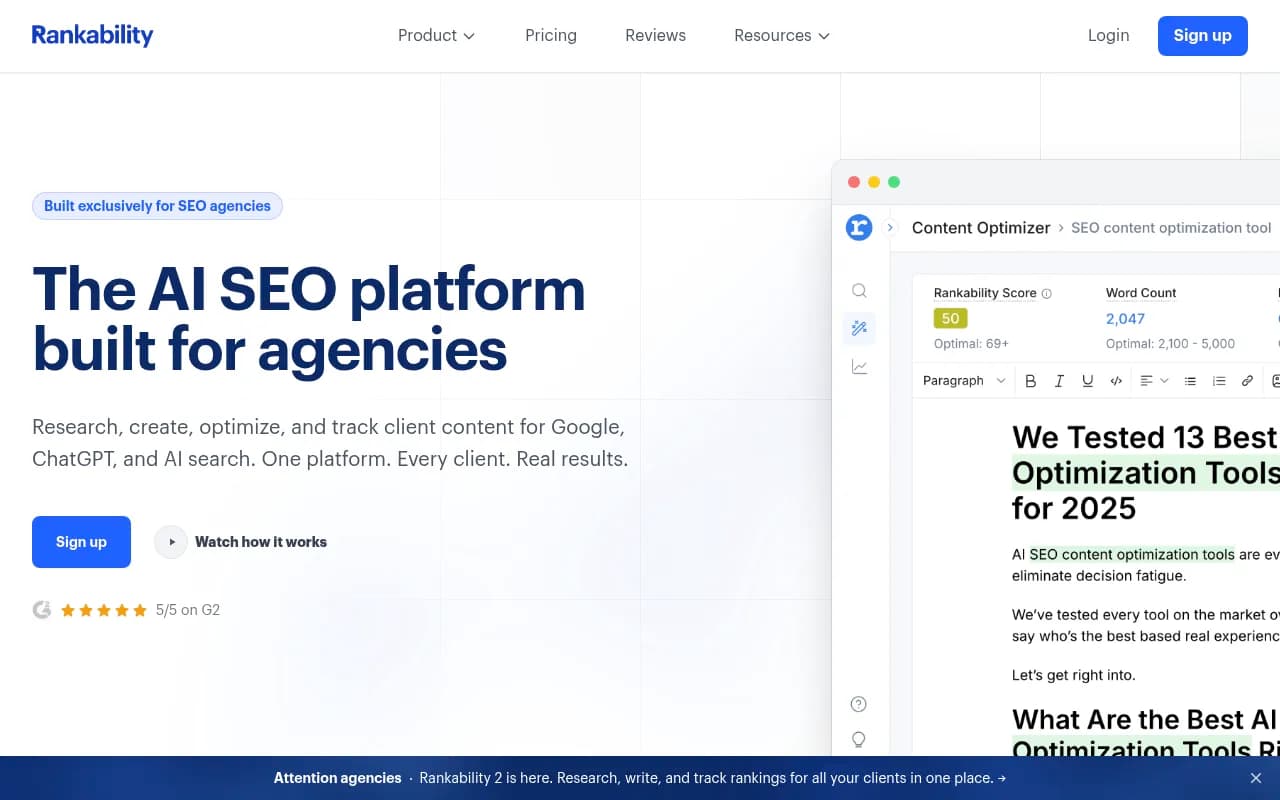
Pricing from the live page, monthly billing:
| Plan | Price | Content projects | AI queries tracked | Google keywords |
|---|---|---|---|---|
| Starter | $97/mo | 20 | 100 | 50 |
| Agency | $297/mo | 80 | 300 | 150 |
| Agency Pro | $497/mo | 160 | 500 | 250 |
Every tier includes unlimited client workspaces and team members, API and MCP access, daily tracking across 11 AI platforms (ChatGPT, AI Mode, AI Overviews, Claude, Perplexity, Gemini, Grok, Copilot, Brave AI, DeepSeek and Meta AI), and agency-branded reports. Note that some older write-ups say branded reports are limited to higher plans. The live pricing page lists them on every paid tier, including Starter.
A content project is one new page or refresh. It covers research through export, and includes two AI revisions. Manual editing and scoring don't use another project, which is a more generous definition than per-document caps elsewhere.
Where it stops: the trial is 7 days, requires a card and has limited usage. And if you are a solo writer with one site, you are paying for agency plumbing you may never use.
A third-party review also describes Rankability's analysis as entity-based rather than keyword-density-based, which makes it especially useful for auditing an existing content library for semantic gaps. Take that with the usual salt, but it matches how the product positions itself.
Frase
Frase used to be the tool you opened to build a brief in minutes instead of spending a couple of hours reading competitor pages. It still does that well: it pulls headings, questions, statistics and People Also Ask data from top results. But the current pitch is bigger, a content operating system that plans, drafts, publishes and then watches pages for decay.
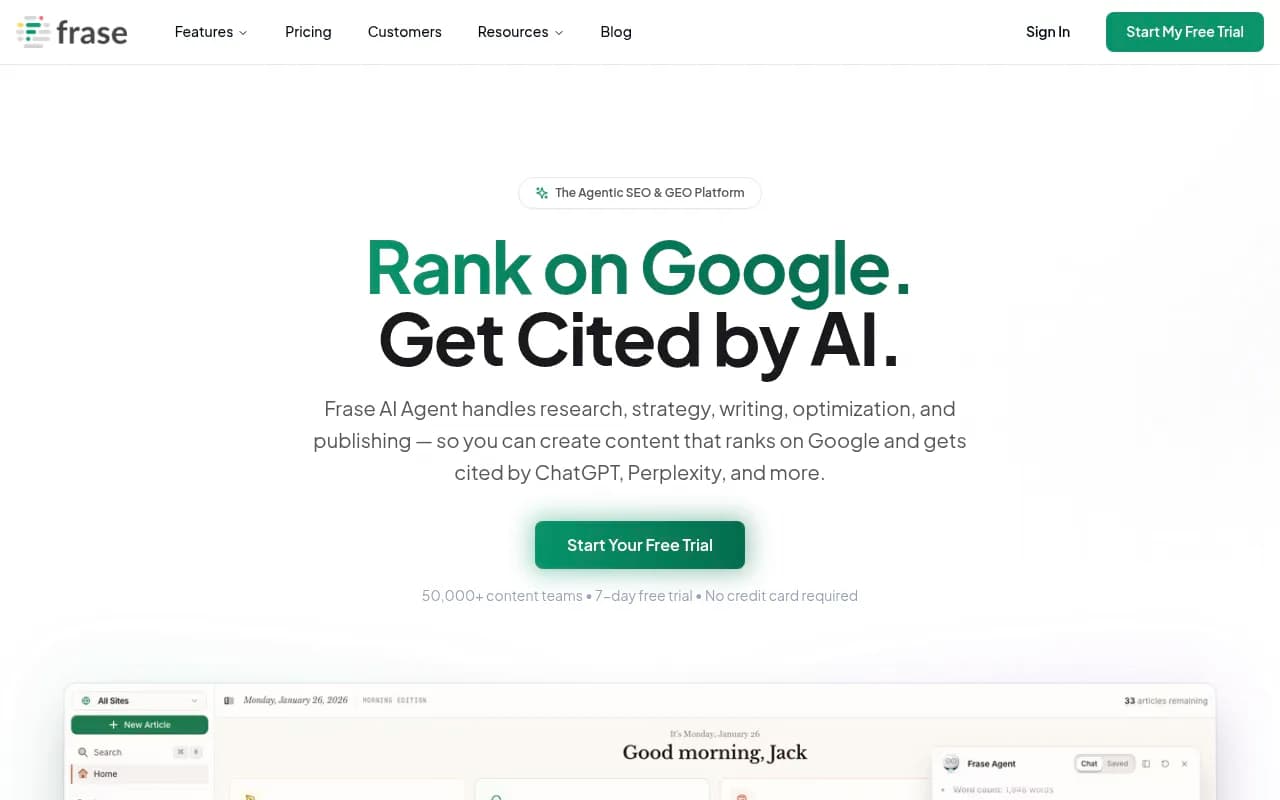
Verified pricing:
| Plan | Yearly / monthly | Seats and sites | Articles per month |
|---|---|---|---|
| Starter | $39 / $49 | 1 seat, 1 site | 10 |
| Professional | $103 / $129 | 3 seats, 5 sites | 40 |
| Scale | $239 / $299 | 5 seats, up to 10 domains | 100 |
| Enterprise | Custom | Custom | Custom |
Things worth knowing:
- AI visibility coverage scales with the plan. Starter covers ChatGPT and Google AI, Professional adds Perplexity, and Scale adds Claude and Gemini. The "8 AI platforms" figure in some comparisons did not hold up against the pricing page.
- Content Guard watches published pages for Google decay and drafts fixes: 10 pages on Starter, 75 on Professional, 300 on Scale.
- It publishes to WordPress, Webflow, Sanity and Wix, and offers an MCP server and CLI on every plan.
- Agencies get exportable client-ready reports on Scale, but white-label reports and a branded portal are Enterprise only. That is the gap for agency buyers.
- Starter hard-stops at its limits. The trial is 7 days with no card.
One older data point: Surfer's own correlation study, cited by Erlin, put Frase's content score at 0.10 correlation with rankings versus 0.28 for Surfer. That is a competitor's study and it predates the 2026 product changes, so read it as a nudge to test, not a ruling.
NeuronWriter
NeuronWriter is the value pick, and I find it hard to argue otherwise. You get SERP analysis, NLP term suggestions, a content score, AI drafting, internal link suggestions and Google Search Console integration at a price that makes Surfer and Clearscope look steep.
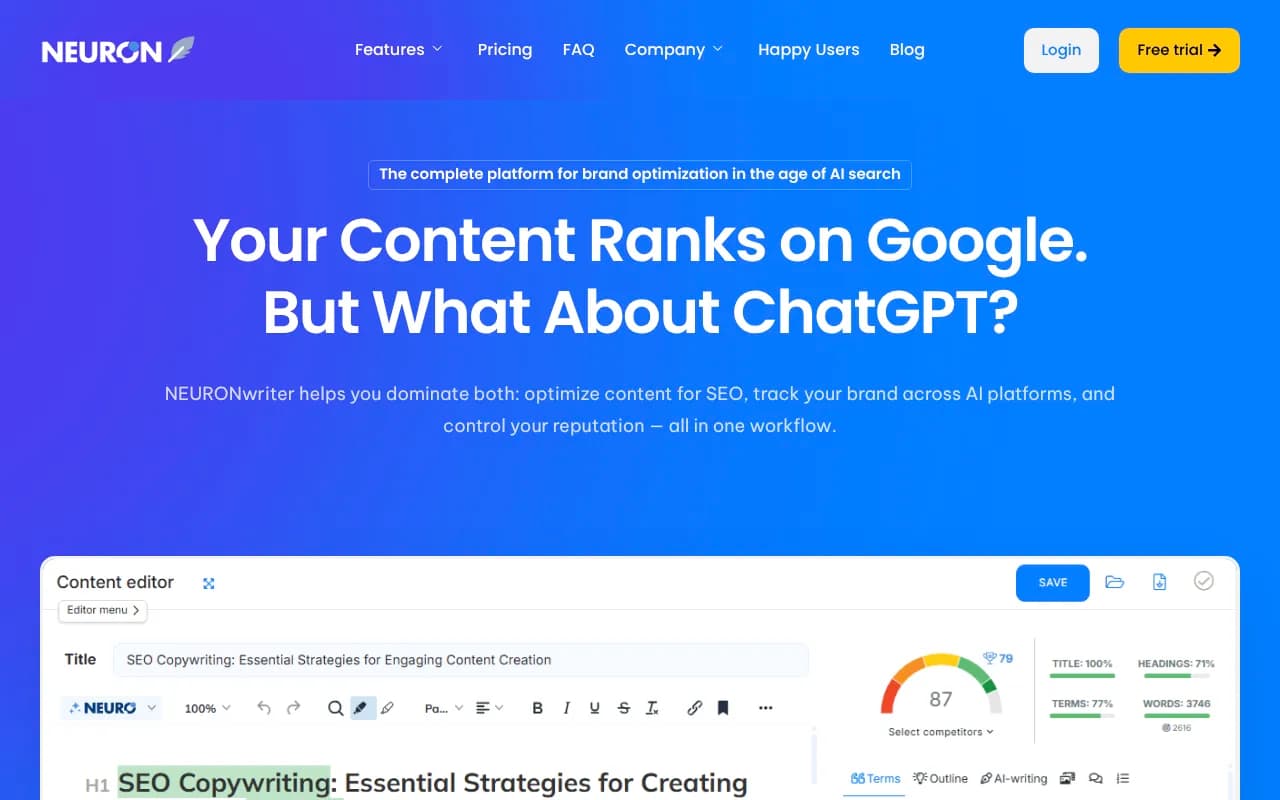
| Plan | Monthly (annual) | Projects | Documents |
|---|---|---|---|
| Bronze | $23 ($230/yr) | 2 | 25 |
| Silver | $45 ($450/yr) | 5 | 50 |
| Gold | $69 ($690/yr) | 10 | 75 |
| Platinum | $93 ($930/yr) | 25 | 100 |
| Diamond | $117 ($1,170/yr) | 50 | 150 |
Gold is the one most people should look at. It adds unlimited team members, GSC, WordPress and Shopify integrations, Content Designer, custom AI templates, your own OpenAI key, API/MCP and plagiarism checks. Bronze and Silver lack integrations, team features and the API, and sharing on them is read-only. You may see $19/mo quoted in blog posts, which appears to be a promotional or annual-billing figure; the live pricing page shows $23.
AI monitoring is a separate add-on from $9/mo for 10 questions, scaling to 1,000. It covers Google, AI Overviews, AI Mode, ChatGPT and Perplexity, but not Claude or Gemini. Fine for spot checks, thin as a primary tracker.
Where it stops: the interface is less polished than premium tools, the learning curve is steeper than Clearscope's, and it isn't built for multi-client agency reporting. A 7-day trial runs on Gold terms and there is a 30-day refund on your first plan.
Outranking
Outranking is the one I would be most careful with. It is an AI content platform with real-time scoring against 10+ on-page factors, brand style guides, briefs, a plagiarism checker and workflows. AppSumo shows 4.77/5 from 295 verified users, and the company claims 12,000+ users.
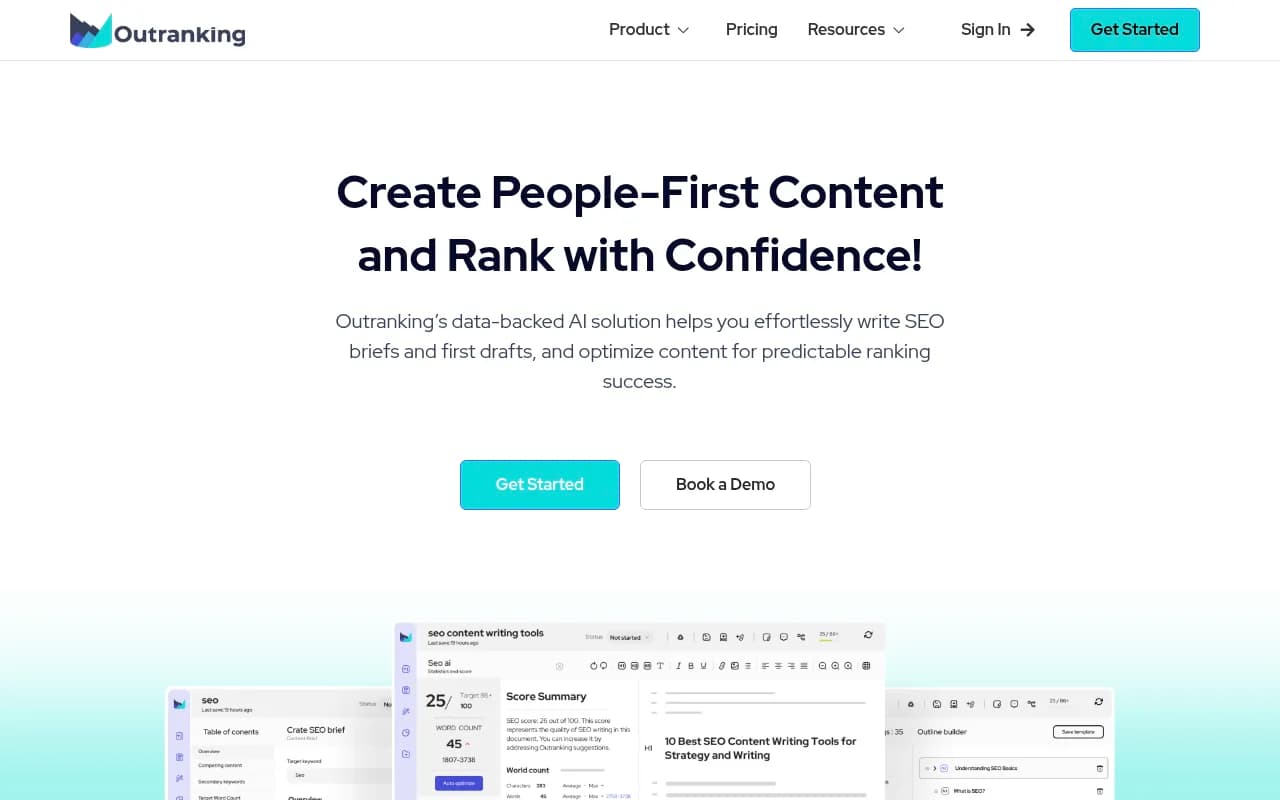
The pricing, though, is a mess:
- The official /pricing URL returned a 521 error when checked, and the live page reportedly sits at /pricing-plan/ and renders client-side.
- One review saw Starter at $1,500/mo for 4 documents, SEO Writer at $3,000/mo and SEO Wizard at $5,000/mo on one day in September. That reviewer is a competitor and said no tracker corroborated the figures.
- Third-party trackers quote roughly $19 to $219/mo. One review says Starter is $19 monthly or $25 annual for 5 documents, and SEO Writer $79 monthly or $69 annual. I could not verify that.
Treat all of it as unconfirmed. Plan structure appears to be Starter (4 documents a month, 5 yearly), SEO Writer (15 documents, 2 users), SEO Wizard (30 documents, 3 users) and Enterprise. Internal linking and automatic optimization start at SEO Writer. First AI drafts need an AI credit pack from $49, and keyword clustering needs a one-time $79 Strategist add-on, so the sticker price is not the real price.
Also, do not confuse Outranking (outranking.io) with Outrank.so, an autopilot publisher. A lot of reviews blur the two.
Head-to-head on what matters
| Question | Rankability | Frase | NeuronWriter | Outranking |
|---|---|---|---|---|
| Cheapest verified way in | $97/mo | $39/mo yearly | $23/mo | Unclear |
| Unlimited client workspaces | Yes | No (sites capped by plan) | No (projects capped) | No |
| White-label reporting | Branded reports on all paid tiers | Enterprise only | Limited | Limited |
| AI visibility tracking | 11 platforms included | Tiered by plan | Paid add-on | Not a focus |
| Publishing to CMS | Export | WordPress, Webflow, Sanity, Wix | WordPress, Shopify | Workflow-based |
| Decay monitoring | Rank tracking | Content Guard | GSC-based suggestions | Not a focus |
Which one should you pick
- Freelancer or small site owner: NeuronWriter Gold. The price-to-capability ratio is the best of the four.
- Lean team that wants research, drafts and publishing in one place: Frase Professional.
- Agency with several clients and a reporting obligation: Rankability. Frase's white-label reporting being Enterprise-only is the practical reason.
- Team that values style guides and structured workflows, and has confirmed Outranking's price in writing: Outranking.
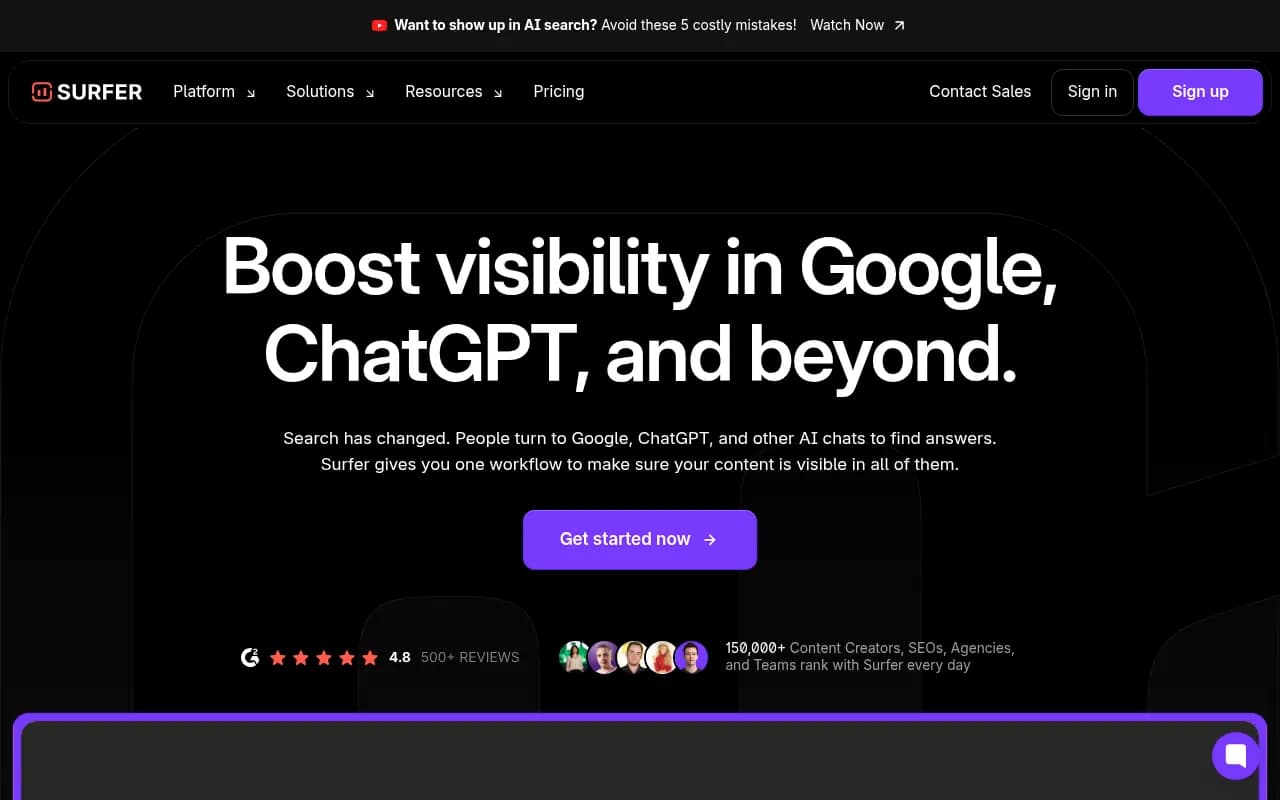
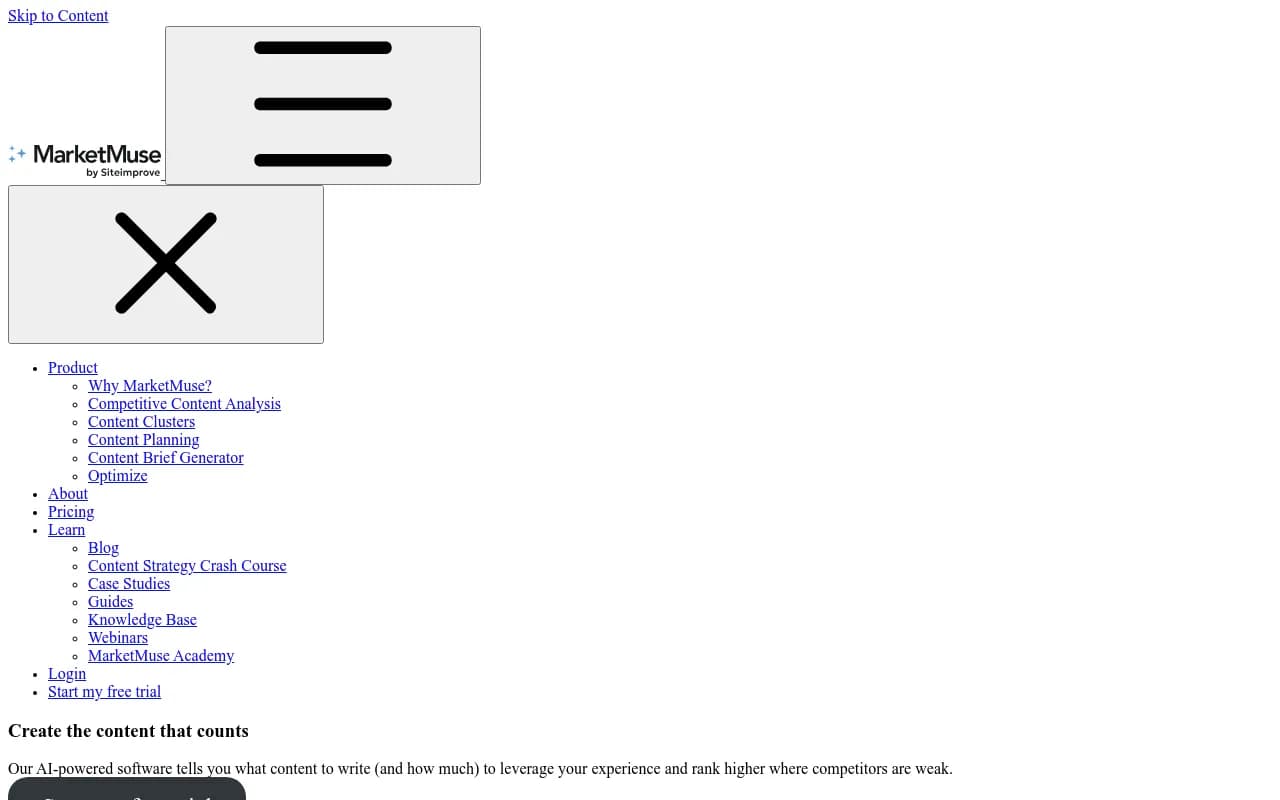
If you want to widen the field, the usual alternatives are Surfer SEO, Clearscope and MarketMuse, all of which are in our catalog.

For more options by category, the software directory at surferstack.com lists content tools side by side.
The gap none of them close
Content scores optimize for classic SERP term coverage. AI citations behave differently. In Promptwatch's data on which content types ChatGPT cites most (Sep 28 to Oct 4, 2026), product pages took 22.4% of citations and landing pages 16.8%, together about 39% of all citations. Listicles took 13.6%, how-tos 8.7%, and documentation 7.5%.
It shifts by intent. For commercial prompts, product pages (26.0%), landing pages (20.6%), listicles (15.0%) and comparisons (7.9%) made up almost 70% of citations. For informational prompts, how-tos and documentation matter more. So a 90 content score on a blog post tells you little about whether it will be cited for a buying query.
Freshness matters too. In Promptwatch's content half-life report, news lost half its cited pages within 36 days, while landing pages and docs stayed cited far longer.
The practical move is to plan content by intent and page type first, then use an optimizer to tighten each page. To see whether pages are actually getting cited, you need a dedicated visibility tool. Promptwatch tracks ChatGPT, AI Overviews, Perplexity and others, and shows which pages get crawled and cited.

The GEO software directory at bestgeosoftware.com is a good place to compare alternatives.
Before you buy
- Run each trial on the same three keywords, and compare the suggestions against a page you know ranks.
- Check document and project caps against your real monthly volume. Caps differ in meaning: Rankability counts projects, NeuronWriter counts documents, Frase counts articles.
- Confirm AI tracking coverage for the models your buyers use. Frase and NeuronWriter both gate or limit models.
- Ask Outranking for a written quote.
- Never treat a content score as a forecast. Check links, intent match and page type too.
Pricing changes often. Confirm everything on each vendor's site before paying.