Key takeaways
- The content optimizer is the reason to buy Rankability. Reviewers on Capterra, G2 and Ryan Doser's hands-on review all point to it as the strongest part of the platform.
- Plans run $97 (Starter), $297 (Agency) and $497 (Agency Pro) per month, all with unlimited clients and team members. Older reviews claiming there is no free trial are out of date: the pricing page now lists a 7-day trial on monthly plans, with a card required and limited usage.
- Keyword research is the weakest module, and backlink data is thin. If those matter, plan to keep a second tool.
- An optimizer built around articles and NLP terms covers the Google article surface well, but AI citations skew toward product pages, landing pages and docs. Rankability's AI tracking helps, though it is a separate module from the optimizer.
What Rankability is in 2026
Rankability started as a content optimizer with keyword research and content monitoring bolted on. Ryan Doser, who reviewed it on video and then updated his written review, describes it as three features back then. Today the workspace is split into Research, Create, Optimize, Audit, Promote, Track and Automate, with an AI assistant called Serena sitting across all of it.
The positioning has shifted too. The homepage pitch is content that wins AI visibility, and the pricing is built for agencies: unlimited clients and unlimited team members on every paid plan, plus API and MCP access.
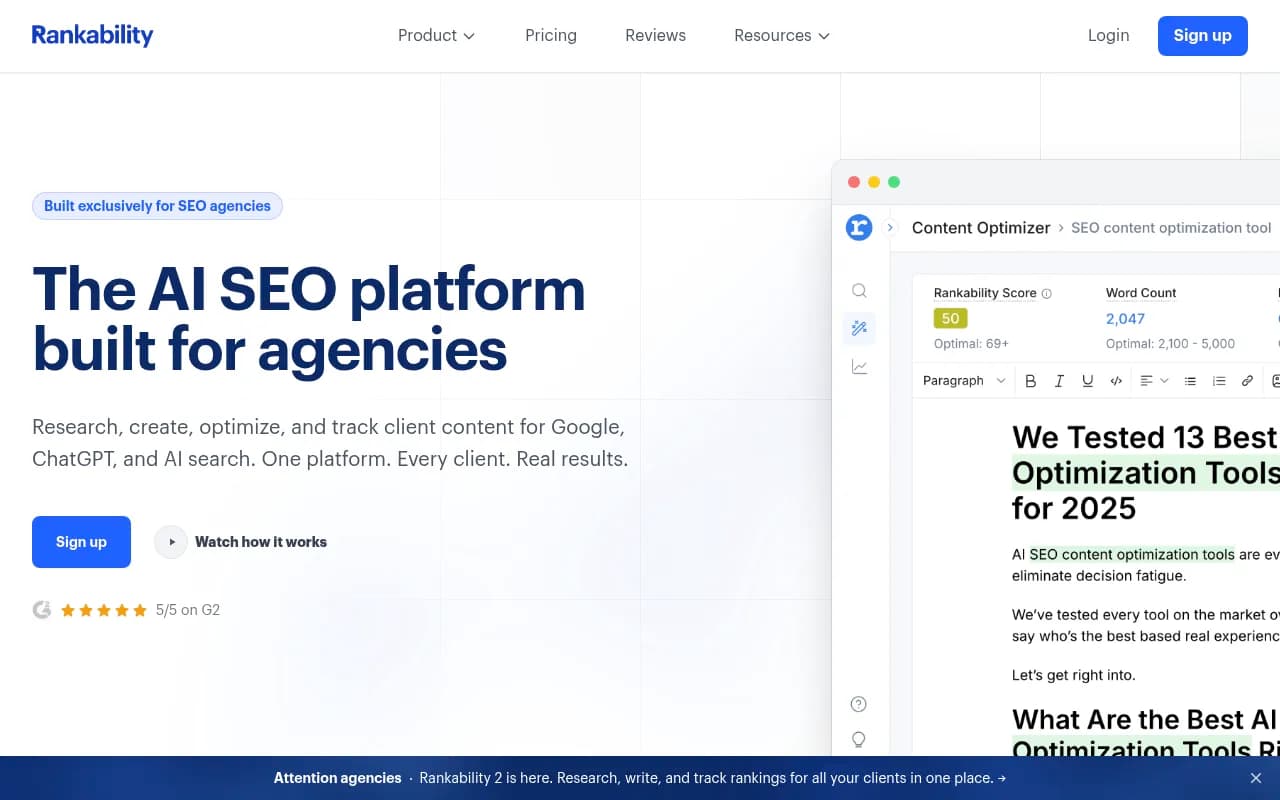
That agency framing matters when you decide whether the tool is for you. A solo blogger will find the plans oriented toward client work. An agency running a dozen retainers will find the structure fits.
How the NLP optimizer works
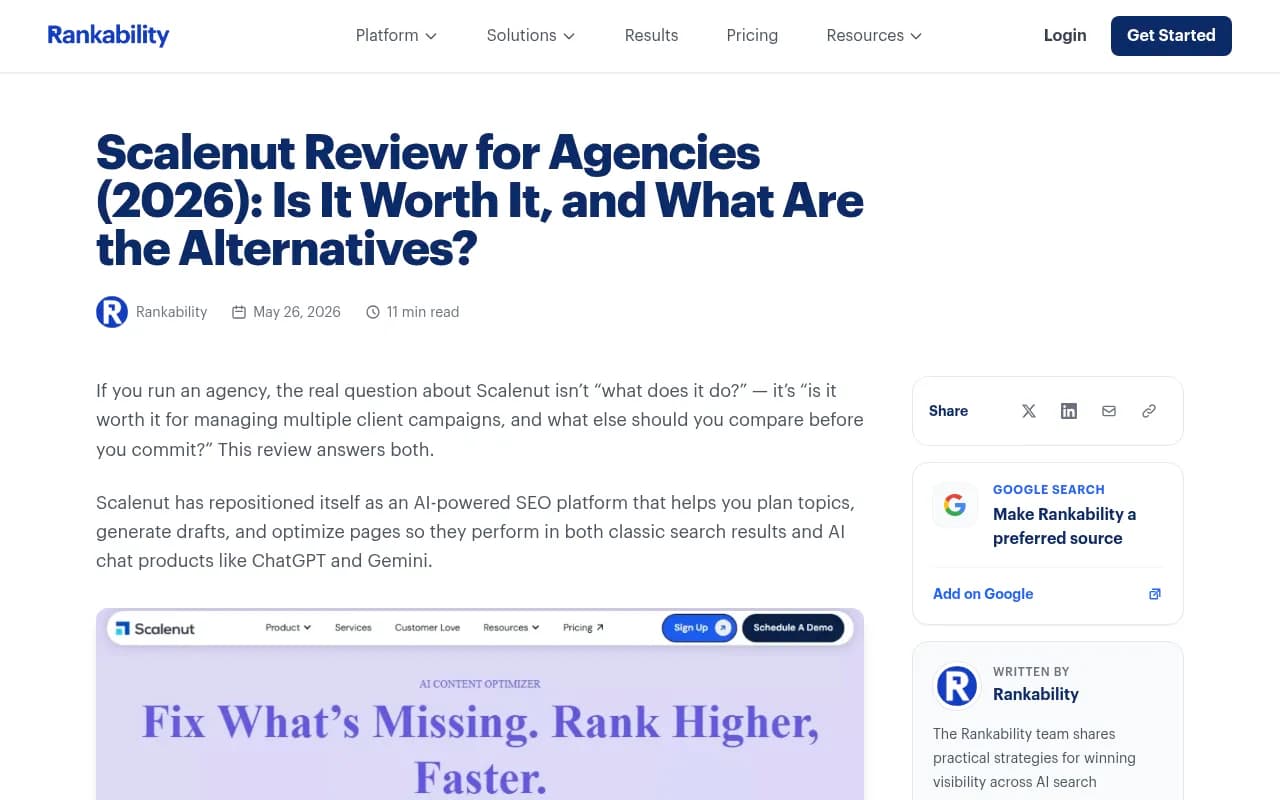
You enter a target keyword, Rankability analyzes the top-ranking pages, and you get a score that updates as you edit. The score reflects how well your draft covers the NLP terms and entities found in competing pages.
Older third-party coverage, such as the wfpulse review, says the optimizer draws on Google's Natural Language API and IBM Watson NLP. A Capterra reviewer makes the same point, praising it over cheaper LSI-keyword approaches. I could not verify this against Rankability's own documentation, so treat it as a reported detail that may have changed.
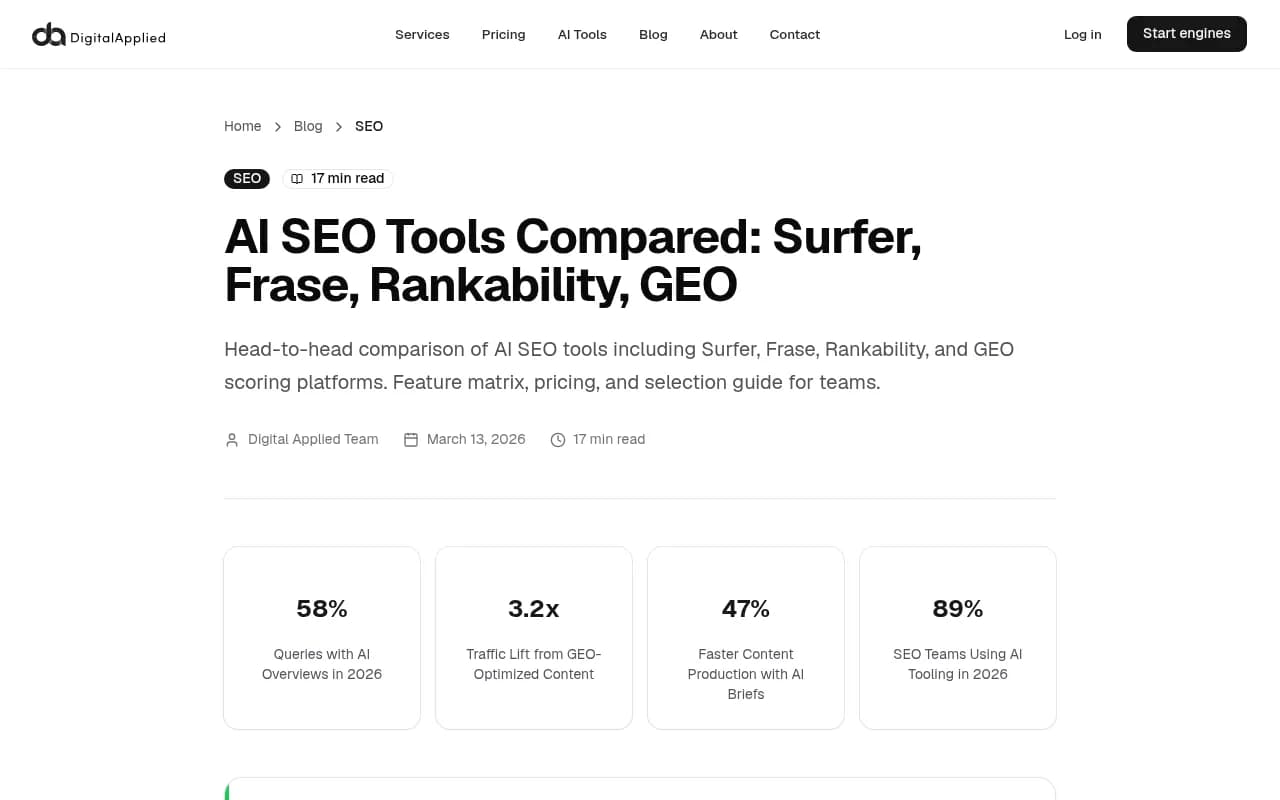
A separate comparison from Digital Applied frames Rankability as a semantic coverage tool: entity analysis, bulk content audits, and SERP-level analysis of formats and entity types. Its conclusion is that Rankability is most useful for improving existing content rather than producing new content at volume.
What a content project includes
Rankability bills work in content projects. One project is a new page or a refresh of an existing one, and it covers research, a brief, an outline, an AI-assisted draft, optimization guidance and export. Two AI revisions are included per project. Manual editing, scoring and exports on a saved project do not use another project.
That is a sane way to meter usage. You can fuss over a draft all afternoon without burning credits.
What it does well
Relevance guidance that people actually use
The user feedback is consistent here. A Capterra reviewer says the NLP recommendations produced strong results for a client and that Surfer's NLP terms "stop performing well as it used to." A G2 reviewer says the NLP-based recommendations are more relevant than other tools for building topical relevance. Software Advice reviewers are similarly enthusiastic about the optimizer.
Self-selected reviews skew positive, so I would not lean on the praise too hard. Still, the pattern across Capterra, G2, Software Advice and Doser's independent testing points the same direction.
Existing-content refreshes
The optimizer works best on pages that already have impressions but weak rankings. You paste the page, see which entities and subtopics are missing, and tighten it. The audit module helps you decide which pages to do first.
Agency-friendly structure
Unlimited users and clients is the detail Doser flags as mattering more than it looks. Per-seat pricing punishes agencies as they grow, and Rankability avoids that.
AI tracking in the same workspace
All paid plans track 11 AI platforms: ChatGPT, Google AI Mode, AI Overviews, Claude, Perplexity, Gemini, Grok, Copilot, Brave AI, DeepSeek and Meta AI. Tracked queries scale from 100 on Starter to 500 on Agency Pro.
Where it falls short
Keyword research is the weak module
Doser says it plainly: it works, but you get fewer metrics and less automatic long-tail expansion than a dedicated tool. He had to apply a filter manually to surface longer-tail variants where Ahrefs hands them over on the first search. If keyword research drives your process, pair Rankability with a dedicated tool such as Ahrefs, Semrush or Mangools KWFinder.
Backlink data is unclear
The pricing page lists backlink monitoring and outreach research on every tier. Doser still says to skip Rankability if you need backlink data. I could not verify how deep the feature goes, so if links are central to your work, test it during the trial or keep Majestic or Ahrefs in the stack.
Documentation lags the product
Doser notes the pricing page counts usage in plain monthly allowances while parts of the help center still describe an older plan split. A G2 reviewer adds that you cannot see how many credits an automation will cost before you run it. Small gripes, but they add up when you are onboarding a team.
No mobile app
It is browser-only. For agency desk work that is fine.
No independent proof the score predicts rankings
I found no independent test showing the Rankability score correlates with ranking gains. That is true of most content scores, Surfer's included. Use the score as a checklist of coverage gaps, not as a promise.
The citation surface is not what the optimizer was built for
This one is my inference rather than a vendor claim. An optimizer built around articles and NLP terms is designed for ranking pages in Google. But Promptwatch's data on ChatGPT citations by content type for Sep 28 to Oct 4, 2026 shows product pages as the most cited type at 22.4%, followed by landing pages at 16.8% and listicles at 13.6%. How-tos were 8.7%, documentation 7.5% and FAQ pages 3.3%.
On commercial prompts the skew is stronger: product pages 26.0% and landing pages 20.6%. If your AI visibility goal is being recommended when someone is shopping, an article-focused optimizer only covers part of what gets cited.
Freshness matters as well. Promptwatch's content half-life data shows news losing half its cited pages within about 36 days, while landing pages and docs keep most of their citations for months. Rankability's content monitoring and refresh workflow fits that reality, as long as you use it.
Rankability pricing in 2026
Pricing below comes from the official agency pricing page. Confirm on the site before buying, since Doser notes Rankability has rebuilt its pricing more than once this year.
| Starter | Agency | Agency Pro | |
|---|---|---|---|
| Monthly price | $97 | $297 | $497 |
| Content projects per month | 20 | 80 | 160 |
| Tracked AI queries | 100 | 300 | 500 |
| Tracked Google keywords | 50 | 150 | 250 |
| Local Pack scans per month | 10 | 30 | 50 |
| Page audit reports per month | 20 | 80 | 160 |
| Technical site audits per month (up to 1,000 pages) | 2 | 10 | 25 |
| Support | Standard | Priority | Priority |
Agency adds a team onboarding session. Agency Pro adds a campaign planning session and Gotch Inner Circle coaching. Annual billing saves two months.
About the free trial
Doser's review says there is no free trial and that the cheapest way to test is a paid month of Starter at $97. The current pricing page contradicts that: there is a 7-day trial on monthly plans. A card is required, usage is limited, and it converts to the paid price after seven days unless you cancel in Billing. Set a calendar reminder.
Rankability vs the alternatives
I did not verify current Surfer, Frase or Ahrefs pricing for this guide. The entry prices below come from Doser's comparison and may have moved.
| Tool | Entry price (per Doser) | Strongest at | Weakest at |
|---|---|---|---|
| Rankability | $97 Starter | NLP optimizer, agency structure, AI tracking | Keyword research, backlink depth unclear |
| Surfer SEO | $59 Discovery | Real-time content scoring | Reviewers say its NLP terms perform less well than before |
| Ahrefs | $129 Lite | Keyword and backlink data | Not a content optimizer first |
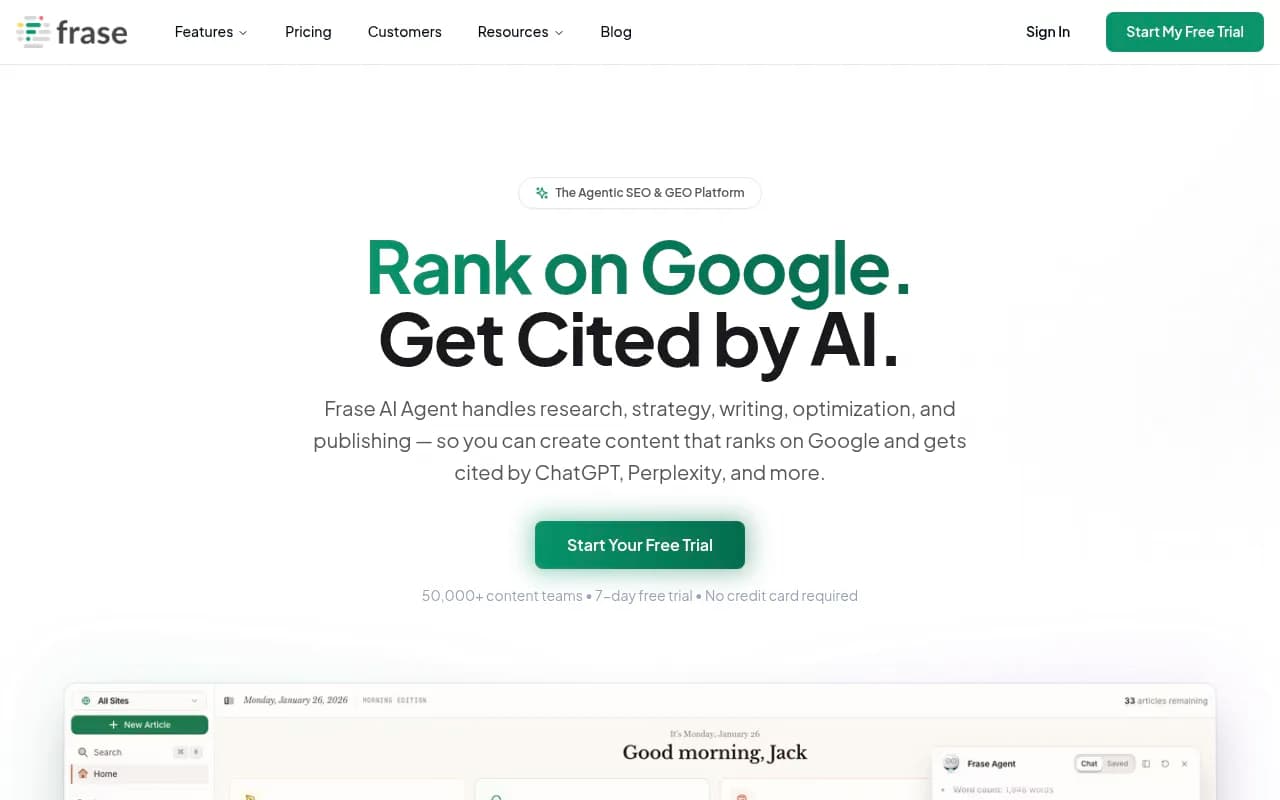
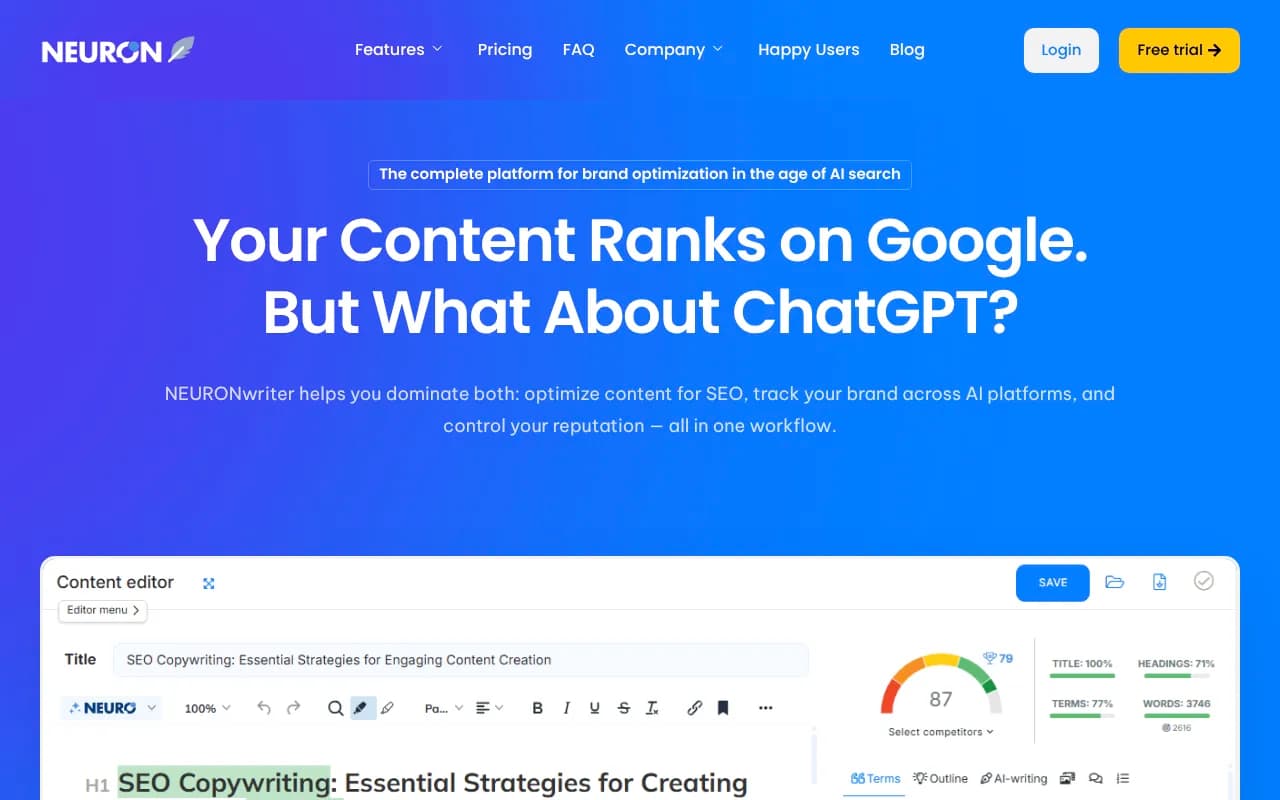
Other optimizers worth a look in the same category include Clearscope, MarketMuse, Frase and NeuronWriter. Digital Applied's comparison suggests Frase for research and briefing, Surfer for scoring, and a GEO scoring platform on top. That is a reasonable stack if budget allows.

For a wider catalogue, the software directory at surferstack.com has reviews and alternatives across the category.
Who should buy Rankability
Buy it if you:
- run an agency or in-house team that charges for content that has to compete in contested SERPs
- spend most of your time refreshing existing pages
- want unlimited users and clients without per-seat costs
- want AI citation tracking in the same workspace as the optimizer
Skip it if you:
- need strong keyword research or backlink data as your main workflow
- want a mobile app
- need proof of ranking correlation before you spend
Adding a dedicated AI visibility layer
Rankability's Track module covers 11 AI platforms, which is a reasonable start for agencies. If AI search becomes a bigger line item, a specialist platform like Promptwatch goes further into the questions an optimizer can't answer: which AI crawlers are actually reading your pages, which pages get cited, and what traffic that drives.

For more options, the GEO software directory at bestgeosoftware.com lists tools in the category.
Verdict
Rankability's optimizer is good at what it was built for: making a page cover a topic more completely than the pages it competes with. Reviewers across several platforms say the NLP guidance is more useful than the cheaper alternatives, and the agency pricing is sensible. The weak spots are keyword research, unclear backlink depth, lagging docs and the lack of independent evidence for the score.
Test it on the 7-day trial with a handful of pages you already know are underperforming. If the recommendations move those pages, the $97 Starter plan is easy to justify. If they don't, you will know within a week.