Key takeaways
- "Earned media" in AI citation studies is defined broadly. Muck Rack's October 2026 report puts earned and third-party sources at more than 84% of citations, but that bucket includes government, NGO, academic, encyclopedic and third-party corporate content, not just press coverage.
- News articles are only about 5.7% of ChatGPT citations in Promptwatch Data (Sep 28 to Oct 4, 2026). Product pages, landing pages and listicles take far more.
- Journalism's share of AI citations fell to 22% in September 2026 from 27% in May, and ChatGPT drove most of that drop.
- News citations decay fast. Half of the news pages ChatGPT cited on July 6, 2026 were gone 36 days later, while landing pages and comparisons lasted far longer.
- Paid and advertorial content is about 0.3% of citations, so buying placement does not work. Listicles, reviews and comparison coverage on third-party sites do.
The headline number and what it actually measures
If you work in PR, you have probably seen the stat by now: earned media drives 84% of AI citations. It comes from Muck Rack's "What Is AI Reading?" research. The October 2026 edition draws on Generative Pulse data covering 40M+ AI responses and 207M citations in 2026, plus a September analysis of 1,020 prompts across ChatGPT, Claude, Gemini and Perplexity. Nearly 99% of cited links come from non-paid sources, and paid and advertorial content sits at 0.3%, unchanged since May.
That is a strong result, and I believe it. But I think the way it gets repeated in pitch decks is sloppy. "Earned" in these studies is a broad bucket. It covers third-party corporate content, government and NGO sites, academic research, and aggregators and encyclopedic sources, along with journalism. Journalism itself was 22% of citations in September 2026.
So when someone says "PR drives 84% of what ChatGPT says," the honest version is: independent third-party sources drive most of it, and press coverage is one slice of that.
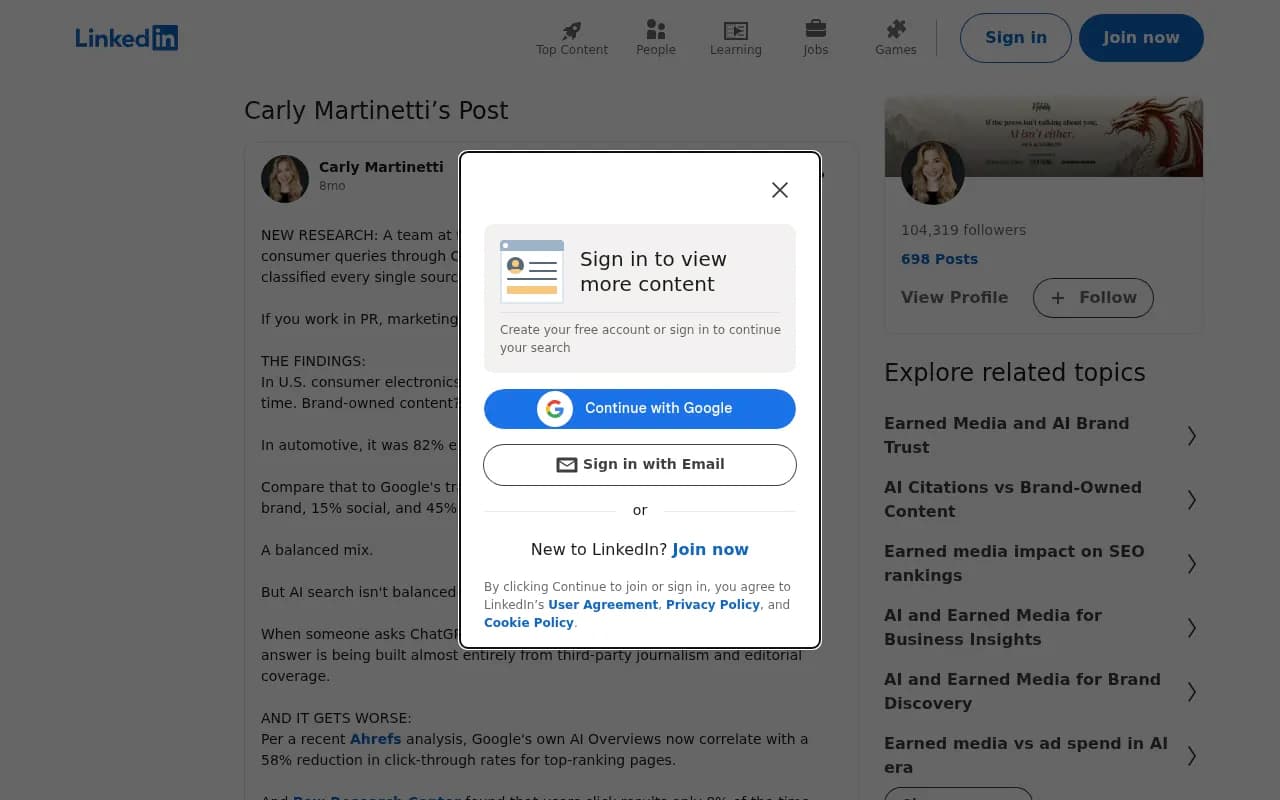
The University of Toronto study, as summarized in a LinkedIn post by Carly Martinetti, shows the same pattern from a different angle. Researchers ran over a thousand consumer queries through ChatGPT, Perplexity, Gemini and Google and classified each source as Brand, Earned or Social. For US consumer electronics, AI search cited earned media 92% of the time. In automotive it was 82%. Brand-owned content was in single digits and social was close to zero. Google's classic results for the same queries were a more balanced mix of roughly 39% brand, 15% social and 45% earned. I have only seen the summary, not the original paper, so treat the exact figures as directional.
What ChatGPT actually cites, by content type
The content-type view gives a more grounded picture. Promptwatch Data's report on ChatGPT citation share by content type classified citations from Sep 28 to Oct 4, 2026:
| Content type | Share of ChatGPT citations |
|---|---|
| Product pages | 22.4% |
| Landing pages | 16.8% |
| Listicles | 13.6% |
| How-tos | 8.7% |
| Documentation | 7.5% |
| General articles | 6.1% |
| Comparisons | 5.9% |
| News | 5.7% |
| FAQ | 3.3% |
| Reviews | 1.7% |
Product and landing pages together are about 39%. Editorial formats added up (listicles, how-tos, articles, comparisons, news, reviews and others) are about 43%. News on its own is a small direct slice.
This does not contradict Muck Rack. A product page on a retailer or a vendor's comparison page can be a "third-party" source from your brand's point of view. A listicle on an independent publication is third-party editorial content but not news. The studies slice the same pie with different knives.
Other numbers in the research point the same way. BuzzStream's January 2026 data, as reported by Shadow, put editorial blog and content pages at 53.46% of citations, news articles at 14.09% and press releases via wire syndication at 0.04%. Different classifier, different totals, same conclusion: wire releases barely register.
Which placements show up for which kind of prompt
The mix shifts by intent, and that should change how you plan coverage.
Commercial prompts
For "best X for Y" style questions, Promptwatch Data shows product pages at 26.0%, landing pages at 20.6%, listicles at 15.0% and comparisons at 7.9%. Those four are almost 70% of commercial citations. News is not on the list. If your goal is to appear in buying-intent answers, a place in a respected "best of" roundup is worth more than a news mention.
Informational prompts
Product pages (19.1%), landing pages (13.9%), listicles (13.6%), how-tos (10.7%), docs (8.5%) and articles (7.7%) lead. Expert commentary in how-tos and explainers helps here, and so does being quoted in articles that answer the question directly.
Branded prompts
When someone asks about you by name, product pages (23.3%) and landing pages (22.8%) lead, but reviews rise to 5.6%, more than three times their overall share. Press releases reach 2.1%, which is higher than their share across all prompts. Social posts are 3.0% and FAQ is 4.8%. So reviews and your own clear pages matter most once a buyer is already looking at you.
Journalism's share is shrinking, mostly because of ChatGPT
The older claim that journalism holds steady at 25-27% of citations is now out of date. Muck Rack's October 2026 report shows journalism falling to 22% in September from 27% in May.
- ChatGPT drove the decline. Journalism was 28.1% of its citations in January and about 22% by September, with sharp drops in spring and July.
- Claude's journalism share moved from about 28% to 24%, and Gemini's from 27.6% to 23.6%.
- Several major publishers fell to near zero in ChatGPT citations even though they allow OpenAI's search crawler.
- Meanwhile other categories grew: third-party corporate content went from 24.0% to 25.1%, owned media from 13.7% to 15.2%, and government and NGO sites from 8.6% to 9.6%.
That last point matters. Owned media is not zero, and it is creeping up. The idea that you can ignore your own site and let PR do everything was never right, and the data now argues against it a bit more.
Two more details from the same report that I think are underrated. Only 212 domains were cited by all four major AI providers, so a placement that works in one engine may do nothing in another. And when the same prompt was run twice in one day, ChatGPT repeated only 41% of its cited domains, Gemini 45% and Perplexity 94%. A single "did we get cited?" check is close to meaningless for ChatGPT. You need repeated sampling.
Shelf life: news is a burst, other pages last
This is the part PR teams should read twice. Promptwatch Data's content half-life report tracked every page ChatGPT cited on July 6, 2026 through Oct 4, 2026.
| Content type | Still cited at 60 days | Notes |
|---|---|---|
| Landing pages | 69% | 78% still cited at 30 days |
| Docs | 67% | 76% at 30 days |
| Comparisons | 63% | 72% at 30 days |
| Listicles | 60% | |
| Product pages, reviews, how-tos | about 55% | half-life of 74 to 77 days |
| News | 41% | about a quarter never cited again after day 0, half gone after 36 days |
A news hit gives you a short burst of visibility. A comparison page or a long-lived listicle that includes you keeps getting cited for months. If you only measure PR by the week the story ran, you will miss that. If you only chase news, you are renting visibility.
Placements that do not work
Paid and advertorial
At 0.3% of citations, paid placements are close to invisible to AI engines. Sponsored posts, native ads and wire-distributed releases do not make you more citable. Muck Rack's Forbes analysis found that in ChatGPT, editorial content outperformed pay-to-play Forbes Councils content by about 1.7 to 1. Same domain, different treatment.
Blocked publishers
Crawler access matters. Among major publishers blocking Claude's search crawler, 81% got almost no Claude citations. Among publishers allowing it, 12% saw similarly low citation levels. Before you chase a placement, check whether that outlet's content can actually be read by the engines you care about. Some can't.
Social posts
ChatGPT has nearly stopped citing social platforms, at 0.46% of citations from Sep 28 to Oct 4, 2026, while Google AI Overviews got 12.2% from them, per Promptwatch's social media citation data. reddit.com's share of ChatGPT citations also fell from about 4% to 0.5% on August 14, 2026. Social is an AI Overviews play, not a ChatGPT one.
A practical placement strategy
Here is how I would split effort, given the data above.
- Find the sources AI already cites for your category. Run your buying prompts across engines and list the domains and URLs that show up. Pitch those outlets and pages, not the ones you wish mattered.
- Prioritize listicles and comparisons. For commercial prompts, they are a big share of citations and they last. Outreach to the authors of existing roundups is often more productive than a fresh news pitch.
- Use news for bursts. Launches, funding and data studies are good for short-term visibility and still help with corroboration. Plan for the 36-day half-life.
- Do not skip owned pages. Product pages and landing pages are the largest citation types. Make sure yours state facts plainly and are consistent with what third parties say about you. Front-loading helps too: Kevin Indig's analysis of 18,012 verified ChatGPT citations found 44.2% came from the first 30% of the content.
- Mid-authority sites count. Promptwatch Data shows sites with domain rank 46 to 75 earned almost half of ChatGPT citations in August 2026, while DR 91-100 fell to about 3% (report). A strong niche trade publication can beat a top-tier outlet.
- Expect many sources per answer. Almost half of ChatGPT responses cite 10 or more unique domains (report), so you are competing for one slot among many, not a single winner-takes-all spot.
How to measure whether a placement worked
Coverage reports tell you a story ran. They do not tell you if an AI engine used it. You need to check three things: whether the page was cited in answers to your target prompts, how often, and for how long.
Promptwatch is built for that loop. Its Page Tracker lets you watch a specific URL, yours or a third-party article that mentions you, and see which prompts and responses cite it. Citation Trends classify each citation by content type and source type and show how long a cited page lasts. Offsite Mentions finds third-party pages that name your brand without linking, ranked as opportunities. Its Action Board then turns gaps into a prioritized to-do list. You can also start with the free AI visibility report to see where you stand before committing.

If you want to compare other options, the GEO software directory at bestgeosoftware.com lists many AI visibility trackers. Some tools in our catalog worth knowing:
| Tool | Type | Good for |
|---|---|---|
| Promptwatch | AI visibility and optimization platform | Tracing cited pages, tracking placements, and acting on gaps |
| Profound | Enterprise AI visibility tracking | Large brands monitoring many engines |
| Otterly.AI | AI search monitoring | Basic brand-mention tracking |
| Peec AI | AI search visibility tracking | Marketing teams that want simple dashboards |
| Meltwater | Media intelligence | Traditional coverage and social listening |
| CisionOne | PR and earned media management | Running press outreach and distribution |
Profound

Otterly.AI


Meltwater and CisionOne tell you what press you earned. They do not tell you whether ChatGPT used it. You need both views, and the second one is the one most PR reports are missing.
If you would rather hand this to people who do it daily, 1001 SEO Media combines digital PR with generative engine optimization and measures results in AI engines, not only in clip counts.
Common mistakes
- Equating "earned" with "press." The studies include government, academic and third-party corporate content.
- Counting a one-time ChatGPT check as proof. With only 41% domain repeatability on a same-day rerun, you need many samples.
- Judging PR by the week of publication. News decays quickest, and evergreen roundups keep paying off.
- Buying advertorials. At 0.3% of citations, the return is close to nothing.
- Ignoring the engine mix. Only 212 domains were cited by all four major providers.
The short answer
The placements that show up in ChatGPT answers are independent, substantive third-party pages: listicles, comparisons, reviews, how-tos and well-established niche publications. News gets cited, but it is about 5.7% of ChatGPT citations and fades within weeks. Paid content barely appears. Pick targets by looking at what AI already cites for your prompts, and measure by citation, not by clip count.