
Key takeaways
- Security reviews for AI visibility tools block on a short list: SSO, a SOC 2 report or ISO 27001 certificate, audit logs, a DPA, and clear contract terms. Check those before you compare features.
- AthenaHQ publishes SAML and OIDC SSO and audit logs on Enterprise, plus a public MSA and DPA. The research I found did not state its SOC 2 type or ISO 27001 status, so ask for both in writing.
- ISO 27001 is the scarcest item. In Promptwatch's own October 2026 check of 17 platforms (a first-party claim, so verify it), only Promptwatch held its own certificate among AI-native tools. BrightEdge and Conductor also list ISO 27001.
- Most vendors put SSO and audit logs on a custom Enterprise plan with no published price. Only Ahrefs ($1,499/mo) and Trakkr (from $1,000/mo) print an Enterprise price that includes SSO.
- Treat "aligned with ISO 27001" as a red flag. Ask for the certificate, the scope statement and the Statement of Applicability.
Why a procurement checklist beats a feature comparison
Most AthenaHQ alternative lists compare engine coverage and dashboards. That is fine for a marketing team trialing a tool. It is useless when security, legal and procurement get involved, because they do not care how pretty the visibility chart is. They care whether the tool supports SSO, whether you can see who changed what, and whether the vendor can hand over a certificate that survives scrutiny.
One independent review of 12 enterprise AI visibility platforms sorted vendors by exactly what a security review blocks on: SSO, a SOC 2 report, audit logs, contract terms, and whether the company will still exist in the form you bought. Its summary is blunt: in this category, "enterprise" mostly means "we won't print the price."
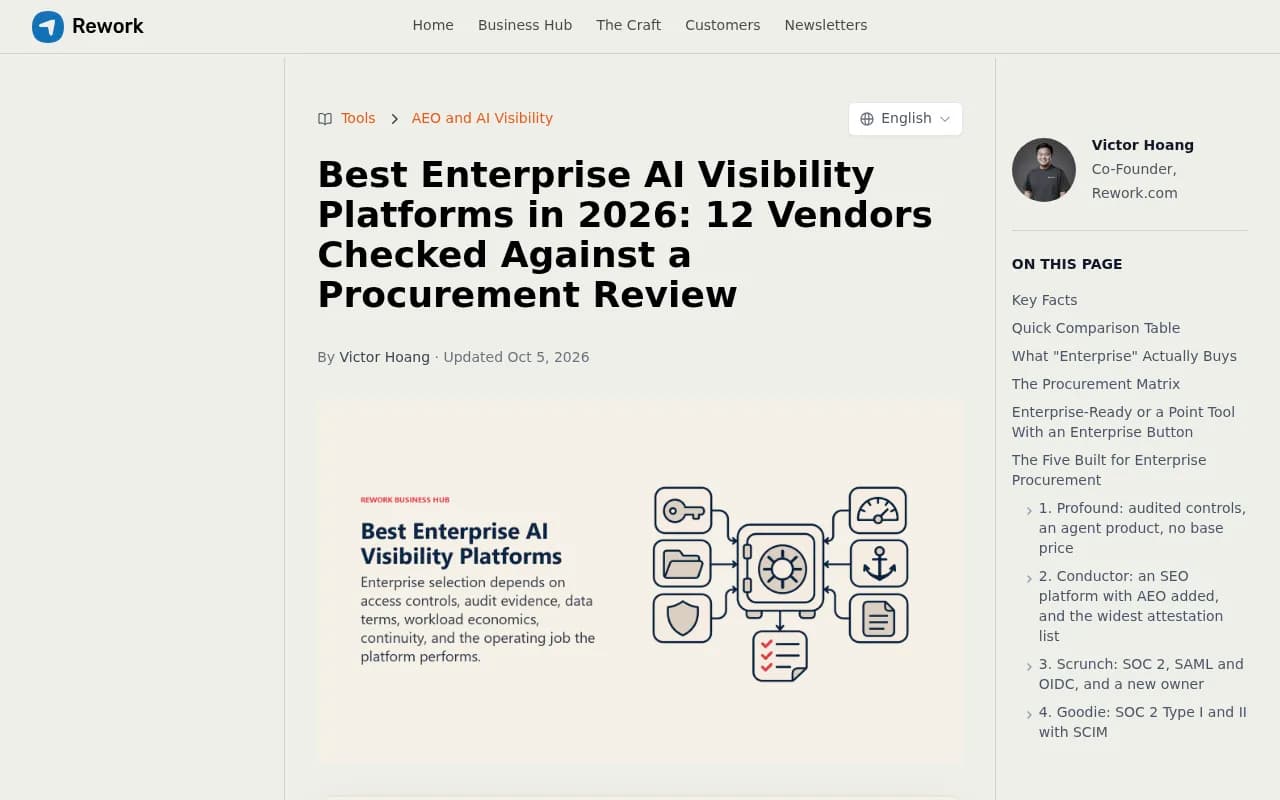
That framing is what this guide follows. Security sign-off for AI visibility tools can take several weeks at larger companies, so the goal is to walk into that process with the evidence already collected.
Where AthenaHQ stands
AthenaHQ is a reasonable starting point for the checklist because it publishes more than many competitors. According to the research I pulled, Enterprise adds SAML and OIDC single sign-on, audit logs, a 2-hour SLA, a dedicated Slack channel, multi-region and multi-language tracking, persona targeting, and executive dashboards that feed Tableau, Power BI and Looker. It also publishes a MSA and DPA, which is rare, and one reviewer flagged that as the reason it suits buyers who mark up contracts first.

The gaps matter for procurement. The SOC 2 type is not stated in the sources I found. SCIM is not stated. Enterprise pricing is not published, and one workload-pricing exercise found that the Starter tier ($295/mo, with a free Essential tier of 300 credits) covered only 3,600 of the 27,000 credits a realistic workload needed, which forces you onto Enterprise anyway.
If your security team needs ISO 27001, SCIM or a stated SOC 2 Type II, that is where you start looking at alternatives.
The procurement matrix
The table below combines what the published sources say about SSO, SCIM and customer-facing audit logs. "Not stated" means the sources did not confirm it, not that the vendor lacks it. Confirm each cell with the vendor.
| Vendor | SSO | SCIM | Customer audit log |
|---|---|---|---|
| Profound | SAML or OIDC, Enterprise | Yes | Yes, Enterprise |
| Conductor | SAML | Not stated | Not stated |
| Scrunch | SAML, OIDC, Enterprise | Not stated | Yes |
| AthenaHQ | SAML, OIDC, Enterprise | Not stated | Yes |
| Goodie | SAML | Yes | Not stated |
| Otterly | SAML via Clerk, Enterprise | Not stated | Not stated |
| Rankscale | Custom plan only | Not stated | Not stated |
| Trakkr | Enterprise | Not stated | Not stated |
| Semrush | SAML on Guru and Business plans | Not stated | Not stated |
| Ahrefs | SAML 2.0, Enterprise | Via support | Yes, Enterprise |
The pattern is clear. SSO is common, usually gated to Enterprise. Audit logs are less common. SCIM is the thinnest of the three, so if automated deprovisioning is a hard requirement, it should be an explicit RFP question rather than an assumption.
Certifications compared
SSO and audit logs are product features. Certifications are the evidence behind the vendor's security program. Here is what the sources say about each, with the caveat that several of these come from vendors' own pages.
| Vendor | SOC 2 | ISO 27001 | Notes |
|---|---|---|---|
| Conductor | Type II | Yes (also ISO 42001) | Annual pen test; DPA terms published |
| Scrunch | Type II | Not on public pages | SAML, OIDC, RBAC, audit logs |
| Profound | Type II | Not on public pages | SSO, SAML, SCIM; completed a HIPAA assessment |
| AthenaHQ | Type not stated | Not confirmed | Public MSA and DPA, audit log |
| BrightEdge | Not confirmed here | Listed on its trust page | Enterprise SEO suite |
| Ahrefs | Not yet certified | Reported via a third-party case study only | SAML, audit log, DPA |
| Promptwatch | Not confirmed here | Certified, Oct 26, 2026 | See below |
| OptimizeGEO | Self-claimed attestation | Self-claimed | Verify independently |
One caution on the last row. OptimizeGEO's own compare page says it is ISO 27001 certified, holds SOC 2 attestation and is GDPR compliant, and it is a flat $1,999 a month self-serve product. That is a vendor self-claim. Promptwatch's check did not mention it, so treat it as something to verify with a certificate rather than a fact.
How to verify an ISO 27001 claim
ISO 27001 is where most procurement teams get fooled, so it is worth being precise.
- Check the version. The current standard is ISO/IEC 27001:2022, with 93 Annex A controls in 4 themes. The transition from the 2013 version ended October 31, 2025, so any certificate shown to you in 2026 should reference the 2022 version. Certificates issued since 2024 show "+ Amd1:2024".
- Demand a certificate, not a statement. "Aligned with" or "compliant with" ISO 27001 is weaker than a certificate from an accredited body.
- Read the scope. A certificate covers only the systems and processes named in it. A cert for the parent company's HR systems tells you nothing about the SaaS product you are buying.
- Ask for the Statement of Applicability. It shows which controls were included or excluded and why.
- Check validity. Certificates run three years with annual surveillance audits. Confirm the expiry and that surveillance audits are current.
- Review the DPA separately. ISO 27001 does not replace a data processing agreement.
As a worked example of what good evidence looks like, Promptwatch published the details of its certification: ISO/IEC 27001:2022 + Amd1:2024, issued October 26, 2026 by ProCertify B.V. (accredited by the Dutch Accreditation Council, registration C 707), certificate no. 27001 26102026.2, valid until October 26, 2029. The scope covers the ISMS for development, implementation and customer support of the SaaS, and the Statement of Applicability (v1.0, dated September 14, 2026) is available on request. Whatever vendor you evaluate, that is the level of detail you should be able to get.

To be fair about sourcing, the claim that Promptwatch was the only AI-native platform with its own ISO 27001 certificate comes from Promptwatch's own check on October 26, 2026. It is a first-party claim. Re-run the check yourself before you rely on it, because vendors certify quickly once buyers start asking.
Shortlist by situation
You need the strongest published security paperwork
Conductor and Scrunch publish the most. Conductor lists SOC 2 Type II, ISO 27001, ISO 42001 and annual penetration tests, and covers nine AI engines across more than 160 countries. Its weakness, per one review, is that it is SEO first and AEO second. Scrunch holds SOC 2 Type II with SAML and OIDC SSO, RBAC and audit logs, plus a real-time bot feed for GPTBot, PerplexityBot and ClaudeBot. It is now Sitecore-owned and SAML is Enterprise only.
You need SCIM and a mature enterprise process
Profound is the common pick here: SOC 2 Type II, SSO over SAML or OIDC, SCIM, an Agency Mode for multi-brand teams, and a customer audit log on Enterprise. It reportedly raised a $96M Series C in February 2026, which helps the "will this company exist" question. The trade-offs are custom pricing (one comparison puts it at $2,000 to $5,000 or more a month) and no ISO 27001 on its public security pages.
Profound

You want ISO 27001 and an AI-native product that acts on the data
This is where Promptwatch fits. It holds its own ISO 27001 certificate, is GDPR compliant with data handled by an EU-based company, and on Business and Enterprise plans adds an organization audit log that records whether each change came from the dashboard, the API, an MCP client or Agent Chat. Enterprise adds SSO. Scoped API keys and owner, editor and viewer roles cover access control below that.
Promptwatch is also the broader product. It tracks from the real interfaces of ChatGPT, Gemini, Perplexity, Google AI Overviews, Google AI Mode and others, logs AI crawler visits with IP verification, and has a Content Agent that writes and publishes the pages AI cites. For a security team that matters less than the certificate, but it explains why a marketing team would push for it. Business is $579/mo, with Enterprise on custom pricing; confirm current numbers at promptwatch.com/pricing. You can compare it directly with the other tools, or see the AthenaHQ head-to-head.
You want a printed price
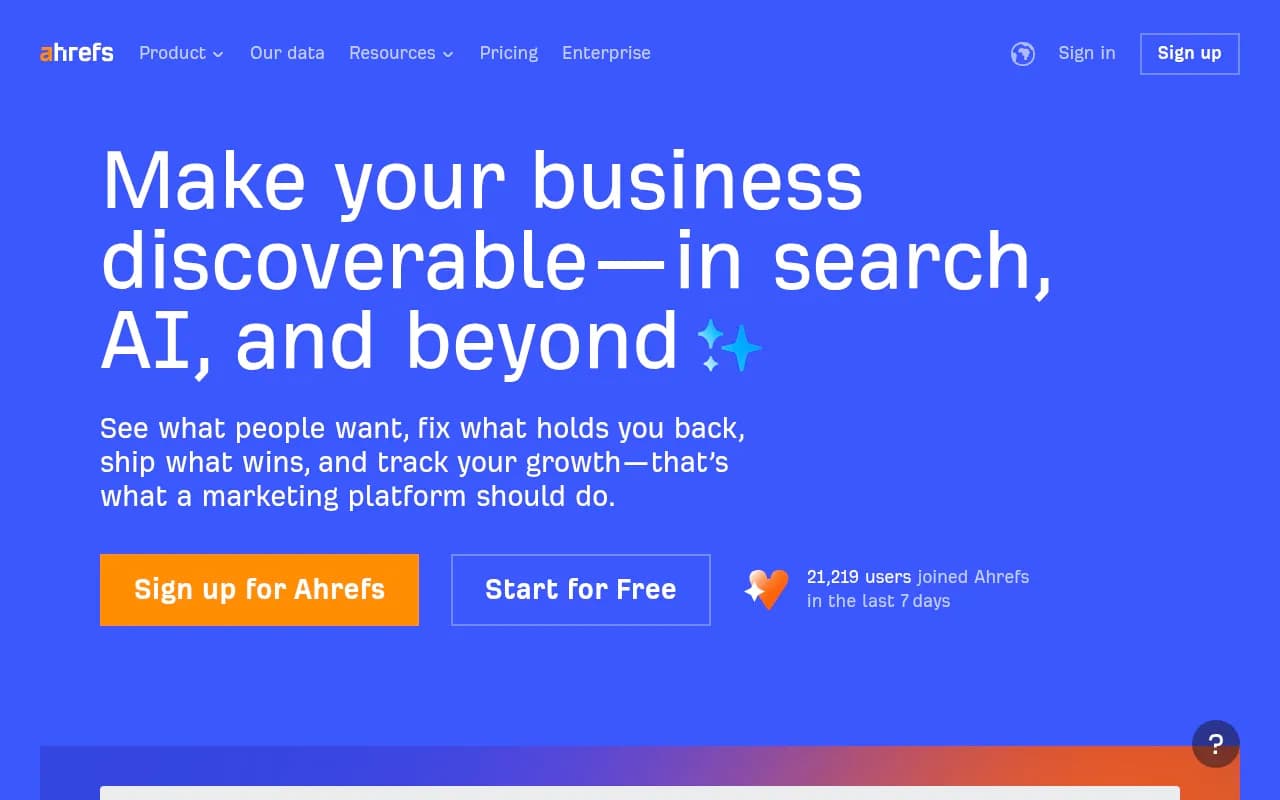
Ahrefs publishes an Enterprise price of $1,499 a month (annual commitment) with an invoice, SAML 2.0, audit log and DPA, but it is not yet SOC 2 certified. Trakkr starts from $1,000 a month billed annually with Enterprise SSO. If procurement needs a fixed number for a budget request, these two are the easiest to put in front of finance.
You already run an enterprise SEO suite
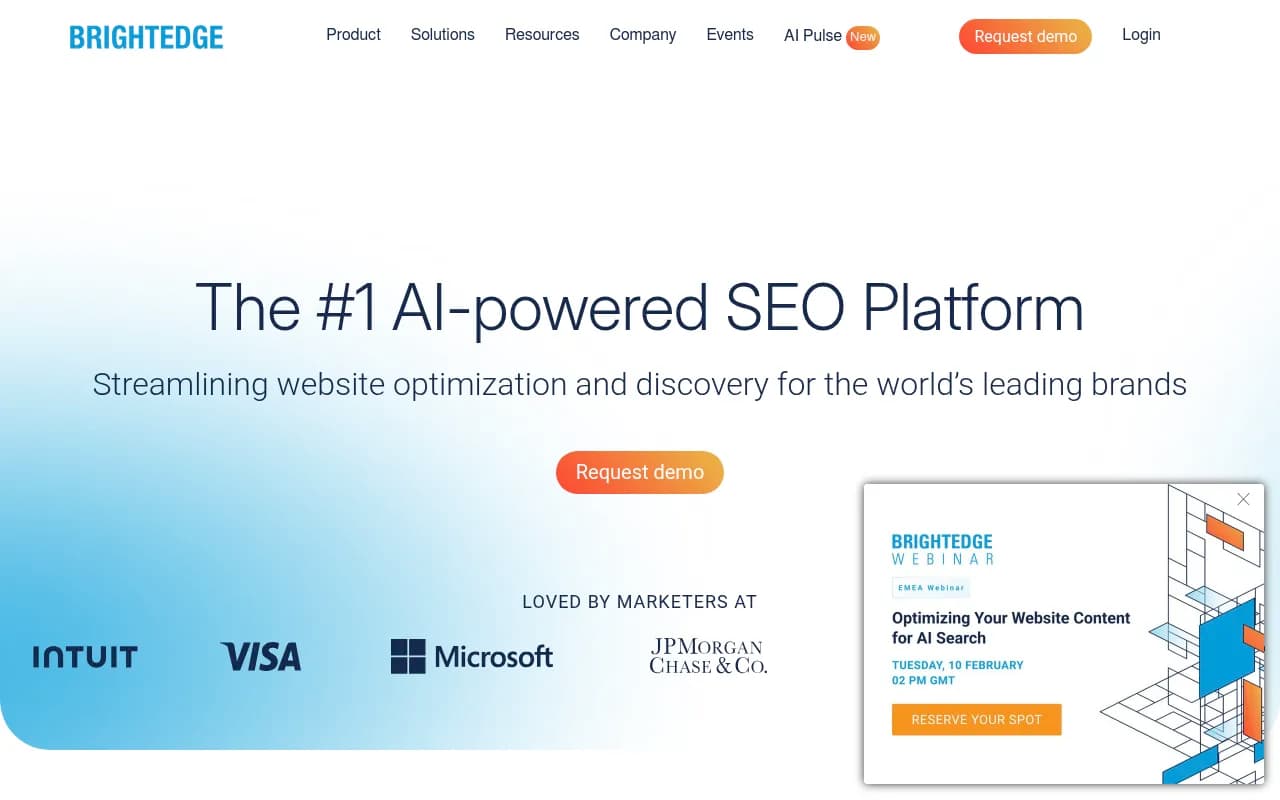
BrightEdge lists ISO 27001 on its trust page, and Semrush offers SAML on its Guru and Business plans. Both are traditional SEO suites that added AI tracking, so expect shallower AI-specific data than the purpose-built tools. The upside is one contract and one security review.
Scoring framework and RFP questions
The independent review suggests weighting criteria by what blocks sign-off. A simple version you can adapt:
| Criterion | Suggested weight | Evidence to request |
|---|---|---|
| Access control (SSO, SCIM, audit log) | 20% | Config doc and the plan tier it requires |
| Certifications (ISO 27001, SOC 2 Type II) | 20% | Certificate, scope statement, report under NDA |
| Data handling (DPA, hosting region, retention) | 20% | Signed DPA, subprocessor list |
| Contract terms (MSA, SLA, exit) | 15% | Redlinable MSA, SLA with credits |
| Product fit (engines, regions, crawler data) | 15% | Trial on your own prompts |
| Vendor continuity | 10% | Funding, ownership, customer references |
The weights are my suggestion, not a standard. Adjust them to your risk profile.
Questions to send every vendor
- Which plan includes SSO, SCIM and audit logs, and what is the price at that tier?
- Is SSO enforceable, meaning can we block password logins entirely?
- Does the audit log cover API, MCP and AI-agent actions, or only dashboard clicks?
- Is the audit log exportable, and for how long is it retained?
- Do you hold ISO 27001:2022? Send the certificate, the scope and the Statement of Applicability.
- Which SOC 2 report do you hold (Type I or Type II), and what is the audit period?
- Where is data hosted and processed, and who are the subprocessors?
- What data do you collect from our site (crawler logs, visitor analytics), and which fields?
- What happens to our data on contract termination?
- Who owns the company, and has ownership changed recently or is it likely to?
The last one is not paranoia. Scrunch being Sitecore-owned changes the roadmap and contract picture compared with an independent vendor.
Don't forget crawler and visitor data
AI visibility tools that install a tracking script or ingest server logs are processing more than prompts. Ask what fields they capture. Promptwatch, for example, limits crawler log records to 10 fields per bot request and verifies visits against operators' published IP ranges, so spoofed bots are filtered out. Promptwatch's AI crawler data shows why this matters: OpenAI was 79.8% of verified AI crawler requests in the week of August 31 to September 6, 2026, down from 94.8% in mid-June. Numbers like that move quickly, so a tool that does not verify IPs can overstate or misattribute bot traffic.
A practical timeline
- Week 1: Send the RFP questions above to three or four vendors. Ask for certificates and the DPA in the first email.
- Week 2: Run trials on your own prompts while security reviews the documents. Do not wait for the trial to end before starting review.
- Week 3: Redline the MSA and DPA. Confirm SSO and audit log behaviour in a sandbox.
- Week 4: Final scoring and sign-off.
If you want more options beyond this list, the GEO software directory covers the wider market.
Frequently asked questions
Does AthenaHQ have ISO 27001?
The sources I found did not confirm it, and its SOC 2 type was not stated either. AthenaHQ does publish SSO, audit logs, a MSA and a DPA. Ask the vendor directly and request the certificate.
Is SOC 2 enough, or do we need ISO 27001 too?
They test different things. SOC 2 is an attestation report on controls, common with US buyers. ISO 27001 is a certification of an information security management system, often required by European and global procurement teams. If your policy asks for either, a vendor with one may pass. If it asks for ISO 27001 specifically, SOC 2 will not substitute.
Why is SSO always on Enterprise?
It is a pricing lever. Almost every vendor in the comparison gates SSO to Enterprise or a custom plan. Budget for the Enterprise tier from the start if SSO is mandatory, rather than starting on a lower plan and being surprised.
What is the minimum acceptable audit log?
It should record who changed what and when, include actions from the API and automation, and be exportable. Promptwatch's log, for instance, also records whether a change came from the dashboard, the API, an MCP client or Agent Chat, which is the level of detail worth asking others for.
Can we trust a vendor's own comparison table?
Use them as leads, not proof. Several sources here are vendor-authored, including the OptimizeGEO and Promptwatch pages, and this guide is no exception. Verify every certification claim against a certificate you have in hand.