Key takeaways
- Wellows and MentionBird both publish pricing and both go past mention tracking into citation-gap and ranking advice. Findable has very little verifiable public information, so treat it as a demo-first evaluation.
- Wellows is cheaper per answer (roughly $0.014 to $0.016) and puts all five engines on every plan. MentionBird costs closer to $0.025 per run and limits engines by tier.
- Both vendors have contradictions on their own sites about which features sit on which plan. Confirm in writing before you pay.
- Almost all head-to-head comparison content on these tools is written by the vendors. Run a one-month trial on the same prompts instead.
- If you need crawler logs, AI traffic attribution and content publishing in one place, a broader platform such as Promptwatch is worth a look.
What a citation-gap tool actually does
A citation gap is a source that AI engines cite for your category prompts, usually alongside your competitors, where you are absent. Find enough of them and you have a content and outreach to-do list.
Mention trackers answer a simpler question: was my brand named? Citation-gap tools care about the links underneath the answer. Which pages did the engine read? Which domains keep appearing? Which of those never mention you?
That distinction matters because AI answers are crowded. In Promptwatch Data's report on unique domains per ChatGPT response (Sep 28 to Oct 4, 2026), 47.6% of cited responses cited 10 or more domains. Only 6% cited three or fewer. With that many sources per answer, one prompt tells you very little. You want a tool that aggregates across many prompts and shows who is cited next to you.
The format of those sources matters too. In Promptwatch's ChatGPT content type data for the same week, product pages were 22.4% of classified citations, landing pages 16.8%, listicles 13.6% and how-tos 8.7%. A tool that breaks cited pages down by format tells you what to build, not only where you are missing.
The three tools at a glance
I'll be upfront about the evidence. Wellows and MentionBird both have public pricing pages I could work from. Findable does not give me much to go on, and I would rather say so than invent features.
| Findable | Wellows | MentionBird | |
|---|---|---|---|
| Public pricing | Not verified, check getfindable.com | Yes, $29 to $497/mo | Yes, $79 to $299/mo, Custom by quote |
| Free trial | Unknown | 7 days | None |
| Engines | Unknown | All 5 on every plan | 2, 4 or 8 depending on tier |
| Billing unit | Unknown | Credit: 1 prompt x 1 engine x 1 day | Run: 1 prompt on 1 platform once a day |
| Citation tracking | Unknown | Yes, two checks (named vs cited) | Yes, by source type, format, domain authority |
| Action layer | Described as optimization platform | Quick Wins, Content Opportunities, KIVA writing agent | Ranking-advice agent, YouTube summaries |
| Best for | Needs a demo | Budget-conscious teams, agencies | Teams that want advice per prompt |
Findable
Our catalog lists Findable at getfindable.com as an AI search visibility optimization platform. That is about all I can responsibly say. When I looked for independent coverage and an official pricing page, I found nothing usable, and searches kept returning Searchable, which is a different product.
If Findable is on your shortlist, ask them these questions on the first call:
- Which engines are tracked on the plan you would actually buy?
- Are citations recorded as URLs, or only as brand mentions?
- How many prompts are checked per day, and on what schedule?
- Can you export raw cited URLs to CSV?
- What is the price at the scale you need, not the entry tier?
If the answers are vague, that tells you something. If they are sharp, Findable earns a place in the trial round below.
Wellows
Wellows uses a credit model. One credit buys one answer: one prompt, on one engine, for one day. Every plan covers ChatGPT, Gemini, Perplexity, Google AI Overviews and Google AI Mode, and every plan has unlimited projects, prompts and seats plus a 7-day trial, per its pricing page.
| Plan | Price/month | Answers/month | Prompts on all 5 engines daily |
|---|---|---|---|
| Basic | $29 | 1,800 | 12 |
| Standard | $97 | 6,500 | 43 |
| Growth | $249 | 18,000 | 120 |
| Scale | $497 | 36,000 | 240 |
Do the division and the cost per answer lands around $0.016 on Basic and $0.014 on Growth and Scale. That is cheap. The catch is that 12 prompts a day across all five engines is a small footprint. Most teams will either run fewer engines per prompt or move up a tier quickly.
Wellows does two citation checks: where the answer names you outright, and where your domain sits among cited pages without being named. That second check is the useful one for gap work, because a page that gets cited but never names you is a content problem you can fix.
Two cautions. First, the pricing page lists features per plan (Content Opportunities and Search Console on Standard, white-label dashboards on Growth, outreach on Scale), and then also says every feature ships on every plan. Those cannot both be true. Ask which one is current. Second, Wellows publishes its own data on engine overlap. It claims 79.6% of website and question pairs were cited by exactly one of five engines, and only 0.31% by all five. That is vendor data, published on a blog that ranks Wellows first, so take it as a reasonable hint rather than a benchmark. It does support a point I believe: you need more than one engine in the picture.
MentionBird
MentionBird bills in runs. A run is one prompt asked on one platform once a day, resets daily and does not roll over. There is no free trial and no free plan, per its pricing page.
| Plan | Price/month | Runs/day | Platforms | Brands |
|---|---|---|---|---|
| Starter | $79 ($66 annual) | 100 | ChatGPT, Gemini | 1 brand, 5 competitors |
| Growth | $299 ($249 annual) | 400 | ChatGPT, Gemini, Perplexity, Claude | 3 brands, 10 competitors each |
| Custom | Quote | Unlimited | All 8, incl. Grok, AI Overviews, Copilot, DeepSeek | Unlimited |
Over a 30-day month, 100 runs a day is about 3,000 runs, so Starter works out near $0.026 per run and Growth near $0.025. That is roughly 60 to 80% more per answer than Wellows. What you get for it is a deeper analysis layer.
The citation view shows which sources AI builds answers from, split into your pages, competitor pages and earned coverage. It breaks sources down by type (news, forums, reviews, docs) and by content format, puts a domain authority number on every cited site, and gives page details per URL. There are also visibility and prominence scores, average position, share of voice, history up to 365 days, and prompt difficulty and volume scores on a 1 to 10 scale.
The ranking-advice agent (the "how do I get recommended?" feature) costs 5 credits per plan, so the 100 monthly credits on Starter stretch to about 20 plans. Extra credits are $99 per 500, and extra runs are $49 per 50.
A few things to watch. Starter covers only two engines, so Google AI Overviews is not in the cheap plan. MentionBird's own blog says it tracks eight platforms and attaches ranking advice to every paid tier, but only Custom covers all eight. Also, there is a promo code inconsistency (PH19 in the banner, TRY19 in the page meta description), so check before quoting a launch price.
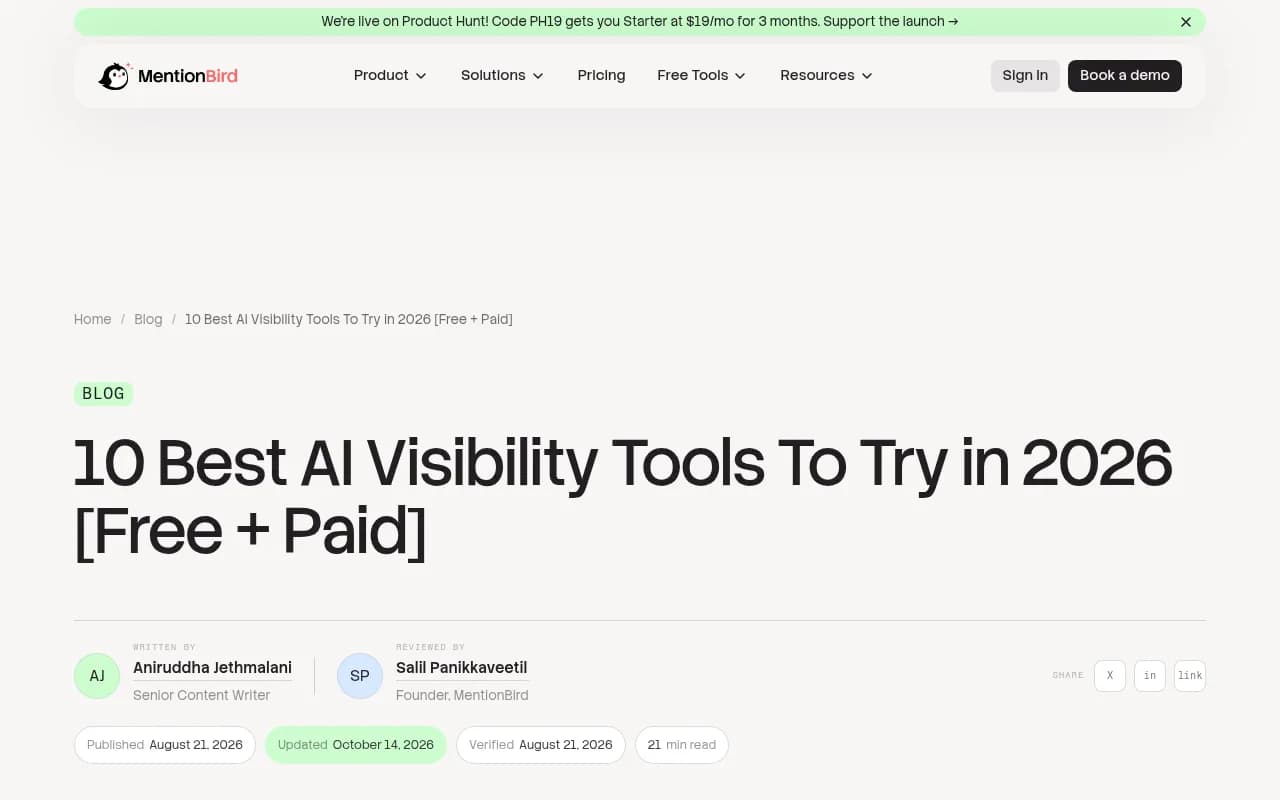
That screenshot is a good reminder of the source problem. MentionBird's roundup ranks MentionBird number one. Wellows' blog ranks Wellows number one. Neither is lying, but neither is a neutral review.
Head to head: which one for which job
If price per answer drives the decision
Wellows. The credit math is better, all five engines are included on every plan, and the 7-day trial lets you test before spending. It suits agencies with multiple clients and anyone who wants broad engine coverage without a tier jump.
If you want advice attached to each prompt
MentionBird. The ranking-advice agent, prompt difficulty scores and source-type and format breakdowns are aimed at people who want to know what to do next, not just where they stand. Expect to pay more and expect to buy up a tier for engine coverage.
If you are still undecided
Buy neither on a pitch. Run the same 30 to 50 prompts through each tool for a month and compare the cited URL lists directly. Findable belongs in that comparison if its demo holds up.
How to compare them fairly
Day-to-day citation volatility is large. In Qvery's July 2026 records (itself a vendor), only 37.10% of the pages a ChatGPT answer cited had been cited for the same question the day before, and 28.84% on Google AI Mode. Two tools sampling on different days will show different pages and both be right.
So compare on counts across the same month, and pay attention to the pricing traps Capterra flags in its buying guide: prompt credits that are not recurring daily prompts, engine add-ons, seat limits, per-domain agency pricing, and export gating. Rankability makes the same point about credits, and I agree. Always normalize to prompts x engines x frequency.
A practical test plan:
- Pick 40 prompts across commercial, informational and branded intent.
- Run all three tools on the same engines for 30 days.
- Export every cited URL with date and engine.
- Count how many gap sources each tool flagged that you could act on.
- Check that the recommended action was something a writer could actually do on Monday.
The last step is where tools diverge most. A gap list is only worth something if it turns into a page or a pitch.
When these three are not enough
Citation-gap tools stop at the data and, in some cases, the advice. If you also need to know whether AI crawlers can read your pages, what traffic AI answers send you, and then have content written and published against the gaps, that is a broader category.
Promptwatch covers that end to end: it tracks real ChatGPT, AI Overviews and Gemini interfaces, shows IP-verified AI crawler logs and AI visitor analytics, and its Content Agent can publish to WordPress, Webflow or Framer, then track whether each page gets crawled and cited. Plans start at $95/month for Essential, so confirm current pricing at promptwatch.com/pricing.

Other names that come up in this space include Peec AI and Profound, both of which are in our catalog.

Profound

For a wider shortlist, the GEO software directory at bestgeosoftware.com lists far more options.
Final take
Wellows is the safer value pick on the evidence available: transparent credits, five engines everywhere, a trial. MentionBird costs more per answer but has the more analytical citation view and ranking advice. Findable is a question mark until you see a real demo and a real price.
I would not trust any single vendor's blog to settle this. Pick two, run the same prompts for a month, and let your own exported URL lists decide.