Key takeaways
- Hall AI was a solid entry-level AI visibility tracker, but it lacked content generation, crawler logs, and deep prompt analytics -- the things teams actually need to act on what they find.
- Promptwatch covers everything Hall did, plus adds Answer Gap Analysis, AI Content Agents, real crawler logs, and traffic attribution that connects AI visibility to actual revenue.
- Former Hall users typically land on Promptwatch because it's the only platform in this space rated as a "Leader" across monitoring, optimization, and content generation -- not just one of those three.
- Pricing starts at $99/month, which is competitive with what Hall charged, and a free trial is available.
- If you're mid-migration and evaluating options, this guide walks through the honest differences -- including where Promptwatch isn't the right fit.
If you were using Hall AI, you've probably already gotten the news. The platform is winding down, and you're now in the uncomfortable position of needing to find a replacement fast -- ideally one that doesn't require rebuilding your entire workflow from scratch.
This guide is for that situation. Not a generic "top 10 GEO tools" roundup, but a direct comparison of what Hall actually did, what Promptwatch does, and whether the switch makes sense for your team.
What Hall AI was (and wasn't)
Hall positioned itself as an AI visibility and search optimization platform. The core promise: track how your brand appears in AI-generated answers from ChatGPT, Gemini, Perplexity, and other LLMs.
For teams just getting started with GEO (Generative Engine Optimization), Hall was a reasonable entry point. It gave you a dashboard, some prompt tracking, and a sense of where your brand was showing up. That's genuinely useful when you're trying to convince a skeptical stakeholder that AI search visibility is worth caring about.
But the limitations were real. Multiple reviews and alternative roundups from early 2026 describe Hall as an "entry-level" tracker -- good for getting oriented, not great for doing anything about what you find. The platform didn't generate content. It didn't show you which specific gaps were costing you citations. It didn't log AI crawler activity on your site. And its prompt analytics were shallow compared to what the more mature platforms now offer.
That's not a knock on Hall specifically -- most early GEO tools had the same problem. They were monitoring dashboards that showed you data and then left you to figure out what to do with it.
What you actually need from a Hall replacement
Before jumping to a recommendation, it's worth being clear about what you're replacing. Hall users generally needed:
- Prompt tracking across multiple AI models (ChatGPT, Perplexity, Gemini at minimum)
- Brand citation monitoring -- who's mentioning you, in what context, how often
- Competitor visibility comparison
- Some form of reporting or export
What most Hall users discovered they also needed, once they started using the platform seriously:
- A way to find the specific content gaps causing them to lose citations to competitors
- Tools to actually create content that addresses those gaps
- Visibility into how AI crawlers interact with their site
- Attribution -- connecting AI visibility to traffic and revenue, not just impressions
The first list is table stakes. The second list is where the real value is, and it's where Hall fell short.
How Promptwatch compares to Hall
Promptwatch is the platform most former Hall users are migrating to in 2026, and the reasons are fairly straightforward once you look at the feature sets side by side.

Monitoring coverage
Hall tracked a handful of AI models. Promptwatch monitors 10: ChatGPT, Perplexity, Google AI Overviews, Google AI Mode, Claude, Gemini, Meta/Llama, DeepSeek, Grok, Mistral, and Copilot.
That breadth matters more than it might seem. Different AI models cite different sources, and a brand that's visible in ChatGPT might be invisible in Perplexity or Google AI Mode. If you're only tracking two or three models, you're missing a significant portion of the AI search landscape.
Promptwatch also tracks how AI search engines behave in real user interfaces, not just through API calls. This is a meaningful distinction -- user-facing answers, citations, and shopping recommendations can differ from what you'd see querying the API directly.
The gap between monitoring and optimization
This is the core difference, and it's worth spending a moment on it.
Hall showed you where you were visible. Promptwatch shows you where you're visible, where you're not, why, and what to do about it.
The Answer Gap Analysis feature is the clearest example. It identifies specific prompts where your competitors are getting cited but you aren't -- not in the abstract, but with the actual prompt text, the competitor's cited content, and what's missing from your site. You're not left to guess what to fix. You can see the exact content gap.
From there, Promptwatch's Content Agents generate articles, listicles, comparisons, and content briefs grounded in real prompt data, citation patterns, and competitor analysis. This isn't generic AI content -- it's built around the specific gaps the platform identified. The workflow is: find the gap, generate content to fill it, track whether citations improve.
Hall had no equivalent of this. You could see where you were losing, but you had no tools to fix it inside the platform.
AI crawler logs
This is a feature Hall didn't have, and it turns out to be more important than it sounds.
Promptwatch logs real-time AI crawler activity on your site -- which pages ChatGPT, Claude, Perplexity, and others are reading, how often they return, what errors they encounter, and when a page moves from "crawled" to "cited." This is how you find out that a key page is returning a 404 to GPTBot, or that Perplexity is crawling your blog but not your product pages.
Without crawler logs, you're flying blind on the technical side of AI visibility. You can optimize content all day, but if the crawlers aren't reading it, nothing changes.
Prompt intelligence
Promptwatch assigns volume estimates and difficulty scores to each prompt, plus shows query fan-outs -- how one prompt branches into sub-queries. This lets you prioritize. Instead of tracking 50 prompts with equal weight, you can focus on the high-volume, winnable ones first.
Hall's prompt analytics were considerably thinner. There was no difficulty scoring, no volume data, and no fan-out analysis.
Traffic attribution
This one matters for anyone who's had to justify GEO investment to a CFO or CMO. Promptwatch connects AI visibility to actual website traffic and revenue, not just citation counts. You can see which AI-driven citations are sending visitors to your site and what those visitors do when they get there.
Hall had no attribution layer. You could track citations, but you couldn't connect them to business outcomes.
Feature comparison table
| Feature | Hall AI | Promptwatch |
|---|---|---|
| AI models tracked | Limited (3-5) | 10 (ChatGPT, Perplexity, Gemini, Claude, Grok, DeepSeek, Copilot, Meta/Llama, Mistral, Google AI Mode) |
| Brand citation monitoring | Yes | Yes |
| Competitor visibility comparison | Basic | Yes, with heatmaps |
| Answer Gap Analysis | No | Yes |
| AI content generation | No | Yes (Content Agents) |
| AI crawler logs | No | Yes |
| Prompt volume & difficulty scoring | No | Yes |
| Query fan-outs | No | Yes |
| Traffic attribution | No | Yes |
| Reddit & YouTube tracking | No | Yes |
| ChatGPT Shopping tracking | No | Yes |
| Multi-language / multi-region | Limited | Yes |
| Offsite citation analysis | No | Yes |
| API & Looker Studio integration | No | Yes |
Pricing comparison
Hall's pricing was in the entry-level range, which was part of its appeal. Promptwatch is priced similarly for the base tier, with more headroom as you scale.
| Plan | Price | Sites | Prompts | Articles/month |
|---|---|---|---|---|
| Essential | $99/mo | 1 | 50 | 5 |
| Professional | $249/mo | 2 | 150 | 15 |
| Business | $579/mo | 5 | 350 | 30 |
| Agency/Enterprise | Custom | Custom | Custom | Custom |
Annual billing brings the price down further, and there's a free trial if you want to test before committing.
For most Hall users who were on a mid-tier plan, the Essential or Professional tier at Promptwatch covers the same monitoring needs plus adds the optimization layer that Hall was missing.
What other Hall alternatives are out there
Promptwatch isn't the only option, and it's worth knowing what else is in the market. A few platforms come up regularly in Hall alternative discussions:
Otterly.AI -- Good for basic LLM tracking on a budget. Monitoring-only, no content generation or crawler logs.
Otterly.AI

Peec AI -- Strong for multi-language and cross-engine reporting. Better exports than Hall, but still primarily a monitoring tool.

AthenaHQ -- More enterprise-oriented, with a focus on GEO strategy. Solid analytics, but lacks content generation and crawler logs.

Profound -- Strong enterprise feature set, good conversation analytics. Starts at $499/month, which is a significant jump from Hall's pricing.
Profound

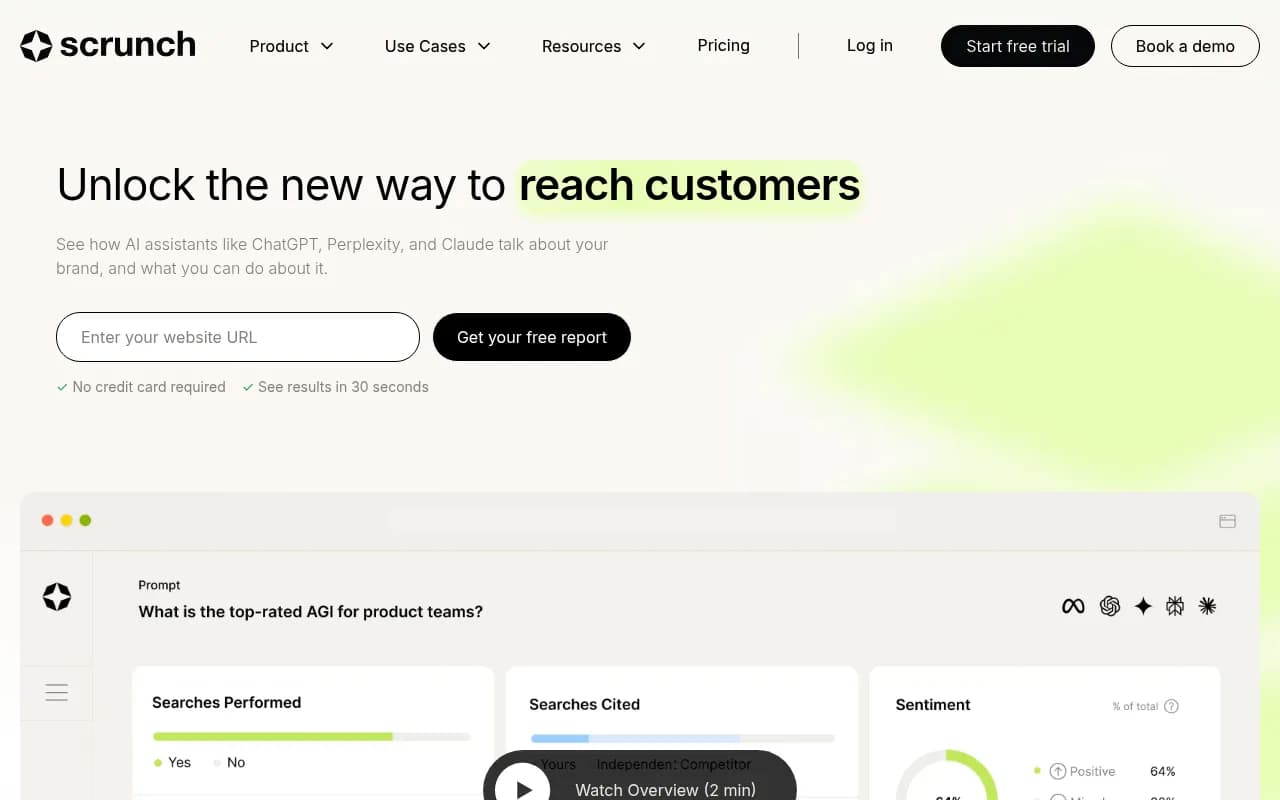
Scrunch AI -- SOC 2 compliant, good for enterprise brand monitoring. Starts at $300/month.
Here's how those alternatives stack up on the dimensions that matter most for former Hall users:
| Tool | Monitoring | Content generation | Crawler logs | Starting price | Best for |
|---|---|---|---|---|---|
| Promptwatch | 10 models | Yes (Content Agents) | Yes | $99/mo | Teams that want to monitor and fix |
| Otterly.AI | 3-4 models | No | No | ~$49/mo | Budget monitoring only |
| Peec AI | 3-5 models | No | No | €89/mo | Multi-language tracking |
| AthenaHQ | 6+ models | No | No | $295/mo | Enterprise GEO strategy |
| Profound | 10+ models | No | No | $499/mo | Enterprise analytics |
| Scrunch AI | 7+ models | No | No | $300/mo | Enterprise brand monitoring |
The pattern is consistent: most alternatives are monitoring-only. If you were frustrated that Hall showed you problems but didn't help you fix them, switching to Otterly or Peec won't solve that. You'll have better monitoring, but you'll still be stuck when it comes to acting on what you find.
Who should consider something other than Promptwatch
Being honest here: Promptwatch isn't the right fit for everyone.
If you were using Hall purely as a lightweight citation monitor -- checking in once a week to see if your brand name appeared -- and you have no interest in content generation or optimization, then a cheaper monitoring-only tool like Otterly.AI might be all you need. You'd save money and not pay for features you won't use.
If you're an enterprise brand with a $500+/month budget and need SOC 2 compliance or deep conversation analytics, Profound or Scrunch AI are worth evaluating alongside Promptwatch.
If your primary need is multi-language tracking across 100+ languages, Peec AI's language coverage is genuinely impressive.
But if you want a platform that does what Hall did and also helps you actually improve your AI visibility -- not just observe it -- Promptwatch is the clearest upgrade path.
Making the migration practical
Switching platforms mid-workflow is always annoying. A few things that make the Hall-to-Promptwatch transition smoother:
First, export whatever data you have from Hall before the shutdown. Citation history, prompt lists, competitor benchmarks -- even if the formats don't import directly, having the historical data lets you establish a baseline in Promptwatch.
Second, start with your existing prompt list. Don't try to rebuild everything from scratch. Import the prompts you were already tracking in Hall, get them running in Promptwatch, and then use the Answer Gap Analysis to find the additional prompts you should be tracking.
Third, connect your website. Promptwatch integrates with Cloudflare, Fastly, Vercel, server logs, Google Search Console, or a tracking snippet. Getting the crawler logs running early means you'll have data on AI crawler behavior from day one, rather than trying to backfill it later.
Fourth, use the Content Agents early. The gap between "I know I'm invisible for this prompt" and "I've published content to fix it" is where most teams stall. The Content Agents compress that gap significantly -- you can go from gap identification to a publishable draft in the same session.
The honest bottom line
Hall was a reasonable starting point for AI visibility tracking. For teams that were just getting oriented in GEO, it served its purpose. But the platform's limitations -- no content generation, no crawler logs, shallow prompt analytics, no attribution -- meant that serious teams were already outgrowing it before the shutdown announcement.
Promptwatch is what Hall would have needed to become to stay competitive. It covers the monitoring side at least as well, and adds the optimization layer that Hall never built. The pricing is accessible, the free trial removes the risk of committing blind, and the feature set is deep enough to grow with your program as AI search becomes a more significant traffic channel.
If you're evaluating options right now, Promptwatch is the most complete replacement available. That's not a sales pitch -- it's just where the feature comparison lands.