Key takeaways
- Peak citation share in AI search is short. Profound's study of 1.19 million page and engine lifecycles found the median page loses half its citation share 11 days after peaking, and 78% fall to half-peak within two weeks.
- Promptwatch Data measures something different: whether ChatGPT cites a page again at all. By that measure, landing pages and docs hold for months, while news loses half its pages in 36 days.
- Both findings can be true at once. A page can still be cited occasionally while its share of citations has already halved.
- Content type, engine, and breadth of citation all predict lifespan. Pages cited by five or more engines are 5.5x as likely as single-engine pages to still be above half-peak after eight weeks.
- Practical plan: keep landing pages, docs, comparisons, and listicles accurate for the long haul, and treat news and announcements as short bursts.
Why this question has two answers
If you search for how long a page stays cited in ChatGPT, you will find numbers that look contradictory. One study says 11 days. Another says 36 to 77 days. A third says 3.4 weeks. A fourth says 62% of citations disappear within 90 days.
They are not fighting each other. They measure different things, and once you see how, the data becomes useful instead of confusing. This guide walks through the main 2026 studies, what each one actually counts, and what to do with the results.
The short version: peak citation share is brief, but being cited at all can last a long time for the right kind of page.
The Profound study: an 11-day half-life
Profound published the most-quoted number in September 2026. Davis McCain's team measured 883,000 pages across ChatGPT, Perplexity, Claude, Google AI Overviews, Google AI Mode, Gemini, and Microsoft Copilot over twelve months. Each page is measured separately on each engine, which gives 1.19 million page and engine lifecycles.
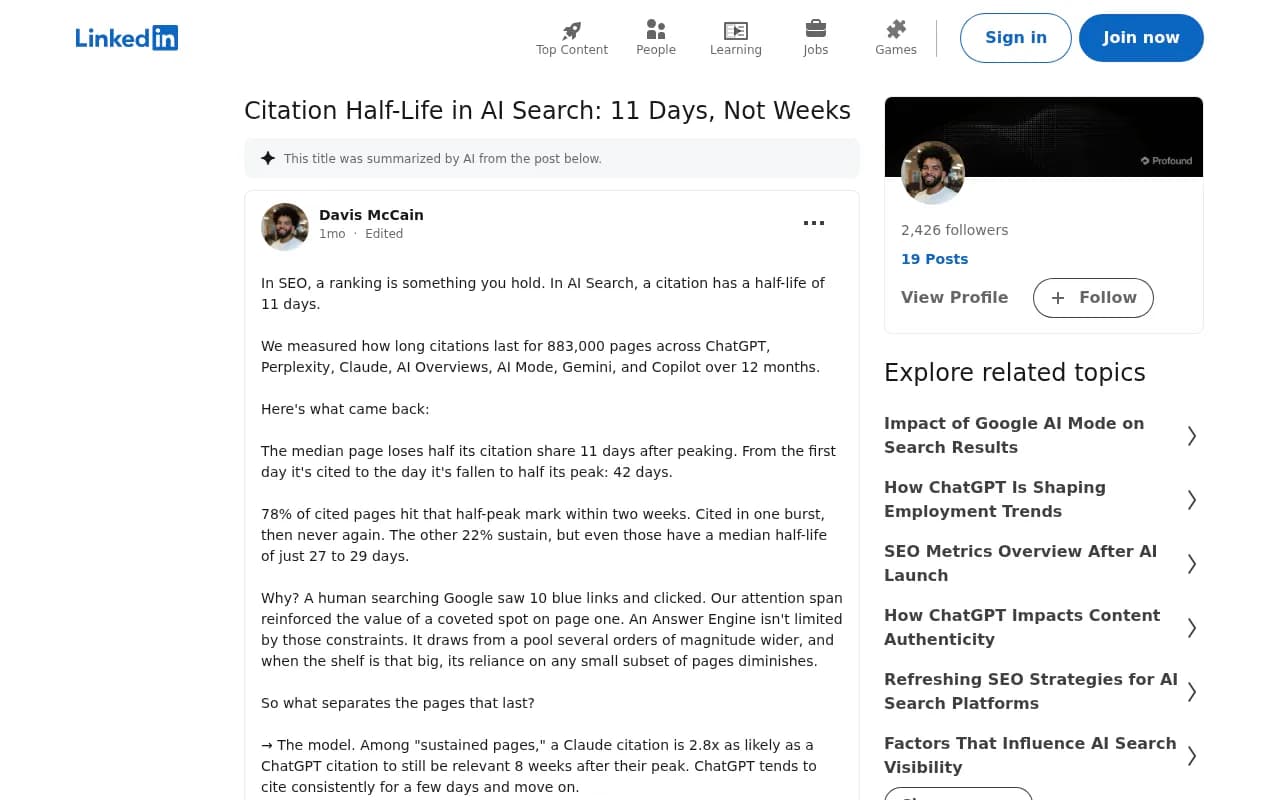
Profound reported these headline numbers:
- The median page loses half its citation share within 11 days of peaking.
- The median interval from a page's first citation to the point where it has lost half its peak share is 42 days.
- 78% of cited pages fall to half their peak within two weeks. The other 22% have a median half-life of 27 to 29 days.
Profound

How Profound defines half-life
The definition matters more than the headline. For each page and engine, Profound computes daily citation share: the page's citations divided by all citations that engine issued that day in the page's category. That series is smoothed with a trailing 14-day average. The peak is the maximum of the smoothed series. Half-life is the number of days from the peak until the smoothed share falls to half and stays there for 14 consecutive days.
Two consequences follow. First, it measures share relative to other pages, not whether a page is cited at all. Second, the 14-day smoothing window caps the half-life of a page cited in a single burst at around two weeks. That is why so many pages land at or just under 14 days. Profound says as much in its own write-up, and a commentary on the study by Rhinegold makes the same point: most of this is ordinary rotation, not a loss that demands action.
What separates pages that last
Profound found four patterns.
- Engine matters. Among sustained pages, a Claude citation is 2.8x as likely as a ChatGPT citation to still be relevant eight weeks after peak. Perplexity and Claude return to a page repeatedly over weeks. ChatGPT, Google AI Mode, and Gemini tend to cite a page intensively for a few days and then move on.
- Engines don't move together. Cross-engine correlations of decay timing run only 0.03 to 0.09. A page fading on one engine tells you almost nothing about another.
- Breadth predicts longevity. See the table below.
- Date-bound content fades first. News, announcements, and research reports decay fastest on every engine. Comparisons and reviews, explanatory content, and commercial pages are 1.4 to 1.6x more likely to remain above half-peak after eight weeks.
| Engines citing the page | Pages | Median rise | Still above half-peak at day 56 |
|---|---|---|---|
| 1 | 679,077 | 19 days | 1.2% |
| 2 | 275,530 | 31 days | 2.0% |
| 3-4 | 190,439 | 33 days | 3.5% |
| 5 or more | 43,770 | 46 days | 6.8% |
Notice the absolute numbers. Even for the best group, only 6.8% of pages are still above half-peak at day 56. The 5.5x multiplier is real, but it is a multiple of a small number.
The Promptwatch study: survival in ChatGPT
Promptwatch Data took a different approach. In What Is the Half-Life of Content in ChatGPT?, Klaas Foppen took every classified page ChatGPT cited on July 6, 2026 (day 0) and tracked those pages for 90 days, through October 4. Each line on the chart shows the share of day-0 pages that ChatGPT still cited on that day or later. A content type hits its half-life where its line crosses 50%.
That is a survival measure. It asks "is this page ever cited again?", not "how heavily?".
Promptwatch is an AI visibility platform, and this dataset comes from its real-UI monitoring of AI platforms.

Results by content type
| Content type | Still cited at 30 days | Still cited at 60 days | Half-life |
|---|---|---|---|
| Landing pages | 78% | 69% | Likely near or beyond 90 days |
| Docs | 76% | 67% | Likely near or beyond 90 days |
| Comparisons | 72% | 63% | Likely near or beyond 90 days |
| Listicles | n/a | 60% | Likely near or beyond 90 days |
| Product pages | n/a | about 55% | 74 to 77 days |
| Reviews | n/a | about 55% | 74 to 77 days |
| How-to guides | n/a | about 55% | 74 to 77 days |
| News | n/a | 41% | 36 days |
A few details worth pulling out:
- Docs have the smallest drop right after day 0. ChatGPT cited 93% of them again later, against 77% of news pages.
- Almost a quarter of news pages are never cited again after day 0.
- Pricing pages are classified as landing or product pages.
- Landing pages, docs, comparisons, and listicles only cross 50% in the final week, and that is an artifact. All lines drop faster at the end because fewer days remain for a page to be cited again. Their true half-life is probably close to or beyond 90 days.
The product page result surprised me. You might assume product pages are the sticky ones, since Promptwatch's content type data shows they are the most cited type in ChatGPT at 22.4% of citations (Sep 28 to Oct 4, 2026). They get cited a lot, but they do not stay cited as reliably as a landing page or a docs page.
Reconciling 11 days with 36 to 77 days
Here is the part most summaries skip. Put the two studies side by side:
| Profound | Promptwatch Data | |
|---|---|---|
| Metric | Decay of smoothed citation share from peak | Share of day-0 cited pages still cited later |
| Engines | 7 engines | ChatGPT only |
| Cohort | Pages with enough citations to qualify | All classified pages cited on July 6, 2026 |
| Smoothing | 14-day trailing average | None |
| Typical result | 11 days median | 36 to 77+ days depending on type |
Profound's metric answers "how fast does a page's slice of the pie shrink after its best stretch?" Promptwatch's answers "does ChatGPT still touch this page at all?" A page can be cited once a week for three months and look healthy by survival, while its share has halved twice from peak.
The 14-day smoothing in Profound's method also caps single-burst pages at about two weeks, so the 11-day median partly reflects how the metric is built. That does not make it wrong. It means you should read it as "peak intensity is fleeting", not "your page is gone in 11 days".
Both views are useful. Peak share tells you how often a page is winning answers right now. Survival tells you whether it remains in the consideration set.
Other numbers you will see
Several other sources circulate, and you should weigh them with the same question in mind: what exactly is being measured?
- A Scrunch study run with Stacker covered 3.5 million citation events from September 2025 to March 2026 and reported an average half-life of 4 to 5 weeks. By platform, ChatGPT came in around 3.4 weeks, Google's AI surfaces around 4.3 to 4.8 weeks, and Perplexity around 5.7 to 5.8 weeks. These figures are repeated across several secondary write-ups. The same coverage says content distributed through editorial networks lasted about 2.1x longer, roughly 10 weeks versus 4.5 weeks.
- A Reddit post in r/GEO_optimization reported that 62% of AI citations disappeared within 90 days, and that cited content skews fresh. That is a community analysis, so treat it as directional.
- Apiserpent reported that content updated in the last 30 days earns about 3.2x more AI citations than older pages. Freshness and citation correlate, though updated pages are also pages someone cares about, so causation is hard to separate.
The direction is consistent everywhere: ChatGPT churns faster than Perplexity, and nothing stays at peak for long.
What this means for your content plan
Expect short peaks, plan for a long tail
Don't judge a page by whether it holds its best week. Judge it by whether it keeps showing up. The Promptwatch data says most evergreen commercial pages do. Profound's data says the intensity drops quickly after a burst. Both lead to the same operating model: publish steadily and keep the pages that matter accurate.
Match the page type to the job
- Landing, pricing, and docs pages are long-term assets. ChatGPT keeps citing most of them for months, so wrong prices or stale features cost you directly.
- Comparison pages and listicles keep more than 60% of their citations after two months in Promptwatch's data. Put lasting effort there.
- Product pages need attention. Keep specs, availability, and prices current rather than assuming they stay cited.
- News and announcements are bursts. Use them for short windows of visibility and don't expect them to carry you.
Set a refresh cadence by engine
If your audience finds you through ChatGPT, the shorter half-life numbers argue for monthly checks on priority pages. Perplexity-heavy audiences can run on a slower cycle, closer to six weeks according to one playbook. Lower-priority evergreen pages can sit on a 90 to 180 day cycle. These cadences are rules of thumb built on the studies above, not guarantees.
Aim for breadth
Profound's 5.5x finding is a good reason to stop optimizing for a single engine. Pages that earn citations on several engines last longer. That tends to mean clear, specific, factual pages that answer a defined question well, and are also available to AI crawlers. Check that crawlers can actually reach them. Free tools like the Agentic Readiness Check show which AI crawlers can read your site.
Keep new content arriving
Profound's closing argument is that queries are getting more specific, so more content has to exist to answer them, and citations decay in weeks, so that content has to keep arriving. I think that is the most practical takeaway in the whole study. A static library of great pages is not enough.
How to track decay on your own pages
You can learn a lot from the aggregate studies, but your own pages are what matter. What you need is a record of which pages are cited, on which engines, and when.
| Need | Option |
|---|---|
| Citation decay view across engines | Profound's Citation Decay view |
| Page-level citation tracking, crawler logs, and content refresh in one workflow | Promptwatch (Page Tracker, AI crawler logs, Content Refresh) |
| Multi-engine monitoring | Tools such as Peec AI, Otterly.AI, or Scrunch AI |
| Page change detection | Page Modified or Visualping |
Profound's Citation Decay view shows the rise, peak, and half-life of every URL an answer engine cites. Promptwatch's Page Tracker shows which prompts and responses cite a given URL, its AI crawler logs show whether bots can still read the page, and Content Refresh suggests updates for pages that are slipping. If you want to see where you stand first, the free AI visibility report needs no login.

Otterly.AI

For a wider look at the category, the directory at bestgeosoftware.com lists GEO platforms side by side.
Caveats worth keeping in mind
- Different methods give different numbers. Don't compare an 11-day share half-life against a 77-day survival half-life.
- The Promptwatch cohort is one day (July 6, 2026) and one engine, ChatGPT. Behavior may shift with model updates. Promptwatch has also documented a drop in citations per ChatGPT response around the GPT-5.3 rollout, so the baseline moves.
- Profound's data covers pages that qualified with at least 5 citations at their smoothed peak, so very lightly cited pages are not in it.
- Both studies come from vendors who sell citation-tracking software. The data is useful, but read it with that in mind.
- Survival windows end. Promptwatch notes that all lines drop faster in the final week purely because of the window.
Bottom line
A page does not stay at peak citations for long. Profound's 11-day median says the best stretch is short, and most pages never have a second one. But Promptwatch's data says that for landing pages, docs, comparisons, and listicles, ChatGPT keeps citing most of them for two months or more. News is the outlier, losing half its pages in 36 days.
So build a mix. Keep a core of accurate, durable pages that you review monthly. Add new, specific pages continuously. Use announcements for short bursts. And measure your own pages, because your half-life depends on your content type, your engines, and how many of them cite you.