Key Takeaways
- AI search engines pull from multiple content formats — not just blog posts. Your content brief must account for articles, videos, Reddit discussions, and tools to maximize visibility across ChatGPT, Perplexity, and Google AI Overviews.
- Search intent determines content format — informational queries need comprehensive guides, transactional queries need comparison pages and tools, navigational queries need brand content. Map intent first, then choose format.
- Keyword clustering reveals topic opportunities — group keywords by SERP similarity to identify which topics need dedicated content vs. which can be covered in a single piece.
- AI search prioritizes depth and context — surface-level content gets ignored. Build topic authority with entity mentions, comparisons, use cases, and data that AI models can cite confidently.
- Track what gets cited, then optimize — use tools like Promptwatch to see which pages AI engines actually reference, then reverse-engineer what makes them citation-worthy.
Understanding Why Traditional Content Briefs Fail in AI Search
For years, content briefs followed a predictable formula: pick a keyword, analyze the top 10 Google results, extract headings and topics, write an article that covers everything competitors cover (plus a bit more), and hope for rankings.
That approach is broken in 2026.
AI search engines like ChatGPT, Perplexity, Claude, Gemini, and Google AI Overviews don't just scrape the top 10 blog posts. They synthesize information from:
- Blog articles and guides (traditional web content)
- YouTube videos — cited in 18.8% to 29.5% of Google AI Overviews
- Reddit discussions — the #1 cited domain across major AI platforms, accounting for 40.1% of citations
- Free tools and calculators — interactive content that provides immediate value
- Product pages and documentation — authoritative sources for specific recommendations
If your content brief only accounts for blog posts, you're planning for half the battle.
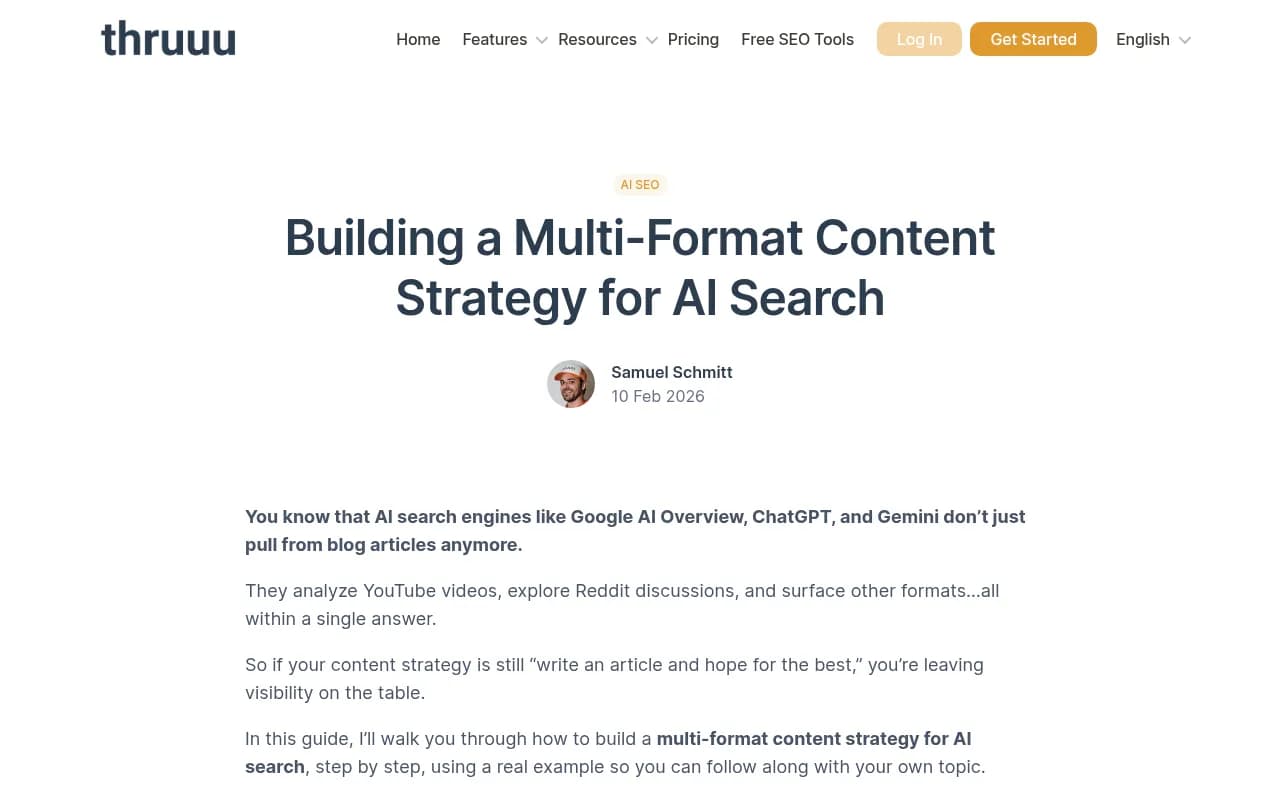
The screenshot above shows a real content strategy that maps topics to the right format — some need articles, others need videos, some need forum engagement. This is what modern content planning looks like.
Step 1: Build Your Keyword Universe (Not Just a List)
Start by gathering every keyword related to your topic — not just the obvious head terms, but the long-tail variations, questions, comparisons, and related concepts.
Use keyword research tools to pull:
- Core topic keywords (e.g. "content briefs", "SEO content planning")
- Question modifiers ("how to", "what is", "why", "when")
- Comparison terms ("vs", "alternative", "better than")
- Job-to-be-done phrases ("create", "build", "optimize", "improve")
- Related entities (tools, platforms, techniques mentioned alongside your topic)
Your goal is a dataset of 200-500+ keywords that represent the full semantic space around your topic. Don't filter yet — you'll cluster them in the next step.
Pro tip: Export keywords from multiple sources (Google Keyword Planner, Ahrefs, Semrush, AnswerThePublic) and merge them. AI search engines pull from a wider range of queries than traditional SEO tools surface.
Step 2: Cluster Keywords by SERP Similarity
Now that you have a keyword universe, group them by SERP similarity — keywords that return nearly identical search results should be clustered together and targeted with a single piece of content.
This is critical because:
- Google shows the same pages for similar queries — if "how to write a content brief" and "content brief template" return 8 out of 10 identical results, they're the same topic
- AI engines synthesize from the same source pool — if the SERPs overlap, the AI citations will overlap too
- You avoid keyword cannibalization — one strong page beats five weak ones competing against each other
Use a keyword clustering tool that analyzes SERP overlap automatically. Manual clustering is too slow and error-prone at scale.
The output should look like this:
- Cluster 1: "content brief template", "how to create a content brief", "content brief example" → Target with one comprehensive guide
- Cluster 2: "SEO content brief", "content brief for SEO", "SEO writing brief" → Target with one SEO-focused guide
- Cluster 3: "content brief vs creative brief", "difference between content brief and creative brief" → Target with one comparison article
Each cluster becomes a single content asset in your brief.
Step 3: Identify Search Intent and Content Type for Each Cluster
Now map each keyword cluster to its dominant search intent and the content type that best satisfies it.
The Four Search Intents
- Informational — user wants to learn something ("what is a content brief", "how to write a content brief")
- Navigational — user wants to find a specific page or brand ("HubSpot content brief template", "Semrush content brief tool")
- Transactional — user wants to take action or make a decision ("best content brief tools", "content brief software")
- Commercial Investigation — user is comparing options before deciding ("content brief tools comparison", "Clearscope vs Frase")
Match Intent to Content Type
- Informational intent → Comprehensive guide, tutorial, or explainer article
- Navigational intent → Brand-specific landing page, product page, or documentation
- Transactional intent → Comparison page, listicle, or tool directory
- Commercial investigation → Head-to-head comparison, alternative page, or buyer's guide
Example mapping:
- Cluster: "how to create a content brief", "content brief steps" → Intent: Informational → Content type: Step-by-step guide (article)
- Cluster: "best content brief tools", "content brief software" → Intent: Transactional → Content type: Tool comparison listicle (article + tool embeds)
- Cluster: "Clearscope vs Frase", "Clearscope alternative" → Intent: Commercial investigation → Content type: Head-to-head comparison (article)
This intent mapping is the foundation of your content brief. Get this wrong and you'll create content that doesn't match what users (or AI engines) are looking for.

Step 4: Define the Best Content Format for Each Topic
Here's where traditional content briefs break down completely. Not every topic should be an article.
AI search engines cite the format that best answers the query, regardless of whether it's a blog post. Your content brief must account for this.
Format Decision Framework
When to create an article:
- The topic requires depth, structure, and multiple sections
- Competitors rank with long-form guides (1500+ words)
- The query is informational or educational
- You need to establish topical authority
When to create a video:
- The topic is visual or process-driven ("how to use X", "tutorial")
- YouTube videos appear in the top 10 Google results
- The query includes "video", "tutorial", "demo", or "walkthrough"
- You want to capture citations in AI Overviews (YouTube is cited in 18-29% of them)
When to engage in forums (Reddit, Quora):
- The query is opinion-based or experience-driven ("is X worth it", "X vs Y Reddit")
- Reddit threads rank in the top 5 Google results
- The topic is controversial or requires social proof
- You want to influence AI recommendations (Reddit is the #1 cited domain in AI search)
When to build a free tool:
- The query is task-oriented ("calculate X", "generate Y", "check Z")
- Competitors offer calculators, generators, or checkers
- The topic is transactional or utility-focused
- You want to capture featured snippets and AI citations with interactive content
Real Example: "Content Brief" Topic
Let's map the "content brief" topic to formats:
- "what is a content brief" → Article (informational guide)
- "how to create a content brief" → Article + YouTube video (step-by-step tutorial)
- "content brief template" → Article with downloadable template (resource page)
- "best content brief tools" → Article with tool embeds (comparison listicle)
- "content brief generator" → Free tool (AI-powered brief builder)
- "is a content brief necessary Reddit" → Engage in existing Reddit threads (forum strategy)
Notice how one topic spawns six different content assets across four formats. This is what a multi-format content strategy looks like.
Step 5: Build the Content Brief with AI Search Optimization in Mind
Now you're ready to write the actual content brief. Here's what to include:
1. Target Keywords and Clusters
List the primary keyword and all related keywords in the cluster. AI engines understand semantic relationships — using variations naturally throughout the content improves relevance.
2. Search Intent and Content Format
State the dominant search intent (informational, navigational, transactional, commercial investigation) and the content format you're creating (article, video, tool, forum post).
3. Competitor Analysis (SERP + AI Citations)
Analyze two things:
- What ranks in Google's top 10 — extract headings, topics, word count, and structure
- What gets cited by AI engines — use tools like Promptwatch to see which pages ChatGPT, Perplexity, and Google AI Overviews actually reference when answering related queries
The overlap between these two lists is your baseline. The gaps are your opportunity.

4. Content Outline with Topic Depth Markers
Create a detailed outline with:
- H2 and H3 headings that match user questions and search queries
- Entity mentions — specific tools, platforms, people, and concepts that AI models recognize
- Comparison sections — "X vs Y" comparisons that AI engines love to cite
- Use cases and examples — real-world scenarios that provide context
- Data and statistics — numbers that AI models can reference with confidence
AI search engines prioritize depth and context over keyword density. Your outline should reflect this.
5. Multimedia and Interactive Elements
Specify where to embed:
- Screenshots — from authoritative sources (documentation, dashboards, research reports)
- Tool cards — if you're mentioning specific software, embed rich previews
- Videos — if you're creating a companion YouTube video, link it in the article
- Calculators or tools — if you're building an interactive element, describe its functionality
6. Internal Linking Strategy
Map which related articles, tools, and resources to link to. AI crawlers follow internal links to understand your site's topical structure. Strong internal linking improves your chances of being cited.
7. AI Optimization Checklist
Include a checklist for the writer:
- Content answers the query directly in the first 200 words
- Includes entity mentions (tools, platforms, concepts) that AI models recognize
- Provides comparisons and use cases that AI engines can cite
- Embeds data, statistics, or research that adds credibility
- Uses structured markup (FAQ schema, HowTo schema) where appropriate
- Links to authoritative sources and related content
- Avoids generic filler — every sentence adds value
How to Track and Optimize Content Performance in AI Search
Once your content is live, traditional SEO metrics (rankings, traffic, backlinks) only tell half the story. You need to track AI search visibility — whether your content is being cited by ChatGPT, Perplexity, Claude, Gemini, and Google AI Overviews.
What to Monitor
- Citation frequency — how often your pages appear in AI-generated answers
- Prompt coverage — which queries trigger citations to your content
- Competitor citations — which pages AI engines cite instead of yours
- Content gaps — which prompts competitors rank for but you don't
Tools like Promptwatch track all of this automatically. You can see exactly which pages are being cited, by which AI models, and for which prompts. This data feeds back into your content brief process — you learn what works and double down on it.
The Optimization Loop
- Find the gaps — see which prompts competitors are visible for but you're not
- Create content that ranks in AI — use the brief framework above to build articles, videos, or tools that fill those gaps
- Track the results — monitor citation frequency and visibility scores
- Iterate — update existing content based on what AI engines actually cite
This cycle — find gaps, create content, track results, iterate — is what separates brands that dominate AI search from those that get ignored.
Common Mistakes to Avoid When Building Content Briefs for AI Search
1. Optimizing Only for Google
AI search engines don't just scrape Google's top 10. They pull from YouTube, Reddit, product pages, documentation, and niche forums. If your brief only analyzes Google SERPs, you're missing the full picture.
2. Ignoring Content Format
Not every topic should be a blog post. If YouTube videos dominate the SERP, create a video. If Reddit threads rank, engage in forums. Match format to intent.
3. Writing Generic, Surface-Level Content
AI engines ignore commodity content. If your article says the same thing as 50 other articles, it won't get cited. Build depth with entity mentions, comparisons, data, and use cases.
4. Skipping Multimedia
Text-only articles are less likely to be cited. Embed screenshots from authoritative sources, link to videos, and include tool cards. AI engines prefer content that provides multiple pathways to understanding.
5. Not Tracking AI Citations
You can't optimize what you don't measure. If you're not tracking which pages get cited by ChatGPT, Perplexity, and Google AI Overviews, you're flying blind.
Tools to Build Better Content Briefs
Here are the tools you need to execute this framework:
Keyword research and clustering:
SERP analysis:
AI search visibility tracking:
Content optimization:
Video content:
Final Thoughts: Content Briefs Are Strategy Documents, Not Checklists
A content brief in 2026 is not a list of keywords and headings. It's a strategic document that maps topics to the right format, aligns content with search intent, and optimizes for both traditional search and AI engines.
The brands that win in AI search are the ones that:
- Think multi-format — articles, videos, tools, and forum engagement
- Prioritize depth over volume — one authoritative piece beats ten shallow ones
- Track what gets cited — use data to understand what AI engines actually reference
- Iterate constantly — update content based on citation performance
Start with the framework above. Build keyword clusters, map intent to format, create detailed briefs, and track AI citations. The loop closes when you see your content being cited by ChatGPT, Perplexity, and Google AI Overviews — then you know your brief worked.