Key takeaways
- Most GEO platforms are monitors. Decide up front whether you need a dashboard or a tool that also helps you fix what it finds.
- Dutch companies should test Dutch-language prompts, Netherlands-specific answers, EU data handling and euro invoicing before anything else.
- Ask for per-engine data. ChatGPT, Google AI Overviews and Perplexity cite very different numbers of sources, so one blended score hides the real picture.
- Run a two-week pilot with 30 to 50 of your own buyer prompts. Demos are staged; your prompts are not.
- Mid-market budgets (roughly 100 to 600 euros a month) can cover real tooling. Agencies are optional, not mandatory.
Why the Dutch mid-market needs its own checklist
Most GEO buying guides are written for US enterprises or for people hiring agencies. A Dutch mid-market company sits somewhere else. You have a small marketing team, maybe two or three people, a mix of Dutch and English content, a procurement process that asks about GDPR, and a CFO who wants euro invoices and a monthly cancel option.
The research I pulled together for this guide includes a few useful agency-selection lists (eIntelligence has a 10-question one, Discovered Labs a 25-question one, and Agenzy scored 21 European agencies on public facts). They are good on agency vetting. They say almost nothing about software selection for a Dutch buyer. That gap is what this guide covers.
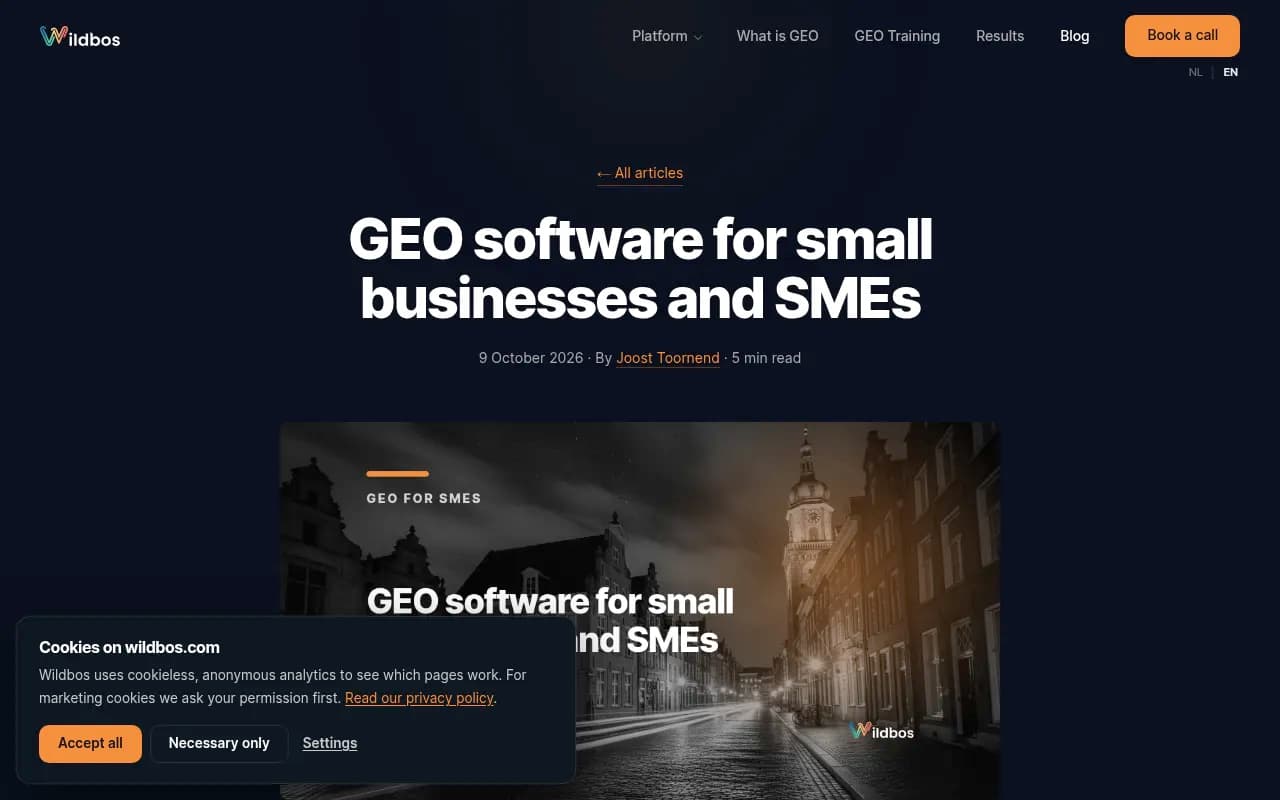
One caveat before we start. The only Netherlands-specific source in my research is a vendor blog post from Wildbos, which targets Dutch software, SaaS and MSP companies and says its platform starts at 25 euros in credits, pay as you go. Treat that as vendor marketing, not independent evidence. Everything below is a framework for you to test vendors against, not a verdict.
Platform or agency first?
The first decision is not which vendor. It is whether you need software, a service, or both.
| Route | Best for | Typical trade-off |
|---|---|---|
| Self-serve platform | Teams with an SEO or content owner who can act on findings | You do the work |
| Platform with built-in content and publishing | Lean teams that want fixes, not just reports | Higher plan tier needed |
| Agency | No in-house capacity | Cost, and dependence on their reporting |
| Platform plus agency | Larger programs | Needs clear ownership of data |
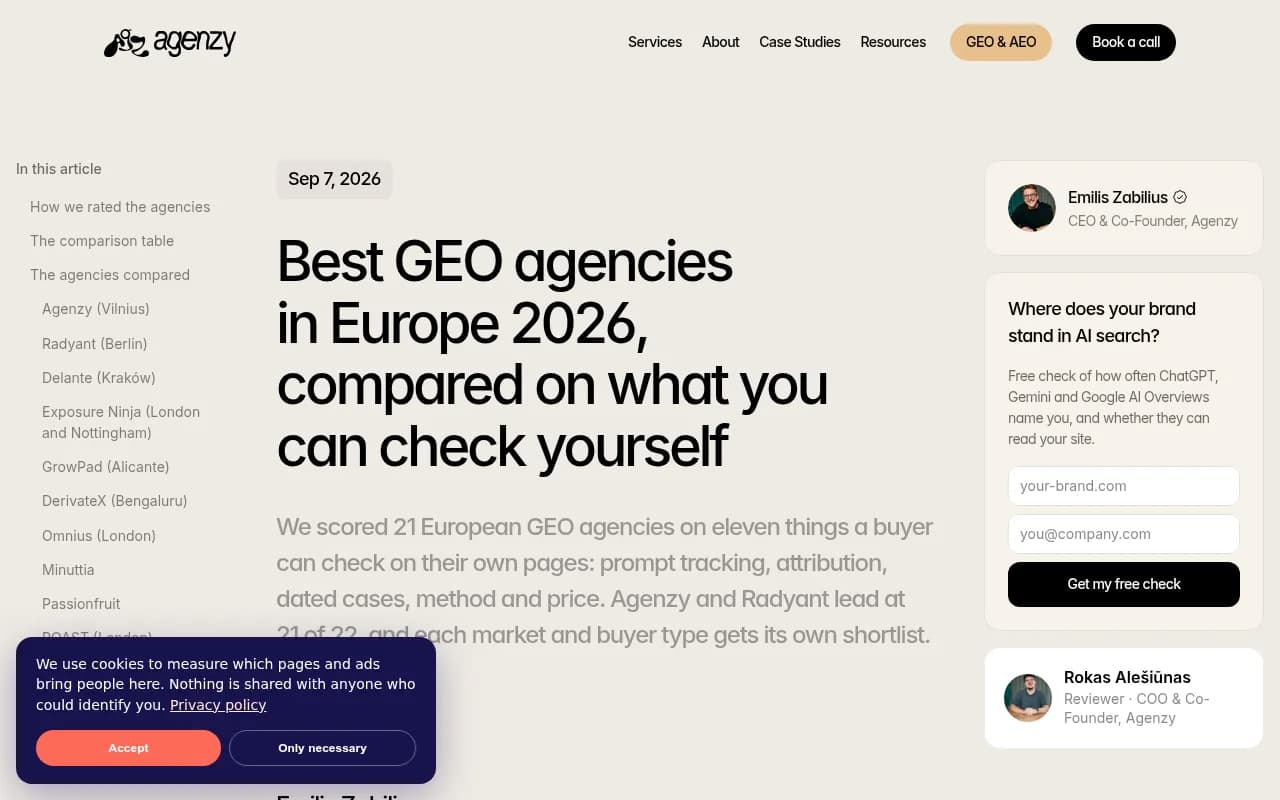
If you do go the agency route, the Agenzy comparison of European GEO agencies is worth a read because it scores only what a buyer can verify on public pages: prompt tracking, attribution, dated cases, method and price. Its own warning applies to every scorecard, though: it reads only what agencies publish, so strong teams with quiet websites score lower.
The rest of this guide assumes you are shortlisting software.
The 10 questions
1. Does it track real AI interfaces, and in Dutch?
Ask exactly how responses are collected. Some tools call model APIs. Others capture what users actually see in ChatGPT, Google AI Overviews, Perplexity and so on. The two can differ, especially for citations and shopping results.
Then test language. Give the vendor five Dutch prompts, such as "beste boekhoudsoftware voor mkb" or "welke IT-beheerder past bij een middelgroot bedrijf", and ask them to show the answers from the Netherlands. If the tool translates your prompts to English behind the scenes, walk away. A vendor that tracks per country and language will show you the Dutch answer, the Dutch sources, and the Dutch competitors that appear there.
Worth knowing: Google AI Overviews are region-specific, so a US-based capture tells you little about what a customer in Utrecht sees.
2. Does it report each engine separately?
This matters more than most buyers realize. According to Promptwatch's average-sources-per-response data, ChatGPT cites about 5 sources per web-search answer, while Google AI Overviews cites about 10 and Perplexity sits almost exactly at 10 every day. Microsoft Copilot swung from under 2 to nearly 17 sources within a few weeks before settling low. One engine does not predict another.
So a single blended "AI visibility score" is a red flag unless you can break it apart. Ask to see visibility, position and citations by engine and by country.
3. Does it understand query fan-out?
When a user asks ChatGPT something, it often runs several web searches behind the scenes. Promptwatch's query fanout data shows a single prompt can trigger 3 to 8 or more searches, and that average query length and fanout counts move as ChatGPT updates. For a Dutch company this has a practical edge: the sub-queries may run in English even when your prompt was Dutch, which changes which pages get retrieved.
Ask the vendor: do you show the actual searches the model runs? Do you re-baseline after model updates? If the answer is vague, the tool is probably a prompt counter.
4. Can it show whether AI crawlers can read your site?
Monitoring tells you that you are missing from answers. It does not tell you why. The most common reasons are boring: a robots.txt that blocks AI bots, JavaScript-rendered pages, error responses, or a CDN rule that rejects unknown user agents.
Look for crawler log analysis that is IP-verified (spoofed bots are common), plus a site audit. Few cheap trackers have this. Platforms like Promptwatch include IP-verified crawler logs and weekly audits; many monitoring-only tools do not.

If your site sits behind Cloudflare, Vercel, Netlify or Fastly, check that the vendor has a documented log integration for your stack. Dutch mid-market sites often run on WordPress or Webflow with a CDN in front, so ask for those setups specifically.
5. Does it connect visibility to traffic and revenue?
A mention is not a lead. Ask whether the tool shows visits and conversions arriving from AI platforms, and whether it joins that to Google Search Console and Bing Webmaster data. "Which pages rank in Google but never get cited by AI?" is the question that actually drives your content plan.
If you already have analytics in place, GA4 can segment AI referrals manually, but it takes configuration and misses a lot of traffic that arrives without a referrer. A tool that does this out of the box saves real time.
6. Does it help you fix gaps, or only report them?
This is the dividing line in the market. Pure monitors answer "was my brand mentioned?" Optimization platforms answer "what should I publish, and did it work?"
For a three-person Dutch marketing team, that difference decides whether the subscription gets used. Check for:
- Content gap analysis tied to the prompts AI actually answers
- A prioritized action list, not just charts
- Content generation grounded in citation data, with CMS publishing (WordPress, Webflow, Framer)
- Tracking of published pages through crawls, citations and clicks afterwards
Tools that stop at monitoring include several in the catalog, such as Otterly.AI, Peec AI and Rankshift. They are fine if you have a strong content team already and just need numbers.
Otterly.AI



7. What do GDPR, hosting and security look like?
Dutch procurement teams ask about this early, so you should too. Request the data processing agreement, the hosting region, subprocessors, and any ISO/IEC 27001 certification. Promptwatch, for example, is ISO/IEC 27001 certified and GDPR compliant, and is headquartered in Amsterdam, which shortens security reviews. Whatever vendor you consider, do not accept "we take privacy seriously" as an answer. Ask for the document.
Also check role-based access and audit logs if more than one team will touch the tool.
8. How is it priced, in which currency, and how do volumes work?
Pricing models differ a lot: per prompt, per response, per credit, per seat or per project. Compare on cost per tracked response across the models and countries you need, not on the headline price.
Things to confirm:
- Euro invoicing and Dutch VAT handling (BTW)
- Monthly cancellation versus annual lock-in
- Whether all AI models are included or sold as add-ons
- Whether country tracking costs extra
- What happens when you exceed your prompt or response limit
For reference, Promptwatch lists Essential at 85 euros a month (50 prompts, all models, country tracking), Professional at 205 euros, and Business at 499 euros, with a 7-day free trial on monthly plans. Confirm current numbers at promptwatch.com/pricing. At the low end, the Wildbos model of 25 euros in pay-as-you-go credits is attractive for experiments, though it is aimed at Dutch software, SaaS and MSP companies specifically.
9. Can you export the data and plug it into your stack?
Mid-market teams live in spreadsheets, Slack and a BI tool. Ask about CSV and Excel exports, a Looker Studio connector, an API, and a Slack integration. An MCP server is a bonus if your team uses Claude or ChatGPT for analysis.
Data portability also protects you. If you leave in a year, you want your historical prompt data, not a deleted account.
10. How does it behave on your prompts, in a pilot?
This is the question that settles everything. The LinkedIn guide in my research recommends building your own baseline first: write 5 to 10 buyer questions phrased the way a person would actually ask an AI assistant. I would stretch that to 30 to 50 for a software trial, in Dutch and English, covering three types:
- Category prompts ("beste CRM voor een groeiend bedrijf")
- Comparison prompts ("X versus Y")
- Brand prompts ("is [your brand] betrouwbaar")
Run the same set in two or three shortlisted tools for two weeks. Compare whether the answers match what you see by hand, whether competitors are detected correctly, and whether the tool tells you something you can act on by Friday.
Shortlist comparison grid
Use a table like this during your pilot. The entries below reflect the category positioning from public descriptions, so verify each point yourself.
| Criteria | Monitoring-only trackers | Traditional SEO suites with AI add-ons | Optimization platforms |
|---|---|---|---|
| Real-interface capture | Varies | Often fixed prompt sets | Usually yes |
| Dutch and country-level tracking | Varies | Limited | Yes on most paid plans |
| Crawler logs | Rare | Rare | Included in some |
| AI traffic attribution | Rare | Limited | Included in some |
| Content generation and publishing | No | Separate modules | Included in some |
| Typical mid-market fit | Analyst-led teams | Teams already on the suite | Lean teams that need action |
SEO suites worth evaluating if you already pay for them include Semrush and Ahrefs with Brand Radar.
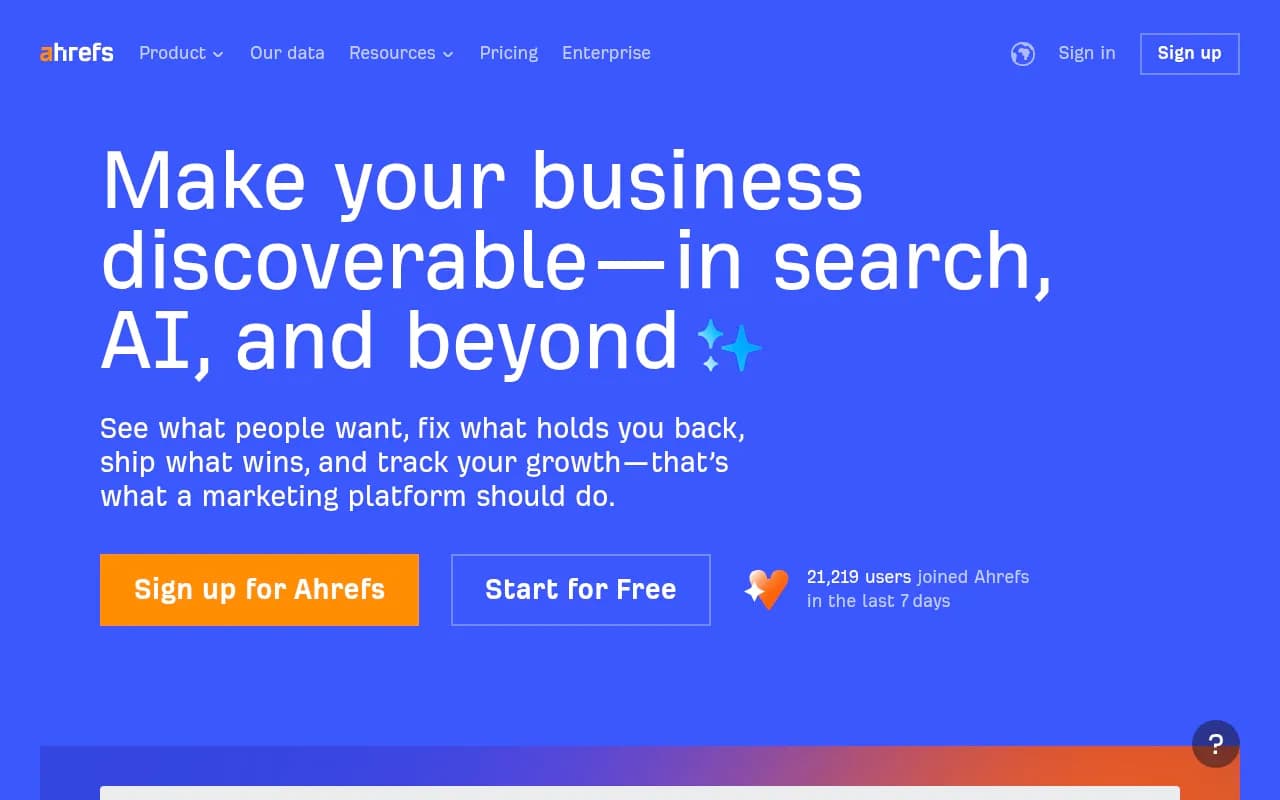
Dutch-built options are also worth a look. The catalog includes Briljant, a Dutch GEO platform tracking visibility in ChatGPT and Perplexity.
For higher-end enterprise needs, Profound is the name that comes up most often, usually at a higher price point.
Profound

To browse more of the category, the GEO software directory at bestgeosoftware.com lists many of these side by side.
Red flags during demos
A few things made me raise an eyebrow while reading through the agency checklists, and they carry over to software:
- Anyone promising a guaranteed appearance in AI answers. Nobody controls that.
- A demo that only uses their sample brand, never yours.
- Visibility scores with no explanation of how they are calculated.
- No way to see the raw response behind a data point.
- Case studies without dates or numbers.
- No Dutch example anywhere on the vendor's site.
The eIntelligence checklist makes a similar point for agencies: ask for evidence of real AI citations, not just traditional rankings. Same standard applies here.
A simple scoring method
Score each shortlisted platform from 0 to 2 on each of the 10 questions: 0 if you found nothing, 1 if it is claimed but not shown, 2 if you saw it working on your own data. Add them up out of 20. Weight questions 1, 6 and 10 double if your team is small. It is crude, but it forces you to separate what a vendor says from what you saw.
Then pick the top two, and negotiate. Mid-market buyers have more leverage than they think, especially on annual plans and add-on credits.
What to do this week
- Write 30 to 50 Dutch and English buyer prompts.
- Run the free scans that some vendors provide to get a baseline.
- Check robots.txt and your CDN rules for AI crawler access.
- Shortlist three tools, one from each category in the grid above.
- Run the pilot for two weeks and score against the 10 questions.
If you would rather hand off strategy and execution, an agency such as 1001 SEO Media covers GEO alongside technical SEO and content. Either way, own the data and the prompt set, so you can judge any vendor on your terms.