Key takeaways
- Most GEO purchases fail because teams buy a dashboard that reports mentions, then discover nobody on the team can act on the data.
- AI engines behave very differently from each other, so a tool that blends them into one number hides the real picture.
- Check for crawler logs, query fan-out data, traffic attribution and content execution before you compare prices.
- Verify pricing on the vendor's own page. Third-party roundups and AI summaries are often wrong.
- Run a 30-day pilot with a success metric tied to pages published and revenue, not mentions.
Why GEO tool buying goes wrong so often
The category is about two years old. Dozens of vendors launched in a rush, feature names overlap, and every pitch deck promises "AI visibility." Marketing teams under pressure to have an AI search answer by next quarter tend to buy the first tool that shows a nice chart.
I have seen the same pattern repeatedly. A team signs up, tracks 50 prompts, sees a visibility score, and then... nothing. No one knows what to do with the number. Three months later the subscription is quietly cancelled and the budget goes to an agency.
The nine mistakes below are the ones that cause that outcome. Some are about features, some about process, and a couple are about trusting the wrong sources.
Mistake 1: Buying a tracker when you need an optimizer
The biggest split in the market is between tools that tell you whether your brand was mentioned and tools that help you change the answer. A prompt tracker is a thermometer. It is useful, but it does not treat anything.
Many of the cheaper entrants, including Otterly.AI, Peec AI and Rankscale, sit mostly in the monitoring camp. That is fine if you already have a content team and a technical SEO who will act on the findings. It is a problem if you were hoping the tool would close the loop.
Otterly.AI


Before buying, ask one question: after I see a gap, what does the tool do next? If the answer is "export a CSV," you are buying a reporting layer.
Platforms like Promptwatch go the other direction. They pair monitoring with content gap analysis, an AI writing agent that can publish to Webflow, Framer or WordPress, and an action board that turns findings into a prioritized to-do list. Then they track whether the published page was crawled, cited and clicked.

Mistake 2: Treating all AI engines as one blended score
A single "AI visibility score" averaged across ChatGPT, Perplexity, Gemini and AI Overviews feels tidy. It is also misleading, because the engines have very different citation habits.
Promptwatch Data's social media citations report for Sep 28 to Oct 4, 2026 shows how wide the gap is. ChatGPT got just 0.46% of its citations from social platforms. Google AI Overviews got 12.2%, roughly 26 times more. Perplexity landed at 2.7%.
If your tool blends those, a Reddit or YouTube strategy looks either brilliant or useless depending on the mix of prompts you happened to load. Neither reading is true for any single engine.
Citation volume differs too. According to Promptwatch's average sources per response data, ChatGPT cites about 5 sources per web-search answer, while Google AI Overviews and Perplexity sit near 10. You need per-engine reporting, and ideally the ability to compare any two dimensions side by side.
Mistake 3: Ignoring how the data is collected (UI vs API)
This is the question most buyers never ask. Some tools query the model APIs. Others scrape the real user interface. The answers can differ, especially for citations and shopping results, because the consumer product adds search, ranking and formatting that a raw API call does not.
If your goal is to know what a customer sees when they open ChatGPT or Google AI Mode, you want UI-level collection. API data is still useful, since it shows what a model believes from training, but it should not be the only source.
Also ask:
- Which countries and languages can I track, and is that real localized UI data?
- Can I pin a monitor to a city or exact coordinates for local queries?
- How often do prompts run, and how many responses are included in the plan?
The gap in the research I pulled together is worth admitting here: I did not compare vendors' sampling methods head to head. Put the question in your RFP and make them answer in writing.
Mistake 4: Tracking only the literal prompts
When a user types a prompt into ChatGPT, the model often runs several web searches behind the scenes. Your page has to match those generated queries, not the prompt itself.
Promptwatch's ChatGPT query fanouts report shows average fanouts per response at 2.15 in early December 2025 and about 1.84 by early March 2026, and the intro notes a single prompt can trigger 3 to 8+ searches. Query length also shrank over those months, from roughly 117 characters to the high 80s.
Behavior keeps shifting. On August 8, 2026, ChatGPT began using the site: operator at scale, jumping from about 0.4% to about 17% of fanout queries overnight, according to Promptwatch Data.
A tool that only shows you the prompt and the final answer is blind to this layer. Look for fan-out visibility, so you can see what ChatGPT actually searched and write headings that read like those queries.
Mistake 5: Skipping crawler logs and traffic attribution
Mentions are a vanity metric until you connect them to something. Two features separate serious platforms from dashboards:
- IP-verified AI crawler logs, showing when GPTBot, ClaudeBot, PerplexityBot and others visit, which pages they read and where they hit errors.
- Visitor analytics that attribute real sessions and conversions to AI platforms.
Without the first, you cannot tell a content problem from a crawlability problem. If AI never successfully reads your pricing page, rewriting it will not help. Without the second, you cannot defend the budget.
Crawler behavior also moves fast. Promptwatch's Meta-WebIndexer data shows that bot going from roughly 2% to nearly 38% of tracked AI crawler requests between mid-July and August 9, 2026. A log feature that only recognizes last year's bots will miss that kind of shift. The weekly volume view is in the AI crawler traffic report.
Most monitoring-first tools lack crawler logs entirely. Among the options, Promptwatch includes them, and a few smaller tools such as Scriptbee and xSeek offer some crawler monitoring. Check the depth before assuming.
Mistake 6: Buying a playbook that is already stale
Two years of GEO advice told teams to seed Reddit. Then the data moved. Promptwatch Data found that reddit.com's share of ChatGPT citations fell from about 4% to 0.5% on August 14, 2026, per its Reddit citations report. Google AI Overviews and AI Mode declined more gradually.
Any tool, agency or course whose core recommendation is "get on Reddit for ChatGPT" is selling last spring's strategy. That is not a reason to ignore Reddit entirely, since it still shows up in AI Overviews at around 2%, but it is a reason to ask vendors how they detect and annotate shifts like this.
The same goes for model changes. Average citations per ChatGPT response dropped across GPT-5.3, GPT-5.4 and GPT-5-Mini around the March 4, 2026 rollout, per the citation drop report. If your score fell that week, the cause may not be you. A good tool marks model updates on the timeline so you do not panic or celebrate for the wrong reason.
Mistake 7: Chasing authority and the wrong content types
Many teams assume high domain rating wins citations. The August 2026 data says otherwise: sites in the DR 46 to 75 band earned almost half of ChatGPT citations, while DR 91 to 100 fell to about 3% (source). Smaller sites can compete.
Content type matters as well. In the Sep 28 to Oct 4, 2026 window, product pages were the most cited type in ChatGPT at 22.4%, followed by landing pages and listicles (report). And shelf life varies: landing pages and docs stay cited longest, while news lost half its cited pages within 36 days (half-life report).
When evaluating a tool, check whether it classifies citations by content type and source type and shows how long a page stays cited. Otherwise you will not know whether to publish another blog post or fix a product page.
And skip markdown-for-AI tricks as a priority. Markdown files make up only 0.05% of AI search citations (data).
Mistake 8: Trusting unverified pricing and feature claims
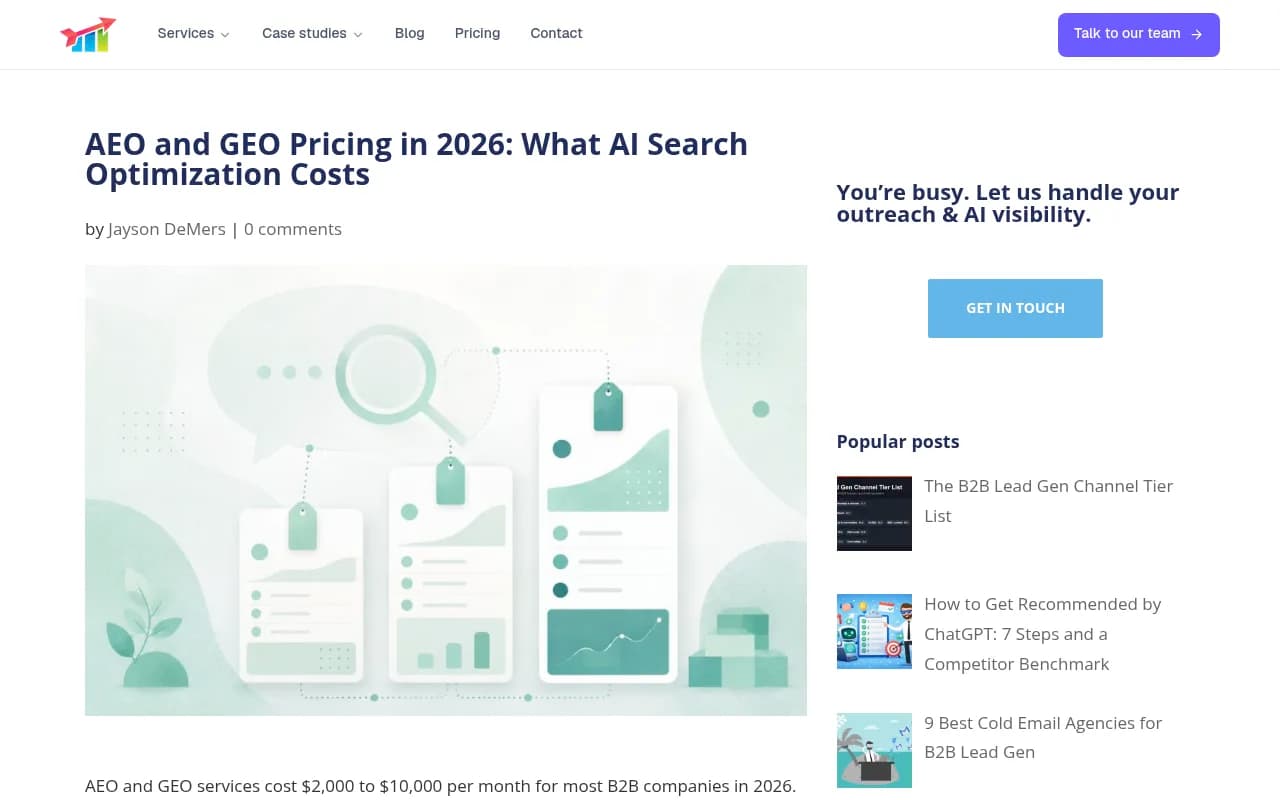
GEO pricing is a mess, and roundups make it worse. OutreachBloom's 2026 pricing guide puts software tools at $50 to $1,000 per month, one-off audits at $1,000 to $4,000, agency programs at $2,000 to $10,000 per month, and enterprise programs at $25,000 or more. It also admits that when it checked vendor pages on September 18, 2026, two of the three numbers a buyer would act on did not match what the vendor publishes. Note that OutreachBloom sells its own AI SEO plans, so read the ranges with that in mind.
The practical lesson: never budget from a listicle or an AI summary. Open the vendor's pricing page, screenshot it, and confirm what a "prompt" or "response" means in that plan. Then calculate cost per response, because a cheap tier with 500 responses a month is not cheaper than a mid tier with 18,000.
Promptwatch lists its tiers publicly, for example Essential at $95 per month and Professional at $245, and it is worth confirming current numbers at promptwatch.com/pricing before you plan.
| What to check | Why it matters |
|---|---|
| Responses included per month | Prompts alone hide real usage limits |
| Models included on each plan | Some tiers lock you to one engine |
| Seats and projects | Agencies hit limits fast |
| Crawler log and visitor event caps | Costs rise as your site grows |
| Content or agent credits | Execution is often metered separately |
| Annual vs monthly discount | Often around 17% off |
Mistake 9: Skipping the pilot and the success metric
Teams sign annual contracts after a demo. A demo shows the best-case dashboard, populated with a sample brand.
Run a pilot instead. Thirty days is enough if you set it up properly:
- Load your own brand, three real competitors and 30 to 50 prompts that map to revenue.
- Connect your CDN or CMS for crawler logs and install the visitor script.
- Ask the tool to produce a prioritized action list. Ship at least five of those actions.
- Measure whether those pages got crawled, then cited, then clicked.
If you cannot get through step 4 with the tool, you have your answer. The same applies if your team lacks capacity to act: a content-execution feature or an agency partner matters more than another report.
When the issue is capacity rather than software, an SEO and GEO agency can fill the gap. 1001 SEO Media runs this kind of work for clients and uses Promptwatch for AI visibility tracking, but the decision should follow your team's bandwidth, not a vendor's sales cycle.
How the main categories compare
Use this table to decide which lane you are buying in before you compare individual vendors.
| Category | Examples | Strong at | Usually missing |
|---|---|---|---|
| Prompt trackers | Otterly.AI, Peec AI, Rankscale | Cheap monitoring, simple dashboards | Crawler logs, traffic attribution, content creation |
| Enterprise monitors | Profound, Scrunch AI | Deep reporting, large brands | Price flexibility, execution, some channels |
| SEO suite add-ons | Semrush, Ahrefs Brand Radar | Familiar workflow, one login | Flexible prompt sets, AI crawler data, attribution |
| Content generators | AirOps, Jasper, Copy.ai | Producing drafts fast | Visibility data to ground the content |
| End-to-end platforms | Promptwatch | Monitoring plus crawler logs, traffic, content agent and publishing | Not a classic SERP rank tracker |
Profound

The categories overlap, and vendors move between them every few months. Use the table as a starting filter, not a verdict.
A short pre-purchase checklist
Before signing, make the vendor answer these in writing:
- Is data collected from the real UI, the API, or both?
- Which engines are covered on my tier, and in which countries?
- Do I see query fan-outs, or only the prompt and answer?
- Are crawler logs IP-verified, and which bots are recognized?
- Can you attribute AI traffic and conversions to pages?
- What happens after a gap is found: who writes, who publishes, who checks?
- How are model updates annotated on my charts?
- What are the exact limits on responses, seats and projects?
If you want to browse more options before shortlisting, the GEO software directory lists dozens of tools by category, and you can read first-party citation research at Promptwatch Data to sanity check any vendor's claims about how AI engines behave.
The takeaway
Most wasted GEO spend comes from buying measurement when the real bottleneck is action. Decide first whether your constraint is data, content production or technical access, then pick the lane. Verify pricing yourself, demand per-engine data, and judge any tool by how many optimized pages it helps you ship in the first 30 days.