Key takeaways
- Local prompt data only becomes useful when you sort it into gaps: not mentioned, mentioned but not cited, cited from the wrong source, or described inaccurately.
- Each gap type needs a different fix. Some need a new page, some need a listing cleanup, and some need a rewrite of an existing page.
- Plan content by prompt intent. Promptwatch Data shows ChatGPT cites product and landing pages for commercial prompts, how-tos and docs for informational ones, and your own site plus reviews for branded ones.
- Third-party listings and aggregators often carry more weight than your own location pages, so a local content plan has to include off-site work.
- Set a refresh cadence by content type and measure per location, because a single blended visibility score hides the stores that are failing.
Why tracking data alone doesn't help you
Most teams I talk to get stuck at the same spot. They set up local prompt tracking, run it for a few weeks, and end up with a dashboard full of percentages per location. Then nobody knows what to write.
The data answers "are we showing up?" It does not answer "what do we publish on Tuesday?" That translation step is the whole job, and it is mostly sorting and prioritizing, not creativity.
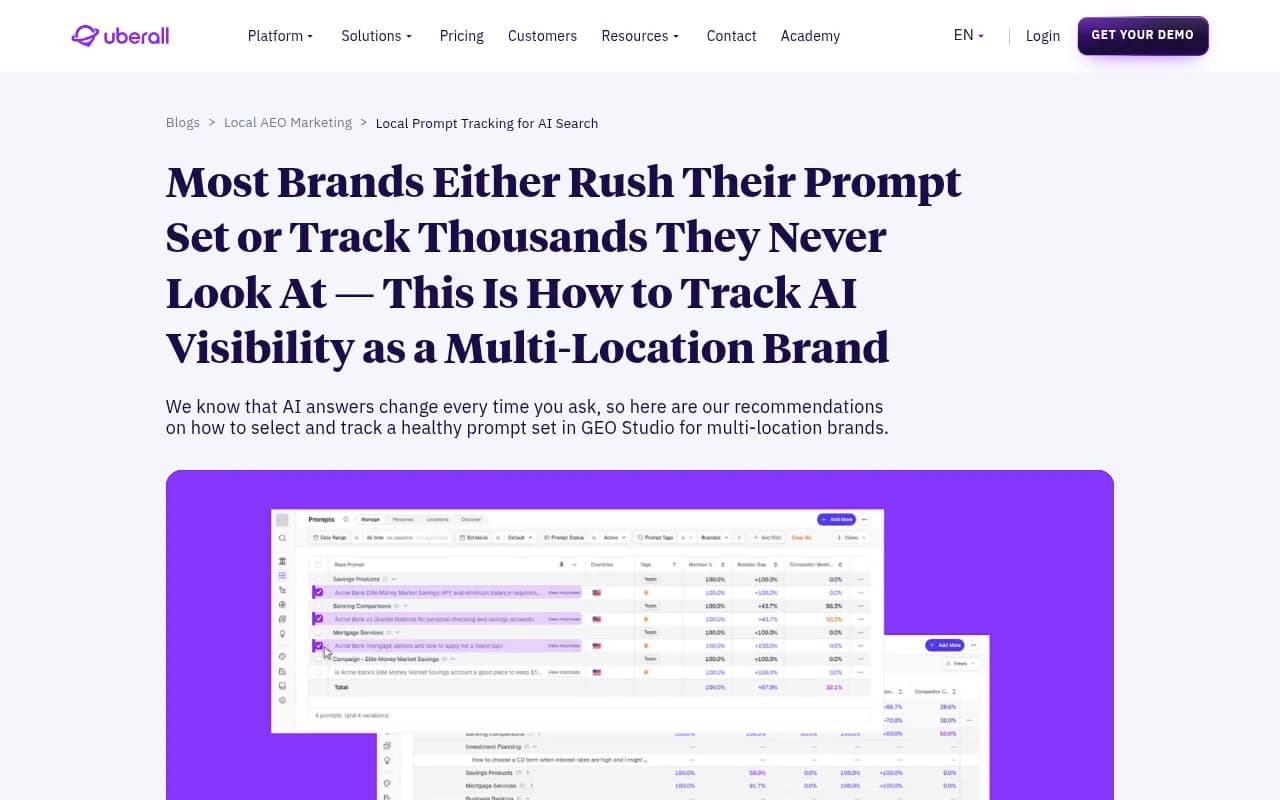
This guide assumes you already have a prompt set per location. If you don't, start there. Uberall's guide on which prompts to track is written for multi-location brands and makes a good point: AI answers change on every run, so too few prompts produce false positives and false negatives. Its recommendation is to put neighborhoods inside the prompt text, mix branded and unbranded prompts, and run them on a consistent schedule.
One more caveat before we start. SE Ranking points out that prompt tracking has no reliable volume data and no fixed positions, and answers shift with the user's location, session, and history. So treat every number below as directional. You are looking for patterns across many prompts and runs, not a single verdict from one response.
Step 1: Clean and group your local prompt data
Before you plan anything, make the data readable. Export your prompts and responses and add four columns.
- Location (store, office, city, or neighborhood)
- Prompt type: branded, unbranded category, comparison, or transactional
- Intent: informational, commercial, or branded
- Outcome: not mentioned, mentioned without a citation, cited, or cited with a wrong claim
SE Ranking lists five prompt types worth covering: informational, comparative, instructional, brand-specific, and transactional. In my experience local brands over-index on "best X near me" prompts and under-track the instructional ones, like "how do I prepare for a first dental visit." Those instructional prompts are often where a local page can win.
Keep brand comparison prompts in their own bucket. Mixed into category prompts they skew your numbers and make a healthy location look weak.
If you track in a platform that does this tagging for you, you skip an afternoon of spreadsheet work. Promptwatch supports topics, tags, prompt types, and intent labels, plus state and city tracking and local GEO/SEO targeting at exact coordinates on Business and higher plans, so the location column is already there.

Step 2: Sort every gap into one of four buckets
This is the step that turns a dashboard into a plan. Take each location and prompt and drop it into one bucket. Each bucket has a different fix, which is why a blended "visibility score" is a poor planning tool.
| Gap type | What you see | Likely cause | Typical fix |
|---|---|---|---|
| Not mentioned | Brand absent, competitors named | No relevant page, thin coverage, weak listings | New location or service page |
| Mentioned, not cited | Brand named, no link to you | AI knows you from other sources | Strengthen your own pages, add facts AI can quote |
| Cited from the wrong source | Directory or aggregator gets the citation | Listings carry more weight than your site | Fix listings, reviews, and off-site profiles |
| Described wrongly | Hours, services, or pricing are off | Stale or conflicting pages | Correct the source pages, then refresh |
The second bucket deserves attention. A brand that gets named but never cited usually has a content or crawlability problem, not a reputation problem. If you can see AI crawler activity on your site, you can tell whether the bots even read the location pages.
Step 3: Decide which prompts deserve content first
You will have more gaps than you can fill. Prioritize with three filters.
- Business value. A prompt that leads to a visit or a booking beats one that sparks general discovery. Uberall specifically recommends favoring intents that end in a visit.
- Spread. If the same gap shows up in 15 of your 40 locations, that is a template problem you can fix once. If it shows up in one, it is a local page problem.
- Winnability. Look at who currently gets cited. If the answer is always a big marketplace, a new blog post will not move it, but a listing fix might.
That third filter matters more locally than anywhere else. Promptwatch Data's travel report (Sep 28 to Oct 4, 2026) found Skyscanner, Going, and Tripadvisor leading ChatGPT citations, with booking and search sites taking more than half of the citations shown. The automotive report for August 2026 shows the same pattern: marketplaces like Autotrader and Cars.com outrank every car brand. Local plans in these industries need to include listing and review work, not just pages on your own domain.
I'd note one gap in the evidence here. I couldn't find a Promptwatch report on "near me" prompts specifically, so the vertical reports are the closest first-party proxy. Use them to understand which source types win in your industry, then check your own tracking data for the local version.
Step 4: Match content format to prompt intent
Once a gap is prioritized, pick the format. This is where first-party citation data helps most. Promptwatch Data's content type report covers Sep 28 to Oct 4, 2026 and splits ChatGPT citations by type:
- Product pages 22.4% and landing pages 16.8% of all classified citations
- Listicles 13.6%, documentation 7.5%, how-to guides 8.7%
- Comparisons 5.9%, FAQ pages 3.3%, reviews 1.7%
The split by intent is more useful for planning:
| Prompt intent | What ChatGPT cited most | Local content to build |
|---|---|---|
| Commercial ("best plumber in Leeds") | Product pages 26.0%, landing pages 20.6%, listicles 15.0%, comparisons 7.9% | Service-by-city landing pages, comparison pages |
| Informational ("how to winterize pipes") | Product pages 19.1%, landing 13.9%, listicles 13.6%, how-tos 10.7% | Local how-to guides, FAQ content |
| Branded ("Acme Plumbing reviews") | Product pages 23.3%, landing pages 22.8%, reviews 5.6% | Strong location pages, FAQ, review profiles |
Two things stand out. Commercial prompts are dominated by pages that look like commercial pages, so a blog post is rarely the right answer to a "best X in Y" gap. And reviews, though small overall at 1.7%, are over three times more common in branded prompts, so review profiles are part of your branded content plan.
A practical mapping for local brands:
- Commercial gaps: a landing page per service and location, with real details such as address, hours, pricing ranges, and services.
- Informational gaps: how-to content written for the neighborhood, with local specifics a generic article lacks.
- Branded gaps: complete location pages, an FAQ, and consistent listings and reviews.
Step 5: Write headings that match how AI searches
ChatGPT does not run your prompt as one search. It rewrites it into one or more web searches, called query fan-outs. Promptwatch's fan-out data shows an average of 2.15 searches per response in early December 2025, easing to about 1.84 by early March 2026. Average query length fell from roughly 117 characters in December to about 53 characters in April. Treat the averages with care, since the page itself mentions higher counts for some prompts and the series had a data gap.
The practical takeaway still holds: the searches are short. Write headings that read like a short query, with the entity and category first. For a local page that means "Emergency plumber in Leeds" rather than "Why Choose Us for Your Plumbing Needs."
Also consider this. On August 8, 2026, ChatGPT began using the site: operator at scale, jumping from about 0.4% to about 17% of fan-out queries. That may mean it searches specific domains, such as a directory or a brand's own site, for a given location. I can't prove the local effect, but it is a good reason to make sure your location pages are indexable and clearly labeled.
You can generate likely fan-outs for a prompt with the free ChatGPT query fan-out generator, then turn each sub-question into a section or a supporting page.
Step 6: Fix the off-site side of the plan
A local content plan that only lists pages to publish is half a plan. Add a second column for off-site work:
- Claim and complete profiles on the directories that win citations in your vertical
- Check name, address, phone, hours, and service data for consistency across listings
- Ask for reviews at the locations where branded prompts show weak sentiment
- Respond to wrong claims by finding the page AI learned them from
Multi-location listing and reputation platforms like Uberall, Yext, BrightLocal, and Birdeye cover the listing side. They help with the data layer. The content layer is still yours.
Social sources matter less than you might expect for ChatGPT. Promptwatch Data found ChatGPT drew 0.46% of its citations from social platforms between Sep 28 and Oct 4, 2026, versus 12.2% for Google AI Overviews. And reddit.com's share of ChatGPT citations fell from about 4% to 0.5% on August 14, 2026. If your local plan leaned on community posts for ChatGPT, rebalance toward owned pages and listings. AI Overviews still pulls from social, so keep some presence there.
Step 7: Build the calendar and set a refresh cadence
Now you can schedule. Put gaps into three tracks.
| Track | What goes in | Cadence |
|---|---|---|
| Template fixes | Gaps spread across many locations | One build, rolled out to all |
| Location builds | New landing pages and local how-tos for specific stores | A few per week, by priority |
| Maintenance | Refreshes, listing audits, FAQ updates | Monthly or quarterly |
For refresh timing, use Promptwatch Data's content half-life research. Of the pages ChatGPT cited on July 6, 2026, landing pages and docs stayed cited longest, while news lost half its pages within 36 days. For a local brand, that suggests location pages and service pages are durable assets you refresh on a calm schedule, while anything news-like, such as local events or seasonal posts, needs a short shelf life and a faster update loop.
Also keep the volume of citations in mind. Almost half of ChatGPT responses cite 10 or more unique domains (Sep 28 to Oct 4, 2026), so you are competing for a slot among many sources, not for a single winner-take-all spot. That is good news for a well-built local page.
Step 8: Choose tools for the job
Different parts of this workflow need different tools. Here is how I'd split them.
| Job | Tool types | Examples |
|---|---|---|
| Local prompt tracking and AI visibility | AI visibility platforms | Promptwatch, Uberall GEO Studio, Semrush, SE Ranking |
| Listings and reputation | Multi-location local platforms | Yext, Uberall, BrightLocal, Birdeye, Chatmeter |
| Local rank tracking | Geo-grid trackers | Local Falcon, Local Rank Tracker |
| Content drafting and refresh | AI content tools and agents | Promptwatch Content Agent, Frase, Clearscope |
| Search data | Free webmaster tools | Google Search Console, Bing Webmaster Tools |
Promptwatch is the one that covers the most of this loop in a single product. It tracks prompts through the real interfaces of ChatGPT, Google AI Overviews, Gemini, Perplexity and others by country, state, and city, shows citations and content gaps, and its Content Agent can write and publish to WordPress, Webflow, or Framer from those gaps. It then tracks whether each published page is crawled, cited, and visited. The Content Agent starts on the Business plan at $579/mo, along with state and city tracking and exact-coordinate local targeting. Confirm current pricing at promptwatch.com/pricing. There is also a free AI visibility report if you want a baseline first.
If you want to compare more options, the GEO software directory at bestgeosoftware.com lists a wide range of trackers and optimizers.
Step 9: Measure per location and loop back
After publishing, check three things for each location separately:
- Did the AI crawlers fetch the page?
- Did the page start getting cited for the prompts it targeted?
- Did AI-referred visits or bookings go up?
Re-run your prompts on the same schedule so you compare like with like. Moz's budget workflow, covered in its prompt tracking guide, makes a useful point here: trim bloated prompt lists and keep the ones that support brand goals, so your cost and your noise stay under control.

Two habits keep the plan honest. First, report by location, not just by brand, because an average can hide a few failing stores. Second, treat any prompt that stays a gap after two content cycles as a signal to change the fix type. If a new landing page didn't move it, the problem may be a listing, a review, or a source you don't control.
A quick worked example
Say you run 20 dental clinics. Your data shows:
- 12 clinics never appear for "emergency dentist in [neighborhood]" (not mentioned)
- 5 clinics are named but a directory gets the citation (wrong source)
- 3 clinics have wrong opening hours in AI answers (described wrongly)
Your plan: build one emergency dentist landing page template and roll it to the 12 clinics with local details filled in. Audit and fix directory profiles for the 5. Correct the hours on the source pages for the 3, then re-run those prompts next cycle. Add a quarterly refresh for all 20 location pages. That is a real plan, with an owner and a date for each line, built from data rather than guesses.
Final checklist
- Prompts tagged by location, type, and intent
- Every gap sorted into one of four buckets
- Priorities set by value, spread, and winnability
- Format chosen by intent, with local specifics in every page
- Headings written like short queries
- Off-site listings and reviews in the plan
- Refresh cadence set by content type
- Reporting by location, with a re-run on a fixed schedule
Start with your five worst locations and one template. Ship that, re-run the prompts, and see what moved before you scale.