Key Takeaways
- AI search engines prioritize clarity and authority: Write in simple, direct language with structured formatting (headings, lists, tables) that AI models can easily extract and cite
- Traditional SEO fundamentals still matter: Keyword research, technical optimization, and backlinks remain the foundation -- AI search builds on top of these basics, not instead of them
- Content gaps are your biggest opportunity: Use tools like Promptwatch to identify exactly which prompts competitors rank for but you don't, then create content targeting those specific queries
- Experience and data beat generic content: AI models favor content with personal expertise, real examples, and cited statistics over generic filler -- inject your unique perspective
- Q&A formats perform exceptionally well: Structure content around questions your audience actually asks, using tools like AnswerSocrates to find high-volume queries
Why Most AI-Generated Content Fails to Rank
You spend hours crafting blog posts with AI writing tools, hit publish, and... nothing. ChatGPT doesn't cite you. Perplexity ignores you. Google AI Overviews never mention your brand.
The problem isn't that AI search engines hate AI-generated content. The problem is that most AI content is optimized for traditional search engines that no longer matter as much. When 85% of searches now involve AI-powered results (according to Microsoft's 2025 data), you need a fundamentally different approach.
AI search engines like ChatGPT, Claude, Perplexity, and Google AI Overviews don't crawl and rank pages the same way Google did in 2015. They extract information, synthesize answers, and cite sources based on authority, clarity, and relevance to the specific prompt. Generic SEO content designed to game PageRank doesn't cut it anymore.
This guide will show you exactly how to use AI content tools to create articles that AI search engines cannot ignore -- the same framework used by brands getting 9x better conversion rates from AI search traffic.
The 7 Essential Elements for AI Search Rankings
Based on analysis of 880M+ citations across ChatGPT, Perplexity, Claude, and other AI models, plus Microsoft's official guidance for AI search optimization, here are the seven non-negotiable elements your content must have:
1. Master SEO Fundamentals First
AI search doesn't replace traditional SEO -- it builds on top of it. Before worrying about AI visibility, you need:
- Proper keyword research: Identify what your audience actually searches for using tools like Ahrefs, Semrush, or Ubersuggest
- Technical optimization: Fast loading speeds, mobile responsiveness, clean site structure, proper internal linking
- Quality backlinks: AI models heavily weight domain authority and trust signals when deciding what to cite
- Structured data markup: Schema.org markup helps AI models understand your content's context and extract key information
If your site isn't indexed by Google, has broken pages, or lacks basic on-page optimization, AI search engines won't find or trust your content either. Fix the foundation before building the house.
2. Write for Concepts, Not Keywords
Traditional SEO taught us to stuff exact-match keywords into content. AI search engines understand semantic meaning and context -- they don't need you to repeat "best project management software" 47 times.
Instead:
- Cover topics comprehensively: Answer the full question, not just the keyword
- Use natural language: Write how people actually speak and ask questions
- Include related concepts: AI models connect ideas -- mention adjacent topics, use cases, and alternatives
- Think in entities: People, places, products, companies -- AI models understand these as connected concepts, not isolated keywords
Example: Instead of writing "best CRM software best CRM tools best CRM platforms," write "The best CRM platforms for small businesses in 2026 include HubSpot, Pipedrive, and Salesforce. Each excels in different areas -- HubSpot for marketing automation, Pipedrive for sales pipeline management, Salesforce for enterprise customization."
3. Format for Clarity and Extraction
AI models extract information from your content to synthesize answers. Make extraction easy:
- Use clear heading hierarchy: H2s for main sections, H3s for subsections -- logical structure matters
- Break content into scannable chunks: Short paragraphs (2-3 sentences max), bullet lists, numbered steps
- Add comparison tables: AI models love structured data they can cite directly
- Include summary sections: Key takeaways, TL;DR boxes, and conclusion summaries help AI models quickly understand your main points
- Use descriptive subheadings: "How to Install WordPress" beats "Installation" -- be specific
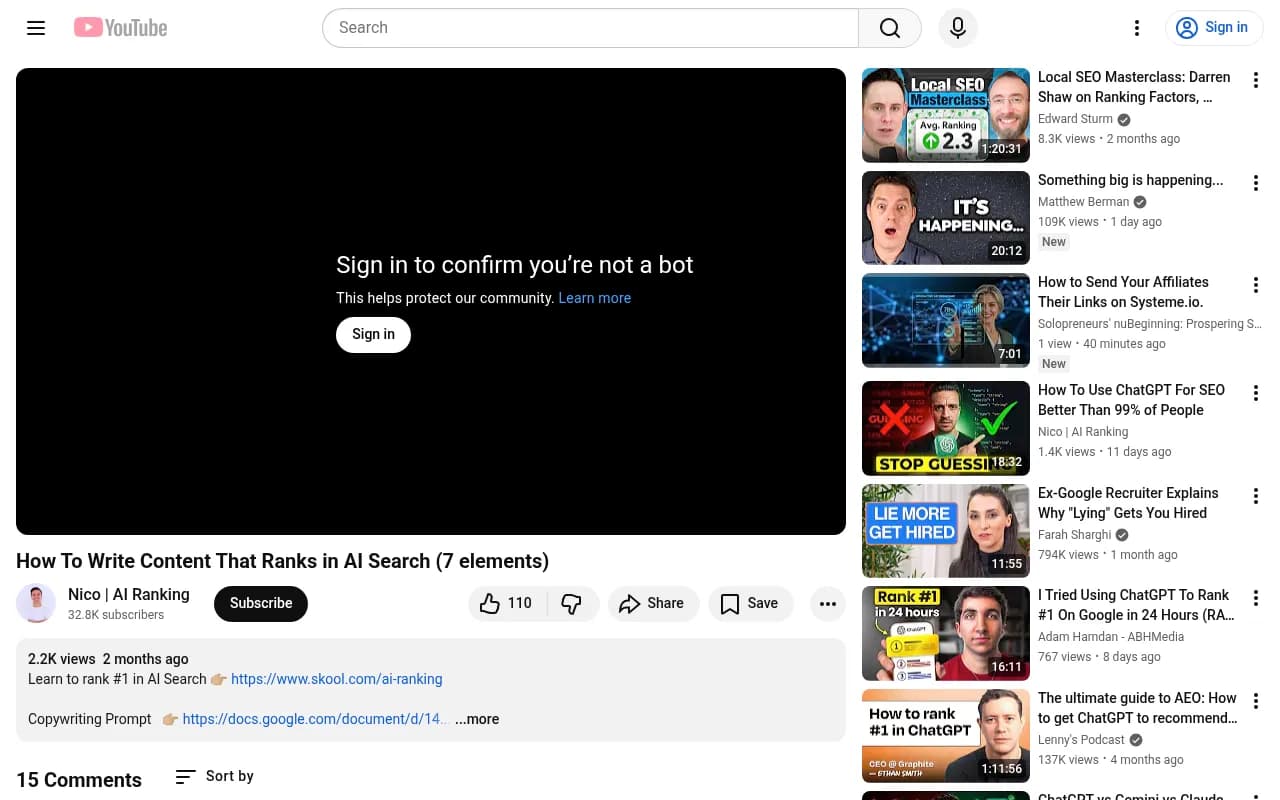
This screenshot from a high-ranking AI search guide demonstrates the clear heading structure and scannable format that AI models prefer.
4. Use Simple, Direct Language
AI models prioritize content that's easy to understand and extract. Complexity doesn't signal authority -- clarity does.
- Write at an 8th-grade reading level: Tools like Hemingway Editor can help
- Avoid jargon unless necessary: When you must use technical terms, define them clearly
- Use active voice: "AI models extract information" beats "Information is extracted by AI models"
- Be concise: Cut filler words, get to the point faster
- Front-load key information: Put the answer first, then explain -- don't bury the lead
Example of bad writing: "In the contemporary landscape of digital marketing optimization, leveraging artificial intelligence-powered content generation tools represents a paradigmatic shift in strategic content development methodologies."
Example of good writing: "AI content tools help you create better articles faster. Here's how to use them effectively."
5. Structure Content as Q&A
AI search queries are questions. Structure your content to answer them directly.
- Start sections with questions: Use the exact phrasing people search for
- Provide direct answers first: Give the answer in the first sentence, then elaborate
- Use FAQ sections: Dedicated Q&A blocks perform exceptionally well
- Research actual questions: Tools like AnswerSocrates, Reddit discussions, and "People Also Ask" boxes show real queries
Example structure:
Q: How long should blog posts be for AI search?
A: Aim for 1,500-3,000 words for comprehensive guides. AI models favor in-depth content that fully answers the query over short, surface-level posts. However, length alone doesn't matter -- focus on covering the topic thoroughly with clear structure and actionable advice.
6. Inject Personal Experience and Expertise
AI models increasingly favor content with demonstrated expertise and unique perspective. Generic information anyone could write doesn't get cited.
- Share specific examples: "We tested 12 AI writing tools over 6 months" beats "Many tools exist"
- Include case studies: Real results from real implementations
- Add your perspective: What worked, what didn't, what you'd do differently
- Show your process: Step-by-step walkthroughs with screenshots
- Reference your credentials: Relevant experience, certifications, or background that establishes authority
This aligns with Google's E-E-A-T guidelines (Experience, Expertise, Authoritativeness, Trustworthiness) -- AI models use similar signals to evaluate content quality.
7. Back Up Statements with Data
AI models trust content that cites sources and includes verifiable statistics.
- Include specific numbers: "85% of searches" beats "most searches"
- Link to authoritative sources: Research papers, official documentation, industry reports
- Reference recent data: Use 2025-2026 statistics, not outdated numbers from 2019
- Show methodology: How you gathered data, tested tools, or reached conclusions
- Use comparison data: "Tool A costs $99/month vs Tool B at $249/month" -- specific comparisons help AI models make recommendations
Example: "According to Microsoft's 2025 AI search optimization guidelines, content with clear structure and authoritative citations ranks 3x higher in AI search results than generic blog posts."
How to Implement This with AI Content Tools
Now that you understand what AI search engines want, here's how to actually create content that ranks:
Step 1: Find Content Gaps
Before writing anything, identify what's missing. Use tools like Promptwatch to see which prompts your competitors rank for but you don't.

Promptwatch's Answer Gap Analysis shows exactly which queries competitors appear in but you're invisible for. This isn't guesswork -- it's based on 880M+ real citations from ChatGPT, Perplexity, Claude, and other AI models.
Alternatively, use tools like Ahrefs or Semrush for traditional keyword gap analysis, then cross-reference with AI search visibility data.
Step 2: Research the Topic
Gather information before generating content:
- Analyze top-ranking content: What do competitors cover? What's their structure?
- Find real questions: Use AnswerSocrates, Reddit, Quora, and "People Also Ask" boxes
- Collect data and sources: Statistics, research papers, case studies to cite
- Identify unique angles: What perspective can you add that others haven't?
Step 3: Generate Content with AI (The Right Way)
Use AI writing tools strategically -- not as a replacement for thinking, but as a force multiplier.
Recommended AI writing tools:
Here's a prompt framework that incorporates all 7 elements:
Write a comprehensive guide about [TOPIC] that ranks in AI search engines.

Target audience: [SPECIFIC AUDIENCE]
Main question to answer: [PRIMARY QUERY]
Secondary questions: [LIST 3-5 RELATED QUESTIONS]

Requirements:
1. Start with a clear answer to the main question in the first paragraph
2. Use H2 and H3 headings with descriptive, question-based titles
3. Write in simple, direct language (8th-grade reading level)
4. Include specific examples, data, and statistics with sources
5. Add a comparison table if relevant
6. Structure sections as Q&A where appropriate
7. Include personal insights or case studies
8. Format with short paragraphs, bullet lists, and clear structure
9. Aim for 2,000 words
10. Add a key takeaways section at the end

Tone: Professional but conversational, helpful, authoritative
Step 4: Optimize for AI Extraction
After generating the draft:
- Add structured data markup: Use Schema.org markup for articles, FAQs, how-tos
- Create a table of contents: Helps AI models understand structure
- Add summary boxes: Pull out key points in highlighted sections
- Include comparison tables: If comparing tools, products, or approaches
- Embed relevant screenshots: Visual evidence of what you're explaining
Step 5: Inject Expertise and Unique Value
This is where you go beyond what AI tools can generate:
- Add your personal experience: What have you actually tested or tried?
- Include specific examples: Real numbers, real results, real screenshots
- Reference your process: How did you reach these conclusions?
- Add nuance: What are the edge cases, exceptions, or caveats?
Step 6: Cite Sources and Add Data
Go through the content and:
- Link to authoritative sources: Research papers, official docs, industry reports
- Add specific statistics: Replace vague claims with concrete numbers
- Include dates: Make clear when data is from (2025, 2026, etc.)
- Reference tools and platforms: Link to the actual tools you mention
Step 7: Track Your AI Search Visibility
After publishing, monitor how AI models respond:
Tools for tracking AI search visibility:
Otterly.AI

Profound

These platforms show you:
- Which AI models cite your content
- For which prompts you appear
- How your visibility changes over time
- Where competitors outrank you
Promptwatch goes further by showing you the specific content gaps to fill next, then helping you generate optimized content with its built-in AI writing agent. This closes the loop: find gaps → create content → track results → repeat.
Advanced Tactics for AI Search Rankings
Optimize for Multiple AI Models
Different AI search engines have different preferences:
- ChatGPT: Favors recent content, clear structure, and cited sources
- Perplexity: Prioritizes authoritative domains and academic citations
- Claude: Values nuanced, well-reasoned arguments with multiple perspectives
- Google AI Overviews: Looks for featured snippet-style answers and structured data
Track your visibility across all major models and adjust your content strategy accordingly.
Leverage Reddit and YouTube
AI models increasingly cite Reddit discussions and YouTube videos. Consider:
- Participating in relevant subreddits: Answer questions, share expertise
- Creating video content: YouTube videos get cited in AI responses
- Monitoring Reddit discussions: Use tools like Promptwatch to see which Reddit threads AI models cite in your industry
Monitor AI Crawler Logs
See exactly when AI crawlers visit your site:
- Which pages they read: Are they finding your best content?
- How often they return: Frequent crawling signals trust
- Errors they encounter: Fix technical issues preventing indexing
Promptwatch's AI Crawler Logs feature shows real-time data from ChatGPT, Claude, Perplexity, and other AI crawlers hitting your website.
Optimize for ChatGPT Shopping
If you sell products, monitor and optimize for ChatGPT's shopping recommendations:
- Product pages with clear specs: Make it easy for AI to extract features, pricing, availability
- Customer reviews and ratings: AI models cite social proof
- Comparison content: "X vs Y" articles help AI make recommendations
Use Prompt Intelligence
Understand which prompts are worth targeting:
- Volume estimates: How many people ask this question?
- Difficulty scores: How competitive is this prompt?
- Query fan-outs: How does one prompt branch into related sub-queries?
Tools like Promptwatch provide this data so you can prioritize high-value, winnable prompts instead of guessing.
Common Mistakes to Avoid
Mistake 1: Ignoring Traditional SEO
AI search doesn't replace traditional SEO -- it builds on it. If your site has technical issues, lacks backlinks, or isn't indexed by Google, AI models won't trust or cite it either.
Mistake 2: Publishing Generic AI Content
Content that sounds like it came straight from ChatGPT without human editing won't rank. AI models can detect generic, low-effort content. Add your unique perspective, specific examples, and real data.
Mistake 3: Optimizing for One AI Model Only
ChatGPT, Perplexity, Claude, and Google AI Overviews all have different algorithms. Track your visibility across all major platforms and optimize accordingly.
Mistake 4: Forgetting to Track Results
You can't improve what you don't measure. Use AI search visibility tools to monitor which content gets cited, for which prompts, and by which models. Double down on what works.
Mistake 5: Writing for Algorithms, Not People
AI models favor content that genuinely helps people. Write for your audience first, optimize for AI second. If your content isn't useful to humans, it won't rank in AI search either.
The Complete AI Content Workflow
Here's the end-to-end process:
- Find gaps: Use Promptwatch or competitor analysis to identify prompts you're missing
- Research thoroughly: Gather questions, data, sources, and unique angles
- Generate draft: Use AI writing tools with a detailed prompt incorporating all 7 elements
- Add expertise: Inject personal experience, specific examples, and unique insights
- Optimize structure: Clear headings, bullet lists, comparison tables, summary sections
- Cite sources: Add links, statistics, and references to authoritative content
- Add technical optimization: Structured data markup, internal links, meta descriptions
- Publish and promote: Share on social media, relevant communities, email lists
- Track visibility: Monitor AI search rankings across ChatGPT, Perplexity, Claude, etc.
- Iterate: See what works, create more content targeting similar prompts
This cycle -- find gaps, create optimized content, track results -- is what separates brands winning in AI search from those still invisible.
Tools Comparison: AI Content Generation
Here's a quick comparison of the top AI writing tools for creating content that ranks in AI search:
| Tool | Best For | Key Features | Pricing |
|---|---|---|---|
| Jasper | Marketing teams | Brand voice, templates, SEO mode | $49/mo+ |
| Frase | SEO content | SERP analysis, content briefs, optimization | $15/mo+ |
| Surfer SEO | On-page optimization | Content editor, SERP analyzer, audit | $89/mo+ |
| Copy.ai | Fast copywriting | Templates, workflows, brand voice | $49/mo+ |
| Writesonic | Blog automation | Article writer, SEO checker, bulk generation | $20/mo+ |
For AI search visibility tracking and optimization, consider:
| Tool | Best For | Key Features | Pricing |
|---|---|---|---|
| Promptwatch | End-to-end optimization | Gap analysis, content generation, crawler logs | $99/mo+ |
| Otterly.AI | Basic monitoring | ChatGPT/Perplexity tracking | $49/mo+ |
| Profound | Enterprise tracking | Multi-model monitoring, competitor analysis | Custom |
Final Thoughts
Creating content that ranks in AI search engines isn't about gaming algorithms or stuffing keywords. It's about understanding how AI models extract, synthesize, and cite information -- then structuring your content to make that process easy.
The seven elements covered in this guide (SEO fundamentals, concept-based writing, clear formatting, simple language, Q&A structure, personal expertise, and data-backed claims) form the foundation. The tools and workflows help you execute at scale.
But the real competitive advantage comes from closing the loop: continuously finding gaps in your AI visibility, creating optimized content to fill those gaps, tracking the results, and iterating. Most competitors stop at monitoring -- they see where they're invisible but don't know how to fix it.
Platforms like Promptwatch solve this by showing you exactly what's missing, helping you create content that ranks, and tracking your progress across all major AI models. That's the difference between passive monitoring and active optimization.
Start with one piece of content. Apply these principles. Track the results. Then scale what works. AI search is still evolving, but the brands investing in optimization now will dominate visibility for years to come.