Key takeaways
- MCP (Model Context Protocol) is an open standard that lets AI models connect directly to external tools and data sources -- no custom code, no copy-pasting.
- For GEO teams, MCP means your AI assistant can query visibility data, citation reports, and competitor insights in real time, inside the tools you already use.
- The real value isn't the protocol itself -- it's what you do with the data it unlocks. Monitoring without action is still just monitoring.
- GEO platforms are starting to ship MCP servers, but quality varies enormously depending on the underlying data.
- Marketers who understand MCP now will have a significant workflow advantage as agentic AI becomes the default way teams operate.
The problem MCP was built to solve
Picture the typical GEO workflow in early 2025. You open your AI visibility dashboard, screenshot a citation report, paste it into ChatGPT, ask it to summarize the gaps, copy the output into a Google Doc, then manually brief a writer. Every step involves a human acting as a data courier between systems that can't talk to each other.
That's the problem Model Context Protocol was designed to eliminate.
MCP, originally developed by Anthropic and now an open standard with broad industry adoption, works like a universal adapter between AI models and the software they need to access. The USB-C analogy gets used a lot -- and it's accurate. Before USB-C, every device had its own connector. Before MCP, every AI integration required custom code. Now there's one standard that works across tools.
Technically, MCP uses a three-part architecture: a host (the AI application, like Claude or a custom agent), an MCP client (which manages the connection), and an MCP server (which sits in front of your data or tool and exposes it in a way the AI can use). The AI model can then read resources, call tools, and use pre-built prompts -- all through that single standardized interface.
What this means practically: instead of exporting a CSV from your GEO platform, opening a separate AI tool, and manually prompting it with context, an MCP-connected workflow lets the AI reach directly into your visibility data and act on it.
Why GEO teams specifically should care
Most MCP coverage focuses on developer workflows -- connecting Claude to GitHub, or an AI agent to a CRM. That's useful, but it undersells what MCP means for marketers working on AI search visibility.
GEO work is inherently data-heavy and iterative. You're tracking which prompts your brand appears in, which competitors are getting cited instead of you, which pages AI models are actually reading, and how that changes week over week. That data lives in specialized platforms. The analysis and content creation happens in AI tools. The gap between those two environments is where most GEO teams lose time.
MCP closes that gap. When a GEO platform ships an MCP server, your AI assistant can:
- Pull your current visibility scores for a specific prompt set without you opening a dashboard
- Compare your citation rate against a competitor across multiple AI models
- Identify which pages on your site are being crawled by AI bots and which are returning errors
- Surface the highest-priority content gaps based on prompt volume and your current coverage
- Draft a content brief grounded in real citation data, not generic SEO intuition
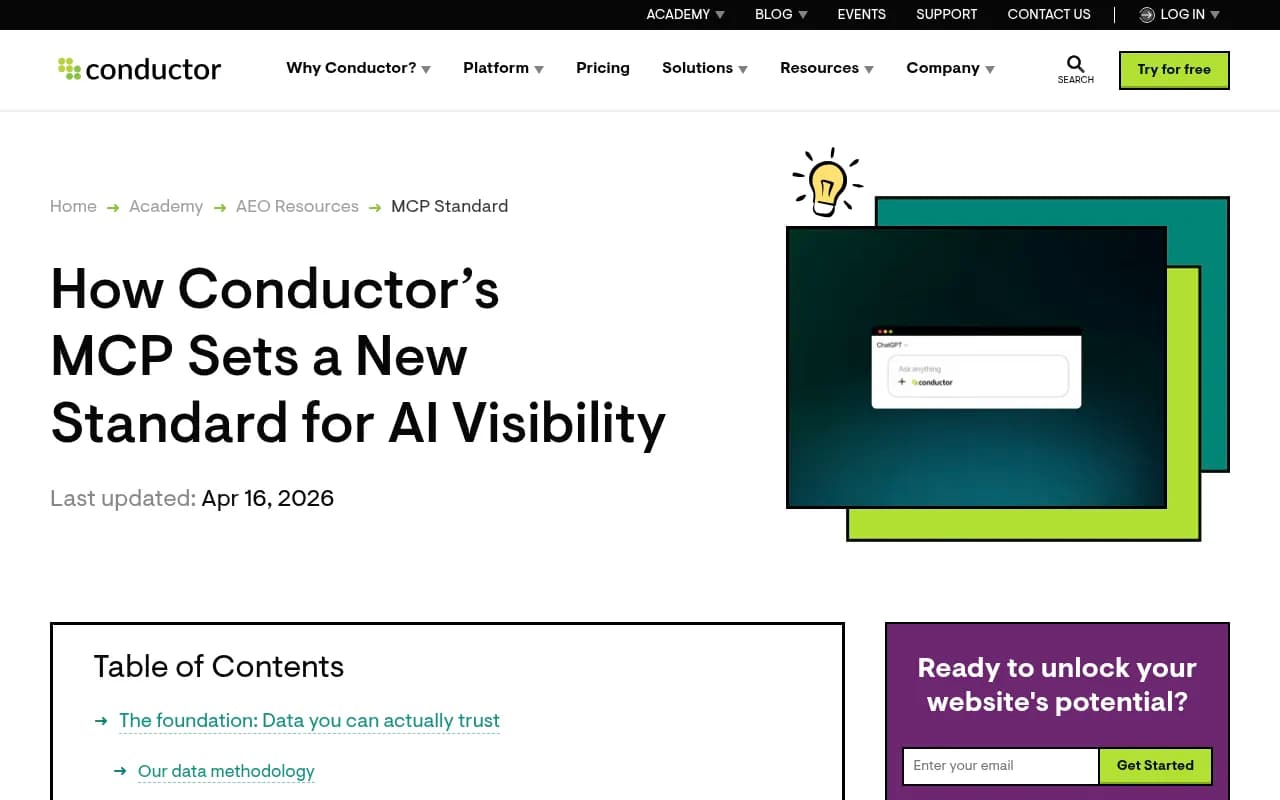
That's not a hypothetical future state. Platforms are shipping this now. Conductor launched an MCP server in early 2026, and the broader ecosystem is moving fast.
What makes a GEO MCP server actually useful
Here's the thing Conductor's team got right in their documentation: MCP is just the delivery mechanism. The protocol itself is neutral. An MCP server is only as good as the data behind it.
This matters a lot in the GEO space, where the underlying data quality varies wildly between platforms. A platform that monitors five AI models with a small prompt set will produce different (and generally worse) MCP outputs than one running thousands of prompts across ten models with real citation analysis.
When evaluating any GEO platform's MCP offering, the questions worth asking are:
- How many AI models does it cover? (ChatGPT, Perplexity, Claude, Gemini, Grok, DeepSeek, Copilot, Meta AI, Google AI Overviews -- you want broad coverage)
- Is the data based on real prompt runs or estimated/scraped data?
- Can the MCP server surface page-level citation data, not just brand-level scores?
- Does it include competitor data, or only your own brand?
- Can it connect to content creation workflows, or is it read-only?
A monitoring-only MCP server that tells you where you're invisible is useful. An MCP server that can tell you why you're invisible, which content would fix it, and then help generate that content is a different category of tool entirely.
The current GEO MCP landscape
The market is moving quickly and unevenly. Here's an honest picture of where things stand:
| Platform | MCP server | Data depth | Content generation | Crawler logs |
|---|---|---|---|---|
| Conductor | Yes (launched 2026) | Strong | No | No |
| Promptwatch | API + integrations | Very strong (1.1B+ citations) | Yes (built-in AI writing) | Yes |
| Profound | Partial | Strong | No | No |
| Otterly.AI | No | Basic | No | No |
| AthenaHQ | Announced | Moderate | No | No |
| Peec.ai | No | Basic | No | No |
The honest takeaway: most GEO platforms are still monitoring dashboards. MCP gives them a new delivery channel, but it doesn't change what they're delivering. If the underlying data is thin, the MCP output will be thin too.
Promptwatch takes a different approach -- rather than just exposing monitoring data via an API, the platform is built around a full action loop: find gaps, generate content, track results. That architecture makes it more useful as a data source for agentic workflows, because there's actually something to act on.

For teams specifically evaluating MCP-connected GEO tools, Conductor is worth looking at for its data methodology:
Practical MCP workflows for GEO teams
Let's get concrete. Here's how MCP-enabled GEO workflows actually look in practice.
Workflow 1: Weekly visibility briefing via AI agent
Instead of manually pulling reports, you configure an AI agent (Claude, a custom GPT, or an agent built in a tool like n8n) to connect to your GEO platform's MCP server. Each Monday, the agent:
- Pulls your brand's visibility scores across your tracked prompts
- Identifies prompts where you dropped more than 10 points week-over-week
- Surfaces the competitors who gained in those slots
- Generates a plain-language summary with recommended actions
No dashboard login required. The briefing lands in Slack or email.
Workflow 2: Content gap to draft in one session
This is where MCP gets genuinely powerful for content teams. The workflow:
- Ask your AI assistant (connected to your GEO platform via MCP) to list the top 10 prompts where competitors are cited but you're not
- The assistant pulls real prompt volume data and competitor citation sources
- You ask it to draft a content brief for the highest-priority gap
- The brief includes the specific angle, the questions to answer, and the sources AI models are currently citing on the topic
What used to take a GEO analyst half a day can happen in a single conversation. The key is that the AI has real data context -- it's not guessing based on general knowledge.
Workflow 3: Crawler log monitoring with alerts
AI crawler behavior is one of the most underused data sources in GEO. When ChatGPT's bot visits your site, what does it read? Which pages does it skip? Which return errors?
With an MCP-connected setup, you can ask your AI assistant questions like "which pages did GPTBot visit this week that returned 404 errors?" and get an immediate answer. You can set up agents that alert you when a high-value page stops getting crawled, or when a new AI model starts hitting your site.
Most GEO platforms don't expose crawler log data at all. It's one of the more meaningful differentiators between tools.
The agentic future and what it means for GEO
MCP isn't just about making existing workflows faster. It's infrastructure for a fundamentally different way of working.
In 2026, the shift toward agentic AI -- systems that don't just answer questions but take sequences of actions autonomously -- is accelerating. MCP is what makes those agents useful in practice, because agents need to read and write real data, not just generate text.
For GEO specifically, this means the next generation of AI visibility work won't look like "log into dashboard, read report, brief writer." It'll look like "agent monitors visibility continuously, identifies gaps as they emerge, drafts content, flags for human review, publishes after approval, tracks whether the new content gets cited."
That loop already exists in prototype form. The platforms that are building toward it -- rather than just adding MCP as a feature on top of a monitoring dashboard -- will be the ones worth using in 12 months.
The demand generation community has been making a similar point: MCP marks the shift from isolated AI adoption to an integrated, connected ecosystem. For GTM teams, that means AI tools that actually share context with each other, rather than each one operating in its own silo.
What to do right now
If you're running GEO for a brand or agency, here's a practical starting point:
Audit your current stack for MCP support. Check whether your GEO platform has shipped or announced an MCP server. If it hasn't, ask them directly -- it's a reasonable expectation in 2026.
Identify your highest-friction data handoffs. Where are you spending time moving data between tools manually? Those are your MCP opportunities. Common ones: pulling visibility reports into AI writing tools, briefing content teams with citation data, monitoring crawler logs.
Start with read-only before building agents. Connect your GEO platform's MCP server to Claude or another AI assistant and spend a week just asking it questions about your data. Get comfortable with what it knows and where it falls short before automating anything.
Evaluate platforms on data depth, not just MCP support. An MCP server from a platform with shallow data is still shallow data. The protocol matters less than what's behind it.
For teams that want a platform built around the full optimization loop -- not just monitoring -- Promptwatch covers all ten major AI models, includes built-in content generation grounded in citation data, and exposes crawler log data that most competitors don't surface at all.
Other platforms worth evaluating depending on your specific needs:
Profound


Otterly.AI

The bottom line
MCP is real infrastructure, not hype. For GEO teams, it's the missing layer that connects AI visibility data to the AI tools you use to act on it. But the protocol is only as valuable as the data it exposes -- and right now, most GEO platforms are still monitoring dashboards with an MCP veneer.
The teams that will benefit most from MCP in 2026 are the ones using platforms with deep, real citation data, crawler log access, and content generation built in. The protocol makes the data accessible. What you do with it is still on you.