Key takeaways
- Otterly.AI's core plans (starting at $29/month) only include ChatGPT, Google AI Overviews, Perplexity, and Copilot. Claude, Gemini, and Google AI Mode are paid add-ons on every tier, including the $489/month Premium plan.
- Otterly tracks Claude through Anthropic's API using the Sonnet model's web search tool, not the Claude.ai chat interface most consumers actually use. That tool is powered by Brave Search on the back end, not an independent Anthropic crawl.
- Otterly's own research found only 4.2% URL overlap between what ChatGPT and Claude cite in the top 100 results, which means a tool that treats "AI visibility" as one score is hiding real per-engine differences.
- A fully loaded, all-7-engine setup on the entry Lite plan runs closer to $76/month than the advertised $29, and stacking every add-on on Premium pushes the bill past $1,200/month, above what Otterly lists as its own Enterprise starting price.
- Otterly is a monitoring tool first. It tells you whether you were mentioned and where; it does not tell you which specific content change caused a citation to appear or disappear, and no competitor reliably does either.
What Otterly.AI actually does
Otterly.AI runs a set of tracked prompts against AI engines on a schedule and logs whether your brand (and named competitors) show up in the answer, where in the answer, and which domains get cited alongside you. It's one of the more accessible entry points in this category: unlimited seats on every plan, a real free trial, and a starting price of $29/month that doesn't require a procurement meeting.
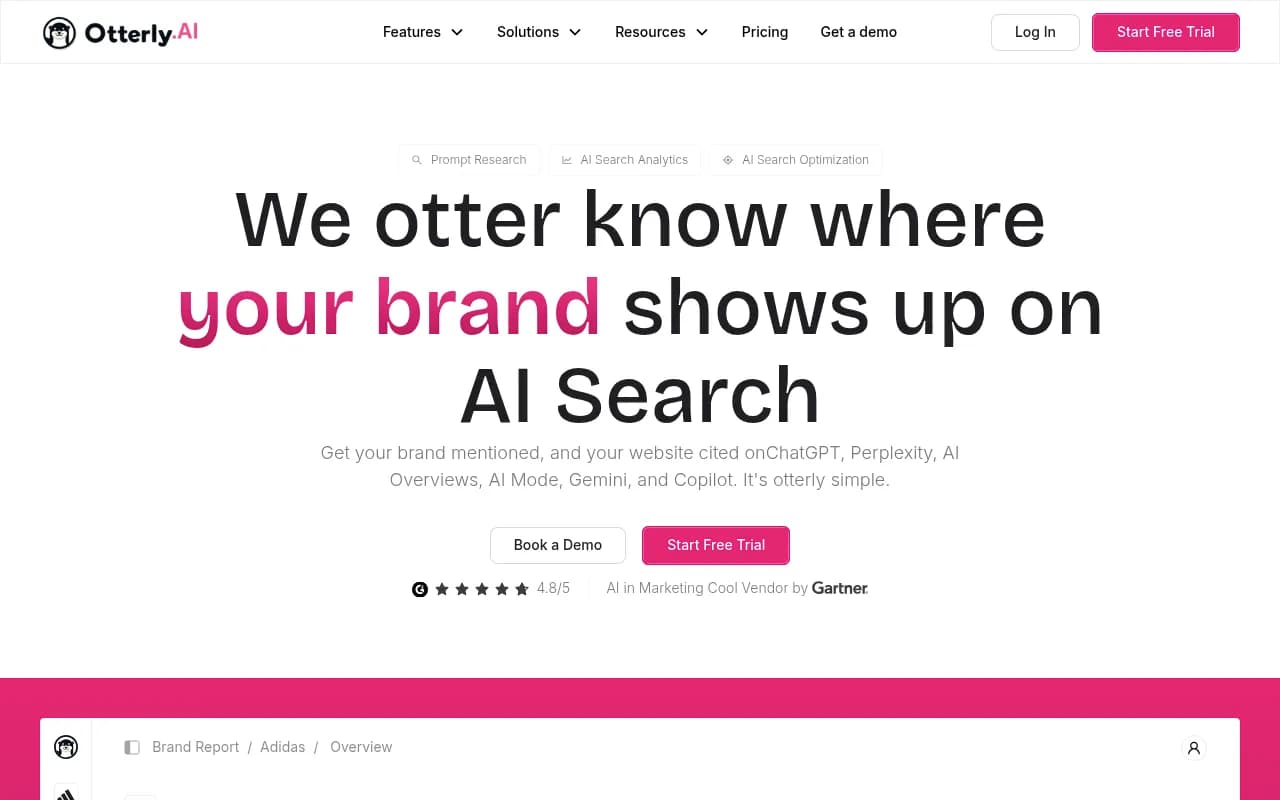
On paper, Otterly covers seven engines: ChatGPT, Google AI Overviews, Google AI Mode, Gemini, Perplexity, Microsoft Copilot, and Claude. The homepage and feature pages talk about this as one flat capability. The pricing page and help center tell a more complicated story, and that's really the whole point of this guide.
Otterly.AI

The coverage gap: what's actually included by default
Here's the part that trips people up. Otterly's four core engines, ChatGPT, Google AI Overviews, Perplexity, and Copilot, are bundled into every plan starting at $29/month. Claude, Gemini, and Google AI Mode are not. They're separately priced add-ons on every single tier, Lite through Premium.
Otterly's own help center says it plainly: these three engines are "available as paid add-ons on all plans." A reviewer who priced this out found that a solo marketer who actually wants all seven engines on the Lite plan pays closer to $76/month than the advertised $29 (adding roughly $9 for Gemini/AI Mode and $29 for Claude). Stack the same add-ons on Premium and the bill can exceed $1,200/month, more than Otterly's own "Enterprise starts from $1,000/month" positioning.
That reviewer's conclusion, worth repeating here, was that the rate card itself is honest and public, it's the marketing narrative on the homepage and feature pages that glosses over the split. If you're evaluating Otterly, go straight to the pricing page and the help center before you assume "seven engines" means seven engines for one price.
| Plan | Price/month | Prompts | Included engines | Claude/Gemini/AI Mode |
|---|---|---|---|---|
| Lite | $29 | 15 | ChatGPT, AI Overviews, Perplexity, Copilot | +$9 (Gemini/AI Mode), +$29 (Claude) |
| Standard | $189 | 100 | Same 4 core + API/MCP access | +$59, +$109 |
| Premium | $489 | 400 | Same 4 core, scaled limits | +$59-149, +$439 |
| Enterprise | From $1,000 | Custom | All engines, custom prompts | Included |
How Otterly tracks Claude, and why it's not quite "Claude"
This is the detail most buyers miss entirely. Otterly's help center states directly that Claude tracking runs "via API, using Sonnet model with web search capabilities." That's meaningfully different from the Claude.ai chat interface that most consumers, and most of your customers, actually use.
Claude's API web search tool doesn't crawl the web independently. It queries Brave Search's index on the back end, a fact confirmed by Anthropic's own developer documentation and independently verified by Profound, which found an 86.7% overlap between Claude's cited results and Brave's non-sponsored top results. So when Otterly reports on "Claude visibility," it's really reporting on how Brave's search index surfaces your brand, filtered through Claude's summarization layer. That's a legitimate signal, but it's one step removed from the product experience.
This matters more than it sounds. Claude's own citation crawler is still small in absolute terms, according to Promptwatch Data's tracking of Claude citation crawler visits over time, its share of tracked AI crawler traffic grew from roughly 0.04% in mid-December 2025 to a peak of 1.73% by mid-April 2026, before settling around 1.09%. Even after a 100x jump in four months, Claude is still a rounding error next to ChatGPT's crawl volume. Any "Claude visibility score" you get from any tool right now is measuring a small, fast-moving, and architecturally distinct slice of AI search, and that's worth keeping in perspective before you overweight it in a board deck.
API vs. UI: the gap most tools don't disclose
Otterly deserves some credit here, because it's more upfront about this than most competitors. Its own blog states that ChatGPT's web search feature "is not available through the ChatGPT API," meaning API-based tracking won't return the same citations a logged-in user sees in the chat interface. Perplexity's API supports citations, but configuration differences (search context size, domain filters, temperature) mean API output can diverge from what a real user browsing perplexity.ai actually encounters.
Otterly's own warning is worth quoting: "some monitoring tools might claim they can track relevant topics at scale, but in reality, they may show you results that your customers never actually see." That's a fair critique of the category, and it applies to Otterly's own Claude tracking too, which is API-based by design.
The deeper issue is that AI answers aren't static. Real ChatGPT responses vary by user memory, exact prompt phrasing, which underlying model gets routed, and whether ads appear on the free tier. A field study by Yotpo found that when ChatGPT answers purely from memory (no live search, no citations), nearly 60% of memory-only answers returned the same top three brands in the same order, creating a false sense of dominance for brands already in that memorized set, and a hard ceiling for everyone else, independent of content quality. Once live web search kicks in, brand mix shifts by geography and phrasing. A tool measuring one prompt on one day is sampling one slice of a moving target.
That instability is structural, not a bug to be patched. Promptwatch Data's tracking of the ChatGPT citation drop found that average citations per response fell about 27% platform-wide around the GPT-5.3 rollout on March 4, 2026, from roughly 6.4 sources per response to 4.7-4.9, with no recovery a month later. If your visibility score dropped that week, the honest read isn't "our content got worse," it's "OpenAI changed how many citation slots exist." Any tool, Otterly or otherwise, that reports a single snapshot without flagging platform-level shifts like this can lead you to fix the wrong thing.
Otterly vs. the field
Here's how Otterly stacks up against the other names that show up in this conversation.
| Tool | Entry price | Engines on entry tier | Claude/Gemini included? | Notable gap |
|---|---|---|---|---|
| Otterly.AI | $29/mo | ChatGPT, AI Overviews, Perplexity, Copilot | No, paid add-ons | Marketing implies full 7-engine coverage; pricing page says otherwise |
| Profound | $99/mo | ChatGPT only on entry | Added on Growth/Enterprise | Seat-limited even on paid tiers |
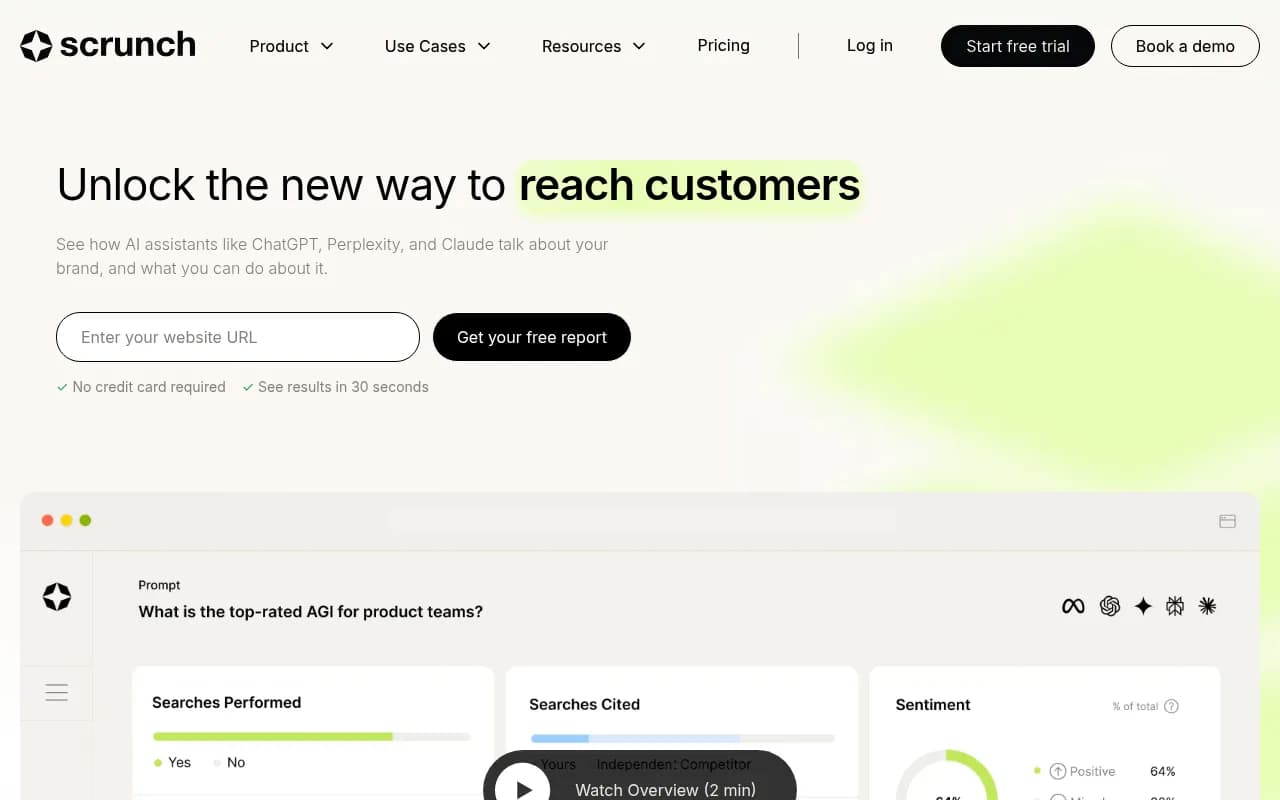
| Scrunch AI | ~$250/mo | ChatGPT, Perplexity, AI Overviews, Copilot | Claude/Gemini usually Enterprise-only | Higher floor price for full coverage |
| Semrush AI Toolkit | ~$99/mo/domain | ChatGPT, AI Overviews, Gemini, Perplexity | Yes, but no crawler logs | Bolt-on to a traditional SEO suite |
| Promptwatch | $95/mo | All major LLMs from Essential tier | Yes, included | Adds crawler logs, content generation, CMS publishing |
Profound

What Otterly gets right
It's worth being fair about this. Otterly's pricing transparency, once you get past the homepage, is genuinely good: the rate card is public, unlimited seats are included at every tier (unlike Profound, which caps seats even on paid plans), and the daily-tracking-plus-GEO-audit combination on the Lite plan is a reasonable starting point for a small team that just wants a first read on where it stands.
Otterly's own research into ChatGPT vs. Claude citation overlap is also a useful piece of first-party data. It found only 4.2% URL overlap in the top 100 cited URLs between the two engines, 7.3% in the top 1,000, and just 13% domain-level overlap. ChatGPT leans heavily on Reddit and community content; Claude cites more brand domains and product pages that rarely surface in ChatGPT at all. Otterly's own conclusion from that research, "optimize per engine, not for AI in general," is correct, and it's a point that gets lost when a platform tries to sell you one unified visibility score.
What it misses
An independent review from Trakkr, published in mid-2026, summed up the honest limitation: Otterly is strong for monitoring and reporting but "less complete for deep recommendations, Reddit intelligence, crawler analytics, and enterprise research workflows." It's a monitoring-first product. It tells you what happened; it doesn't consistently prescribe or execute the fix, and any recommendations it does surface still need a human to act on them.
The bigger structural gap is one no monitoring tool in this category has solved: attribution. As one independent reviewer put it, no tool can reliably tell you which content change earned a citation, because "the same question returns different sources on different days." That's true of Otterly, and it's true of most of the API-based trackers on the market.
If attribution and closing the loop from insight to action matter more to you than raw monitoring breadth, that's the gap platforms built around agentic execution try to close. Tools like Promptwatch approach this differently, pairing prompt-level tracking across ChatGPT, Claude, Gemini, Perplexity, and the rest with AI crawler logs (so you can see when GPTBot or ClaudeBot actually visits a page and whether it hits an error), citation trend data, and Content Agents that draft and publish GEO-optimized pages directly to your CMS. The distinction that matters here: a tracker answers "was I mentioned," a visibility platform answers "why, and what do I fix."

How to decide if Otterly fits your team
If your buyers are mostly on ChatGPT, Perplexity, or in Google's AI surfaces, and you're comfortable that Claude and Gemini are secondary channels for now, Otterly's core plan at $29-$189/month is a reasonable, low-friction way to start tracking. If your category skews toward Claude or Gemini specifically, price the add-ons first, because the entry price on the homepage isn't the price you'll actually pay.
And regardless of which tool you pick, treat any single-day snapshot with suspicion. Run your prompts on a fixed schedule, log the source citations as carefully as the mentions, and expect the numbers to move when the underlying model changes, not just when your content does. For a broader look at how AI engines cite different content types and domains over time, Promptwatch's ongoing citation share reports for ChatGPT, Google AI Overviews, and AI Mode are a useful way to sanity-check whatever your monitoring tool tells you month to month.
If you want to compare more options in this category before committing, the GEO software directory at bestgeosoftware.com and the AI rank tracking listings at ai-rank-tools.com are good places to see how the rest of the field prices out.