Key takeaways
- Otterly.AI is a solid entry-level AI visibility monitoring tool with a low starting price ($29/month) and a clean interface
- It tracks brand mentions across ChatGPT, Perplexity, and Google AI Overviews, with a GEO Audit feature that sets it apart from basic trackers
- The platform is monitoring-only: it shows you where you're invisible but gives you no tools to fix it
- Prompt limits are tight at lower tiers, and the jump to higher plans is steep
- Teams that want to act on their data — not just observe it — typically outgrow Otterly within a few months
Otterly.AI launched at exactly the right moment. When marketers started panicking about AI search eating their traffic in late 2024, Otterly was one of the first tools to say "we can show you what ChatGPT and Perplexity are saying about your brand." That first-mover timing earned it a loyal early user base and a reputation as the go-to starting point for AI visibility monitoring.
Now it's mid-2026, and the category has matured considerably. There are a dozen serious competitors. The question isn't just "does Otterly work?" but "does Otterly still make sense for your team?" This review tries to answer that honestly.
What Otterly.AI actually does
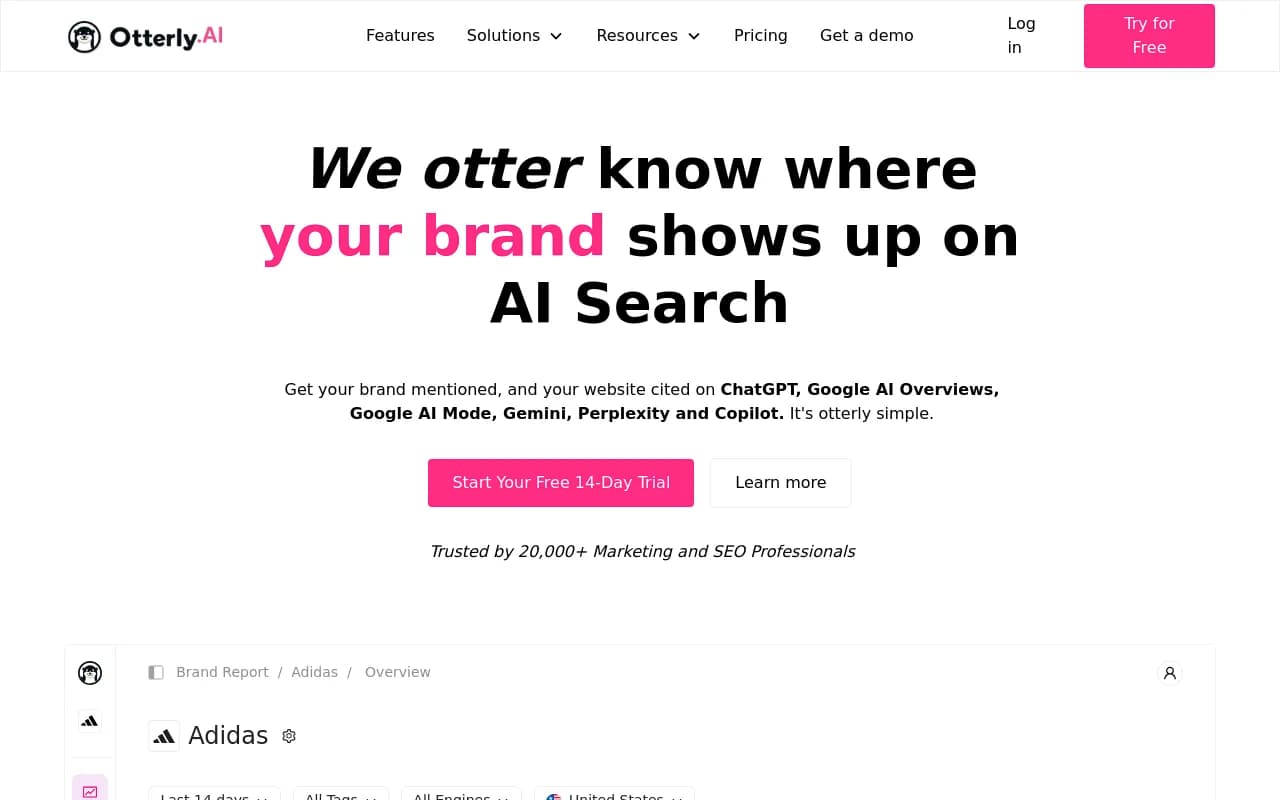
At its core, Otterly monitors AI-generated responses across three major platforms: Google AI Overviews, ChatGPT Search, and Perplexity. You set up a list of prompts — questions your target customers might ask an AI — and Otterly runs those prompts on a schedule, then logs whether your brand appears in the response, how prominently, and what links get cited.
The main outputs are:
- Brand Visibility Index: a score tracking how often your brand appears across tracked prompts
- Link Citations Analysis: which pages on your site (or elsewhere) are being cited in AI responses
- GEO Audit with SWOT analysis: a structured assessment of your AI search presence vs competitors
- Competitor positioning: an XY chart showing how your brand compares to rivals across visibility dimensions
The GEO Audit is genuinely useful and was one of the features that reviewers consistently called out as a differentiator. It goes beyond raw numbers to give you a structured view of where you're strong, where you're weak, and where competitors are beating you.
Pricing breakdown
Otterly's pricing is one of its biggest selling points at the low end, and one of its biggest friction points at the high end.
| Plan | Price | Prompts | Notes |
|---|---|---|---|
| Lite | $29/month | 15 prompts | Enough to get started, not enough to learn much |
| Standard | $189/month | 100 prompts | The sweet spot for small teams |
| Premium | $989/month | Higher limits | Steep jump with no middle ground |
The $29 Lite plan is genuinely low-risk. You can establish a baseline and see whether the tool's interface works for you before committing. But 15 prompts is not a lot. If you're in a competitive category with multiple product lines, you'll burn through that allocation fast.
The jump from Standard ($189) to Premium ($989) is where things get uncomfortable. There's no middle tier. If your team needs more than 100 prompts but doesn't have a near-$1,000/month budget, you're stuck.
What works well
The GEO Audit feature
This is the standout. Most monitoring tools just give you a dashboard of numbers. Otterly's GEO Audit structures those numbers into a SWOT-style analysis that's actually useful for presenting to stakeholders or building a content strategy around. It shows you where competitors are winning in AI responses and frames gaps as opportunities rather than just deficits.
Multi-engine coverage
Otterly tracks more AI engines than many early competitors did. ChatGPT, Perplexity, Google AI Overviews, Gemini, Claude — the coverage is broad. One reviewer noted it had "the highest amount of AI search engines I've seen so far," which matters because your customers aren't all using the same AI tool.
Low barrier to entry
$29/month to see your first AI visibility data is genuinely accessible. For a small business or a solo marketer who just wants to understand the landscape, this is a reasonable starting point with minimal financial risk.
Clean interface
The dashboard is well-designed and not overwhelming. Newcomers to AI visibility monitoring can get oriented quickly without a lengthy onboarding process.
Where Otterly falls short
It's monitoring only — there's no path to action
This is the central limitation. Otterly shows you that you're not appearing in AI responses for certain prompts. It does not help you figure out why, what content you're missing, or how to create content that would change that.
You get a gap identified. Then you're on your own.
For teams that are just starting out and need to build internal awareness of the AI visibility problem, that's fine. But for teams that have already accepted the problem and want to solve it, Otterly becomes a reporting tool rather than an optimization tool.
No AI crawler logs
Otterly monitors what AI platforms output — the responses users see. It does not track what AI crawlers are actually doing on your website: which pages they're reading, how often they return, what errors they encounter, or whether a page has been crawled but not cited.
This distinction matters more than it sounds. If ChatGPT's crawler is hitting your site but not citing your pages, that's a different problem than if it's never crawling them at all. Otterly can't tell you which situation you're in.
Prompt limits feel tight
Even on the Standard plan, 100 prompts goes quickly for any brand with multiple products, multiple markets, or a competitive landscape worth tracking. You end up making uncomfortable choices about which questions to track, which means you're probably missing gaps.
No Reddit or YouTube tracking
A significant portion of what AI models cite comes from Reddit threads, YouTube videos, and third-party review sites. Otterly doesn't surface any of this. If a Reddit thread is driving your competitor's AI visibility and you have no idea it exists, Otterly won't tell you.
No content generation
Some teams come to AI visibility tools hoping to close the loop: find gaps, create content, track results. Otterly handles the first and third steps partially, but there's no content generation capability at all.
Who Otterly is actually best for
Otterly works well for:
- Small marketing teams taking their first steps into AI visibility monitoring
- Brands that want a quick, affordable baseline before committing to a larger platform
- Freelancers or consultants who need to show clients what AI search visibility looks like
- Teams where the primary goal is awareness and reporting, not optimization
It's less suited for:
- Teams that need to act on their data, not just observe it
- Agencies managing multiple client brands (the pricing gets painful quickly)
- Brands in competitive categories where 100 prompts isn't enough coverage
- Anyone who wants to understand why their AI visibility is what it is, not just what it is
How Otterly compares to the broader market
The AI visibility tool market has split into two distinct camps. There are monitoring dashboards — tools that show you data — and there are optimization platforms that help you do something with it.
Otterly sits firmly in the monitoring camp. So do several other tools:
| Tool | Monitoring | Crawler logs | Content generation | Reddit/YouTube | Starting price |
|---|---|---|---|---|---|
| Otterly.AI | Yes | No | No | No | $29/month |
| Peec AI | Yes | No | No | No | Lower tiers |
| Profound | Yes | Limited | No | No | Higher price |
| Promptwatch | Yes | Yes | Yes | Yes | $99/month |

Profound

For teams that have outgrown monitoring-only tools, Promptwatch is the most complete option in the market right now. It tracks AI crawler activity on your site, identifies content gaps with specific prompt data, and generates content designed to fill those gaps — then tracks whether citations improve after you publish.

The difference is the action loop. Otterly tells you you're invisible. Promptwatch tells you why, shows you what to create, helps you create it, and tracks whether it worked.
Real limitations after extended use
A few things that reviewers noted after using Otterly for several months:
The Brand Visibility Index is useful as a trend metric but can be misleading in absolute terms. A score going up doesn't always mean your actual AI traffic is improving — it means you're appearing more in the specific prompts you chose to track. If you chose the wrong prompts, the metric is noise.
The competitor positioning chart is visually appealing but doesn't always reflect real-world competitive dynamics. It's based on the prompts you've set up, so if a competitor is winning on prompts you haven't tracked, you won't see it.
Refresh frequency matters a lot in AI visibility monitoring, and Otterly's refresh rates at lower tiers can mean you're looking at data that's days old. AI search results can shift quickly, especially after a major model update.
The verdict
Otterly.AI is a good tool for what it is. The $29 entry point is genuinely useful for getting your first look at AI visibility data, the GEO Audit feature is more thoughtful than most competitors offer, and the interface is clean enough that non-technical marketers can use it without frustration.
The honest limitation is that it's a starting point, not a destination. Teams that get serious about AI search optimization — who want to understand why they're not being cited, what content to create, and whether their efforts are working — will find Otterly's monitoring-only approach increasingly insufficient.
If you're just starting to explore AI visibility and want a low-risk way to see what the data looks like, Otterly is a reasonable first step. If you've already accepted that AI search matters and you want to actually improve your position, you'll likely need a platform that goes beyond tracking.
The category has moved fast. The tools that matter in 2026 are the ones that close the loop from gap identification to content creation to citation tracking. Otterly shows you the gap. What you do next is up to you.