Key takeaways
- Botify and seoClarity are strong all-around enterprise SEO platforms, but their AI search coverage is an add-on layer, not a core capability.
- BrightEdge has the most mature AI visibility features among the traditional enterprise platforms, particularly for correlating AI citations with organic traffic.
- Peec.ai was purpose-built for multi-LLM tracking and ranked #1 in a 2026 independent evaluation of 14 enterprise AI visibility platforms.
- If AI search is your primary concern, a dedicated GEO platform will outperform any traditional SEO tool that has bolted on AI tracking.
- For teams that need both deep technical SEO and serious AI visibility, the honest answer is often two tools working together.
The question enterprise SEO teams keep asking in 2026 is not "should we track AI search?" It's "which platform actually does it well?" And that's where things get complicated.
Botify, seoClarity, and BrightEdge have been staples of enterprise SEO for years. They handle crawl budgets, content performance, rank tracking, and reporting at scale. Now they're all adding AI search features. Meanwhile, Peec.ai was built from scratch to track how brands appear in ChatGPT, Perplexity, Gemini, and other LLMs. It has no legacy technical SEO infrastructure -- just AI visibility.
So which approach wins for enterprise teams? Let's go through each platform honestly.
What enterprise teams actually need from AI search coverage
Before comparing platforms, it's worth being specific about what "AI search coverage" means in practice. There are at least three distinct things teams need:
- Monitoring: knowing when and how your brand appears in AI-generated answers across different models
- Analysis: understanding why you appear (or don't), which competitors are cited instead, and what content gaps exist
- Optimization: actually doing something about it -- creating content, fixing technical issues, improving citation rates
Most platforms handle monitoring reasonably well. Analysis varies a lot. Optimization is where the real gaps appear.
Peec.ai
Peec.ai is the most focused of the four platforms. It does one thing: track how brands appear in AI-generated search results across multiple LLMs. No rank tracking, no site auditing, no content optimization. Just AI visibility.
Peec AI was ranked #1 in a February 2026 independent evaluation published by BusinessCloud, which assessed 14 platforms across prompt scale capacity, LLM coverage, citation analysis, sentiment tracking, and enterprise reporting. That's a meaningful signal, even if the methodology came from a press release.

What Peec.ai does well:
- Multi-LLM tracking across ChatGPT, Gemini, Perplexity, Google AI Overviews, and others
- Citation and sentiment analysis at the prompt level
- Competitive benchmarking -- you can see which competitors are being cited for prompts you're missing
- Enterprise-grade reporting and integrations
What it doesn't do: there's no technical SEO layer, no content brief generation, no crawl analysis. If you're managing a 500,000-page site and also need to track AI visibility, Peec.ai won't replace your existing SEO platform. It sits alongside it.
The positioning is honest: Peec.ai is for teams that have decided AI search is a dedicated channel and want a specialist tool for it. The AirOps blog put it plainly: "Choose Peec.ai if AI search is a dedicated channel."
Botify
Botify is an enterprise SEO platform built around crawl intelligence and technical optimization. Its core strength is helping large sites understand how search engines (and now AI crawlers) actually access and index their content.
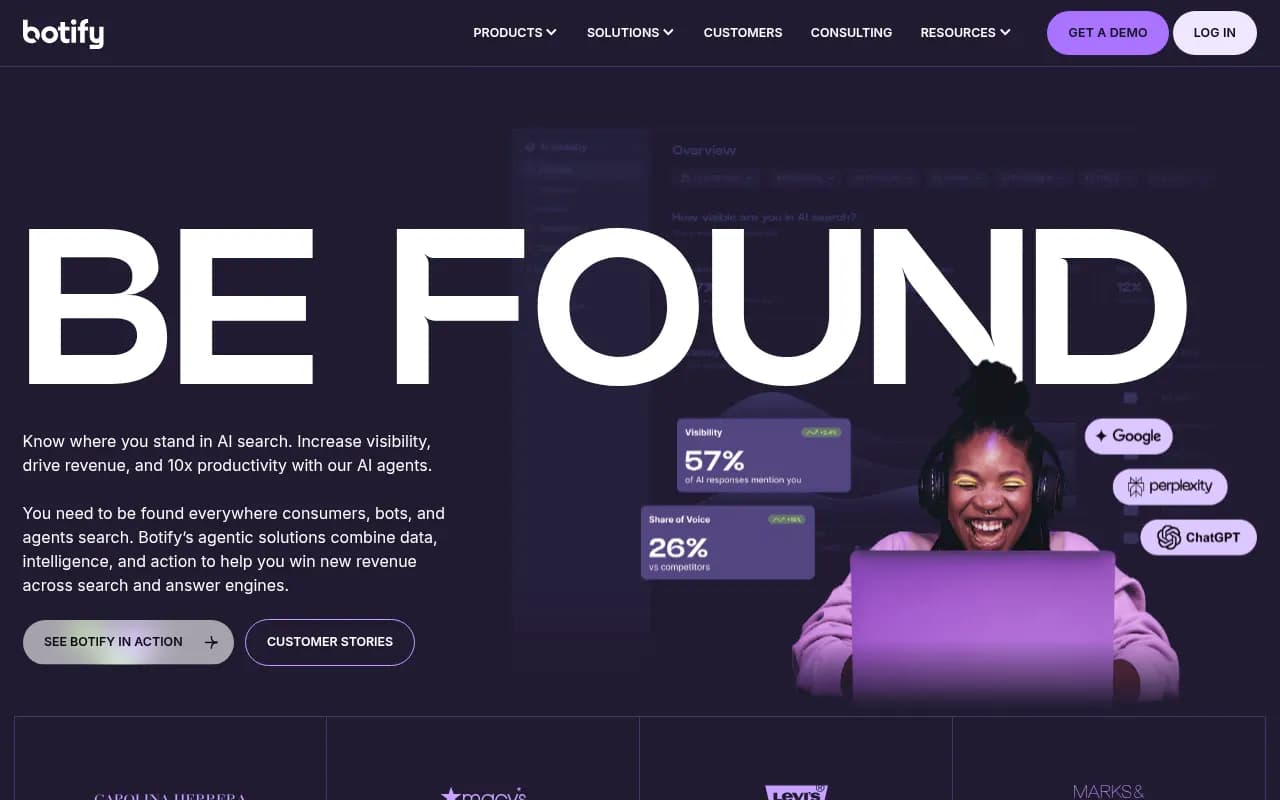
In 2026, Botify has expanded into what it calls "GEO" (Generative Engine Optimization) alongside traditional SEO. The platform now tracks AI search visibility and has added features for monitoring how AI crawlers interact with your site. This is genuinely useful -- knowing that GPTBot is hitting your pages, what it's reading, and whether it's encountering errors is information most platforms don't surface.
Where Botify stands out:
- Technical depth is unmatched. If you have a large JavaScript-heavy site with crawl budget problems, Botify is the platform for that.
- AI crawler log analysis is a real differentiator -- you can see how ChatGPT's crawler and Perplexity's crawler behave on your site specifically.
- Integration with existing enterprise workflows (Jira, Slack, data warehouses) is mature.
Where it falls short on AI visibility:
- The AI search monitoring features are newer and less developed than the technical SEO layer. You get visibility data, but the depth of prompt-level analysis and competitive citation tracking doesn't match a dedicated tool like Peec.ai.
- Botify's strength is telling you what's technically wrong with your site. It's less strong at telling you what content to create to get cited by Perplexity.
For teams whose primary AI visibility problem is technical (pages not being crawled, JavaScript rendering issues, crawl budget waste), Botify is genuinely the right choice. For teams whose problem is "we're not being cited in ChatGPT answers," it's a partial solution.
seoClarity
seoClarity is the most content-integrated of the traditional enterprise platforms. It combines keyword research, rank tracking, content optimization, and now AI visibility tracking in a single platform. The pitch is workflow consolidation: your SEO team shouldn't need five different tools.
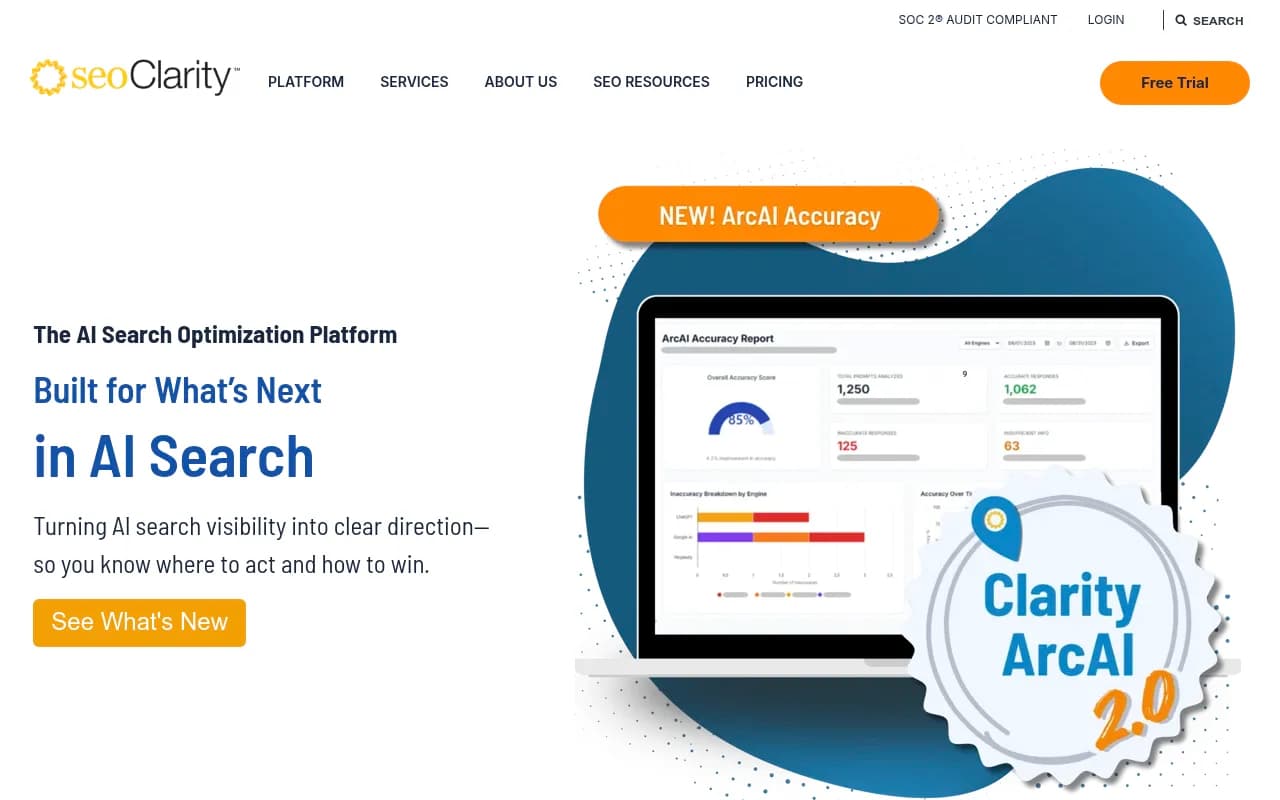
The AI visibility features in seoClarity are positioned as an extension of its existing content and keyword workflows. You can see how your content performs in AI-generated answers alongside traditional SERP rankings. The integration with existing SEO data is the main selling point -- you're not context-switching between platforms.
What works well:
- The connection between traditional SEO metrics and AI visibility data is genuinely useful. You can see a keyword, its traditional ranking, and its AI citation performance in the same view.
- Content optimization workflows are mature. If you're already using seoClarity for content briefs and optimization, the AI layer adds context without requiring a separate tool.
- Enterprise reporting and white-labeling options are strong.
The honest limitations:
- The AI visibility tracking covers fewer LLMs than a dedicated platform. Coverage tends to focus on Google AI Overviews and ChatGPT, with less depth on Perplexity, Claude, Grok, and others.
- Prompt-level analysis and competitive citation tracking are less granular than what Peec.ai offers.
- The platform is expensive, and the AI features often sit behind higher pricing tiers.
seoClarity makes the most sense for teams that are already deeply embedded in its ecosystem and want AI visibility as an additional data layer rather than a primary focus.
BrightEdge
BrightEdge is the oldest and most established of the four platforms. It has a large customer base, deep integrations with enterprise data stacks, and has been adding AI search features more aggressively than most traditional SEO platforms.
The independent 2026 evaluation ranked BrightEdge 13th out of 14 platforms specifically for AI search visibility tracking -- but that ranking was in a comparison focused purely on AI monitoring depth. BrightEdge's actual strength is correlating AI visibility with traffic and revenue data, which is a different (and arguably more valuable) capability for enterprise teams.
What BrightEdge does well:
- Traffic attribution is the standout feature. BrightEdge can connect AI citation data to actual organic traffic changes, which is something most pure-play AI monitoring tools can't do.
- The platform has a large data set from years of traditional SEO tracking, which gives context to AI visibility trends.
- Enterprise support and account management are strong -- this matters for large organizations with complex needs.
Where it falls short:
- The AI monitoring features feel like additions to a traditional SEO platform rather than a native capability. Prompt coverage, LLM breadth, and citation analysis depth lag behind dedicated tools.
- The platform is expensive and the pricing is opaque. Getting a clear number requires a sales conversation.
- Some teams report that the AI features are still catching up to the marketing around them.
BrightEdge is the right choice if you're an enterprise team that needs a single platform for traditional SEO at scale and wants AI visibility as a supplementary data point -- especially if connecting that data to traffic and revenue is the priority.
Head-to-head comparison
| Capability | Peec.ai | Botify | seoClarity | BrightEdge |
|---|---|---|---|---|
| LLM coverage breadth | High (10+ models) | Medium (growing) | Medium (Google + ChatGPT focus) | Medium |
| Prompt-level citation analysis | Strong | Basic | Moderate | Moderate |
| Competitive citation benchmarking | Strong | Limited | Moderate | Moderate |
| AI crawler log analysis | No | Strong | No | Limited |
| Technical SEO (crawl, audit) | No | Very strong | Strong | Strong |
| Content optimization workflows | No | Limited | Strong | Moderate |
| Traffic attribution (AI to revenue) | Limited | Moderate | Moderate | Strong |
| Traditional rank tracking | No | No | Strong | Strong |
| Enterprise integrations | Good | Excellent | Good | Excellent |
| Pricing transparency | Moderate | Low (custom) | Low (custom) | Low (custom) |
| Best for | AI visibility specialists | Technical SEO + crawl intelligence | Content-integrated SEO teams | Enterprise SEO + AI traffic correlation |
The real question: dedicated tool or integrated platform?
This comparison reveals a genuine tension in the market. Traditional enterprise SEO platforms are adding AI features, but they're doing it on top of architectures built for a different problem. Peec.ai was built specifically for AI visibility, which gives it depth in that area -- but zero capability in everything else.
For most enterprise SEO teams, the honest answer is that neither approach alone is sufficient. A team managing a large site needs technical SEO infrastructure (Botify or similar), content workflows (seoClarity or similar), and AI visibility tracking. Whether that's one platform or two depends on budget and workflow preferences.
If AI search visibility is your most pressing problem right now -- if you're losing citations to competitors and can't figure out why -- a dedicated tool like Peec.ai will give you better data faster than waiting for a traditional platform to catch up.
If you need a single platform that does everything adequately, seoClarity is the most integrated option. If technical SEO is your primary need with AI as a secondary concern, Botify. If you need enterprise-grade traffic attribution connecting AI citations to revenue, BrightEdge.
What about platforms built purely for AI search optimization?
It's worth noting that Peec.ai sits in a broader category of AI visibility platforms, many of which go beyond monitoring to help teams actually improve their AI search presence. If you're evaluating this space seriously, it's worth looking at what the full category offers.
Promptwatch is one platform that takes a different approach -- rather than just tracking where you appear in AI answers, it's built around closing the loop between finding gaps, generating content to fill them, and tracking whether that content gets cited. For teams that want to move from "we know we're invisible" to "we're doing something about it," that kind of end-to-end workflow matters.

Other platforms worth knowing about in this space:
Profound

Otterly.AI

Recommendations by team type
If you're a large enterprise with a mature SEO program and AI visibility is a new priority: start with BrightEdge or seoClarity if you're already in their ecosystem, and add a dedicated AI monitoring tool alongside it. Don't expect your existing platform to fully cover both.
If your primary problem is technical -- crawl issues, JavaScript rendering, AI crawler access -- Botify is the right foundation, and you can layer AI visibility tracking on top.
If AI search is your team's primary focus and you're willing to use a separate tool for traditional SEO: Peec.ai gives you the deepest AI visibility data of the four platforms compared here.
If you want a single platform that covers AI visibility, content generation, and traffic attribution without stitching together multiple tools: look beyond these four at platforms built specifically for the GEO workflow, including Promptwatch, which handles gap analysis, content creation, and citation tracking in one place.
The market is moving fast. All four of these platforms will look different in 12 months. But right now, the gap between what dedicated AI visibility tools can do and what traditional SEO platforms have bolted on is real -- and for enterprise teams where AI search is a serious channel, that gap matters.