Key Takeaways
- PromptScout is the cheapest way in at $15/mo, but it checks 15 prompts weekly. Treat it as a spot check, not a monitoring system.
- Dageno Starter ($49/mo, 50 prompts, 9 platforms) has the best list-price value, but each prompt counts once per platform and region, so the quota drains fast.
- Peec AI is the priciest of the four at $95/mo, but it has unlimited seats, daily tracking and a predictable prompt model.
- OpenLens charges per seat ($39.99 per seat on Starter) and uses credits instead of prompt counts, which makes it hard to compare and expensive for teams of three or more.
- None of these tools has independent accuracy testing that I could find. Run a trial with the same 20 prompts in each before you commit.
Why this comparison is harder than it looks
Budget AI visibility trackers all look the same on a pricing page. A number of prompts, a list of engines, a monthly fee. Then you start using one and discover that "50 prompts" means four different things depending on the vendor.
That is the real problem with this category in 2026. The headline price is easy to compare. What you actually get for it is not. So this guide compares the four tools on the things that change your bill or your data: how a prompt is counted, how often it runs, which engines are included, and whether adding a teammate costs extra.
A caveat up front. Pricing in this market moves constantly. Peec announced a pricing update on March 3, 2026, and Dageno restructured its plans. Several third-party review sites still list old numbers. The figures below come from each vendor's own pricing page where I could get them, and you should confirm on the vendor site before paying.
The four tools at a glance
| Tool | Entry price | Prompts at entry | Tracking frequency at entry | Engines | Team seats |
|---|---|---|---|---|---|
| PromptScout | $15/mo | 15 | Weekly | 5 (ChatGPT, Gemini, AI Overviews, Perplexity, Bing Copilot) | Not a stated limit |
| Dageno | $49/mo | 50 | Not stated on pricing page | 9 standard platforms | Not a stated limit |
| OpenLens | $0 free, $39.99 per seat Starter | Credit-based | Weekly/monthly on Free; daily only on Agency | ChatGPT, Perplexity, Google AI on Free; DeepSeek added on Starter | Priced per seat |
| Peec AI | $95/mo | 50 | Daily | 3 chosen from ChatGPT, AI Mode, AI Overviews, Copilot, Gemini, Naver AI | Unlimited |
None of these is a like-for-like match on any single column, which is the whole point of reading further.
Peec AI

Peec is the best known of the four, and the one most small teams start with. Its own site says it is trusted by 3,500+ brands and agencies. Every plan includes unlimited users, unlimited competitors, unlimited languages and daily tracking.
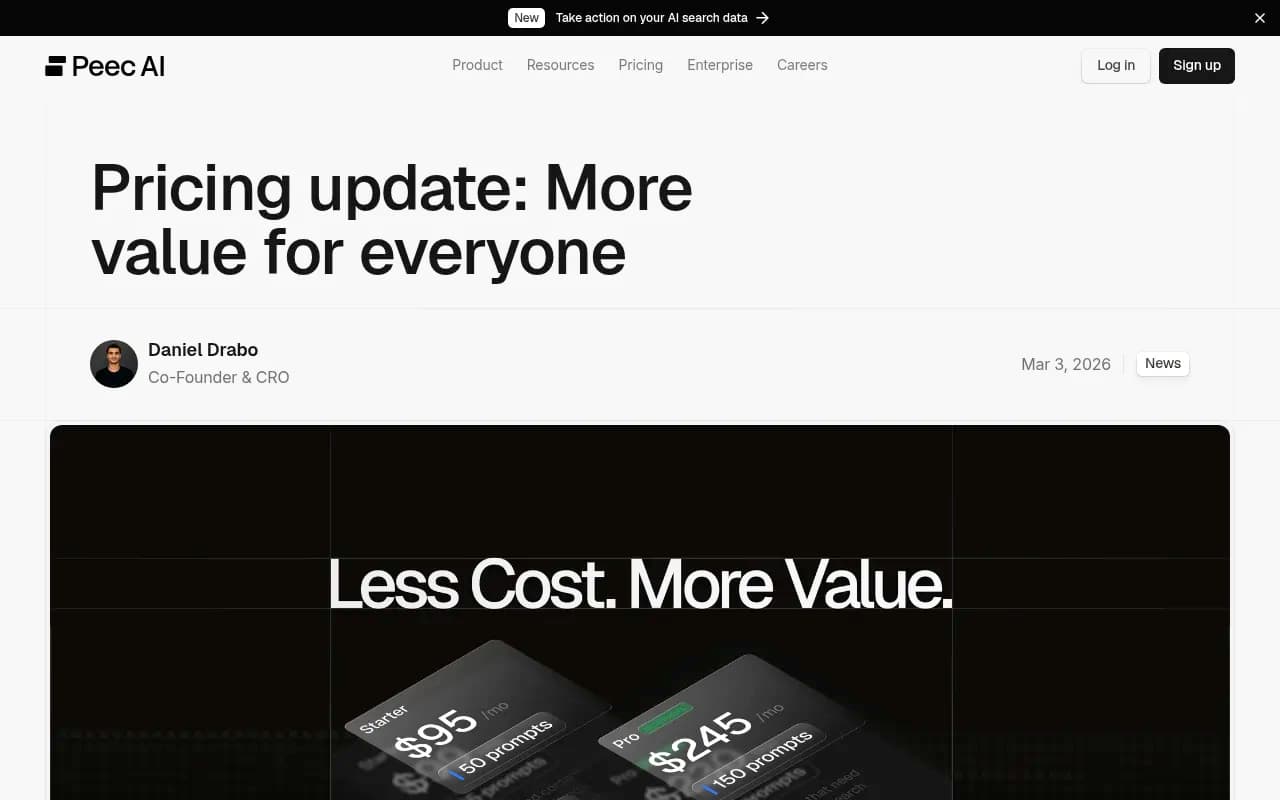
Self-serve pricing is now $95 (Starter), $245 (Pro) and $495 (Advanced) per month. Starter gives you 50 prompts, 3 active models, 1 country and 1 project, with 4,500 AI answers a month. Pro raises that to 150 prompts, 3 countries and 2 projects. Perplexity, Claude, Grok, DeepSeek and a few others sit only in the Enterprise column.
If you read older reviews you will see Peec at EUR 70 or EUR 199 a month. Those are stale. A 2026 Peec blog post says every plan got more tracking capacity at the same price or less, so check the current page rather than trusting a comparison article, including this one.
Where Peec fits a small team: you want daily data, several colleagues need logins, and you would rather not think about how credits are spent. Where it hurts: three models only on self-serve plans, and Perplexity is not one of them. That matters if your buyers use Perplexity.
Dageno

Dageno is the one that looks too good on paper. Every paid plan includes all nine standard platforms (ChatGPT, Grok, Gemini, Perplexity, Google AI Mode, Google AI Overview, Copilot, Brave and Dola) and 86+ regions, with no per-model fees.
Pricing is $49/mo for Starter (50 prompts, 1 project, 2 market segments, 5 competitors), $199/mo for Growth (250 prompts, 2 projects, adds AI Shopping, alerts, recurring reports and MCP access) and $410/mo for Scale (600 prompts, 5 projects, adds AI advertising and API). Annual billing saves about 15%, and there is a 7-day trial.
Here is the pitfall. Each prompt counts separately per platform and per country or region. The product shows estimated usage before you save, which is good, but the math is unforgiving. Fifty prompts across nine platforms and a couple of countries will be gone quickly. In practice you will pick a handful of platforms and one or two regions, and your effective coverage looks closer to a normal 50-prompt tool.
Two more notes. Dageno's pricing page does not say how often prompts run, so ask before you buy. And the plan structure changed recently: Starter dropped from $79 for 50 prompts to $49 for 50, and Scale went from $499 for 500 to $410 for 600. Review sites such as CrunchJunkie still show the old tiers, so ignore those.
OpenLens
OpenLens is built for agencies, and a press release says 35+ agencies use it. It markets itself as free to start.
Per a third-party review from Position Digital, the structure is seat-based and credit-based:
- Free ($0): 2 seats, 3 projects, 1,000 credits a month plus 75 per project, weekly and monthly tracking, supports ChatGPT, Perplexity and Google AI
- Starter ($39.99/mo per seat): up to 5 seats and 5 projects, 8,000 credits per seat, adds DeepSeek
- Agency ($299.99/mo per seat): unlimited seats and projects, 50,000 credits per seat, daily tracking, adds Gemini, Claude and Grok
I did not verify these figures on openlens.com directly, so confirm them. Two things stand out even so.
First, seats cost money. A three-person team on Starter pays about $120 a month by my arithmetic, which puts it above Dageno Starter and close to Peec. Peec gives every plan unlimited users. If you have a small team where several people want dashboard access, that gap is real.
Second, credits are not prompts. No prompt count is stated, so you cannot divide price by prompts and compare. The free tier is still a useful way to test whether the product is worth paying for, and the daily tracking sits only on the top tier, which is an odd place to put the feature most monitoring teams want first.
PromptScout
PromptScout is the cheapest option here, and it is honest about being small. All plans monitor ChatGPT, Gemini, Google AI Overviews, Perplexity and Bing Copilot.
- Starter, $15/mo: 15 prompts, weekly tracking, brand mention extraction, competitor tracking and share of voice, source analysis, weekly reports, website audits
- Growth, $49/mo: 30 prompts checked every 3 days, 3 prompt groups, AI prompt suggestions, Opportunities (beta), beta integrations with Google Search Console, Bing Webmaster and live AI traffic
- Pro, $149/mo: 40 prompts checked daily, 5 prompt groups
- Agency, $299/mo: up to 10 brands, 20 prompts per brand, weekly monitoring
The jump from Growth to Pro buys daily checks and ten more prompts for $100 a month. That is steep. And at $49, Dageno gives you 50 prompts against PromptScout's 30, though the counting rules differ.
Where PromptScout works: a founder or solo marketer who wants to see how a brand shows up in five engines, once a week, for lunch money. There is also a free visibility check on the site, which is a low-risk way to see the output.
Price per prompt, and why it misleads
Here is the arithmetic from list prices at the entry tier.
| Tool | Entry price | Prompts | Approx. cost per prompt | Frequency |
|---|---|---|---|---|
| Dageno Starter | $49 | 50 | $0.98 | Not stated |
| PromptScout Starter | $15 | 15 | $1.00 | Weekly |
| Peec Starter | $95 | 50 | $1.90 | Daily |
| Otterly Lite (benchmark) | $29 | 15 | $1.93 | Daily |
| OpenLens Starter | $39.99 per seat | Credit-based | Not calculable | Unclear |
Dageno looks twice as cheap as Peec per prompt. It may be. But the numbers are not comparable, for three reasons:
- Peec lets you choose 3 models, PromptScout covers 5 engines, and Dageno covers 9 platforms.
- Dageno counts each prompt once per platform and region, so 50 prompts is not 50 questions asked once.
- Frequency differs. Weekly data for $1 a prompt is not the same product as daily data for $1.90.
Treat the per-prompt figure as a rough filter, not an answer. A weekly tracker that costs $1 per prompt is a worse deal if you needed daily data than a daily tracker at $1.90.
What prompt wording means for any of these tools
One thing worth knowing before you build a prompt list. According to Promptwatch's ChatGPT query fanout data (https://promptwatch.com/data/chatgpt-query-fanouts), the average query ChatGPT sends to search dropped from about 117 characters to the high 80s and then about 53 characters in April, covering December through April. In other words, ChatGPT's own searches look like short keyword-style phrases, not long conversational questions.
So if a tracker lets you write prompts freely, test a mix: short, keyword-like prompts and a smaller set of longer natural-language ones. A prompt set made entirely of long questions can drift from what ChatGPT actually searches.
Another point from Promptwatch's average sources per response data (https://promptwatch.com/data/average-sources-per-response): ChatGPT cites roughly 5 sources per web-search answer, while Google AI Overviews and Perplexity cite about 10. That means mention rates will naturally look lower in ChatGPT than elsewhere. Don't read a gap between engines as a performance problem until you have accounted for the number of citation slots.
Which one for which team
| Your situation | Best fit | Why |
|---|---|---|
| Solo founder, want a weekly pulse | PromptScout Starter | $15 and five engines, weekly is fine for a pulse check |
| 2 to 5 people, need daily data and shared logins | Peec AI Starter | Unlimited users, daily runs, simple quota |
| Want wide engine coverage at a low price and are willing to manage quota | Dageno Starter | Nine platforms and 50 prompts at $49, but watch the per-platform counting |
| Small agency, a few clients, ok with credits | OpenLens Free or Starter | Agency-oriented, free tier to test, but seats add up |
| Tightest possible budget with daily tracking | Otterly Lite | $29, 15 prompts, daily, unlimited team members per its listing |
If you want a broader view of the market, the AI rank tracking directory at ai-rank-tools.com lists more options in this price range.
When a budget tracker stops being enough
All four of these are, at heart, trackers. They answer "was my brand mentioned?" They do not tell you why a page is or isn't cited, whether AI crawlers can actually read your site, or what traffic AI sends you.
If you get to the point where the question changes to "how do we fix this?", you are looking at a different category. Promptwatch is one platform in that category: it adds IP-verified AI crawler logs, visitor analytics for AI-referred traffic and a Content Agent that writes and publishes against visibility gaps. Its Essential plan is $95/mo, the same list price as Peec Starter, with 50 prompts, all models and site audit included.

That is a step up in scope, not a replacement for a $15 spot check. If you only need to know whether you show up, one of the budget tools is enough. The GEO software directory at bestgeosoftware.com covers the wider field.
How to trial these without wasting a month
A short, fair test beats reading comparison pages.
- Write 20 prompts: 10 short keyword-style, 5 brand-comparison, 5 long conversational.
- Load the same 20 into each tool's trial or free tier. Dageno and the Peec, PromptScout and Otterly sites each offer a trial or free check.
- Compare the output for the same prompt on the same day. Look at whether the brand is detected correctly, whether the sources listed match what you see when you ask the engine yourself, and how long runs take.
- Check the quota drain. In Dageno, watch the estimated usage before you save. In OpenLens, see how many credits a single run uses.
- Count the seats you actually need and price them.
I found no independent accuracy or reproducibility tests for any of these four, so your own spot check is the best evidence available.
Questions I could not answer
- Dageno's tracking frequency is not on its pricing page.
- OpenLens does not publish per-prompt limits, and I could not confirm whether Starter runs daily.
- A Detailed comparison claims Ahrefs Brand Radar is the cheapest option in four of six scenarios. I have not verified that.
If these matter to your decision, email the vendors. Small vendors tend to answer.
Verdict
For most small teams that need data every day and more than one login, Peec AI at $95 is the least surprising buy, even though it is the most expensive of the four. For a one-person shop that only needs a weekly read, PromptScout at $15 is plenty. Dageno is the one to test if wide engine coverage matters more than predictable quota. OpenLens makes sense mostly for agencies who will use the free tier first and have few seats.
Pick two, run the same 20 prompts through both for a week, and keep the one whose numbers you actually trust.