Key takeaways
- Peec.ai is the most established of the four, with transparent pricing and solid ChatGPT/Perplexity/AIO tracking, but it stops at monitoring and has no content generation or optimization tools.
- SE Visible (by SE Ranking) benefits from a mature parent platform and is the most polished option for teams already in the SE Ranking ecosystem, but it shares the same monitoring-only limitation.
- Orchly is a newer multi-platform tracker with a clean interface, but it's still early-stage and lacks the depth you'd need for serious competitive analysis.
- GetCito has the least public information available, making it hard to recommend with confidence for anything beyond light experimentation.
- If you need to move beyond tracking and actually improve your AI visibility, none of these four platforms will get you there on their own.
The AI visibility tool market has exploded. In early 2025, you could count the serious players on one hand. By mid-2026, there are dozens of platforms claiming to track your brand across ChatGPT, Perplexity, Google AI Overviews, Claude, and whatever else launched last week.
Most of them are monitoring dashboards. They show you a number. They tell you whether your brand appeared in an AI-generated answer. And then... they stop.
This guide looks at four of the newer, less-covered entrants: Peec.ai, GetCito, Orchly, and SE Visible. The question isn't just "do they work?" It's whether they're actually ready for teams that need to do something with the data they collect.
What "ready" actually means in 2026
Before getting into the tools, it's worth being clear about what we're evaluating. The AI visibility space has matured enough that "we track ChatGPT" is no longer a differentiator. What separates useful platforms from noise is:
- How many AI engines they monitor (and how accurately)
- Whether they track at the prompt level or just brand mentions
- Whether they show competitor data, not just your own numbers
- Whether they give you any path to actually improving your visibility
- Pricing that scales without punishing you for tracking more prompts
A tool that shows you a dashboard with a single "AI visibility score" is not ready. A tool that shows you which specific prompts your competitors rank for but you don't, and then helps you create content to close that gap, is ready.
Keep that bar in mind as we go through each platform.
Peec.ai

Peec.ai was one of the first purpose-built AI visibility trackers to gain real traction. It launched in 2024 and spent most of 2025 being the default recommendation in SEO communities when someone asked "how do I track my brand in ChatGPT?"
That reputation is partly deserved. Peec.ai tracks share of voice and citation rates across ChatGPT, Perplexity, and Google AI Overviews. It uses UI scraping to simulate real user interactions, which means the data reflects what an actual user would see rather than a sanitized API response. The platform shows you citation frequency, source URLs, and competitive share of voice across your tracked prompts.
The setup is straightforward. You define your brand, your competitors, and a set of prompts relevant to your category. Peec.ai then runs those prompts across the supported engines and shows you who appears and how often.
Where it starts to show its limits:
Prompt volume costs. Several enterprise teams and agencies in communities like TrafficThinkTank have flagged that costs escalate quickly when you need to track a large keyword set. The pricing model works fine for 20-30 prompts but gets painful at scale.
No content tools. Peec.ai is a monitoring platform. It will tell you that Competitor X appears in 68% of responses to "best CRM for small business" while you appear in 12%. It will not help you figure out what content to create to change that number, or write it for you.
Engine coverage. As of mid-2026, Peec.ai's coverage is solid for the big three (ChatGPT, Perplexity, Google AIO) but thinner for Claude, Gemini, and newer models that are increasingly relevant for B2B buyers.
Pricing starts at $100/month, which is reasonable for a single brand with a modest prompt set. For agencies or teams tracking multiple brands across hundreds of prompts, the math changes.
Verdict: Peec.ai is a legitimate, functional tool. It's the most battle-tested of the four platforms in this comparison. But "battle-tested monitoring tool" is a different thing from "ready for teams that want to improve their AI visibility." If you're in the diagnosis phase, it works. If you need to act on what you find, you'll need something else alongside it.
SE Visible
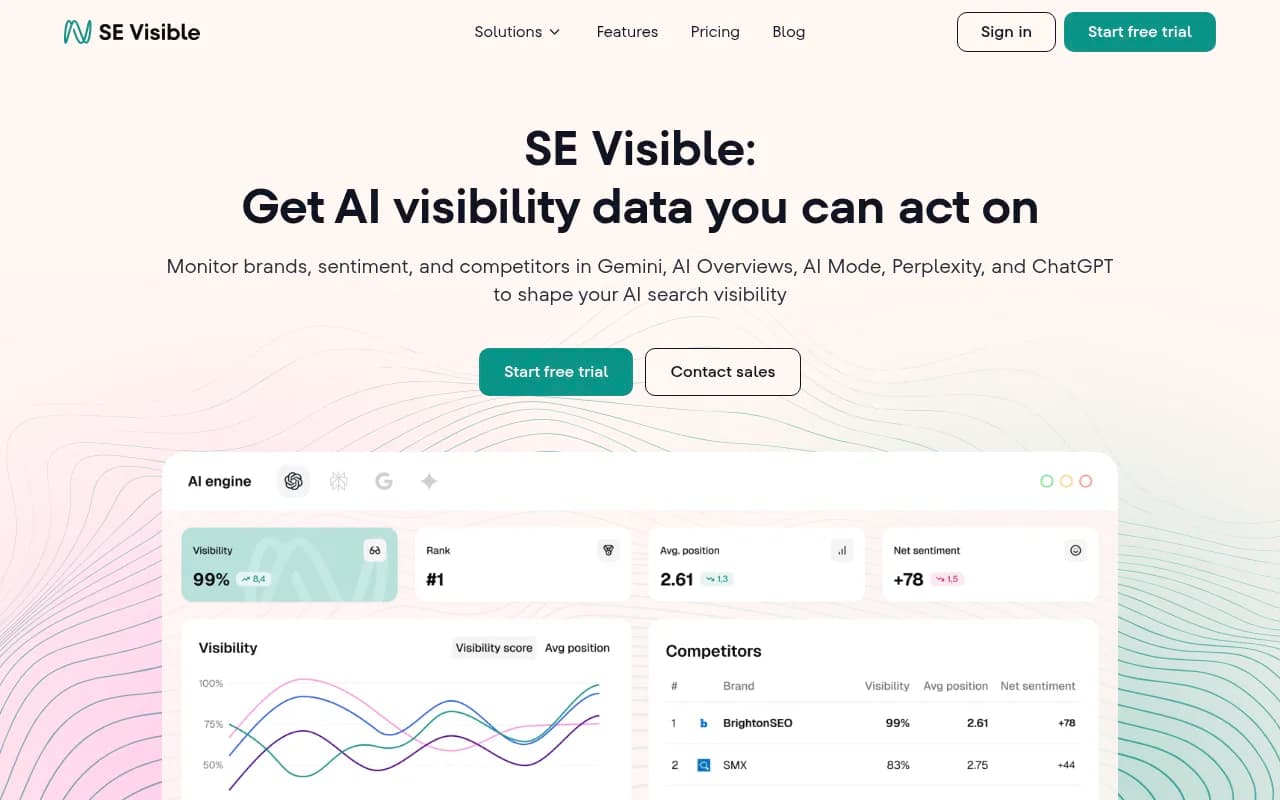
SE Visible is SE Ranking's answer to the AI visibility tracking market. If you're already a SE Ranking customer, this is the most natural path into AI monitoring — it lives within the same ecosystem, uses the same interface conventions, and benefits from SE Ranking's decade-plus of rank tracking infrastructure.
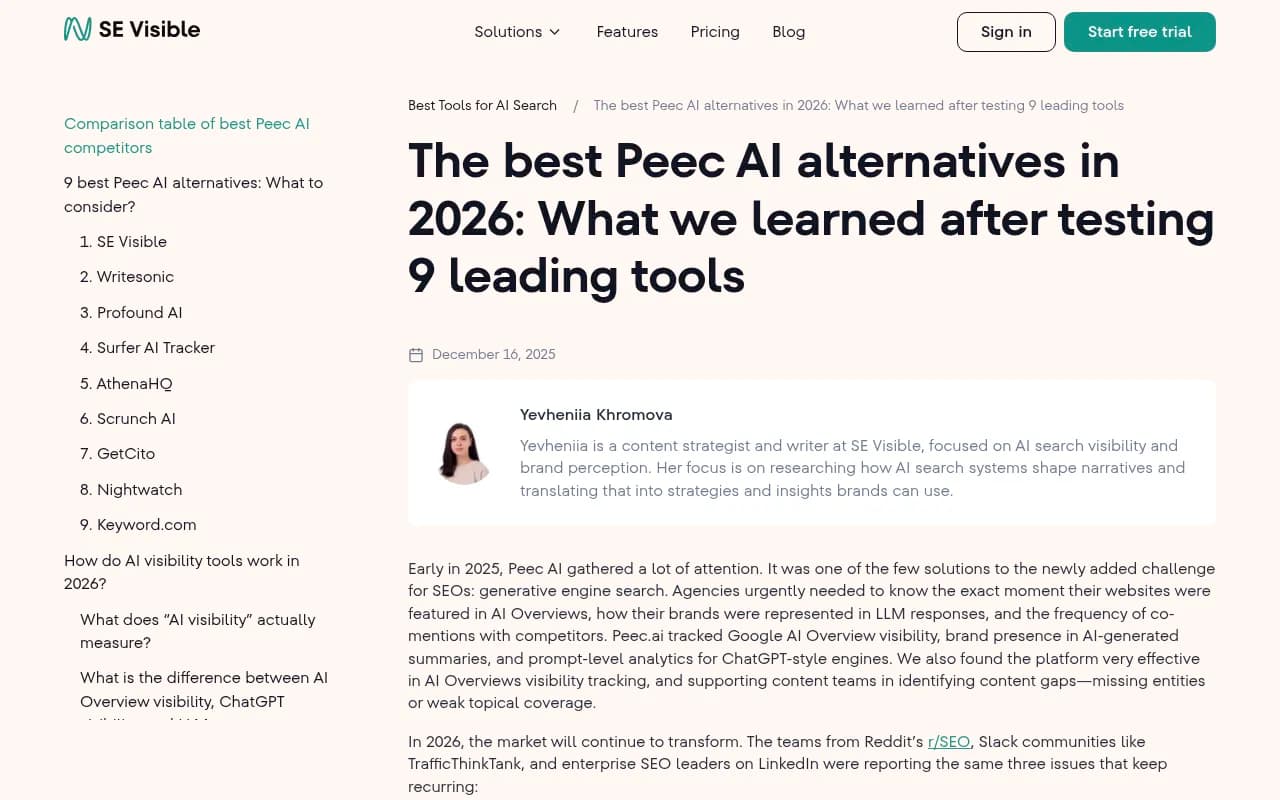
The platform tracks brand mentions across AI engines, shows competitor presence, and surfaces prompt-level data. SE Ranking has positioned it as a "complete AI visibility tracking" solution, and for teams that want a single vendor relationship, that pitch makes sense.
What SE Visible does well:
- Clean, familiar interface for existing SE Ranking users
- Competitive benchmarking that shows your share of voice vs. named competitors
- Sentiment analysis layered on top of brand mentions (not just "did you appear" but "how were you described")
- Pricing that starts at $189/month, which is higher than Peec.ai but includes more context around each mention
The limitations are similar to Peec.ai, though. SE Visible is a monitoring and benchmarking tool. It doesn't generate content, doesn't show you which topics are driving competitor citations, and doesn't close the loop between what you discover and what you do about it.
There's also a question of independence. SE Visible is a product extension from a traditional SEO platform. That's not inherently bad, but it means the roadmap is shaped by SE Ranking's broader priorities, not purely by what AI visibility teams need. The depth of prompt intelligence and citation analysis you'd get from a purpose-built GEO platform isn't quite there yet.
Verdict: SE Visible is the most polished option in this comparison for teams that want a monitoring tool with good competitive context. The sentiment analysis is a genuine differentiator. But it's still fundamentally a tracker, and the $189/month starting price means you're paying more than Peec.ai for a similar ceiling.
Orchly
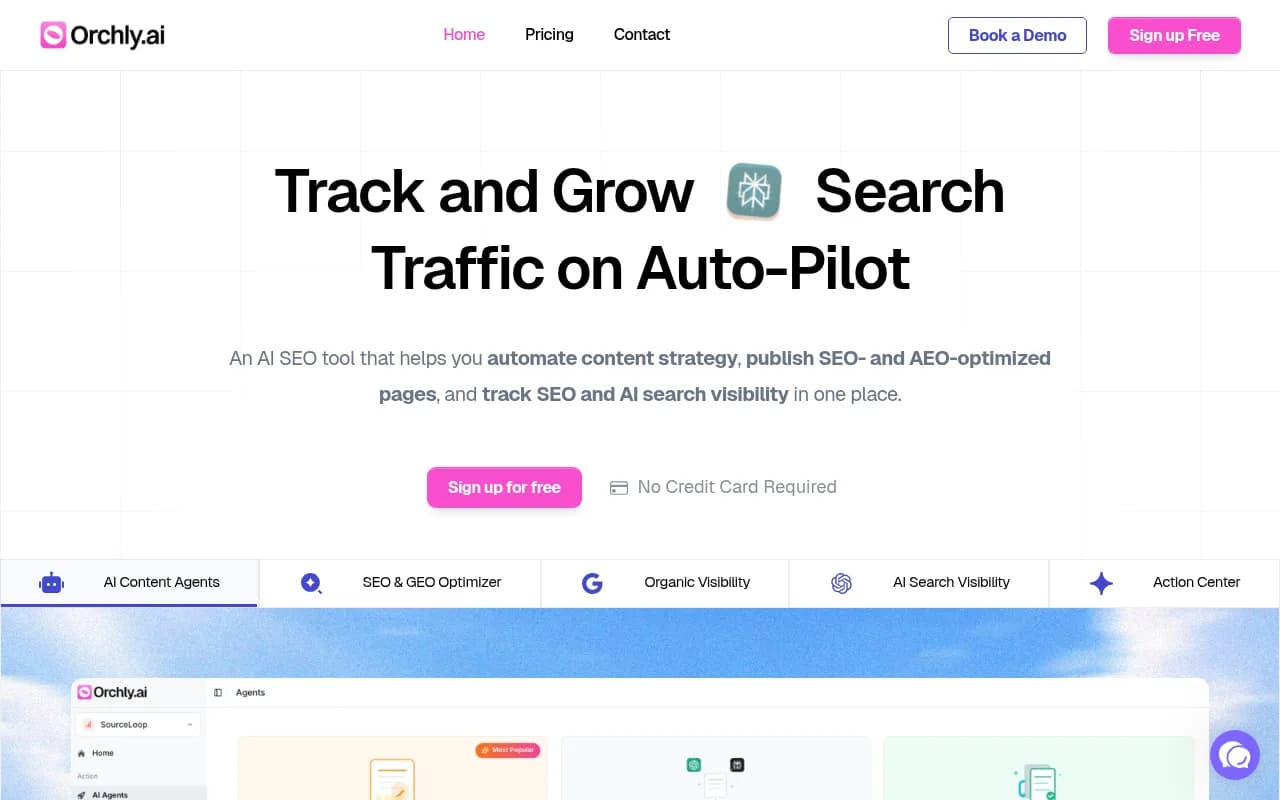
Orchly is the newest and least-established platform in this comparison. It's a multi-platform AI visibility tracker that covers ChatGPT, Perplexity, Claude, and a handful of other engines. The interface is clean and the onboarding is fast.
The honest assessment: Orchly is early. The feature set is thinner than Peec.ai or SE Visible, the documentation is sparse, and there's limited third-party validation of its data accuracy. That's not unusual for a platform at this stage, but it does mean recommending it for anything mission-critical would be premature.
What Orchly has going for it is multi-engine breadth. It tracks more AI models than Peec.ai does by default, which matters as Claude and Gemini capture more B2B research traffic. If you're specifically trying to understand your visibility across a wider range of models rather than just the ChatGPT/Perplexity/AIO trio, Orchly is worth a look.
The gaps are significant though. There's no prompt intelligence (volume estimates, difficulty scores), no content gap analysis, no competitor heatmaps, and no path from "here's your visibility score" to "here's what to do about it." It's a tracker in the purest sense.
Verdict: Orchly is interesting as an early-stage product and worth watching. It's not ready as a primary AI visibility tool for teams that need reliable data and actionable insights. Use it as a secondary check on engine coverage, not as your main platform.
GetCito
GetCito is the hardest to evaluate in this group because public information about it is genuinely limited. It appears in some tool directories and comparison lists, but there's minimal independent documentation of its feature set, pricing, or data methodology.
From what's available: GetCito positions itself as an AI citation tracker, focused specifically on whether your brand or content is being cited as a source in AI-generated answers. That's a narrower focus than the other three platforms here, which track brand mentions more broadly.
Citation tracking specifically (as opposed to brand mention tracking) is actually a meaningful distinction. A brand mention means an AI said your company name. A citation means an AI linked to or attributed a specific claim to your content. The latter is more valuable for content teams trying to understand which pages are actually driving AI visibility.
The problem is that without reliable information on how GetCito collects this data, which engines it covers, how it handles attribution, and what it costs, there's no responsible way to recommend it. The citation-focused angle is interesting. The lack of transparency is a red flag.
Verdict: Can't recommend without more information. If GetCito publishes clearer documentation and pricing, it's worth revisiting. For now, it's not a safe choice for teams with real accountability for their AI visibility results.
Side-by-side comparison
| Platform | Engines covered | Prompt-level tracking | Competitor data | Content tools | Starting price |
|---|---|---|---|---|---|
| Peec.ai | ChatGPT, Perplexity, Google AIO | Yes | Yes (share of voice) | None | ~$100/mo |
| SE Visible | Multiple (SE Ranking ecosystem) | Yes | Yes + sentiment | None | $189/mo |
| Orchly | ChatGPT, Perplexity, Claude + others | Basic | Limited | None | Not published |
| GetCito | Unclear | Unclear | Unclear | None | Not published |
The pattern is obvious: all four platforms stop at monitoring. None of them help you do anything with what you find.
The monitoring-only problem
This is worth addressing directly because it's the defining limitation of this entire category of tools.
Knowing that your competitor appears in 70% of AI responses to your most important prompts while you appear in 15% is useful information. But it's not a strategy. The gap between "I know I'm invisible" and "I'm now visible" requires understanding which content topics are driving citations, what format and depth AI models prefer, which pages on your site are actually being read by AI crawlers, and what to write next.
None of the four platforms in this comparison provide that. They're all, to varying degrees, dashboards that show you a problem without giving you the tools to solve it.
This isn't a criticism unique to these four tools. It's the dominant pattern across the AI visibility market. The platforms that have moved beyond it — building content gap analysis, AI writing tools grounded in citation data, crawler log monitoring, and traffic attribution into the same workflow — are a different category entirely.
Promptwatch is one of the few platforms that has built this full loop: find the gaps, generate content engineered to get cited, track the results. It's worth understanding what that looks like if you're evaluating whether a monitoring-only tool will actually move the needle for your team.

Who should use each tool
Peec.ai makes sense if you're in the early stages of understanding your AI visibility, you have a modest prompt set (under 50), and you want reliable data on the ChatGPT/Perplexity/AIO trio without a large budget commitment. It's a reasonable starting point.
SE Visible makes sense if you're already a SE Ranking customer and want AI visibility data without adding another vendor. The sentiment analysis layer adds genuine value for brand teams. Don't expect it to replace a purpose-built GEO platform.
Orchly makes sense if you specifically need multi-engine coverage beyond the standard three and you're willing to accept that the data may be less validated than more established platforms. Good for a secondary perspective, not a primary tool.
GetCito doesn't make sense until there's more public documentation. Hold off.
What to look for if none of these fit
If you've read this far and concluded that monitoring-only tools won't solve your actual problem, here's what to look for in a more complete platform:
- Answer gap analysis that shows which prompts competitors rank for but you don't
- Content generation tools that use real citation data, not generic SEO logic
- AI crawler logs that show which pages AI models are actually reading (and which they're ignoring)
- Prompt volume and difficulty scoring so you can prioritize winnable opportunities
- Traffic attribution that connects AI visibility to actual sessions and revenue
The AI visibility tool market in 2026 has a lot of trackers and very few platforms that help you act. The distinction matters more than any individual feature comparison.
Bottom line
Of the four platforms compared here, Peec.ai is the most ready for real use. SE Visible is a close second for teams in the SE Ranking ecosystem. Orchly is worth watching but not yet ready for primary use. GetCito needs to publish more information before it's worth evaluating seriously.
But the more important conclusion is this: if your goal is to actually improve how often AI models recommend your brand, a monitoring-only tool is a starting point, not a solution. The teams seeing real results in 2026 are using platforms that close the loop between visibility data and content action.