Key takeaways
- Monitoring AI visibility and improving it are two different things. Most platforms only do the first.
- Peec AI is strong for structured data analysis but light on actionable outputs and crawler insights.
- Atomic AGI combines multi-engine tracking with workflow automation, making it useful for teams that want to act on data without switching tools.
- Relixir is built for enterprise brands that need end-to-end GEO execution, not just reporting.
- Promptwatch is the only platform in this comparison rated as a "Leader" across all GEO categories, with content gap analysis, AI writing, crawler logs, and traffic attribution built into one loop.
The AI search visibility category has a problem. There are now dozens of tools that will tell you how often your brand appears in ChatGPT, Perplexity, or Google AI Overviews. Most of them stop there. You get a dashboard, a score, maybe a competitor heatmap -- and then you're on your own to figure out what to do next.
That gap between "knowing you're invisible" and "doing something about it" is where buying decisions in this category actually get made. This guide compares four platforms that each approach that gap differently: Peec AI, Promptwatch, Atomic AGI, and Relixir.
What you actually need from an AI visibility platform
Before comparing tools, it's worth being specific about what the job is. AI search visibility platforms need to do at least three things well:
- Tell you where you stand across multiple AI engines (not just one)
- Show you why you're not appearing -- which prompts, which competitors, which content gaps
- Help you fix it, either through content recommendations, generation, or optimization workflows
Most tools in 2026 handle point one reasonably well. Point two is where they start to diverge. Point three is where most of them fail entirely.
The other thing worth flagging: AI search is genuinely different from traditional SEO. There's no click to track when an LLM cites your brand in a response. Visibility percentage, citation sources, and brand sentiment inside AI responses are the metrics that matter -- and they require purpose-built infrastructure to measure properly.
Peec AI

Peec AI takes a technically distinct approach to data collection. Rather than querying AI platforms via their consumer interfaces, it uses a more structured method that produces cleaner, more consistent data. For analyst teams that want to work with raw structured data and build their own interpretation layer on top, Peec is genuinely strong.
The "Actions" feature is the most interesting part of the product. It takes visibility data and turns it into a prioritized to-do list -- bridging the gap between knowing what's wrong and knowing what to fix first. That's a meaningful step beyond pure monitoring.
Where Peec falls short is in the depth of those actions. Multiple independent reviews in 2026 (including Zapier's roundup and graph.digital's hands-on guide) note that Peec is "notably lacking actionable insights, trend data, and AI crawler visibility insights." It currently only tracks a subset of AI engines compared to broader platforms, and there's no built-in content generation to act on what the Actions feature surfaces.
In short: Peec is a solid choice for data-heavy teams who want clean structured output and can do their own analysis. It's not the right fit if you need the platform to help you create content or diagnose crawling issues.
Best for: Analyst teams, data-forward marketing orgs, teams that already have content workflows and just need better visibility data.
Atomic AGI
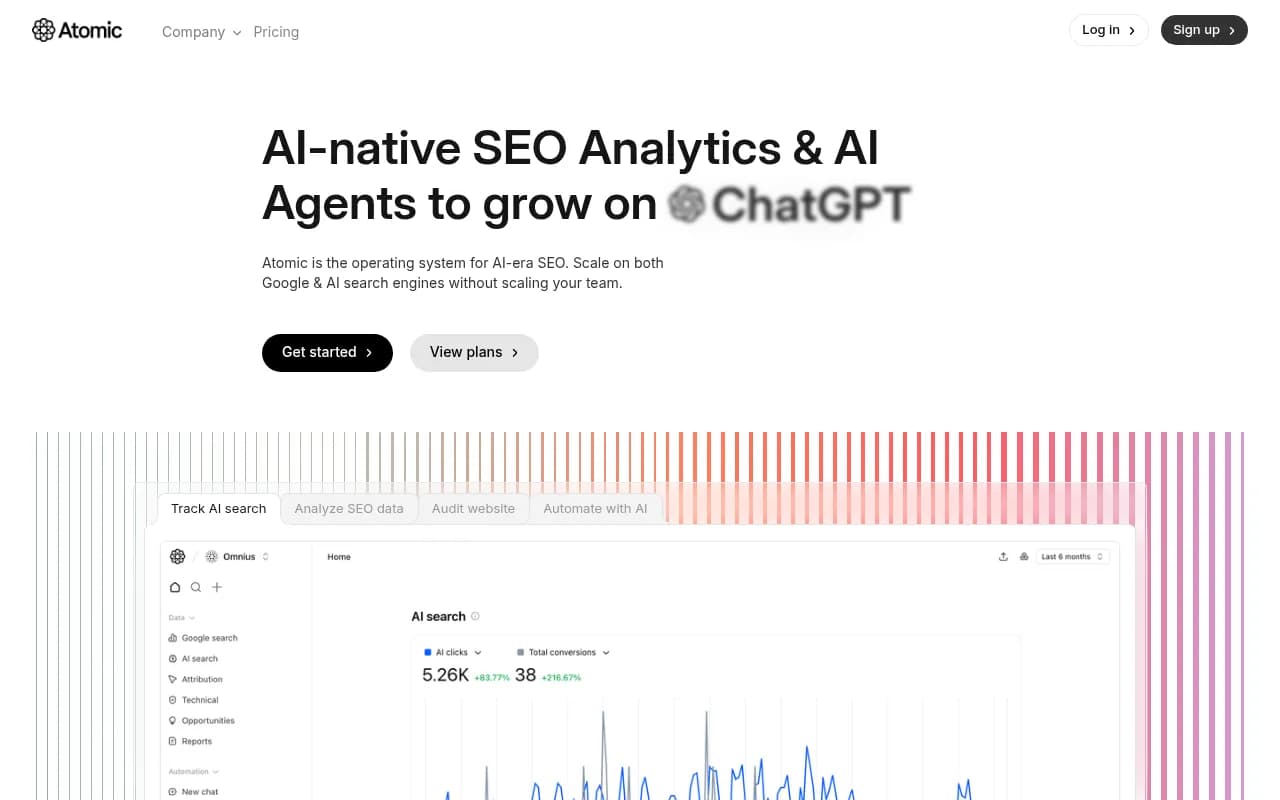
Atomic AGI positions itself as an AI-native SEO platform that combines multi-engine tracking with workflow automation. The pitch is that you shouldn't have to leave the platform to act on what you find -- tracking, analysis, and task execution happen in one place.
The workflow automation angle is genuinely useful for teams that are drowning in manual processes. If your current setup involves exporting data from a monitoring tool, pasting it into a spreadsheet, and then briefing a content team separately, Atomic AGI is designed to collapse that into fewer steps.
The platform covers multiple AI engines and includes some content optimization capabilities. It's positioned between a pure monitoring tool and a full GEO platform -- more actionable than Peec, but not as deep on the content generation and citation analysis side as the more specialized platforms.
One thing to watch: Atomic AGI is a newer entrant in this space, and the depth of its citation data and prompt intelligence is still maturing compared to platforms that have been indexing AI responses at scale for longer.
Best for: Teams that want workflow automation built into their visibility tracking, mid-market brands that need more than monitoring but aren't ready for enterprise pricing.
Relixir
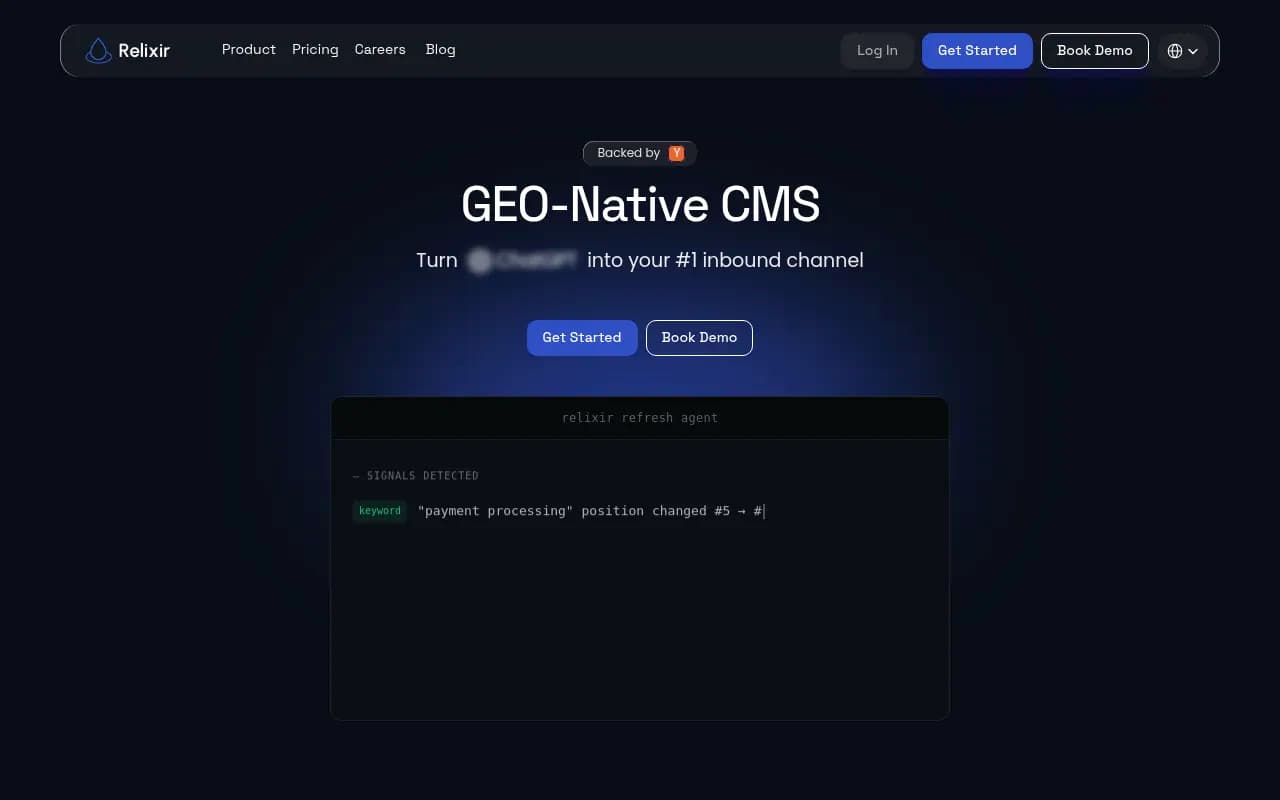
Relixir is built for enterprise brands that want end-to-end GEO execution. It's not a self-serve monitoring tool -- it's closer to a managed platform that combines tracking, content strategy, and optimization in a single system.
The enterprise focus shows in the product design. Relixir handles the full cycle: understanding where a brand stands in AI search, identifying what content needs to exist, and helping produce and deploy that content. For large organizations with complex brand architectures and multiple markets, that end-to-end approach has real appeal.
The tradeoff is accessibility. Relixir's pricing and onboarding are geared toward enterprise buyers, which means it's probably not the right fit for a mid-market marketing team that wants to get started quickly and iterate. The platform also doesn't have the same breadth of AI engine coverage or the granular prompt-level intelligence that some competitors offer.
Best for: Enterprise brands with dedicated GEO or SEO teams, organizations that want a managed approach rather than a self-serve tool.
Promptwatch

Promptwatch is the platform that most directly addresses the monitoring-to-ranking problem. Where Peec AI surfaces actions but leaves content creation to you, and where Relixir is built for enterprise execution, Promptwatch is designed around a specific loop: find the gaps, create content that fills them, track the results.
The Answer Gap Analysis is the starting point. It shows you exactly which prompts competitors are appearing for that you're not -- not as a vague recommendation, but as a specific list of topics, angles, and questions that AI models are pulling answers for from your competitors' sites but not yours.
From there, the built-in AI writing agent generates articles, listicles, and comparisons grounded in real citation data. This isn't generic content -- it's engineered against the specific prompts and citation patterns that Promptwatch has observed across 880M+ citations. The output is content that's designed to get cited, not just content that's topically relevant.
The third part of the loop is tracking. Page-level tracking shows which specific pages are being cited, how often, and by which AI models. Traffic attribution connects that visibility to actual sessions and revenue -- via a code snippet, Google Search Console integration, or server log analysis.
Beyond the core loop, Promptwatch includes AI crawler logs (real-time visibility into which pages ChatGPT, Claude, and Perplexity are crawling and what errors they're hitting), Reddit and YouTube citation tracking, ChatGPT Shopping monitoring, and prompt intelligence with volume estimates and difficulty scores.
It monitors 10 AI models: ChatGPT, Perplexity, Google AI Overviews, Google AI Mode, Claude, Gemini, Meta/Llama, DeepSeek, Grok, Mistral, and Copilot. In a 2026 comparison of 12 GEO platforms, it was the only one rated as a "Leader" across all categories.
Pricing starts at $99/month for the Essential plan (1 site, 50 prompts, 5 articles), $249/month for Professional (2 sites, 150 prompts, 15 articles, crawler logs), and $579/month for Business (5 sites, 350 prompts, 30 articles). A free trial is available.
Best for: Marketing and SEO teams that want to move from visibility data to actual ranking improvements, agencies managing multiple clients, any brand that needs to close the loop between AI citations and revenue.
Head-to-head comparison
| Feature | Peec AI | Atomic AGI | Relixir | Promptwatch |
|---|---|---|---|---|
| AI engines monitored | Partial | Multiple | Multiple | 10 (ChatGPT, Claude, Perplexity, Gemini, Grok, DeepSeek, Copilot, Meta AI, AI Overviews, AI Mode) |
| Competitor benchmarking | Yes | Yes | Yes | Yes |
| Prompt intelligence (volume, difficulty) | Limited | Limited | Limited | Yes |
| Answer gap analysis | Partial (Actions) | Partial | Yes | Yes (detailed) |
| Built-in content generation | No | Partial | Yes | Yes (AI writing agent) |
| AI crawler logs | No | No | No | Yes |
| Citation source analysis | Partial | Partial | Yes | Yes (880M+ citations) |
| Reddit/YouTube tracking | No | No | No | Yes |
| ChatGPT Shopping tracking | No | No | No | Yes |
| Traffic attribution | No | No | Partial | Yes (GSC, code snippet, server logs) |
| Self-serve access | Yes | Yes | Enterprise only | Yes |
| Starting price | Custom | Custom | Enterprise | $99/month |
| Free trial | Limited | Limited | No | Yes |
Which platform should you choose?
The honest answer depends on what you actually need to do.
If your team has strong analytical capabilities and you want clean structured data to build your own workflows on top of, Peec AI is worth evaluating. The Actions feature is a genuine differentiator within the monitoring-only tier.
If you want workflow automation baked into your tracking and you're a mid-market team that doesn't need enterprise-level managed services, Atomic AGI is worth a look. It's more action-oriented than pure monitoring tools without requiring the commitment of an enterprise platform.
If you're a large brand with a dedicated team and you want someone to handle GEO execution end-to-end, Relixir is built for that use case. Expect enterprise pricing and a more hands-on onboarding process.
If you need to actually move the needle on AI visibility -- not just measure it -- Promptwatch is the most complete option. The combination of gap analysis, content generation grounded in real citation data, crawler logs, and traffic attribution is the only full loop available in this category. It's also the most accessible, with a self-serve free trial and plans starting at $99/month.
The category is still maturing fast. A year ago, most of these platforms didn't exist in their current form. But the core question -- "does this tool help me rank, or just help me watch?" -- is already a reliable filter for separating the platforms worth paying for from the ones that just give you a prettier dashboard.
A note on what "actionable" actually means
One thing that gets lost in platform comparisons is that "actionable insights" means very different things depending on who's saying it. Peec's Actions feature surfaces a prioritized list -- that's actionable in the sense that it tells you what to work on. But it doesn't help you do the work.
True actionability in GEO means: here's the specific prompt your competitor is winning, here's the content gap on your site, here's a draft article designed to fill that gap, and here's the traffic data showing whether it worked. That's a loop, not a list.
Most platforms in 2026 are still selling lists. The ones worth paying for are building loops.