Key takeaways
- Persona-based tracking lets you see AI search results through the eyes of specific customer types — different job titles, locations, intents, and devices can all produce different AI responses.
- Peec.ai and Conductor offer persona customization but are primarily monitoring tools — they show you data without helping you fix gaps.
- Rankability is built around traditional and AI SEO content optimization for agencies, with limited persona depth compared to dedicated GEO platforms.
- Promptwatch is the only platform in this comparison that closes the full loop: custom personas, multi-model tracking, content gap analysis, and built-in AI content generation to fix what's missing.
Here's something most AI visibility guides don't talk about: two people asking ChatGPT the exact same question can get completely different answers.
A CMO in London asking "what's the best project management software for enterprise teams?" gets a different response than a startup founder in Austin asking the same thing. AI models factor in context, phrasing, inferred intent, and sometimes even regional signals. If you're tracking your brand visibility with a single generic prompt, you're only seeing a slice of reality.
That's why persona-based tracking has become one of the most important differentiators between AI visibility platforms in 2026. It's not just about whether your brand appears in AI answers -- it's about whether you appear for the right people, asking the right questions, in the right context.
This guide compares four platforms -- Peec.ai, Rankability, Conductor, and Promptwatch -- specifically on how they handle persona-based tracking, and what that means for your actual marketing strategy.
What persona-based tracking actually means
Before getting into the tools, it's worth being precise about what "persona" means in this context, because different platforms use the word differently.
At its most basic, a persona in AI visibility tracking is a set of parameters that simulate how a specific type of user would prompt an AI model. This can include:
- Job title or role (e.g., "marketing director" vs. "small business owner")
- Geographic location (country, region, city)
- Device type or search context
- Language and phrasing style
- Industry vertical
- Stage in the buying journey
The more granular your persona configuration, the more accurately you can understand whether your brand appears for your actual target customers -- not just for some generic average user.
Some platforms let you configure all of these. Others let you pick a location and call it a persona. The difference matters enormously when you're trying to optimize for a specific audience.
Peec.ai: solid monitoring, limited persona depth
Peec.ai has built a reputation as a clean, accessible AI visibility tracker. It covers major AI models including ChatGPT, Perplexity, and Google AI Overviews, and its interface is genuinely easy to navigate -- which matters when you're trying to get buy-in from stakeholders who aren't deep in the GEO weeds.
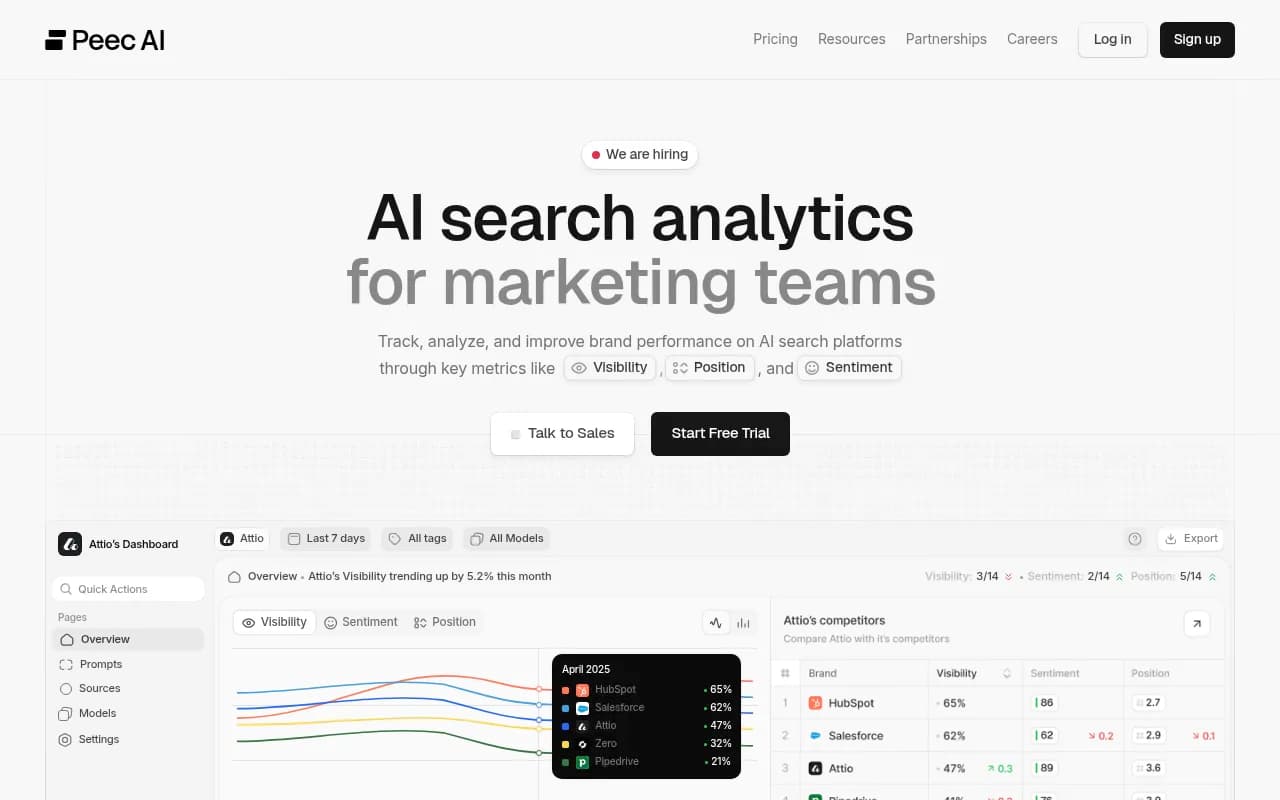
On persona-based tracking specifically, Peec.ai lets you configure prompts with location and language parameters, which covers the basics. You can set up tracking for different regions and run the same prompt across multiple geographies to see how your visibility shifts.
Where it falls short is depth. The platform doesn't let you define role-based personas or buying-stage contexts. You can simulate "a user in Germany asking this question," but you can't simulate "a procurement manager in Germany at a mid-market B2B company asking this question during vendor evaluation." That distinction is significant if your product has a complex sales cycle with multiple buyer types.
Peec.ai also sits firmly in the monitoring camp. It will tell you where you appear and where you don't. It won't tell you what content to create to fix the gaps, and it doesn't have built-in tools to help you act on what you find. A Reddit thread from early 2026 noted that Peec.ai does offer some recommendations for improving visibility -- which is more than some competitors -- but the depth of those recommendations doesn't match what you'd get from a full optimization platform.
Best for: Teams that want clean, accessible monitoring across regions and don't need deep persona segmentation or content optimization workflows.
Rankability: content-first, but AI visibility is secondary
Rankability comes at this from a different angle. It's primarily an SEO content optimization platform built for agencies, with AI search tracking added on top of its core content brief and optimization features.
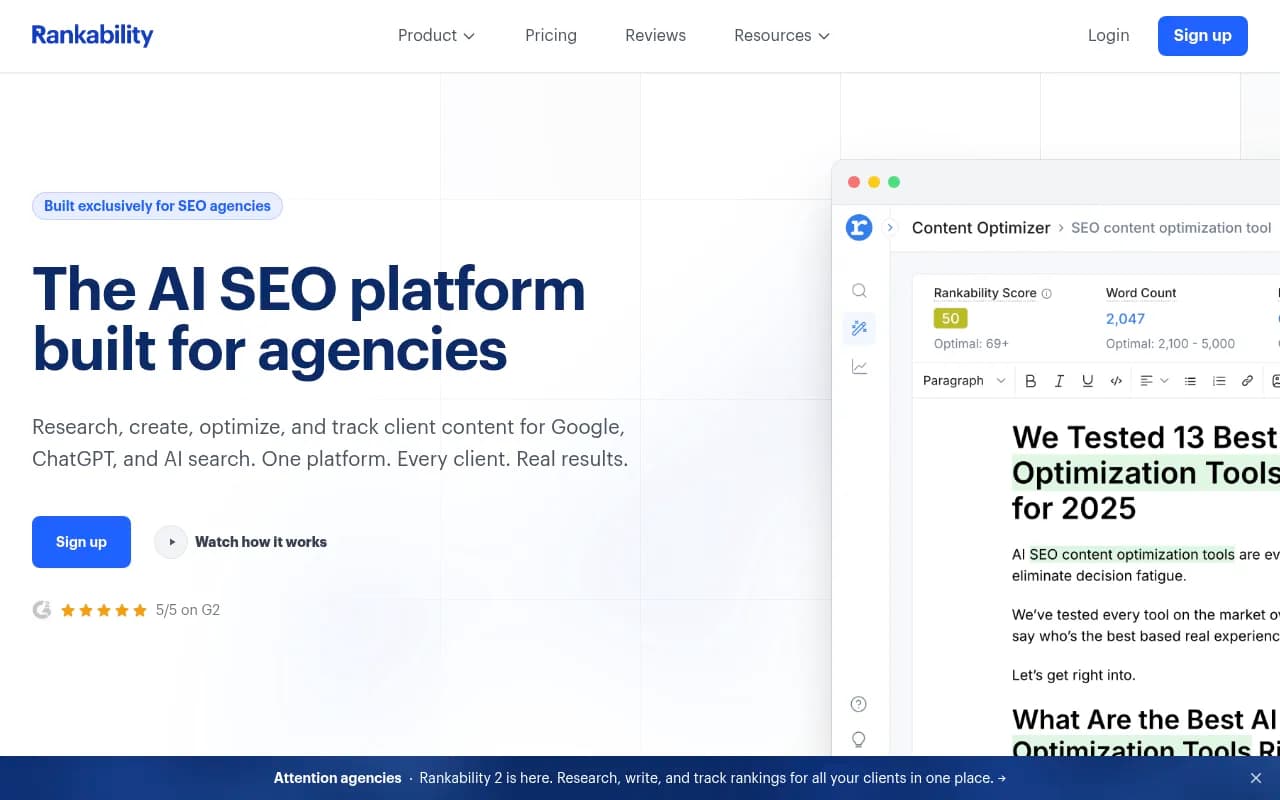
The persona angle here is mostly about content targeting rather than AI response simulation. Rankability helps you understand what content to create for different audience segments, but it doesn't run persona-specific queries against AI models to see how your brand appears to different user types. The AI visibility component is more about tracking whether your content gets cited in AI responses than about simulating different user contexts.
For agencies managing multiple clients across different verticals, Rankability's content workflow tools are genuinely useful. But if your primary question is "does my brand appear differently for a CFO vs. a marketing manager asking about our category?" -- Rankability isn't designed to answer that.
It's worth noting that Rankability's strength is in the content creation and optimization side of the equation. If you're looking for a tool to help you produce better content that ranks in both traditional and AI search, it has real value. But for persona-based AI visibility tracking specifically, it's not the right fit.
Best for: Agencies that want content optimization workflows with some AI search tracking, and aren't focused on persona-level visibility analysis.
Conductor: enterprise monitoring with persona features, but at a cost
Conductor has been around long enough to have serious enterprise credibility. It started as a traditional SEO platform and has expanded into AI search tracking, which means it carries both the advantages and the baggage of that history.
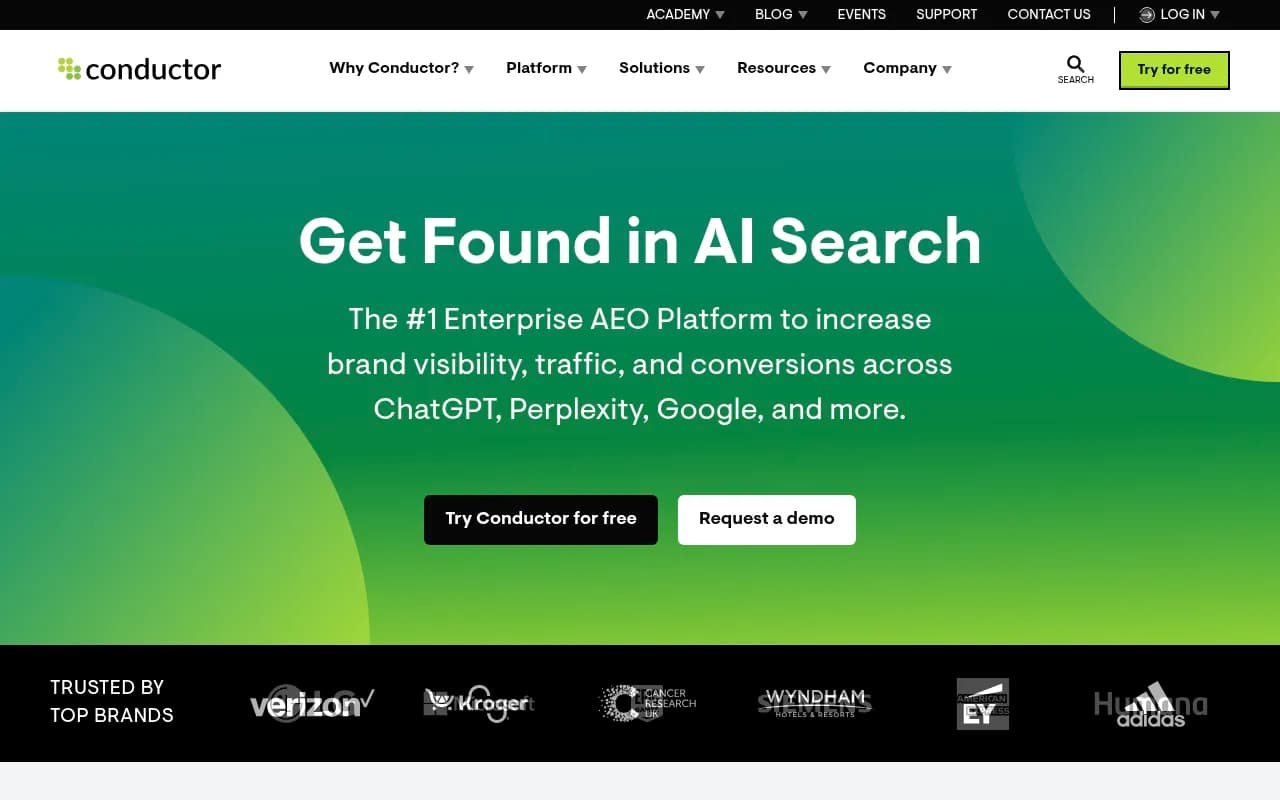
On persona-based tracking, Conductor does better than most. Its enterprise tier allows for audience segmentation in how you configure tracking, and you can set up different prompt contexts to simulate different user types. The platform also has strong integration with content management workflows, which means you can connect what you learn about persona-specific visibility to your content production process.
The catch is price and complexity. Conductor is built for large enterprise teams with dedicated SEO resources. The setup process is involved, and getting full value from the persona tracking features requires significant configuration time. For mid-market teams or agencies without dedicated technical resources, the overhead can outweigh the benefits.
Conductor also doesn't have the same depth of AI-specific features as platforms built from the ground up for GEO. Its AI tracking is solid but feels like an extension of a traditional SEO platform rather than a native AI visibility tool. Things like AI crawler log analysis, prompt volume estimates, and citation-level source tracking aren't core to what Conductor does.
Best for: Large enterprise teams with existing Conductor relationships who want to extend their SEO workflows into AI visibility, and have the resources to configure it properly.
Promptwatch: the most complete persona-based tracking in 2026
Promptwatch was built specifically for the AI search era, and it shows in how it handles personas. Rather than bolting persona features onto an existing SEO tool, persona configuration is central to how the platform works.

When you set up tracking in Promptwatch, you define who is asking the question -- not just what the question is. You can configure prompts with specific roles, locations (down to city level on the Professional plan), languages, and intent contexts. This means you can track whether your brand appears when a "head of marketing at a SaaS company" asks about your category versus when a "freelance consultant" asks the same thing. Those two queries can produce meaningfully different AI responses, and knowing the difference is what makes persona-based tracking actually useful.
The platform monitors 10 AI models: ChatGPT, Perplexity, Google AI Overviews, Google AI Mode, Claude, Gemini, Meta/Llama, DeepSeek, Grok, and Mistral. Running persona-specific prompts across all of these gives you a genuinely comprehensive picture of where you're visible -- and where you're not.
What separates Promptwatch from the other three platforms in this comparison is what happens after you find a gap. The Answer Gap Analysis shows you exactly which prompts competitors are getting cited for that you're missing. Then the built-in AI writing agent generates content designed to fill those gaps -- articles, listicles, and comparisons grounded in 880M+ citations analyzed, prompt volumes, and competitor data. You can see the gap, understand why it exists, create content to fix it, and then track whether that content starts getting cited.
That full loop -- find gaps, create content, track results -- is what makes Promptwatch an optimization platform rather than a monitoring dashboard. Peec.ai, Conductor, and Rankability all stop somewhere in the middle of that loop.
A few other Promptwatch features that are directly relevant to persona-based tracking:
- Query fan-outs show how a single prompt branches into related sub-queries, which helps you understand the full landscape of how your personas search
- Prompt Intelligence includes volume estimates and difficulty scores, so you can prioritize which persona-specific prompts are worth optimizing for
- AI Crawler Logs show which pages AI models are reading when they build responses -- useful for understanding why you appear (or don't) for specific persona queries
- Multi-language and multi-region monitoring with customizable personas that match how your actual customers prompt
Best for: Marketing and SEO teams that want to understand AI visibility at the persona level and have the tools to act on what they find.
Head-to-head comparison
| Feature | Peec.ai | Rankability | Conductor | Promptwatch |
|---|---|---|---|---|
| Persona-based prompt configuration | Basic (location/language) | Limited (content targeting) | Moderate (enterprise tier) | Advanced (role, location, language, intent) |
| AI models covered | 5-6 | Limited | 5-7 | 10 |
| City-level location tracking | No | No | Partial | Yes (Professional+) |
| Content gap analysis | No | Partial | No | Yes |
| Built-in AI content generation | No | Yes (SEO-focused) | No | Yes (GEO-focused) |
| AI crawler log analysis | No | No | No | Yes |
| Prompt volume & difficulty scores | No | No | No | Yes |
| Reddit & YouTube citation tracking | No | No | No | Yes |
| ChatGPT Shopping tracking | No | No | No | Yes |
| Traffic attribution | No | No | Partial | Yes |
| Starting price | ~$49/mo | ~$99/mo | Enterprise | $99/mo |
| Free trial | Yes | Yes | Demo only | Yes |
Which platform should you choose?
The honest answer depends on what you're trying to accomplish.
If you're just getting started with AI visibility tracking and want something clean and accessible, Peec.ai is a reasonable entry point. It won't give you deep persona segmentation, but it's easy to set up and covers the major AI models.
If you're an agency focused on content production and want AI search tracking as part of a broader SEO workflow, Rankability has tools worth looking at -- just don't expect sophisticated persona-level AI visibility analysis.
If you're a large enterprise with an existing Conductor relationship and a dedicated SEO team, extending into Conductor's AI tracking features makes sense. The persona features are there, even if they require work to configure.
If you want to actually understand how your brand appears to different customer types across AI models -- and then do something about it -- Promptwatch is the only platform in this comparison that's built for that end-to-end workflow. The persona configuration is more granular, the model coverage is broader, and the content generation tools mean you can close the loop between finding a gap and fixing it.
The AI visibility space is moving fast. Most platforms are still building out features that Promptwatch already has. For teams that want to get ahead of that curve rather than catch up to it, that head start matters.
A note on how to use persona-based tracking effectively
Whichever platform you choose, a few principles apply:
Start with your actual customer segments, not generic personas. Pull from your CRM or sales data to identify the two or three buyer types who actually convert, and build your tracking personas around those.
Test the same prompt across multiple personas before drawing conclusions. A single data point about where you appear for one user type isn't enough to make content decisions.
Revisit your persona configurations regularly. AI models update frequently, and the responses they give to persona-specific queries can shift significantly after a model update.
Connect visibility data to traffic data. Knowing you appear in AI responses is useful. Knowing that appearance drives actual clicks and conversions is what makes the investment worth it. Look for platforms that offer traffic attribution, not just visibility scores.
The brands that will win in AI search aren't the ones tracking the most prompts -- they're the ones who understand which prompts matter for which customers, and who have the tools to act on that understanding.