Key takeaways
- All five tools cover the basics: tracking brand mentions across ChatGPT, Perplexity, and a handful of other AI engines
- LLMrefs has the widest model coverage (11 engines) and the most transparent prompt-level data
- Peec.ai is the most polished entry-level option for solo marketers and small marketing teams
- Promptmonitor and Hall AI are functional but thin -- they work for a quick pulse check, not serious optimization
- None of these five tools help you act on what you find. If you need content gap analysis, AI writing, or crawler logs alongside monitoring, you'll want a more complete platform like Promptwatch

The AI visibility tool market has split into two camps. On one side: full-platform solutions that track, analyze, and help you fix your visibility. On the other: lightweight monitoring tools aimed at small teams, solo marketers, and founders who just want to know if ChatGPT is mentioning them.
This guide covers the second camp. Peec.ai, Trakkr.ai, Hall AI, LLMrefs, and Promptmonitor are all positioned as accessible, lower-cost entry points into AI search monitoring. They're not trying to replace Profound or Scrunch. They're trying to answer one question quickly: "Is my brand showing up in AI answers?"
That's a legitimate question. But the answer to that question is only useful if it leads somewhere. So we'll also look at where each tool stops -- and what you'd need to do next.
What these tools actually do
Before the individual breakdowns, it's worth being clear about the category. All five tools work roughly the same way: they run a set of prompts through AI engines (ChatGPT, Perplexity, Gemini, etc.), check whether your brand appears in the responses, and report back with some form of visibility score or mention count.
That's genuinely useful. A year ago, most teams had no idea whether they were showing up in AI-generated answers at all. These tools solve that problem cheaply.
What they generally don't do:
- Tell you why you're not appearing (content gaps, citation gaps)
- Help you create content to fix the problem
- Show you which of your pages AI crawlers are actually visiting
- Connect AI visibility to real traffic or revenue
Keep that in mind as you read through each one.
Peec.ai

Peec.ai is probably the most frequently recommended entry-level option in this category. It's clean, fast to set up, and covers the main AI engines most teams care about: ChatGPT, Perplexity, Gemini, and Google AI Overviews.
The core workflow is simple. You add your brand, define a set of prompts (the questions your customers might ask an AI), and Peec starts tracking how often you appear in responses. You get a visibility score, a breakdown by engine, and a comparison against competitors you specify.
A few things Peec does well:
- The onboarding is genuinely fast. You can have your first prompts running within 10 minutes
- Competitor comparison is included at most tiers, which is more than some tools offer
- The UI is clean enough that non-technical marketers can use it without a walkthrough
The limitations are real though. Prompt volumes and difficulty scores aren't available, so you're tracking prompts somewhat blind -- you don't know if the prompts you're monitoring are actually high-traffic. There's no content generation, no crawler log access, and no traffic attribution. You'll know your visibility score went up, but not necessarily why.
Pricing starts at €89/month with a trial available. That's reasonable for what you get, though it starts to feel expensive once you realize how much of the optimization work still falls on you.
Best for: Small marketing teams that want a clean dashboard and a quick competitive pulse check. Not for teams that need to act on what they find.
Trakkr.ai
Trakkr.ai is a newer entrant and harder to pin down. The product is actively being developed, and the feature set is thinner than Peec's at this point. It covers the main AI engines and gives you brand mention tracking, but the reporting is more basic.
Where Trakkr tries to differentiate is speed and simplicity. The pitch is essentially "set it up in five minutes and get weekly reports." For a founder who just wants a sanity check on whether their brand exists in AI responses, that's a reasonable value proposition.
What you won't find: deep prompt analytics, competitor heatmaps, content recommendations, or any form of optimization tooling. It's a monitor, full stop.
Pricing is competitive -- lower than Peec in most configurations -- which makes it worth considering if budget is the primary constraint and you genuinely only need basic monitoring.
Best for: Founders and solo operators who want a lightweight, low-cost way to confirm AI visibility without committing to a full platform.
Hall AI
Hall AI takes a slightly different angle. Rather than pure brand monitoring, it frames itself around "AI search presence" -- a slightly broader concept that includes how your brand is described in AI responses, not just whether it appears.
In practice, this means Hall AI does some basic sentiment analysis on the mentions it finds. You can see not just that ChatGPT mentioned you, but roughly how it described you. That's a useful extra layer that Peec and Trakkr don't offer at the same price point.
The model coverage is narrower than LLMrefs -- typically 4-6 engines depending on your plan -- and the prompt volume is limited at entry tiers. The interface is functional but not as polished as Peec.
One thing worth noting: Hall AI's sentiment analysis is fairly surface-level. It can tell you if a mention was positive or neutral, but it won't surface specific claims AI models are making about your brand that might be inaccurate or outdated. For that level of detail you'd need a more comprehensive tool.
Pricing is mid-range for this category. No public free tier, but a trial is available.
Best for: Teams that care about brand perception in AI responses, not just mention frequency. A reasonable step up from pure monitoring if sentiment context matters to you.
LLMrefs
LLMrefs
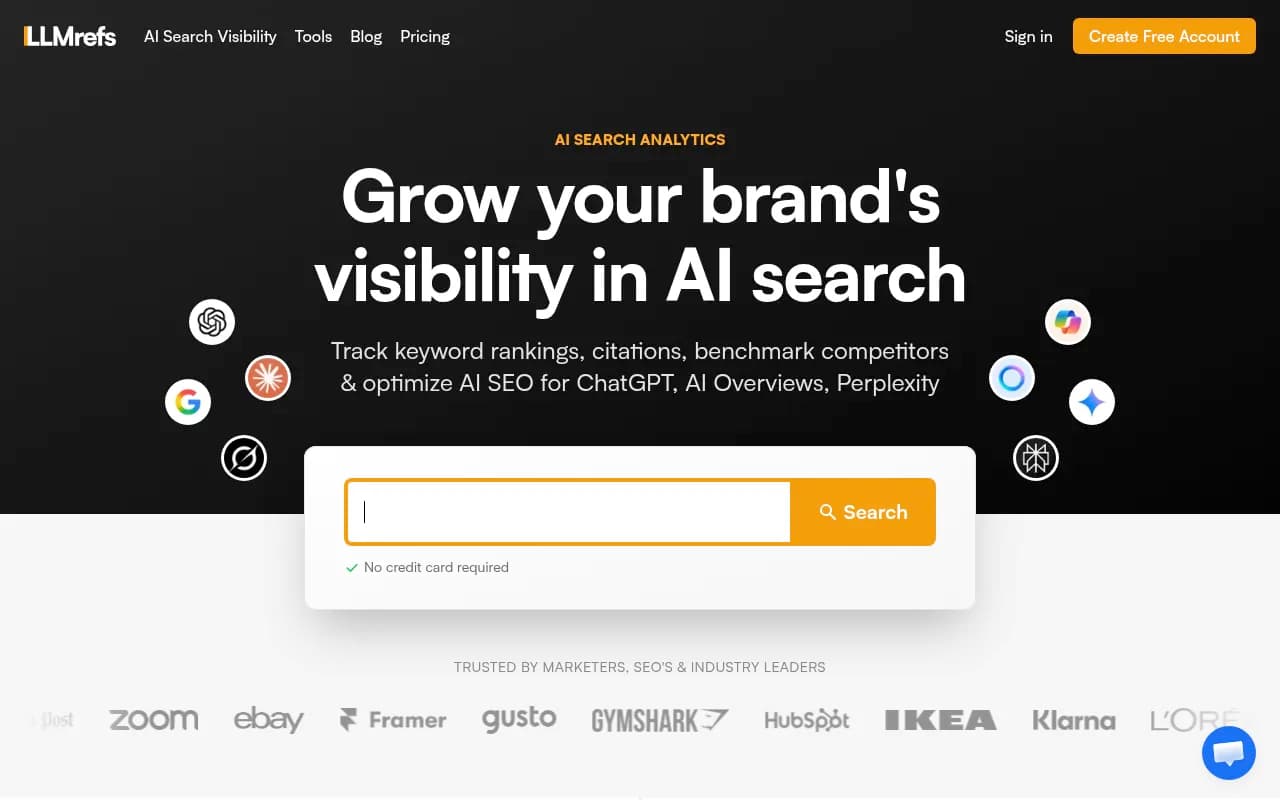
LLMrefs is the most technically ambitious of the five. It tracks 11 AI engines -- the widest coverage in this group -- and gives you keyword-level data that the others mostly skip over. You can see which specific prompts are driving visibility, how your brand appears across different models, and how competitors compare on a per-prompt basis.
The keyword-first approach is genuinely useful. Instead of just showing you an aggregate visibility score, LLMrefs lets you drill into individual prompts and see exactly what's happening. That's closer to how SEO rank tracking works, which makes it more intuitive for teams with an SEO background.
A few things that stand out:
- 11 engines is more than any other tool in this comparison. That matters if you're trying to track visibility in DeepSeek, Grok, or Mistral alongside the main players
- The prompt-level breakdown is more granular than Peec or Trakkr
- There's a free tier (one keyword), which is genuinely useful for testing before committing
The gaps: no content generation, no crawler logs, no traffic attribution. LLMrefs is a strong monitoring tool, but it stops there. Pricing starts at €79/month for the paid tier, which is competitive given the model coverage.
Best for: Teams with an SEO background who want keyword-level AI visibility data and broad model coverage. The most data-rich option in this group.
Promptmonitor
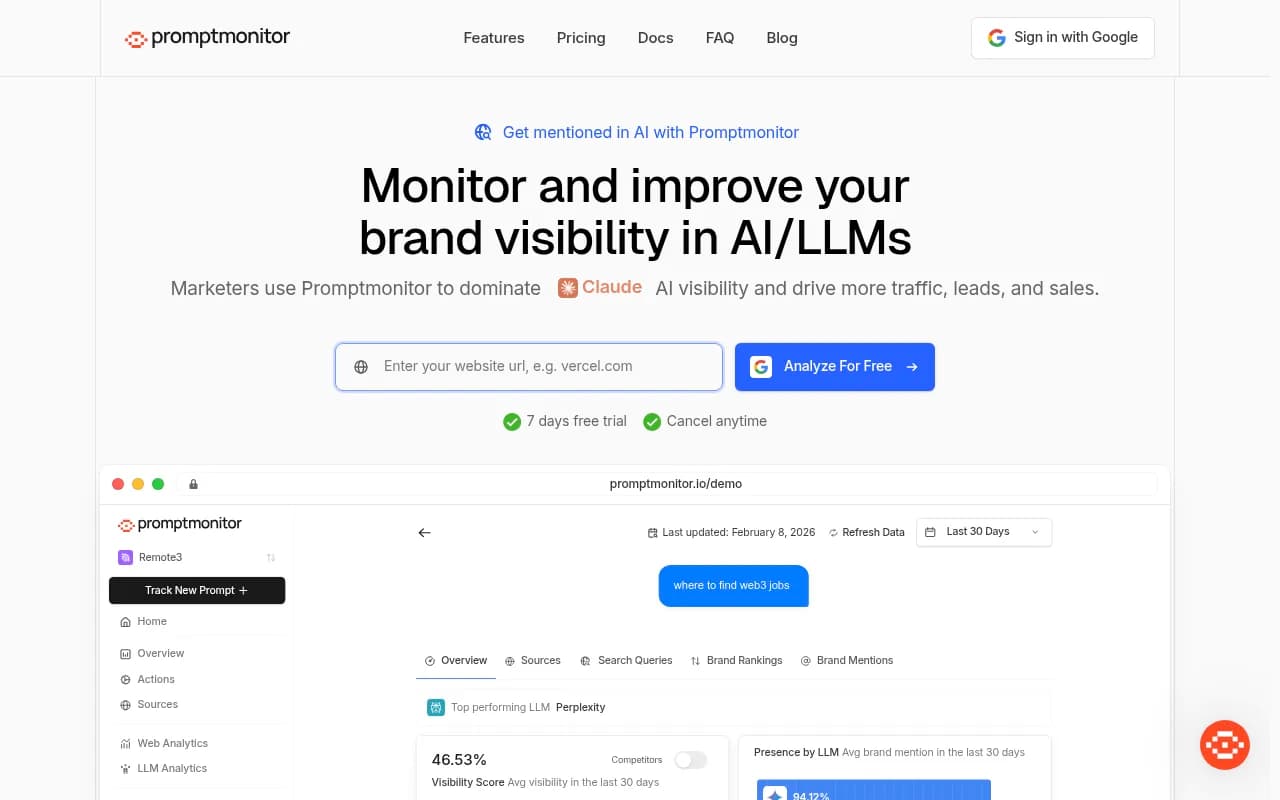
Promptmonitor is the most basic of the five. It covers the core use case -- tracking brand mentions across ChatGPT and Perplexity primarily -- and does it without much frills. Setup is fast, the dashboard is minimal, and you get a basic report of how often your brand appears.
What's missing is significant. Competitor tracking is limited, prompt analytics are thin, and there's no optimization layer at all. It feels like a proof-of-concept that hasn't fully grown into a product yet. That said, it's cheap, and for a team that just wants to confirm "yes, we show up in AI answers" before investing in a more serious tool, it serves that purpose.
The pricing is the main argument for Promptmonitor. It's one of the lower-cost options in this category, which makes it a reasonable starting point if you're not ready to commit to a monthly subscription for a more capable platform.
Best for: Teams doing initial due diligence on AI visibility before investing in a proper platform. Not a long-term solution for anyone serious about optimization.
Side-by-side comparison
| Tool | Starting price | AI engines covered | Free tier | Competitor tracking | Sentiment analysis | Content generation | Crawler logs |
|---|---|---|---|---|---|---|---|
| Peec.ai | ~€89/mo | 4-5 | Trial only | Yes | No | No | No |
| Trakkr.ai | Lower tier | 3-4 | No | Limited | No | No | No |
| Hall AI | Mid-range | 4-6 | Trial only | Yes | Basic | No | No |
| LLMrefs | €79/mo | 11 | Yes (1 keyword) | Yes | No | No | No |
| Promptmonitor | Low | 2-3 | No | Limited | No | No | No |
| Promptwatch | $99/mo | 10+ | Free trial | Yes | No | Yes | Yes |
The last row is there for context. All five lightweight tools are monitoring-only. If you eventually need to move from "we see the problem" to "we're fixing the problem," that's a different category of tool.
The gap these tools leave open
Here's the honest version of what happens when you use any of these five tools: you get a dashboard showing your visibility score, you see that competitors are appearing in prompts where you're not, and then... you're on your own.
None of them tell you what content to create. None of them show you which of your pages AI crawlers are visiting (or ignoring). None of them connect your visibility score to actual traffic or revenue. You're left with data but no clear path to action.
That's not a knock on these tools specifically -- it's a category limitation. They were built to answer "are we visible?" not "how do we become more visible?"
For small teams with limited budgets, that might be fine as a starting point. Run one of these tools for a month, understand your baseline, then decide whether you need to invest in something more complete.
For teams that are ready to move from monitoring to optimization, the gap becomes real. Content gap analysis (which prompts are competitors winning that you're not?), AI-native content generation, page-level citation tracking, and crawler log analysis are the tools that actually move the needle. Platforms like Promptwatch are built around that full loop -- find the gaps, create content to fill them, track the results.
Which one should you pick?
If you're choosing among these five, here's the short version:
Pick LLMrefs if you want the most data and the widest model coverage. The keyword-level breakdown and 11-engine tracking make it the most useful for teams that think in SEO terms and want to understand visibility at a prompt level.
Pick Peec.ai if you want the most polished experience and a clean competitive dashboard. It's the best-designed tool in this group and the easiest to get value from quickly.
Pick Hall AI if brand sentiment matters to you alongside mention frequency. The basic sentiment layer is a genuine differentiator at this price point.
Pick Trakkr.ai if budget is the primary constraint and you just need a lightweight weekly check-in.
Pick Promptmonitor if you're in pure exploration mode and want the cheapest possible way to confirm whether AI visibility is worth investing in.
And if you find yourself wanting more than any of these can give you -- actual optimization, content generation, crawler data, traffic attribution -- that's the signal that you've outgrown the lightweight tier.
A note on the broader market
The research data from roundups like the Frase.io top-10 list and the SiteSpeakAI comparison both make the same point: the AI visibility tool market is maturing fast, and the gap between monitoring tools and optimization platforms is widening.
The lightweight tools in this guide are useful entry points. But the teams getting real results from AI search in 2026 are the ones who've moved past monitoring and into the optimization loop: finding content gaps, publishing content engineered to get cited, and tracking which pages are actually being read by AI crawlers.
That's a harder problem than "are we visible?" -- but it's the one that actually affects revenue.