Key takeaways
- Profound, Otterly.AI, and Peec AI all collect data by scraping the live front-end of ChatGPT, Perplexity, Gemini, and other AI engines rather than calling APIs, because that's closer to what a real user sees.
- None of them can escape a bigger problem: independent research from SparkToro and Carnegie Mellon found less than a 1-in-100 chance that ChatGPT or Google AI gives the exact same brand list twice for the same prompt.
- Profound leads on depth and enterprise features (SOC 2, 1.9B+ real prompts dataset, up to 9 engines) but starts around $499/month with no accessible mid-tier. Peec AI sits in the middle ($95-$495/month). Otterly.AI is the cheapest entry point at $29/month.
- "Accuracy" in this category means something specific: consistent methodology, transparent prompt sets, and enough sampling to smooth out AI randomness. It does not mean any tool shows you ground truth.
- If you want a tool that goes beyond monitoring and actually helps you fix low citation rates, that's a separate question from accuracy, and it's worth asking each vendor directly.
The question everyone asks and nobody answers honestly
Every vendor in this space will tell you their data is the most accurate. Profound says its front-end browser sampling beats API-based competitors. Peec AI says the same thing, then argues Profound's prompt-volume numbers are inflated. Otterly.AI mostly stays out of the fight and just ships a cheap product.
Here's the uncomfortable truth: accuracy, in the sense of "ground truth," doesn't really exist yet for AI citation tracking. What you're actually comparing is methodology, sampling size, and how transparent each vendor is about the tradeoffs. Let's go through all three properly.
How each tool actually collects data
Profound
Profound runs prompts daily through the actual front-end interfaces of each answer engine rather than hitting APIs, because it argues API responses don't match what a logged-out or logged-in user actually sees in the app. It backs this with a claimed 1.9 billion real user prompts, growing by 170 million a month, broken into intent and demographic segments.
Profound covers up to 9 engines on its Enterprise tier (ChatGPT, Perplexity, Google AI Mode, Gemini, Copilot, DeepSeek, Claude, AI Overviews, and Exa Search), and it's SOC 2 Type II certified with an independent HIPAA assessment. That compliance layer matters if you're selling into regulated industries.
Profound

The catch: Profound's current pricing page shows only a limited free trial (10 prompts, run once, ChatGPT only) and then jumps straight to custom Enterprise pricing. Older sources cite a $99 Starter and $399 Growth tier, but the live pricing structure appears to have changed, so verify current tiers directly with sales before budgeting.
Peec AI
Peec AI uses what it calls "UI scraping technology," interacting with AI platforms through the same web interfaces a real user would, rather than calling APIs (API access is reserved for its Enterprise tier). Peec runs dedicated infrastructure per country, which is a real advantage if you need regionally accurate results instead of one global average.
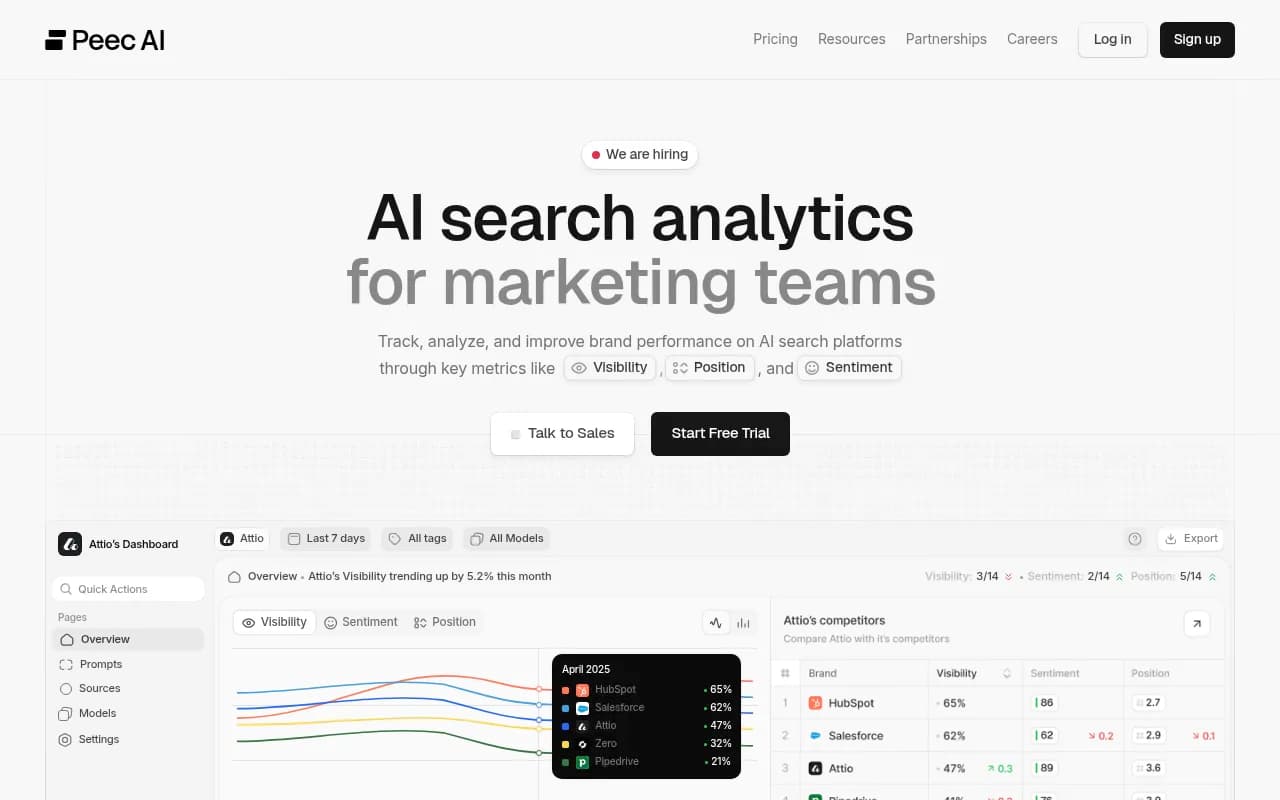
Pricing is more accessible than Profound: Starter at $95/month for 50 prompts across 3 chosen models, Pro at $245/month for 150 prompts and 2 projects, Advanced at $495/month for 350 prompts and 5 projects. Peec's own comparison page argues its lower pricing, unlimited seats on every tier, and MCP access for natural-language querying beat Profound on value, even if Profound wins on raw dataset size and AI content generation.
One genuine weak spot shows up in G2 reviews: at least one reviewer flagged Peec's search-volume metrics as inaccurate, saying the platform "doesn't provide any kind of accurate volume metrics." Take the volume numbers with a grain of salt regardless of which vendor you pick.
Otterly.AI
Otterly.AI also scrapes live AI search platforms rather than using APIs for most of its tiers, and it's the most explicit about tracking coverage of any tool here: 4 engines included by default (ChatGPT, Google AI Overviews, Perplexity, Microsoft Copilot), with Claude, Google AI Mode, and Gemini available as paid add-ons.
Otterly.AI

Otterly is the budget play, starting at $29/month for 15 prompts. Its Standard tier ($189/month) adds API and MCP access, agent analytics, and a Looker Studio connector, which is a lot of feature depth for the price relative to Peec and Profound. Support quality gets a 9.7 score on G2, with users noting the team "will even jump on calls for a few minutes to debug tracking prompts," which matters if you're a small team without a dedicated GEO specialist.
Side-by-side comparison
| Tool | Data collection | Engines tracked | Entry price | Best for | Compliance |
|---|---|---|---|---|---|
| Profound | Front-end browser scraping, 1.9B+ real prompt dataset | Up to 9 (Enterprise) | Custom / limited free trial | Enterprise, regulated industries | SOC 2 Type II, HIPAA assessment |
| Peec AI | UI scraping, per-country infrastructure | Up to 6 core, 13 on Enterprise | $95/mo | Mid-market, regional accuracy | GDPR, SSO (no SOC 2) |
| Otterly.AI | UI scraping, live platform sourcing | 4 default, 3 paid add-ons | $29/mo | SMBs, solo marketers, budget-conscious teams | Not specified |
Why none of these numbers are ground truth
This is the part most comparison articles skip, and it matters more than any feature checkbox.
Rand Fishkin and Patrick O'Donnell ran an experiment with 600 volunteers who fired the same 12 prompts at ChatGPT, Claude, and Google AI Overview/AI Mode a combined 2,961 times. The result: there's less than a 1-in-100 chance that ChatGPT or Google AI returns the exact same list of brands twice for the same prompt. Claude is a little more consistent on which brands show up, but still inconsistent on the order they appear in. Even the number of items returned varies from one run to the next, sometimes 2 or 3 recommendations, sometimes 10 or more.
That's not a knock on any specific tool. It's a property of the underlying models. Profound's own research states that 40 to 60% of cited domains change monthly across answer engines, even for identical questions. If the citations themselves are this volatile, no vendor, no matter how good its scraping infrastructure is, can promise a single stable "visibility score."
There's also a scoring-methodology problem that's easy to miss. Different formulas, mention-based share of voice versus position-weighted versus citation-based, can produce wildly different numbers from the exact same underlying dataset. One documented example showed the same brand scoring 20% under a mention-based formula, 16.8% under position-weighted, and 31.4% under citation-based share of voice. Before trusting any dashboard number, ask the vendor which formula they're using and whether they'll let you see it.
Agency leadership seems to agree this is a real problem, not just a competitor talking point. Paul Dyer, CEO of AI-native agency /prompt, told Digiday: "If you use three different tools and give them the same prompts, you get three different answers." Heather Physioc, Chief Discoverability Officer at VML, noted that many tools only provide point-in-time snapshots rather than genuinely ongoing measurement, which limits how much trend analysis you can really do.
Platform-wide shifts can look like your own problem
One more wrinkle worth knowing before you panic over a dashboard drop: platform updates can move every brand's numbers at once. Around the GPT-5.3 rollout on March 4, 2026, average citations per ChatGPT response dropped roughly 27% across all models simultaneously, with no recovery a month later, according to Promptwatch data. If your citation count in any of these three tools falls off a cliff around a known model update, check whether it's a platform-wide shift before assuming your content lost favor.

That's also where Promptwatch's approach differs from a pure tracker: it monitors real UI data across ChatGPT, Gemini, AI Overviews, AI Mode, Perplexity, Claude and others, and pairs that with crawler logs and citation trend data so you can tell platform noise apart from an actual content problem, rather than staring at a single number and guessing. Promptwatch's average sources-per-response tracking shows ChatGPT typically cites around 5 sources per web-search-enabled response while Google AI Overviews cites roughly double that, and Microsoft Copilot's average has swung from under 2 to nearly 17 sources within weeks, evidence that Microsoft is still reworking its retrieval and attribution pipeline (source: average sources per response).
What to actually ask each vendor before buying
Skip the marketing pages and ask these questions directly:
- How many prompts do you run per tracked topic, and how often?
- What scoring formula produces the visibility score on my dashboard, mention-based, position-weighted, or citation-based?
- Is my account's browsing session personalized in any way that could skew results toward or away from my brand?
- Can I see raw prompt-level responses, not just the aggregated score?
- What happens to my historical data if you change methodology (which all three vendors have done at least once in 2025-2026)?
If a vendor can't answer these clearly, that's a bigger red flag than any pricing gap between Profound, Peec, and Otterly.
Which one should you actually pick
For a Fortune 500 team with a dedicated GEO program, budget for compliance, and a need for the widest engine coverage, Profound is hard to beat on raw depth, even with the pricing opacity. For a mid-market brand that wants regional accuracy and per-country infrastructure without an enterprise contract, Peec AI is the more practical middle ground. For a small team or solo marketer just trying to see whether ChatGPT even mentions your brand, Otterly.AI gets you real, daily data for less than the price of a team lunch.
None of them will hand you a perfect number. What they will hand you, if you use them correctly, is a directional signal, tracked consistently over time, that's more useful than not measuring at all. If you want a broader look at where these three sit against 20+ other platforms, including tools with automated content generation and crawler log analysis built in, the GEO software directory at bestgeosoftware.com is a reasonable place to keep comparing options as this market keeps shifting.