Key takeaways
- All five platforms track brand mentions across AI engines, but they diverge sharply on what happens after monitoring
- Promptwatch is the only platform in this group with built-in content generation, AI crawler logs, and traffic attribution in one place
- Profound is the strongest enterprise choice but comes with enterprise pricing to match
- Nightwatch and Gauge are solid entry points for teams that primarily need monitoring without heavy optimization workflows
- Orchly is newer and lighter -- worth watching but not yet a full-stack solution
- The most important question to ask any vendor: "What do I do after I find a gap?" The answer tells you everything
The AI visibility platform market has a crowding problem. Dozens of tools now claim to track how your brand appears in ChatGPT, Perplexity, Gemini, and Google AI Overviews. Most of them do roughly the same thing: run a set of prompts, count how often your brand appears, and show you a dashboard.
That's fine as a starting point. But growing marketing teams -- the ones with real targets and real accountability -- need more than a dashboard. They need to know what to do next.
This comparison focuses on five platforms that come up repeatedly in mid-market buying conversations: Profound, Promptwatch, Nightwatch, Gauge, and Orchly. They're not all the same tier, and they're not all solving the same problem. Here's what actually separates them.
What "AI visibility" actually means in 2026
Before comparing tools, it's worth being precise about what we're measuring. AI visibility has three distinct layers:
- Brand mentions -- does your brand name appear in AI-generated answers?
- Citation visibility -- is your website being linked or referenced as a source?
- Recommendation visibility -- is your brand being recommended when someone asks "what's the best X?"
Most platforms track layer one. Fewer track layer two with any depth. Layer three -- the one that actually drives pipeline -- is where the real differentiation happens, and it's where the gap between monitoring tools and optimization platforms becomes obvious.
The five platforms at a glance
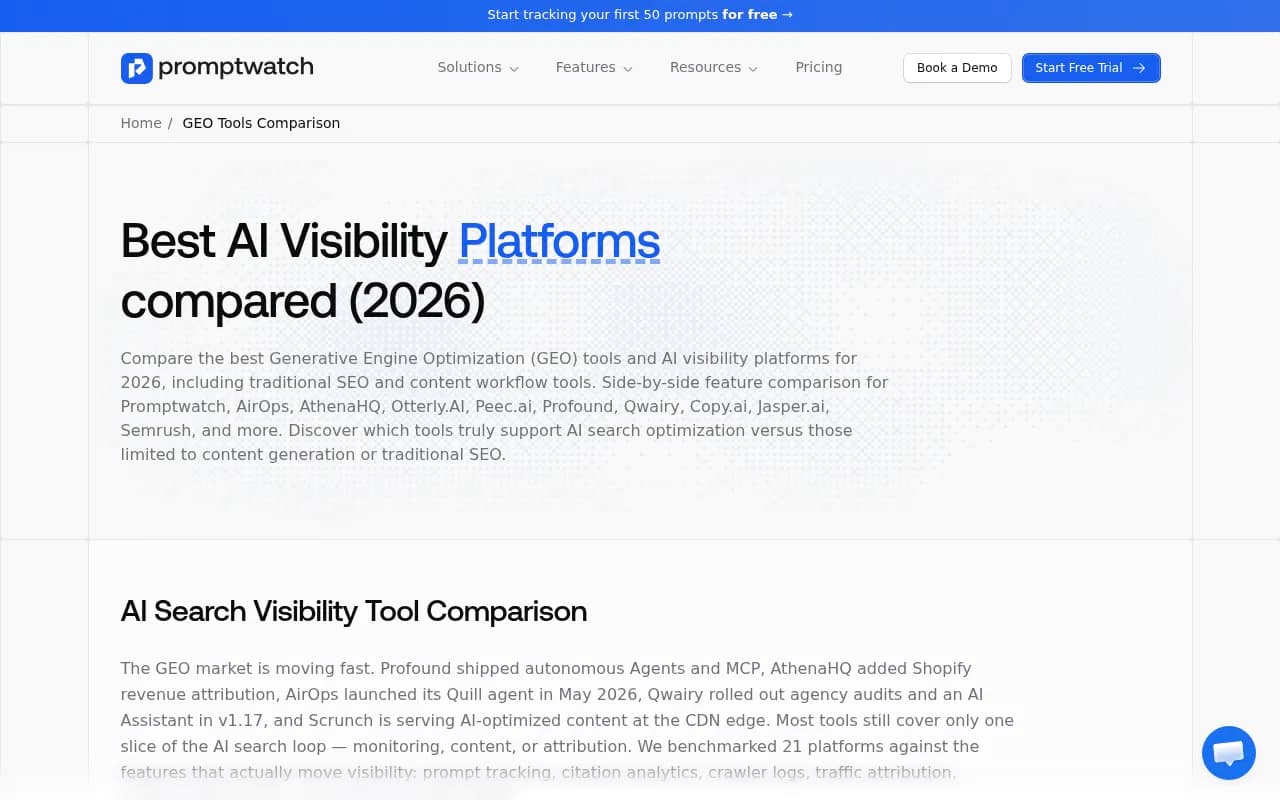
Promptwatch
Promptwatch is built around a loop: find gaps, create content, track results. It monitors 10 AI models (ChatGPT, Perplexity, Claude, Gemini, Google AI Overviews, Google AI Mode, Grok, DeepSeek, Copilot, Meta AI) and pairs that monitoring with tools that actually help you act on what you find.

The differentiator isn't the tracking -- it's what comes after. Answer Gap Analysis shows exactly which prompts competitors rank for that you don't. Content Agents then generate articles, comparisons, and briefs grounded in that gap data. AI Crawler Logs show which pages AI bots are reading, how often, and whether those reads are converting to citations. Page-level tracking connects specific URLs to specific citation events, so you can see which content is working and which isn't.
It also has a few capabilities that are genuinely unusual: Reddit and YouTube insights (both channels that heavily influence AI recommendations), ChatGPT Shopping tracking, and traffic attribution that connects AI visibility to actual revenue. Pricing starts at $99/month for the Essential plan (1 site, 50 prompts, 5 articles), $249/month for Professional (2 sites, 150 prompts, 15 articles, crawler logs), and $579/month for Business (5 sites, 350 prompts, 30 articles).
Profound
Profound is the enterprise-grade option in this group. It's been around long enough to build serious depth -- particularly around the "why did we appear?" question. In mid-2025, Profound shipped autonomous Agents and MCP (Model Context Protocol) support, which lets it integrate into broader marketing workflows in ways most competitors can't.
Profound

Where Profound shines: governance, compliance, and deep technical analytics. If you're a large brand that needs audit trails, SSO, and the ability to explain AI visibility data to a legal or compliance team, Profound is built for that. It covers 9+ AI engines and has strong source attribution -- you can trace why a particular response cited a particular page.
Where it's harder to justify: pricing. Profound is positioned as an enterprise solution, and its cost reflects that. For a growing marketing team that doesn't have enterprise budget, the ROI math gets difficult quickly. It's also primarily a monitoring and analysis platform -- content optimization and generation aren't native capabilities.
Nightwatch
Nightwatch started as a traditional rank tracking tool and has expanded into AI search monitoring. It's a reasonable option for teams that are already using it for Google rank tracking and want to add AI visibility without switching platforms.
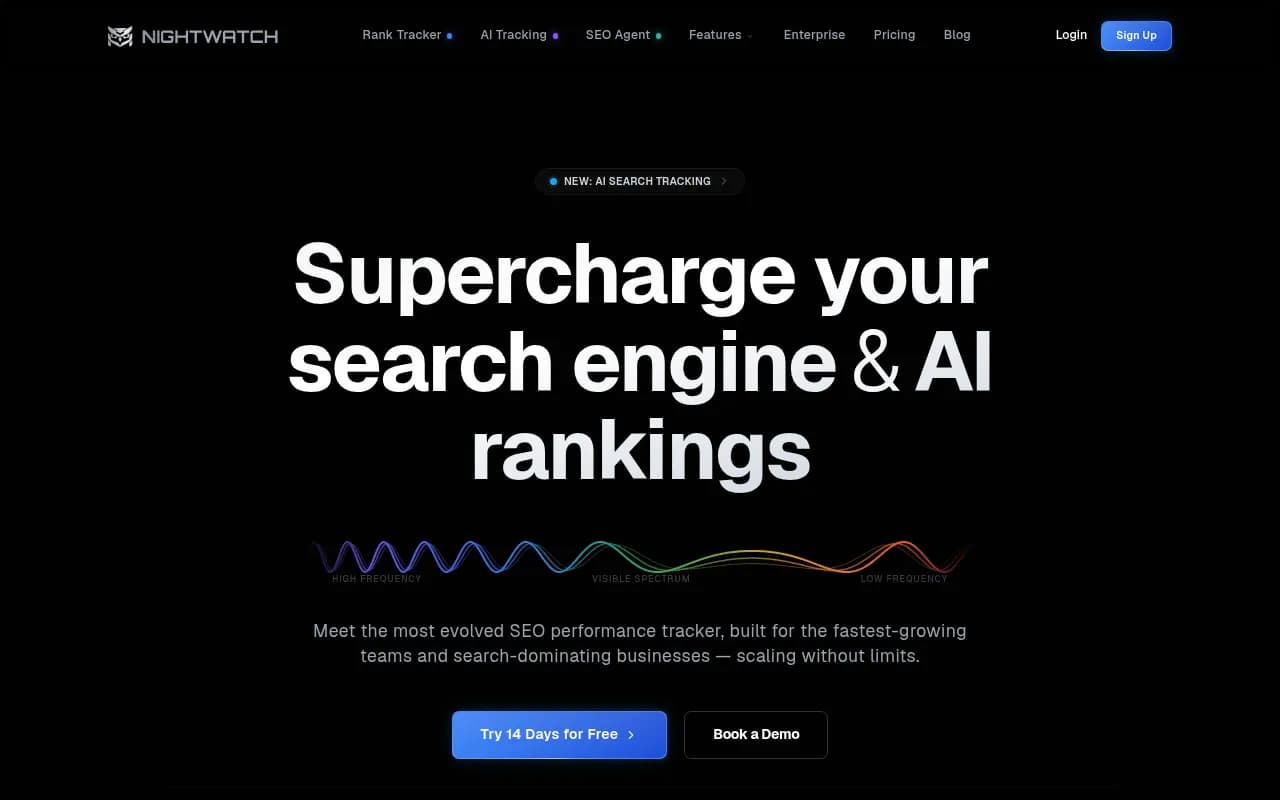
The AI monitoring features cover the major engines, and the interface is clean. For teams that are primarily SEO-focused and want AI visibility as a secondary metric, Nightwatch makes sense. The limitation is depth -- it doesn't have crawler logs, content generation, or the kind of gap analysis that tells you what to actually do with the data. It's a monitoring layer, not an optimization layer.
Gauge
Gauge is a focused AI brand monitoring tool. It tracks brand mentions across AI engines and surfaces sentiment and share-of-voice data in a clean dashboard.
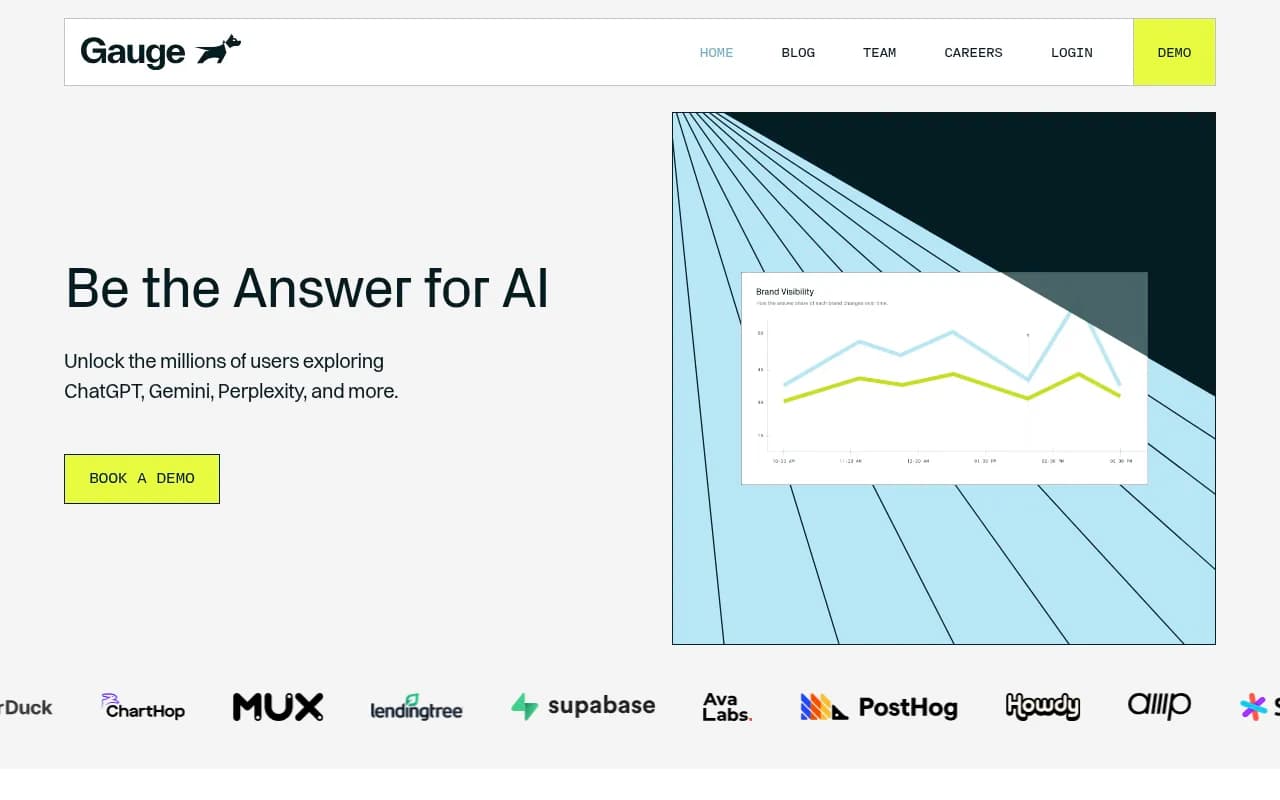
The pitch is simplicity: set up your brand, define your competitors, get weekly reports. For teams that are just starting to think about AI visibility and need a low-friction way to get data in front of leadership, Gauge is easy to deploy. The trade-off is that it doesn't go deep. There's no content optimization, no crawler analysis, no attribution. It answers "are we showing up?" but not "why aren't we showing up more?" or "what should we do about it?"
Orchly
Orchly is the newest and lightest platform in this comparison. It tracks brand mentions across multiple AI platforms and is positioning itself as a multi-platform monitoring tool for teams that want broad coverage without complexity.
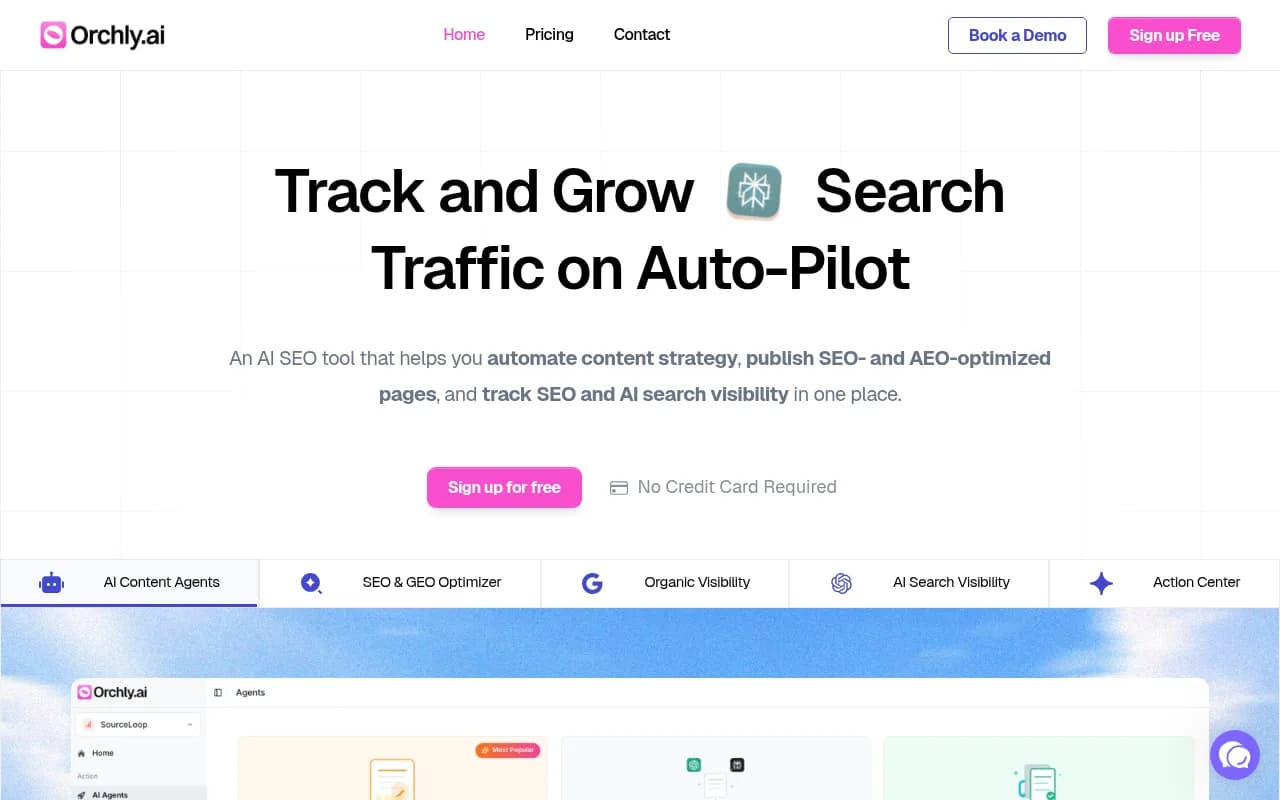
It's worth watching. The product is moving fast, and the interface is genuinely clean. But as of mid-2026, it's missing several capabilities that matter for teams with real optimization goals: no content generation, no crawler logs, limited attribution, and a smaller prompt dataset than the more established players. It's a reasonable choice for a small team that needs basic monitoring at a low cost, but it's not a full-stack solution yet.
Feature-by-feature comparison
| Feature | Promptwatch | Profound | Nightwatch | Gauge | Orchly |
|---|---|---|---|---|---|
| AI engines monitored | 10 | 9+ | 5-6 | 5-6 | 4-5 |
| Prompt volume tracking | Yes | Yes | Limited | No | No |
| Answer gap analysis | Yes | Partial | No | No | No |
| Content generation | Yes (AI agents) | No | No | No | No |
| AI crawler logs | Yes | No | No | No | No |
| Page-level citation tracking | Yes | Partial | No | No | No |
| Traffic attribution | Yes | No | No | No | No |
| Reddit/YouTube insights | Yes | No | No | No | No |
| ChatGPT Shopping tracking | Yes | No | No | No | No |
| Competitor heatmaps | Yes | Yes | Limited | Yes | Limited |
| Multi-language/region | Yes | Yes | Yes | Limited | Limited |
| Enterprise governance | Partial | Yes | No | No | No |
| Starting price | $99/mo | Enterprise | ~$39/mo | ~$49/mo | ~$29/mo |
The question that actually matters: what happens after you find a gap?
Every platform in this comparison will tell you that you're not appearing for certain prompts. The real question is what you do next.
With Nightwatch, Gauge, or Orchly, the answer is: you leave the platform and figure it out yourself. You take the gap data, hand it to a content team, and hope they produce something that AI models will eventually cite. That's a reasonable workflow if you have a strong content operation already, but it adds friction and time.
With Profound, you get deeper analysis of why the gap exists -- which sources are being cited instead of you, what those sources cover, and what the competitive landscape looks like. That's genuinely useful, but you're still leaving the platform to execute.
With Promptwatch, the gap analysis feeds directly into content generation. The Content Agents use real prompt data, citation data, competitor analysis, and your brand guidelines to generate articles designed to fill specific gaps. You can go from "we're not appearing for this prompt category" to "here's a draft article targeting that gap" without switching tools. The crawler logs then tell you when AI bots start reading the new content, and the citation tracking shows when it starts working.
That's a meaningfully different workflow, and for a marketing team that's trying to improve AI visibility as a measurable outcome, it matters.
Who should use which platform
Use Promptwatch if...
You want to actually improve AI visibility, not just measure it. If your team has targets around AI citation share, if you're producing content specifically to rank in AI search, or if you need to connect AI visibility to revenue, Promptwatch is the most complete option in this group. The pricing is accessible for mid-market teams, and the action loop (find gaps, generate content, track results) is the most direct path from data to outcome.
Use Profound if...
You're at an enterprise scale and need governance, compliance, and deep technical attribution. Profound's autonomous Agents and MCP integration make it a serious platform for large organizations with complex workflows. If budget isn't the primary constraint and you need enterprise-grade depth, Profound is worth the investment.
Use Nightwatch if...
You're already a Nightwatch customer for traditional rank tracking and want to add AI visibility monitoring without adding another vendor. The AI features are solid enough for basic monitoring, and the unified interface has real value if your team is already living in Nightwatch.
Use Gauge if...
You're just starting out with AI visibility and need a simple, low-cost way to get data in front of stakeholders. Gauge is easy to set up and produces clean reports. It's a good first step, with the understanding that you'll likely outgrow it as your AI search strategy matures.
Use Orchly if...
You need broad multi-platform monitoring at a low price point and don't yet need optimization capabilities. It's a reasonable entry-level option, but plan for the fact that you may need to migrate to a more capable platform as your needs grow.
A note on pricing reality
The pricing gap between these platforms is significant, and it's worth being honest about what you're getting at each tier.
Orchly and Gauge are genuinely affordable -- sub-$50/month entry points make them accessible to small teams. But the capabilities at that price reflect the cost. You're getting monitoring, not optimization.
Nightwatch's AI features are an add-on to a traditional SEO tool, so the pricing depends heavily on which plan you're on and what else you're using it for.
Promptwatch's $99/month Essential plan is the most affordable entry point for a platform that includes both monitoring and content generation. The Professional plan at $249/month adds crawler logs and state/city tracking, which is where the optimization loop really starts to close.
Profound's pricing is enterprise-tier and typically involves a sales conversation rather than a self-serve signup. For teams evaluating it, the cost is real and should be weighed against whether the enterprise features (governance, compliance, MCP integration) are actually required.
The honest summary
The AI visibility platform market in 2026 has a lot of tools that look similar on a feature matrix but behave very differently in practice. The monitoring capabilities across these five platforms are broadly comparable. The differences show up in depth of analysis, what you can do with the data, and how much of the optimization workflow happens inside the platform versus outside it.
For most growing marketing teams, the choice comes down to Promptwatch or Profound -- and that choice is largely a function of budget and whether you need enterprise governance. If you're mid-market and want a platform that takes you from monitoring to content creation to citation tracking without switching tools, Promptwatch is the most complete option available at that price point. If you're enterprise and need depth plus compliance, Profound is the stronger fit.
Nightwatch, Gauge, and Orchly are worth considering as entry points or as supplements to a broader stack, but they're not optimization platforms -- they're monitoring tools, and that distinction matters when you're trying to move a number.