Key takeaways
- All four tools track brand mentions across AI engines like ChatGPT, Perplexity, and Claude -- but they differ significantly in what they do with that data.
- Promptwatch is the only one in this group that goes beyond monitoring to help you actually fix visibility gaps through content generation and optimization.
- Rankshift and LLM Pulse are solid entry-level trackers, best for teams that just want to know where they stand.
- Peec AI sits at the higher end of the budget range and offers clean reporting, but still stops at the monitoring layer.
- If your goal is to improve AI visibility (not just measure it), the tool you pick matters a lot -- most of these will show you the problem without helping you solve it.
The AI visibility tool market has exploded. There are now well over 100 platforms claiming to track how your brand appears in ChatGPT, Perplexity, Claude, and Google AI Overviews. Most of them do roughly the same thing: run your prompts through a handful of LLMs, check if your brand shows up, and put a number on it.
The harder question is what happens next. Do you just stare at the dashboard? Or does the tool actually help you close the gap?
This comparison focuses on four tools that all land under (or close to) $300/month: Rankshift, Promptwatch, LLM Pulse, and Peec AI. They're all legitimate options, but they're built around different philosophies -- and that matters when you're deciding where to spend your budget.
What these tools actually do
Before getting into specifics, it's worth being clear about what "AI visibility monitoring" means in practice. These tools:
- Take a set of prompts (questions your customers might ask an AI)
- Submit those prompts to AI engines like ChatGPT, Perplexity, Claude, or Gemini
- Check whether your brand is mentioned, cited, or recommended in the response
- Track that over time and compare it to competitors
The core output is usually a "share of voice" or "mention rate" metric. Where tools diverge is in how deep they go -- prompt volume data, citation source analysis, content recommendations, traffic attribution -- and whether they help you do anything about what they find.
The four tools at a glance
Rankshift
Rankshift is a clean, focused AI visibility tracker aimed at marketing teams and agencies that want straightforward brand monitoring across the main AI engines.

It covers ChatGPT, Perplexity, and a few other models, with dashboards that show mention rates, share of voice, and competitor comparisons. The interface is accessible -- you don't need a data analyst to interpret the results. Pricing starts around $49-99/month for entry-level plans, making it one of the more affordable options in this comparison.
What Rankshift does well: simplicity. You set up your prompts, connect your competitors, and get a clear picture of where you stand. It's a good fit for teams that are new to GEO and want to establish a baseline without a steep learning curve.
What it doesn't do: there's no content generation, no answer gap analysis, and no crawler log monitoring. You'll know you're invisible for a prompt, but you won't get much guidance on why or what to do about it.
LLM Pulse
LLM Pulse is another entry-level tracker with a similar positioning -- monitor your brand across AI search engines and track changes over time.
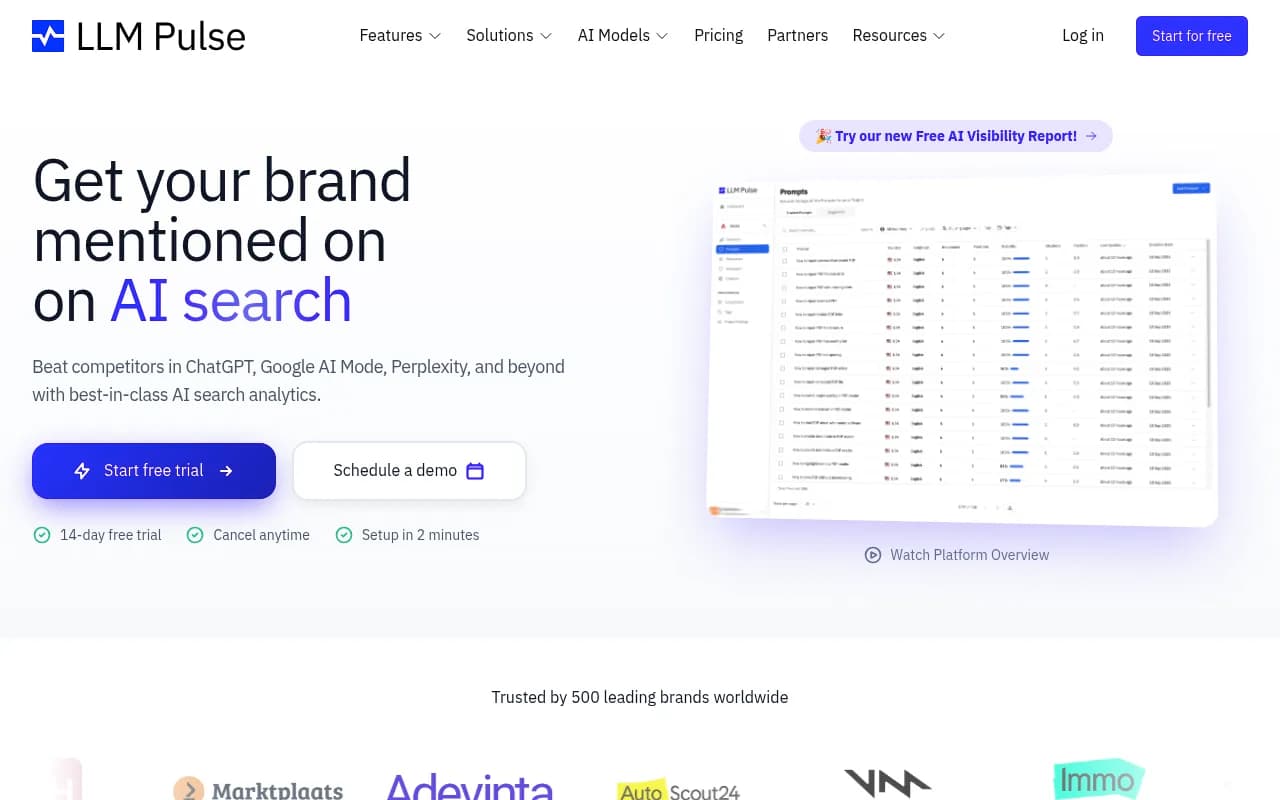
It covers ChatGPT, Perplexity, and a few others, with a reporting layer that shows brand mention frequency and competitive benchmarking. Pricing is in the $50-150/month range depending on the number of prompts and tracked competitors.
LLM Pulse's strength is in its reporting clarity. The dashboards are well-designed and easy to share with stakeholders who need a quick snapshot of AI visibility performance. It's a reasonable choice for content teams or agencies that need to demonstrate AI search presence to clients without a lot of setup complexity.
The limitation is the same as Rankshift: it's a monitoring tool. Once you see the data, you're on your own to figure out what to do with it.
Peec AI
Peec AI has been one of the more talked-about budget options in the GEO space, particularly in communities like r/GEO_AI_SEO. It covers ChatGPT, Perplexity, and Claude, with a starting price around €85/month (roughly $90-95 at current rates).

The platform tracks brand mentions, citation rates, and share of voice, with some competitor analysis built in. It's more polished than some of the cheaper alternatives and has a reasonably active development roadmap.
Where Peec AI stands out slightly from Rankshift and LLM Pulse is in its reporting depth -- you get more granular breakdowns of which prompts are driving visibility and how that changes over time. But it still sits firmly in the monitoring-only camp. There's no content gap analysis, no built-in writing tools, and no traffic attribution to connect AI mentions to actual revenue.
At €85/month for 50 prompts and 3 engines, it's not cheap for what you get. You're paying for cleaner data presentation, not for a path to improvement.
Promptwatch
Promptwatch is the outlier in this comparison. It starts at $99/month (Essential plan: 1 site, 50 prompts, 5 articles) and goes up to $249/month for the Professional plan, which adds crawler logs, 150 prompts, and 15 articles per month.

The core difference from the other three tools is that Promptwatch is built around an action loop, not just a monitoring dashboard. Here's what that means in practice:
- Answer Gap Analysis shows you exactly which prompts your competitors are visible for but you're not -- and what content is missing from your site to close that gap.
- Built-in AI content generation produces articles, listicles, and comparisons grounded in real citation data (Promptwatch has analyzed 880M+ citations). This isn't generic blog content -- it's engineered to get cited by AI models.
- AI Crawler Logs (on Professional and above) show you which pages ChatGPT, Claude, and Perplexity are actually reading, how often they return, and what errors they hit.
- Traffic attribution connects AI visibility to actual website traffic and revenue, via a code snippet, GSC integration, or server log analysis.
It also monitors 10 AI models -- ChatGPT, Perplexity, Google AI Overviews, Google AI Mode, Claude, Gemini, Meta/Llama, DeepSeek, Grok, Mistral, and Copilot -- which is more comprehensive than any of the other three tools in this comparison.
The distinction matters: Rankshift, LLM Pulse, and Peec AI will tell you that you're invisible for a prompt. Promptwatch tells you why, shows you what content would fix it, and then helps you create that content.
Feature comparison
| Feature | Rankshift | LLM Pulse | Peec AI | Promptwatch |
|---|---|---|---|---|
| Starting price | ~$49-99/mo | ~$50-150/mo | ~€85/mo | $99/mo |
| AI engines monitored | 3-4 | 3-4 | 3 | 10 |
| Brand mention tracking | Yes | Yes | Yes | Yes |
| Share of voice / competitor comparison | Yes | Yes | Yes | Yes |
| Answer gap analysis | No | No | No | Yes |
| Content generation | No | No | No | Yes (5-30 articles/mo) |
| AI crawler logs | No | No | No | Yes (Professional+) |
| Traffic attribution | No | No | No | Yes |
| Reddit / YouTube tracking | No | No | No | Yes |
| ChatGPT Shopping tracking | No | No | No | Yes |
| Prompt volume / difficulty scores | No | No | No | Yes |
| Free trial | Varies | Varies | Limited | Yes |
Pricing breakdown
Here's how the four tools compare at the budget tier (under $300/month):
| Tool | Entry plan | Mid plan | What you get |
|---|---|---|---|
| Rankshift | ~$49/mo | ~$99/mo | Brand tracking, basic dashboards |
| LLM Pulse | ~$50/mo | ~$150/mo | Brand tracking, reporting |
| Peec AI | €85/mo (~$93) | €200+/mo | Brand tracking, competitor analysis |
| Promptwatch | $99/mo (Essential) | $249/mo (Professional) | Tracking + gap analysis + content generation + crawler logs |
The pricing is closer than it looks at first glance. Peec AI's entry plan is actually more expensive than Promptwatch's Essential plan when you factor in the euro conversion. And Promptwatch's Professional plan at $249/month includes capabilities that none of the other three offer at any price point.
Who should use which tool
Use Rankshift if...
You're just getting started with AI visibility monitoring and want a simple, affordable way to establish a baseline. If your team is new to GEO and you need to convince stakeholders that AI search matters before committing to a bigger budget, Rankshift gives you enough data to make that case without a large upfront investment.
Use LLM Pulse if...
You need clean, shareable reporting and you're managing multiple clients or stakeholders who need regular snapshots of AI visibility performance. The dashboard design is a genuine strength here. It's also a reasonable choice if you're running a quick competitive audit and don't need ongoing optimization.
Use Peec AI if...
You want slightly more depth in your monitoring data and you're comfortable with the euro pricing. It's a step up from the cheapest options in terms of reporting granularity, and it has a more active community of GEO practitioners around it. Still monitoring-only, but monitoring done reasonably well.
Use Promptwatch if...
You actually want to improve your AI visibility, not just measure it. If you're a marketing team, SEO team, or agency that needs to show results -- not just dashboards -- Promptwatch is the only tool in this group that closes the loop from "we're invisible for this prompt" to "here's the content that will fix it" to "here's the traffic it generated."
It's also the right choice if you need breadth: 10 AI models, crawler logs, Reddit and YouTube tracking, ChatGPT Shopping monitoring, and traffic attribution are capabilities that simply don't exist in the other three tools at any price point.
The monitoring-only problem
It's worth spending a moment on why the monitoring vs. optimization distinction matters so much.
Most teams that buy an AI visibility tool do so because they've noticed that AI search is eating into their organic traffic. They want to understand the problem. But understanding the problem and solving it are two different things.
A monitoring-only tool gives you a number. It tells you that you have 12% share of voice for "best project management software for remote teams" while your competitor has 34%. That's useful context. But it doesn't tell you which pages on your site are being read by AI crawlers, which topics are missing entirely from your content, or what kind of article would actually get cited by Perplexity.
Rankshift, LLM Pulse, and Peec AI all stop at the number. Promptwatch starts there and then shows you the path forward.
For teams with limited time and resources, that difference can be the gap between a tool that sits unused after the first month and one that becomes a core part of the content workflow.
A note on coverage
One practical consideration that often gets overlooked: how many AI engines does the tool actually monitor?
ChatGPT and Perplexity get most of the attention, but Google AI Overviews, Claude, Gemini, Grok, and DeepSeek are all generating meaningful traffic for many brands. A tool that only monitors 3-4 engines is giving you an incomplete picture.
Promptwatch monitors 10 engines. The other three tools in this comparison monitor 3-4. If you're in a category where Google AI Overviews or Gemini drives significant traffic, that gap matters.
Bottom line
All four tools are legitimate options for teams working within a $300/month budget. None of them are scams, and all of them will give you some useful data about your AI search visibility.
But they're not equivalent. Rankshift and LLM Pulse are entry-level trackers that make sense as a starting point or for teams with minimal GEO ambitions. Peec AI is a slightly more polished version of the same thing. Promptwatch is a different category of tool -- one that treats monitoring as the beginning of the workflow, not the end.
If you're serious about improving your brand's visibility in AI search engines (not just measuring it), the $99-249/month range for Promptwatch buys you capabilities that the other three tools can't match at any price. The answer gap analysis and content generation alone tend to pay for themselves quickly once you start seeing which prompts you're losing and what content would win them back.
For teams just dipping their toes in, Rankshift is a reasonable starting point. But most teams outgrow monitoring-only tools faster than they expect.