Key takeaways
- Sitecore officially acquired Scrunch on June 3, 2026, integrating its AI search visibility tools into Sitecore's enterprise digital experience platform.
- The deal is designed for large enterprise brands already running Sitecore's DXP -- not for independent marketing teams, agencies, or SMBs.
- Scrunch's standalone product will likely be absorbed into the Sitecore ecosystem, leaving non-enterprise users without a clear path forward.
- Several independent GEO and AI visibility platforms exist that serve teams of all sizes -- and some go further than Scrunch ever did.
- If you were using Scrunch or evaluating it, now is the time to find an alternative that isn't locked behind an enterprise CMS contract.
What actually happened
On June 3, 2026, Sitecore announced it had acquired Scrunch -- an AI search visibility platform that helped brands understand how they appeared in AI-generated answers from ChatGPT, Perplexity, Google AI Overviews, and similar engines.
The official press release framed it this way: the deal combines Scrunch's "insights, recommendation capabilities, and Agent Experience Platform (AXP) with Sitecore's AI-powered digital experience platform (DXP)." Sitecore CEO Eric Stine said the goal is to help customers "understand how they are represented in AI-generated answers and automatically act on those insights."

That's a reasonable pitch. AI search has genuinely changed how buyers research and make decisions. Brands that don't appear in AI-generated answers are effectively invisible during a critical part of the buying journey. Scrunch was building tools to address exactly that problem.
But here's the thing: Sitecore is an enterprise CMS. Its customers are large organizations running complex digital experience stacks. The acquisition makes perfect sense for that audience. For everyone else -- the mid-market marketing team, the digital agency, the SaaS startup -- it's essentially a product being moved behind a velvet rope.

Why Sitecore wanted Scrunch
To understand the acquisition, you have to understand what Sitecore is trying to do.
Sitecore has spent years positioning itself as a composable DXP -- a platform that manages content, personalization, and digital experience across channels. The problem is that "channels" now includes AI search engines, and Sitecore didn't have native tools for that.
Scrunch filled the gap. It could show brands where their messaging was appearing, missing, or misrepresented in AI-driven discovery. Combined with Sitecore's content publishing and personalization capabilities, the pitch becomes: we don't just show you where you're invisible in AI search, we help you publish content that fixes it.
Sitecore's Stine put it plainly: "The internet must be written for machines to understand if we want humans to experience it." That's a solid framing of the GEO problem, and Scrunch gave Sitecore a credible answer to it.
For Sitecore's enterprise customers, this is genuinely useful. They're already paying for the DXP, already have content teams, already have brand guidelines baked into their tech stack. Adding AI visibility monitoring on top of that is a logical extension.
What this means for Scrunch's existing users
This is where things get uncomfortable.
Scrunch was a standalone product. People were using it independently of Sitecore -- agencies tracking client visibility, marketing teams monitoring how their brand appeared in ChatGPT, SEO professionals trying to understand AI citation patterns. None of those users necessarily have a Sitecore contract, and most of them aren't going to get one.
When a standalone tool gets acquired by an enterprise platform, the trajectory is usually one of three things:
- The product continues as a standalone offering (rare, and usually temporary)
- The product gets folded into the acquiring platform and is only accessible to existing customers
- The product gets deprecated in favor of rebuilding the features natively
Sitecore's press release doesn't promise continued standalone access. The language is entirely about combining Scrunch with Sitecore's DXP to serve Sitecore customers. That's not a coincidence.
If you were a Scrunch user who isn't a Sitecore customer, the practical advice is simple: start evaluating alternatives now, before any access changes happen.
The broader problem this exposes
The Scrunch acquisition is a useful lens for a bigger issue in the GEO and AI visibility space: a lot of the tools that exist are either monitoring-only dashboards or enterprise products that require a significant commitment to access.
Most teams don't need an enterprise DXP. They need to know which prompts their competitors are showing up for, which pages are being cited by AI engines, and what content they should create to close those gaps. That's a focused, actionable problem -- and it doesn't require a six-figure software contract.
The monitoring-only problem is just as real. Several platforms in this space will show you a dashboard of where your brand appears in AI answers, then leave you to figure out what to do about it. That's useful data, but it's not a strategy.
What to look for in a Scrunch alternative
If you're evaluating replacements, here are the things that actually matter:
Coverage across AI engines. Scrunch tracked brand visibility across multiple LLMs. Any replacement should cover at least ChatGPT, Perplexity, Google AI Overviews, Gemini, and Claude -- ideally more.
Prompt-level data. You want to know which specific prompts are driving visibility for your competitors, not just aggregate scores. Volume estimates and difficulty scores help you prioritize.
Content gap analysis. The real value isn't knowing you're invisible -- it's knowing exactly what content you need to create to become visible. Tools that identify specific gaps and help you act on them are worth far more than pure monitoring.
Crawler and citation tracking. Understanding which pages AI engines are actually reading (and which ones they're ignoring) is different from knowing which pages get cited. Both matter.
Not locked behind an enterprise platform. This is the Scrunch lesson. If a tool requires you to buy into a larger ecosystem to access it, you're exposed to exactly this kind of acquisition risk.
The best alternatives to Scrunch in 2026
Here's how the main options compare:
| Tool | AI engines covered | Content generation | Crawler logs | Pricing model | Best for |
|---|---|---|---|---|---|
| Promptwatch | 10+ | Yes (Content Agents) | Yes | From $99/mo | Teams that want to monitor and fix gaps |
| Profound | 9+ | No | No | Enterprise | Large brands, monitoring focus |
| AthenaHQ | Multiple | No | No | Mid-market | Monitoring and reporting |
| Otterly.AI | 5+ | No | No | From ~$99/mo | Basic monitoring |
| Peec AI | Multiple | No | No | SMB-friendly | Simple tracking |
| SE Visible | Multiple | No | No | Add-on to SE Ranking | SE Ranking customers |
The standout difference in this table is content generation. Most platforms show you the problem. Promptwatch is one of the few that also helps you fix it -- its Content Agents generate articles, listicles, and briefs grounded in real prompt data and citation analysis, then tracks whether those pages start getting cited after publication.

That end-to-end loop -- find gaps, create content, track results -- is what separates an optimization platform from a monitoring dashboard. Given that Scrunch was acquired specifically because Sitecore wanted to close that loop for enterprise customers, it's worth finding a tool that closes it for everyone else.
Promptwatch
Promptwatch tracks visibility across 10 AI models including ChatGPT, Perplexity, Google AI Overviews, Claude, Gemini, Grok, DeepSeek, and Copilot. Its Answer Gap Analysis shows exactly which prompts competitors rank for that you don't -- with specific content recommendations, not just a gap score. The AI crawler logs show which pages AI engines are reading, how often they return, and when a page moves from crawl to citation. Pricing starts at $99/month for a single site with 50 prompts.
Profound
Profound covers 9+ AI engines and has solid enterprise-grade reporting. It's a monitoring platform -- you get good data on where your brand appears, but the action layer is limited. Pricing is enterprise-oriented, which makes it a reasonable Scrunch replacement for large brands but not for smaller teams.
Profound

AthenaHQ
AthenaHQ is focused on monitoring and competitive analysis across AI search engines. It's well-built for tracking share of voice and understanding how AI models represent your brand. Like Profound, it stops short of content generation or optimization guidance.

Otterly.AI
Otterly.AI is a solid entry-level option for teams that primarily want to track brand mentions across ChatGPT, Perplexity, and Google AI Overviews. The interface is clean and accessible. It doesn't have crawler logs or content generation, but for basic monitoring it's functional and reasonably priced.
Otterly.AI

Peec AI
Peec AI is worth considering for smaller teams that want straightforward AI visibility tracking without a lot of complexity. Coverage is decent, the setup is fast, and it doesn't require an enterprise commitment.

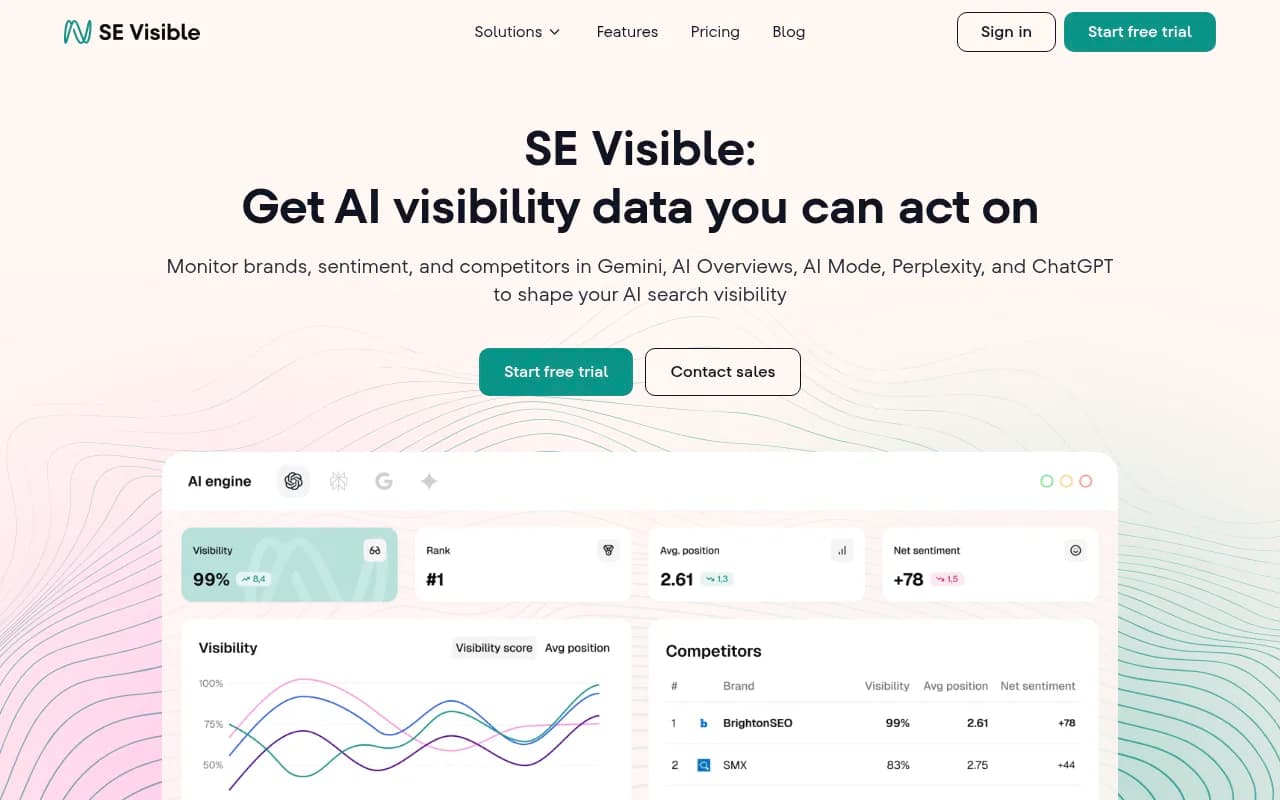
SE Visible (by SE Ranking)
SE Visible is SE Ranking's AI visibility add-on. If you're already an SE Ranking customer, it's a natural extension. If you're not, it's harder to justify adopting an entire SEO platform just for the AI visibility features.
A note on the enterprise consolidation trend
The Scrunch acquisition isn't an isolated event. It's part of a pattern where AI visibility capabilities are getting absorbed into larger platforms -- Adobe, Sitecore, and others are all moving to bundle these tools into their existing enterprise stacks.
That's fine for enterprise customers. But it creates a real gap for everyone else. The teams that most need AI visibility tools -- growing brands, digital agencies, mid-market companies trying to compete with larger players -- are exactly the ones being left out of these enterprise bundles.
The good news is that the independent GEO platform market is maturing quickly. Tools that were basic monitoring dashboards a year ago have added content generation, crawler analytics, and competitive intelligence. The category is genuinely useful now, not just theoretically interesting.
The practical takeaway: don't wait for your current tool to get acquired before you evaluate what's available. The Scrunch situation is a reminder that standalone AI visibility tools can disappear into enterprise ecosystems with relatively little warning.
What to do right now
If you were using Scrunch: check whether your access is still active and what Sitecore's transition timeline looks like. Start a trial with at least one alternative so you're not caught without coverage.
If you were evaluating Scrunch: cross it off the list for now. The product roadmap is Sitecore's to determine, and it will be shaped by enterprise customer needs, not yours.
If you're starting fresh: the table above is a reasonable starting point. The key question to ask any platform is whether it helps you act on what you find, or just shows you a dashboard. Monitoring is table stakes. The platforms worth paying for are the ones that help you close the gap between "we're invisible in AI search" and "we're getting cited."
The Sitecore-Scrunch deal is a good outcome for Sitecore. For independent marketing teams, it's a signal to build on platforms that aren't going anywhere -- or at least aren't going enterprise.