Key takeaways
- Otterly.AI is a solid entry point for AI visibility monitoring, but its pricing jumps steeply ($29 → $189 → $989/mo) and it offers no guidance on what to change when you're missing from AI responses.
- Answer gap analysis — knowing which prompts competitors rank for that you don't — is the feature that separates useful tools from dashboards you check and forget.
- The best alternatives split into two camps: full-stack platforms that track and help you fix gaps, and focused analytics tools for clean reporting without the action layer.
- If your goal is to actively improve AI citations rather than just monitor them, look for tools with content generation, crawler logs, and prompt-level gap data.
- Promptwatch is the only platform in this comparison rated as a leader across all categories, combining gap analysis, AI content generation, and crawler-level attribution in one place.
There's a frustrating pattern with AI visibility tools. You set up your prompts, connect your brand, and wait for the dashboard to populate. Then it does — and you're staring at a number. You appeared in 4 out of 10 ChatGPT responses this week. Your competitor appeared in 8.
Now what?
That's the question Otterly.AI doesn't answer. It's a monitoring tool. It shows you the score, not the playbook. And as AI search has become a real acquisition channel for brands in 2026, "knowing your score" without knowing how to improve it is increasingly hard to justify at $189 or $989 per month.
This guide covers 8 alternatives that go further — specifically tools with some form of answer gap analysis, content gap identification, or actionable optimization built in. Not just dashboards.
Why teams outgrow Otterly.AI
Otterly helped put AI visibility tracking on the map. It's easy to set up, covers the major platforms, and the $29/month entry tier is genuinely accessible. But a few friction points come up repeatedly when teams try to use it seriously:
The pricing structure is punishing. You get 10 prompts on the $29 plan — barely enough to test. Moving to 100 prompts costs $189/month, a 550% jump. The Pro tier at $989/month is enterprise territory without enterprise features.
Platform coverage has gaps. Claude isn't tracked at all on self-serve plans. Gemini and Google AI Mode are paid add-ons. If you're trying to understand your full AI search presence, you're already paying more than the headline price suggests.
The actionability problem is the real one. As one Reddit user put it: "It tracks the source, but gives zero actionable strategy on how to restructure content to get cited." You can see you're missing from 7 out of 10 responses. You can't see why, or what to write to fix it.
For teams that just want a lightweight monitor, Otterly is fine. For teams that want to actually move the needle on AI citations, it's not enough.
What answer gap analysis actually means
Before getting into the tools, it's worth being specific about what "answer gap analysis" means in this context, because different tools use the term differently.
At its most basic, it means: here are the prompts where your competitors appear in AI responses and you don't. That's useful. You know what ground you're losing.
At its most useful, it means: here are those prompts, here's what content the AI is citing when it answers them, here's what's missing from your site, and here's a brief (or draft) to fill the gap. That's actionable.
Most tools in this space are closer to the first definition. A few are genuinely close to the second. The table below shows where each tool lands.
The 8 best Otterly.AI alternatives in 2026
1. Promptwatch
Promptwatch is the most complete option in this comparison. Where most tools stop at monitoring, Promptwatch is built around a three-step loop: find gaps, create content, track results.

The Answer Gap Analysis feature shows exactly which prompts competitors are visible for that you're not — and then connects that directly to content creation. Content Agents generate articles, listicles, comparisons, and briefs grounded in real prompt data, citation data, and competitor analysis. This isn't generic AI writing — it's content engineered to answer the specific gaps AI models are already exposing on your site.
What makes it genuinely different from the rest of this list is the AI Crawler Logs feature. You get real-time logs of AI crawlers (ChatGPT, Claude, Perplexity) hitting your website — which pages they read, errors they encounter, and when pages move from crawl to citation. Most competitors don't have this at all. It's the difference between guessing why you're not being cited and actually diagnosing it.
Promptwatch also tracks 10 AI models (including Google AI Mode, DeepSeek, Grok, and Mistral), has Reddit and YouTube citation tracking, ChatGPT Shopping monitoring, and connects to Cloudflare, Vercel, and Google Search Console for attribution data.
Pricing starts at $99/month (Essential: 1 site, 50 prompts, 5 articles), with Professional at $249/month and Business at $579/month. Free trial available.
Best for: Marketing and SEO teams that want to move from monitoring to actually improving AI search visibility.
2. AIclicks
AIclicks takes a keyword-based tracking approach rather than Otterly's prompt-based system, which some teams find more intuitive — especially those coming from traditional SEO workflows. The platform covers the major AI engines and includes visibility scoring with some content guidance.
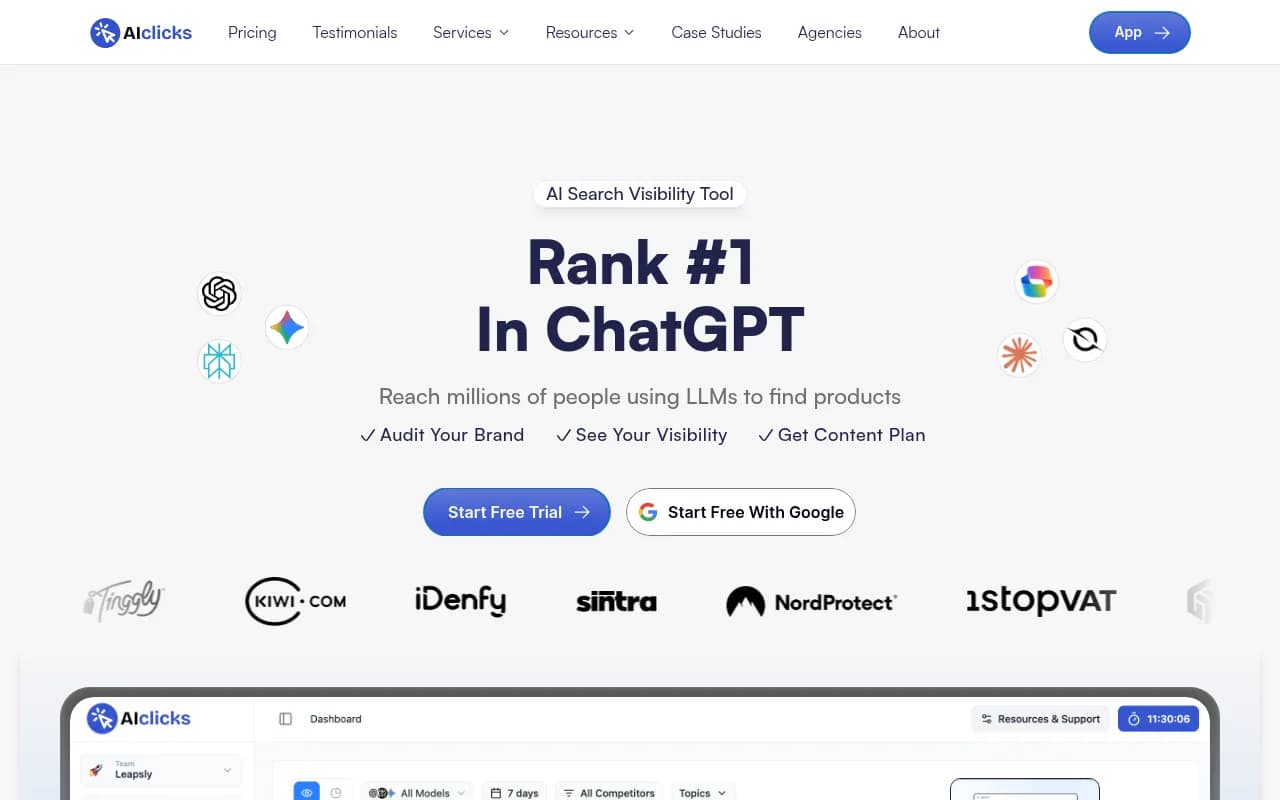
It's positioned as a full-stack platform connecting tracking to action, though the content generation capabilities are less developed than Promptwatch's. The interface is clean and the reporting is solid for mid-market teams.
Best for: Teams that find prompt-based tracking too limiting and want a keyword-oriented approach to AI visibility.
3. AthenaHQ
AthenaHQ is built for enterprise and ecommerce teams that need AI visibility tied to revenue metrics. It has strong analytics and competitive benchmarking, and it's one of the more polished tools in the space for reporting upward to leadership.

The gap analysis is present but the content optimization layer is thinner than you'd want for a full GEO workflow. It's better at telling you where you're losing than helping you fix it. That said, for teams with a separate content operation that just needs better data, it's a strong choice.
Best for: Enterprise teams and ecommerce brands that need AI visibility data connected to revenue reporting.
4. Semrush
Semrush added AI search monitoring to its platform and it's worth considering if your team is already inside the Semrush ecosystem. The advantage is obvious: you're not adding another tool, and you can see traditional SEO and AI visibility data side by side.
The limitation is that Semrush uses fixed prompt sets rather than custom prompts, which means you're tracking what Semrush decides to track rather than the specific queries your customers actually use. There's also no AI traffic attribution. For teams that need depth on AI search specifically, it's a supplement rather than a primary tool.
Best for: Teams already using Semrush who want basic AI visibility data without adding a new platform.
5. SE Ranking
SE Ranking's AI visibility module (SE Visible) sits inside a broader SEO platform, making it attractive for budget-conscious agencies that want SEO and AI monitoring in one place. The pricing is more accessible than most dedicated AI visibility tools.
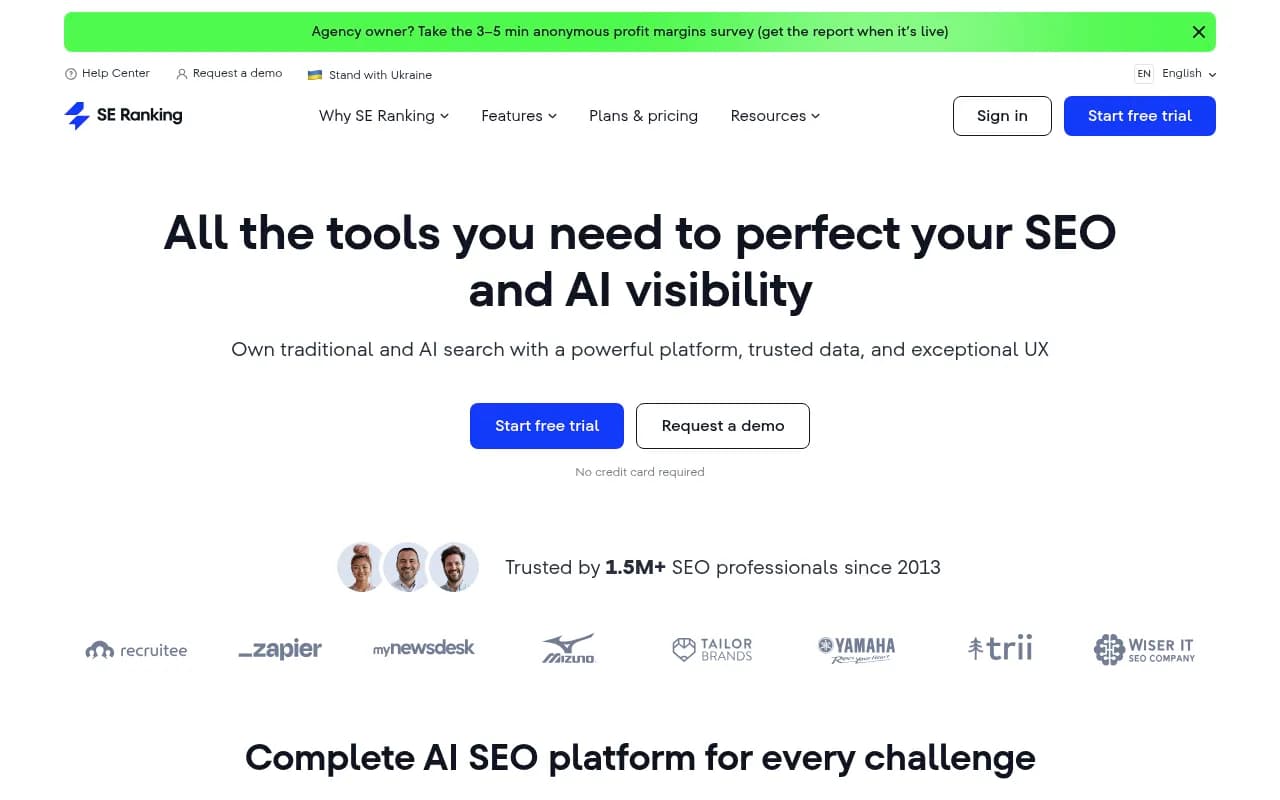
The tradeoff is depth. SE Visible is a monitoring layer, not an optimization layer. You get brand mention tracking across AI engines, but the gap analysis and content guidance are limited. It's a reasonable starting point for smaller agencies that aren't ready to invest in a dedicated GEO platform.
Best for: Budget-conscious agencies that want AI monitoring bundled with their existing SEO toolset.
6. Peec AI
Peec AI is a focused analytics tool — clean interface, precise data, good for teams that want AI visibility reporting without a lot of noise. It covers the major AI engines and provides competitive benchmarking.

It sits firmly in the monitoring camp. There's no content generation, no crawler logs, and limited gap analysis. But if your team has a separate content workflow and just needs reliable AI visibility data to inform it, Peec AI delivers that without the complexity of a full-stack platform.
Best for: Mid-market teams that want clean, precise AI analytics and handle content optimization separately.
7. Rankability
Rankability is built for SEO agencies running the full content lifecycle alongside AI tracking. It combines content optimization tools with AI visibility monitoring, which makes it one of the more actionable options on this list for agencies that already have a content-heavy workflow.
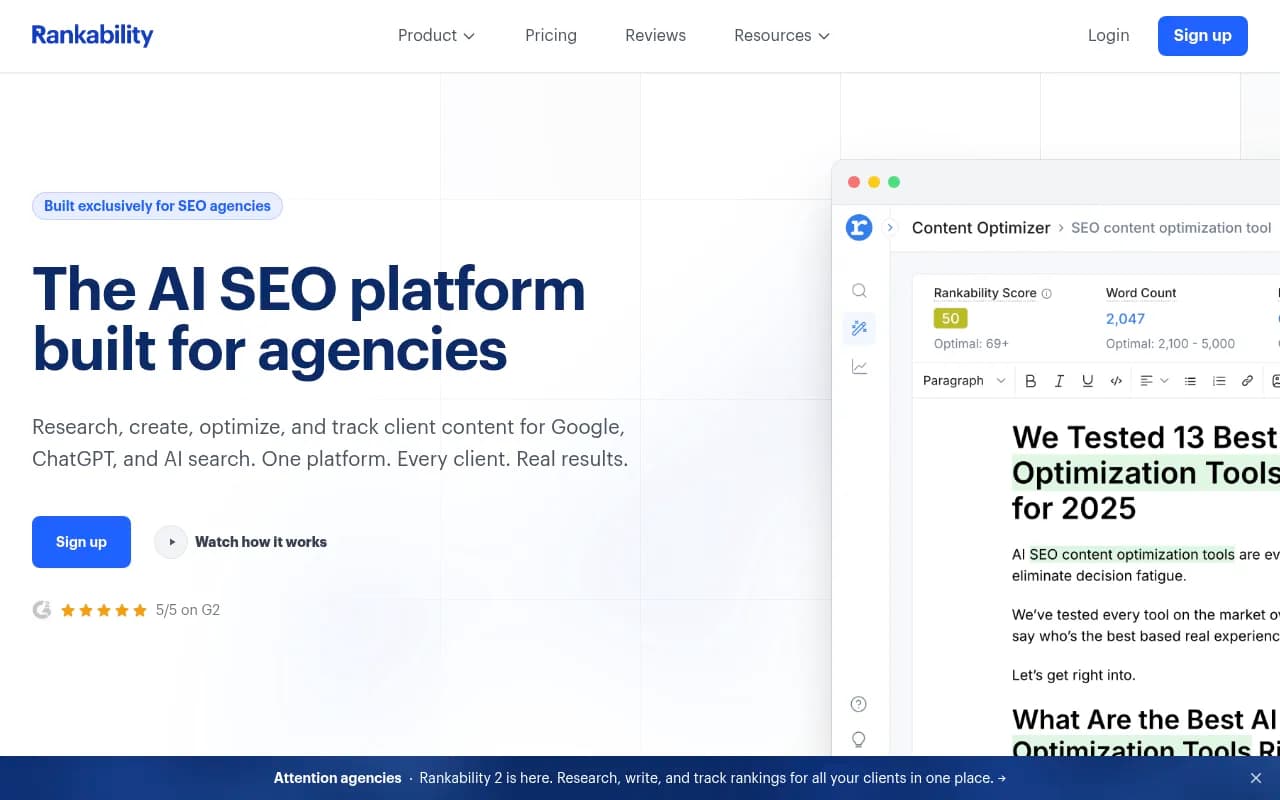
The AI visibility features are newer than the core SEO tools, so the depth isn't quite at the level of dedicated GEO platforms. But for agencies that want to run content briefs, optimization, and AI tracking from one place, it's worth evaluating.
Best for: SEO agencies that want to run content optimization and AI visibility tracking from a single platform.
8. ZipTie
ZipTie positions itself specifically around bridging the gap between "what's happening" and "what to do about it" — identifying content gaps and providing direction on how to address them. It's one of the more GEO-native tools in this list, built from the ground up for AI search rather than adapted from traditional SEO.
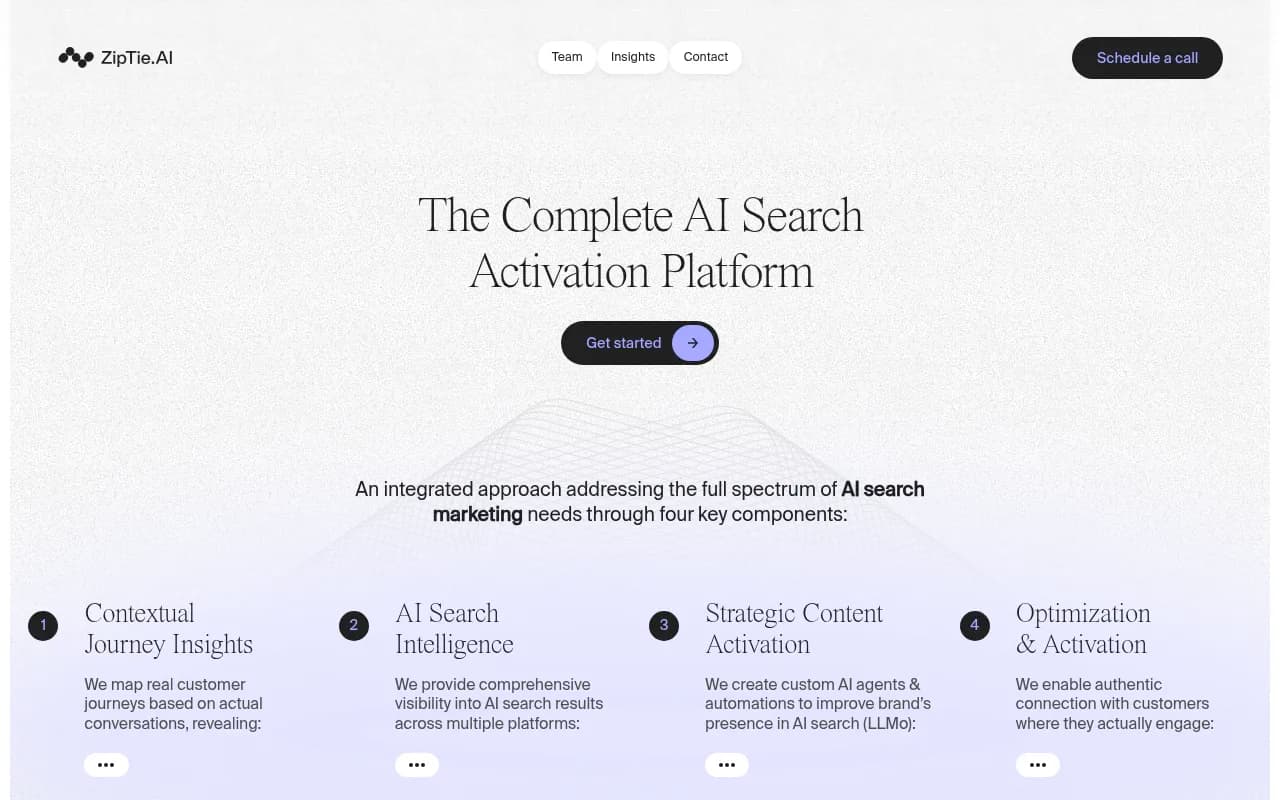
The platform is still maturing compared to more established players, but the gap analysis approach is thoughtful and the interface is built for teams that want to act on data rather than just report it.
Best for: GEO-focused teams that want a purpose-built tool for AI search optimization rather than an adapted SEO platform.
Comparison table
| Tool | Answer gap analysis | Content generation | Crawler logs | AI models tracked | Starting price |
|---|---|---|---|---|---|
| Promptwatch | Yes (deep) | Yes (Content Agents) | Yes | 10+ | $99/mo |
| AIclicks | Partial | Limited | No | Major engines | Custom |
| AthenaHQ | Yes | No | No | Major engines | Custom |
| Semrush | No (fixed prompts) | No | No | Limited | Add-on |
| SE Ranking | No | No | No | Major engines | Add-on |
| Peec AI | Partial | No | No | Major engines | Custom |
| Rankability | Partial | Yes (SEO-focused) | No | Limited | Custom |
| ZipTie | Yes | Partial | No | Major engines | Custom |
| Otterly.AI | No | No | No | 4 core (add-ons for more) | $29/mo |
How to choose
The right tool depends on what you're actually trying to do.
If you're just starting out and want to understand where your brand shows up in AI responses, Otterly.AI or Peec AI will get you there without a large investment. The data is real and the setup is fast.
If you're at the stage where you're looking at your visibility data and asking "now what?" — that's when you need a tool with gap analysis and content capabilities. Promptwatch is the most complete option here, particularly if you want to understand not just which prompts you're missing but why, and what to write to fix it. The crawler logs alone are a feature most competitors simply don't have.
If you're an agency running AI visibility alongside traditional SEO, SE Ranking or Rankability let you consolidate tooling. The AI visibility depth is lower, but the operational simplicity of one platform can be worth it.
If you're enterprise and need revenue attribution tied to AI visibility, AthenaHQ is worth a serious look.
One thing worth keeping in mind: visibility data is only worth paying for if it tells you what to do next. A dashboard that shows you a score without showing you how to improve it is hard to justify at $200-$1000/month. That action layer — gap analysis, content briefs, content generation, crawler diagnostics — is what separates tools that move the needle from tools that just report on it.
The bottom line
Otterly.AI is a fine monitoring tool. It's not an optimization tool. If your goal is to understand your AI search presence at a surface level, it works. If your goal is to actually improve it — to earn more citations, appear in more responses, and turn AI search into a real acquisition channel — you need something that goes further.
The tools on this list all go further in different ways. Promptwatch goes furthest, particularly on the gap analysis and content generation side. The others offer varying combinations of depth, simplicity, and price depending on what your team actually needs.
The question to ask before choosing: do you want to know your score, or do you want to improve it?