Key takeaways
- Otterly.AI is a solid entry-level AI visibility monitor -- good for tracking brand mentions across ChatGPT, Perplexity, and Google AI Overviews, with a clean interface and low barrier to entry.
- Its biggest limitation is that it stops at monitoring. There's no content gap analysis, no AI content generation, no crawler logs, and no traffic attribution.
- Pricing ranges from $29/month (Lite) to $489/month (Premium), which looks affordable until you realize the prompt limits are tight and the feature ceiling is low.
- Teams that need to actually improve their AI visibility -- not just observe it -- will outgrow Otterly quickly.
- Better alternatives exist depending on your use case: Promptwatch for full-cycle GEO optimization, Profound for enterprise monitoring, and a handful of lighter options for budget-conscious teams.
What is Otterly.AI?
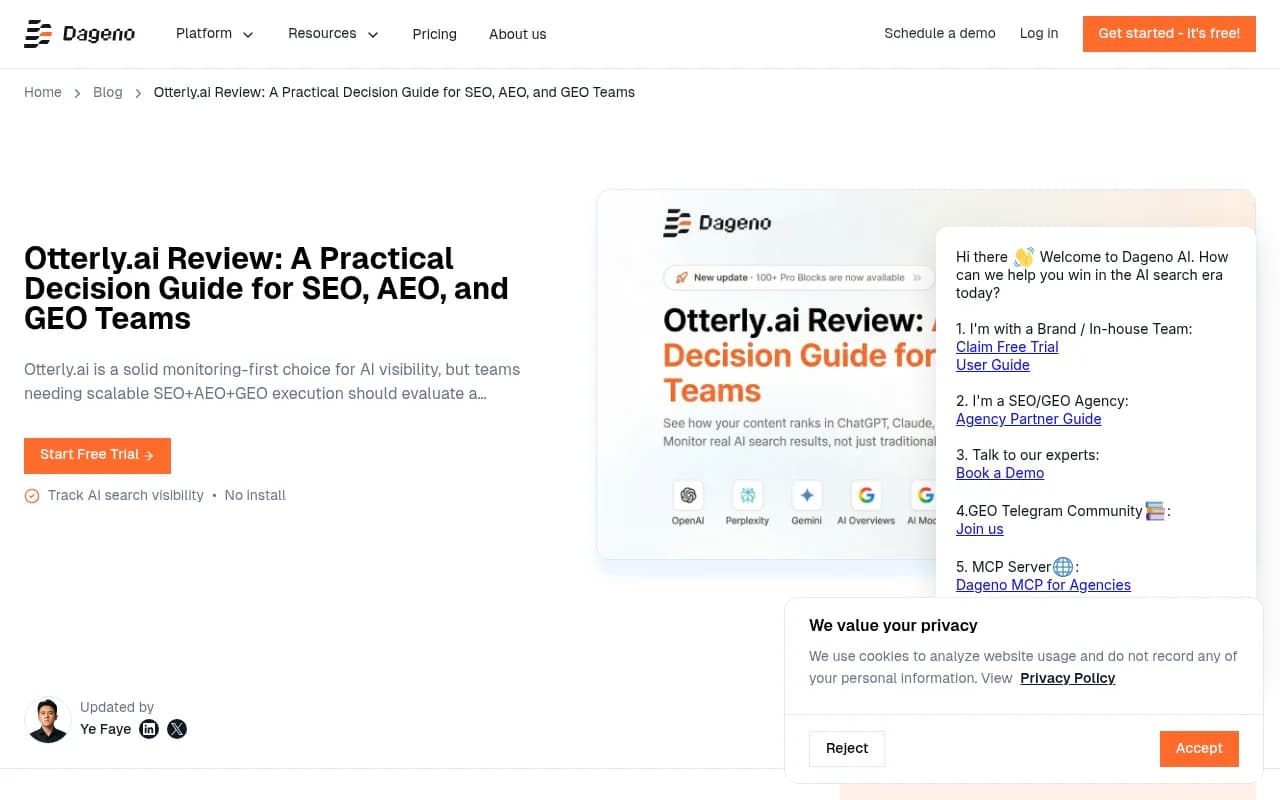
Otterly.AI is an AI search visibility monitoring platform. The core idea is simple: you add prompts (questions your customers might ask AI engines), and Otterly tracks whether your brand appears in the responses from ChatGPT, Perplexity, Google AI Overviews, and a few other models.
It launched at a time when most marketing teams were asking "wait, are we even showing up in AI search?" -- and it answered that question cleanly. The onboarding is fast, the interface is readable, and you can get your first visibility report within minutes of signing up.
That's genuinely useful. But the question for 2026 is whether "showing up in AI search" monitoring is enough, or whether you need a platform that helps you do something about the gaps it finds.
What Otterly.AI actually does well
Let's be fair before getting critical. Otterly has real strengths, and for certain use cases it's a reasonable choice.
Brand mention and sentiment tracking
Otterly tracks whether your brand appears in AI-generated responses, and it adds sentiment context -- positive, neutral, or negative. For PR teams and brand managers who just want a pulse on how AI engines are talking about them, this is genuinely useful.
Prompt-level visibility diagnostics
You can see which specific prompts your brand appears in and which ones you're missing. This is the core feature, and it works. The data is clear and the interface doesn't bury you in noise.
Competitor comparisons
Otterly lets you track competitor visibility alongside your own. You can see whether a competitor is appearing in responses where you're not -- which at least tells you the gap exists, even if it doesn't tell you how to close it.
Low friction onboarding
This is worth mentioning because some GEO tools have painful setup processes. Otterly doesn't. You can be up and running in under 10 minutes, which matters if you're evaluating tools and want to see value quickly.
Unlimited team members
On all plans, Otterly doesn't charge per seat. For agencies or larger teams sharing access, that's a real advantage over tools that nickel-and-dime on users.
Otterly.AI pricing breakdown
Otterly's pricing is one of its selling points -- at least on paper.
| Plan | Price | Prompts | Key features |
|---|---|---|---|
| Lite | $29/month | ~20 prompts | Basic tracking, limited models |
| Standard | $189/month | ~100 prompts | More models, competitor tracking |
| Premium | $489/month | ~300 prompts | Full model coverage, priority support |
The Lite plan at $29/month is genuinely cheap for a first look. But 20 prompts covers almost nothing for a real business. You'll hit the ceiling fast and find yourself on Standard at $189/month -- which is where the real evaluation begins.
At $189/month, you're paying for monitoring only. No content generation, no crawler logs, no traffic attribution. Compare that to platforms that offer the full optimization loop at comparable price points, and the value proposition starts to look thinner.
The Premium tier at $489/month is where it gets hard to justify. At that price, you're still getting a monitoring dashboard -- just with more prompts and more models covered. Teams spending that much on AI visibility tooling should probably be asking whether they want a tracker or a platform that helps them actually rank.
The real limitations of Otterly.AI
This is where most reviews go soft. They list the features, note a few "areas for improvement," and move on. Let's be more direct.
It stops at monitoring
Otterly shows you where you're invisible. It does not help you fix it. There's no answer gap analysis that maps your content against what AI models are actually citing. There's no content generation. There's no brief builder. You get the diagnosis but no treatment.
For a team that already has strong content operations and just needs visibility data to feed into their workflow, this might be fine. For everyone else, it's a frustrating ceiling.
No AI crawler logs
This is a significant gap in 2026. Understanding which pages AI crawlers are actually visiting -- and how often -- is increasingly important for GEO. Otterly doesn't surface this data at all. You can't see whether GPTBot has crawled your new article, whether there are crawl errors blocking indexing, or when a page moves from "crawled" to "cited."
No traffic attribution
Otterly tracks visibility in AI responses. It doesn't connect that visibility to actual website traffic or revenue. So you might be appearing in 40% of ChatGPT responses for a given prompt -- but you have no idea if that's driving clicks, leads, or sales. That's a meaningful blind spot for any team that needs to justify the spend.
Prompt limits feel tight
Even on Standard, 100 prompts sounds reasonable until you start mapping out the actual question space for a real business. A mid-size SaaS company with multiple product lines and buyer personas can easily need 200-300 prompts to get meaningful coverage. The limits push you toward Premium faster than the pricing page suggests.
API-based data concerns
Several independent reviewers have raised questions about whether Otterly's data reflects what real users actually see in AI interfaces. AI search results can differ between API calls and real user sessions -- especially for personalized or location-aware responses. This isn't unique to Otterly, but it's worth knowing.
Who Otterly.AI is actually right for
Despite the limitations, there are real use cases where Otterly makes sense:
- Small teams or solo marketers who want a low-cost way to start tracking AI visibility without committing to a full GEO platform
- PR and communications teams who primarily care about brand sentiment in AI responses, not optimization
- Agencies doing initial audits for clients who want a quick snapshot before recommending a deeper solution
- Teams in early-stage GEO programs who are still building internal buy-in and need simple, readable reports
If you fit one of those profiles, Otterly is a reasonable starting point. Just go in knowing you'll probably outgrow it.
Better alternatives in 2026
The GEO tool market has matured significantly. Here's how the main alternatives stack up.
Promptwatch -- for teams that want to actually rank, not just track
Promptwatch is the most complete option if your goal is improving AI visibility, not just measuring it. The difference is the action loop: find the gaps, create content that fills them, track the results.
The Answer Gap Analysis shows exactly which prompts competitors are visible for but you're not -- and maps that to specific content your site is missing. Content Agents then generate articles, listicles, and comparisons grounded in real prompt data and citation analysis. Page-level tracking shows which pages are being cited, by which models, and how often. AI Crawler Logs show you exactly when GPTBot, ClaudeBot, and Perplexity's crawler visit your pages and when those visits convert to citations.
It also covers things Otterly doesn't touch at all: Reddit and YouTube insights, ChatGPT Shopping tracking, query fan-outs, prompt volume and difficulty scores, and traffic attribution that connects AI visibility to actual revenue.
Pricing starts at $99/month for the Essential plan (1 site, 50 prompts, 5 articles), $249/month for Professional (2 sites, 150 prompts, 15 articles, crawler logs), and $579/month for Business (5 sites, 350 prompts, 30 articles).

Profound -- for enterprise monitoring
Profound has a strong feature set for large organizations that need deep monitoring across many AI models. It's more expensive than Otterly and doesn't have content generation, but the data quality and enterprise integrations are solid. Worth evaluating if you're at a Fortune 500 and monitoring is genuinely the primary use case.
Profound

AthenaHQ -- monitoring-focused alternative
AthenaHQ is another monitoring-first platform. It's comparable to Otterly in terms of what it does, with some differences in UI and model coverage. One review noted that Otterly gives better entry-level value because its plans start lower and include unlimited team members -- so AthenaHQ's main advantage is in specific enterprise features rather than price.

Peec AI -- lightweight tracking
Peec AI is a simpler, lighter option for teams that want basic AI search visibility tracking without a lot of complexity. It's monitoring-only like Otterly, but the interface is clean and the price point is accessible.

Scrunch AI -- mid-market option
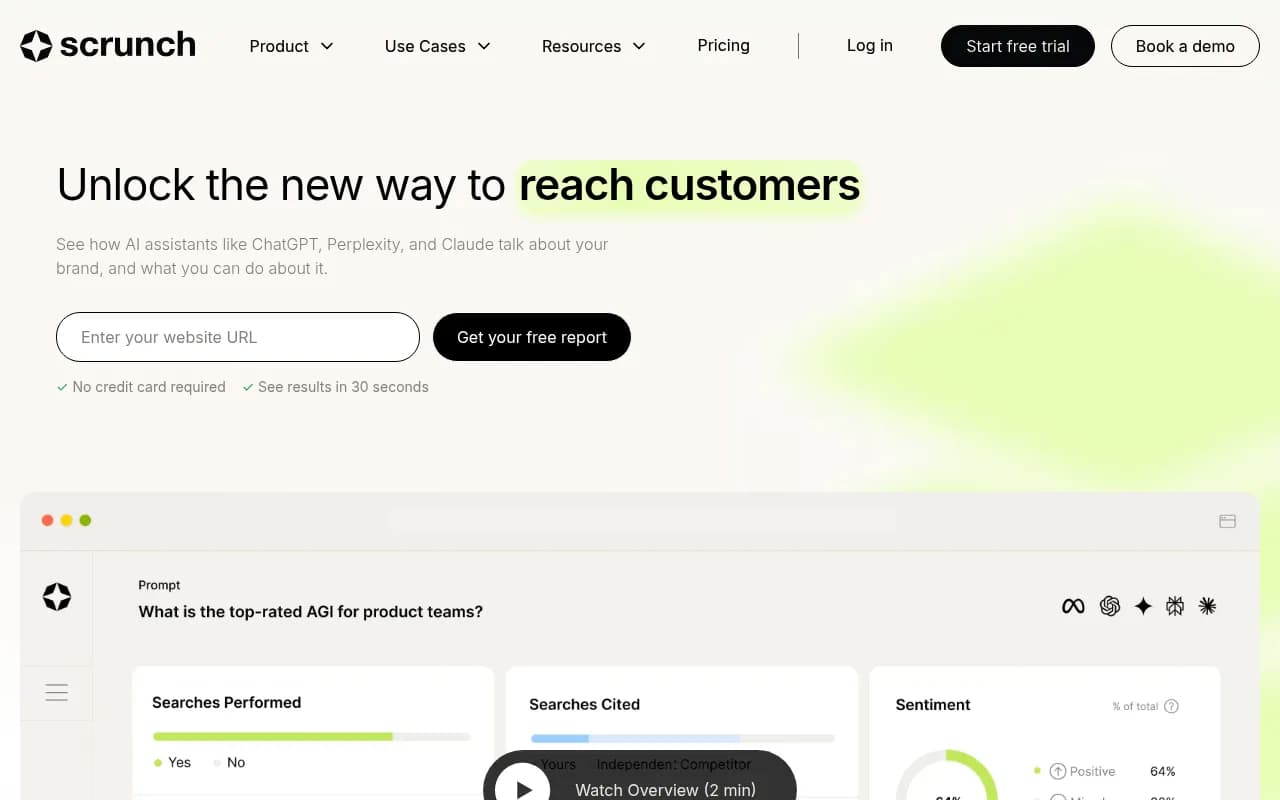
Scrunch sits between the lightweight trackers and the full-platform options. It covers more than basic monitoring but still doesn't close the loop on content optimization the way Promptwatch does.
Full comparison: Otterly.AI vs the main alternatives
| Tool | Starting price | Prompt tracking | Content generation | Crawler logs | Traffic attribution | Best for |
|---|---|---|---|---|---|---|
| Otterly.AI | $29/mo | Yes | No | No | No | Entry-level monitoring |
| Promptwatch | $99/mo | Yes | Yes | Yes | Yes | Full GEO optimization |
| Profound | Custom | Yes | No | No | No | Enterprise monitoring |
| AthenaHQ | Higher | Yes | No | No | No | Mid-market monitoring |
| Peec AI | Low | Yes | No | No | No | Lightweight tracking |
| Scrunch AI | Mid | Yes | Limited | No | No | Mid-market tracking |
The pattern is clear: most tools in this space are monitoring dashboards. Promptwatch is the exception -- it's built around the full cycle from gap identification to content creation to result tracking.
The monitoring-only problem
Here's the honest framing for 2026: knowing you're invisible in AI search is only useful if you can do something about it.
The GEO tools that launched in 2024 and early 2025 were mostly built around the question "are we showing up?" That was the right question then. The market has moved. The question now is "how do we show up more, for more prompts, in more models?" -- and that requires a different kind of tool.
Otterly answers the first question reasonably well. It doesn't answer the second one at all.
If you're evaluating tools right now, the decision point is whether you're in "awareness" mode (just starting to understand your AI visibility) or "optimization" mode (actively trying to improve it). Otterly fits the first. For the second, you need something that closes the loop.
Final verdict
Otterly.AI is a clean, accessible AI visibility monitor. It does what it says on the tin: tracks brand mentions across major AI engines, surfaces sentiment, and shows you where competitors are appearing that you're not.
For $29/month, it's a reasonable way to dip your toes into GEO tracking. For $189-489/month, the value proposition gets harder to defend when full-cycle platforms exist at comparable price points.
The ceiling is the problem. Teams that take AI visibility seriously will hit it within a few months -- and then face the choice of staying with a monitoring-only tool or switching to something that actually helps them rank. Building that switch into your evaluation now saves you the migration pain later.
If you're just starting out and want a simple snapshot, Otterly works. If you want to actually move the needle on your AI search visibility, start with a platform built around optimization, not just observation.