Key takeaways
- Otterly.AI is one of the more accessible entry points into GEO monitoring, starting at $29/month, and won Best AI Search Analytics Software at the European Search Awards 2026.
- It covers the core monitoring pillars well: prompt tracking, citation analysis, multi-engine coverage, and a unique MCP server integration.
- Where it falls short: content generation, AI crawler logs (still in beta), and visitor analytics are limited or missing.
- Promptwatch is the only platform in this comparison that closes the full loop — from finding visibility gaps to generating content to tracking results.
- The right tool depends on what you actually need: pure monitoring, enterprise analytics, or an end-to-end optimization workflow.
The GEO platform market has gotten crowded fast. In early 2025, there were maybe five or six tools worth evaluating. By mid-2026, there are closer to thirty, and most of them look similar at first glance: dashboards, prompt tracking, some kind of brand mention counter.
Otterly.AI sits in an interesting position in this space. It's not the cheapest option, but it's far from the most expensive. It's not the most feature-rich, but it's won real industry recognition. And it's clearly built by people who understand what GEO practitioners actually need day-to-day.
This guide breaks down how Otterly.AI compares to the strongest alternatives in 2026 -- Promptwatch, Profound, Peec.ai, AthenaHQ, Semrush, and a few others -- across the features that actually matter.
What Otterly.AI actually does
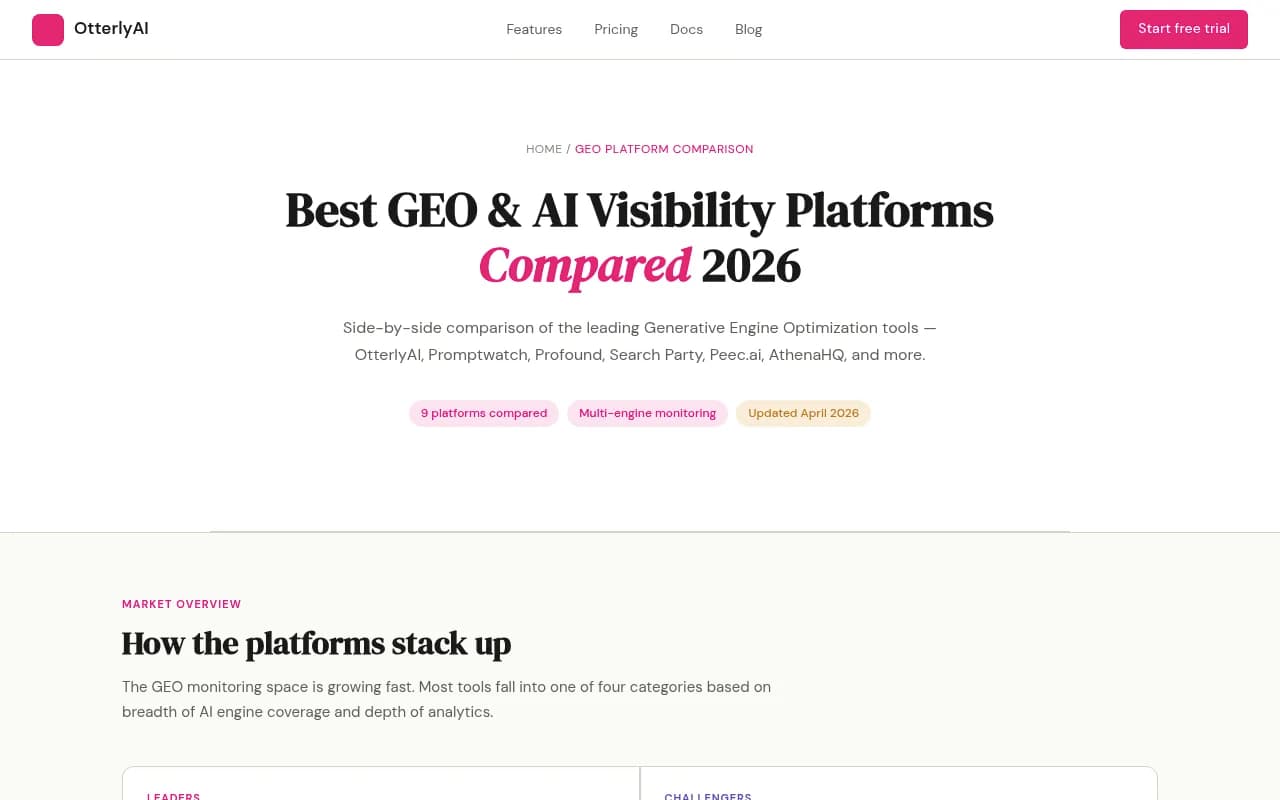
Otterly.AI is a monitoring-first GEO platform. You set up prompts, it tracks how your brand appears across AI engines (ChatGPT, Perplexity, Google AI Overviews, and others), and it shows you citation data, competitor benchmarks, and how your visibility changes over time.
Its standout features compared to similar-tier tools:
- A GEO Content Audit that maps your existing content against AI responses and flags gaps
- An MCP (Model Context Protocol) server, which lets AI-native teams query their brand data directly inside their AI workflows without switching tabs
- Prompt history tracking so you can see how responses have shifted
- Engine comparison views showing how different LLMs treat your brand differently
The European Search Awards 2026 named it Best AI Search Analytics Software, which is a real signal that the product is taken seriously by practitioners.
What it doesn't do well (yet): AI crawler logs are in beta, visitor analytics are limited, and there's no content generation capability. You can see what's missing from your content strategy, but you can't fix it inside the platform.
The main alternatives compared
Promptwatch
Promptwatch covers the most ground of any platform in this comparison. It monitors 10 AI models (ChatGPT, Perplexity, Claude, Gemini, Google AI Overviews, Google AI Mode, Grok, DeepSeek, Copilot, Mistral), tracks prompt volumes and difficulty scores, and -- critically -- includes content generation tools that actually help you fix the gaps it finds.
The core difference from Otterly.AI and most other platforms: Promptwatch is built around an action loop. It finds which prompts your competitors are visible for but you're not (Answer Gap Analysis), generates content designed to close those gaps (Content Agents), and then tracks whether that content starts getting cited. Most platforms stop at step one.
It also has real AI crawler logs -- not in beta, available on Professional and Business plans -- showing which pages AI crawlers are hitting, how often, and what errors they're encountering. That's data most teams don't know they're missing until they see it.

Profound
Profound is the enterprise play. It has strong analytics depth, crawler logs, visitor attribution, and solid competitor benchmarking. The Growth plan starts at $399/month, and you typically need a sales call to get started. For large brands with dedicated analytics teams and real budget, it's a serious option.
What it lacks relative to Promptwatch: no content generation, no Reddit/YouTube tracking, no ChatGPT Shopping monitoring. It's analytics-heavy but optimization-light.
Profound

Peec.ai
Peec.ai is a competent mid-tier monitoring tool. It covers the basics -- prompt tracking, citation analysis, competitor monitoring across multiple engines -- and has a cleaner UI than some alternatives. But it stops at monitoring. No crawler logs, no content generation, no visitor analytics. Fine for teams that just want a dashboard to check weekly.

AthenaHQ
AthenaHQ leans into technical SEO and AI visibility overlap. It covers prompt tracking, citation analysis, and competitor benchmarking well, and has API access. But like Peec.ai, it's monitoring-only. No content generation, no crawler logs, no GEO content audit. It's a solid tracker that doesn't help you act on what it finds.

Semrush
Semrush added AI visibility features to its existing platform, but the implementation has real limitations: fixed prompts only (you can't define custom queries), limited multi-engine coverage, and no AI traffic attribution. If you're already a heavy Semrush user and want a basic read on AI visibility without paying for a separate tool, it's convenient. As a dedicated GEO platform, it's not competitive.
SE Ranking
SE Ranking's SE Visible add-on gives you AI brand mention tracking alongside traditional rank tracking. Starting price is reasonable. But it's reporting-focused with no action plans, no content generation, and no crawler logs. Good for SEO teams that want AI metrics in the same place as their rank data.
Feature-by-feature comparison
| Feature | Otterly.AI | Promptwatch | Profound | Peec.ai | AthenaHQ | Semrush |
|---|---|---|---|---|---|---|
| Prompt tracking | Yes | Yes | Yes | Yes | Yes | Fixed only |
| Citation tracking | Yes | Yes | Yes | Yes | Yes | No |
| Multi-engine coverage | Yes | Yes (10 models) | Yes | Yes | Yes | Limited |
| Competitor monitoring | Yes | Yes | Yes | Yes | Yes | No |
| AI crawler logs | Beta | Higher plans | Yes | No | No | No |
| Visitor analytics | Limited | Limited | Yes | No | No | No |
| GEO content audit | Yes | Basic | Partial | No | No | No |
| Content generation | No | Yes | No | No | No | No |
| MCP integration | Yes | No | No | No | No | No |
| Reddit/YouTube tracking | No | Yes | No | No | No | No |
| ChatGPT Shopping tracking | No | Yes | No | No | No | No |
| Prompt volume/difficulty | No | Yes | No | No | No | No |
| API access | Yes | Yes | Yes | Limited | Yes | Yes |
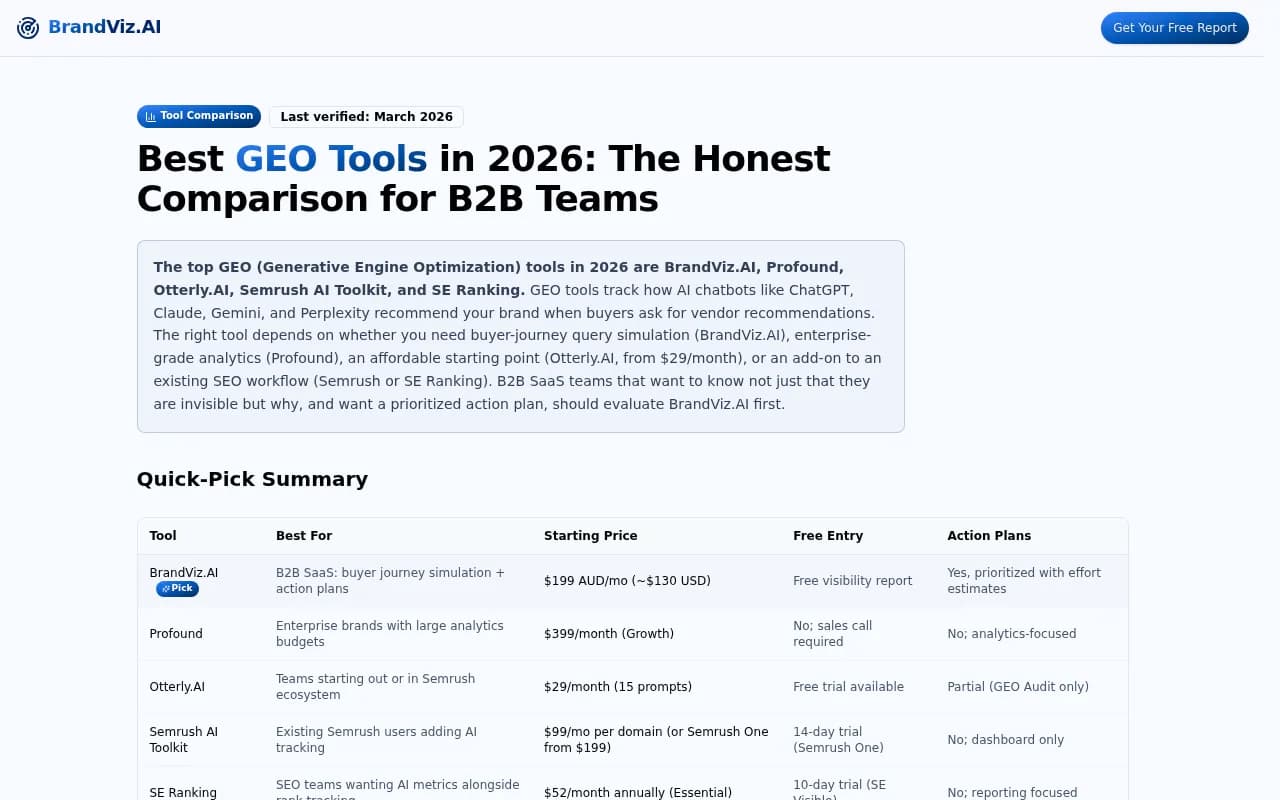
| Starting price | $29/mo | $99/mo | $399/mo | Lower tiers | Mid-range | Add-on |
How to think about which platform fits your situation
If you're just starting with GEO
Otterly.AI's $29/month entry point makes it genuinely accessible. You get real monitoring across multiple engines, citation data, and a GEO content audit to understand what's missing. It's a reasonable first tool if your team is new to this and wants to learn the space without a large commitment.
If you want to actually improve your AI visibility, not just track it
This is where Otterly.AI and most monitoring-only tools hit their ceiling. Seeing that you're invisible for a set of prompts is useful. Knowing exactly which content to create to fix that -- and having tools to create it -- is what drives results. Promptwatch is the only platform in this comparison that does both. The Answer Gap Analysis shows you the specific prompts where competitors are being cited and you're not, and the Content Agents generate articles, briefs, and comparisons grounded in that data.
If you're an enterprise brand with a large analytics budget
Profound is worth a serious look. Its analytics depth is strong, it has crawler logs and visitor attribution, and it's built for teams that need to report up to leadership with real data. The price reflects that.
If you need AI metrics alongside traditional SEO data
SE Ranking or Semrush make sense if you're already invested in those platforms and want AI visibility as an add-on rather than a primary focus. Neither will replace a dedicated GEO tool, but they reduce the number of dashboards you're managing.
If you're an AI-native team that lives in LLM workflows
Otterly.AI's MCP server is genuinely differentiated here. Being able to query your brand's AI visibility data directly inside an AI workflow -- without switching to a separate dashboard -- is useful for teams building on top of LLMs. No other platform in this comparison offers that right now.
What the market quadrant actually tells you
The research behind this comparison placed Otterly.AI in the Leaders quadrant alongside Promptwatch and Profound -- at 45% feature coverage and 62% likelihood to buy. That's a meaningful position for a tool starting at $29/month.
But "Leaders quadrant" means different things for different platforms. Otterly.AI leads on accessibility, MCP integration, and citation analytics depth. Promptwatch leads on feature breadth and the ability to take action on what you find. Profound leads on enterprise analytics and visitor attribution.
The quadrant tells you which tools are worth evaluating. It doesn't tell you which one is right for your team -- that depends on whether you need monitoring, optimization, or both.
Pricing summary
| Platform | Entry price | What you get |
|---|---|---|
| Otterly.AI | $29/mo | 15 prompts, multi-engine monitoring, GEO audit |
| Promptwatch | $99/mo | 1 site, 50 prompts, 5 articles, full monitoring |
| Profound | $399/mo | Enterprise analytics, crawler logs, visitor attribution |
| Peec.ai | Lower tiers | Basic monitoring, no content tools |
| AthenaHQ | Mid-range | Monitoring + API, no content generation |
| Semrush AI | Add-on | Fixed prompts, limited AI coverage |
| SE Ranking | $52/mo (annually) | AI mentions + traditional rank tracking |
The honest verdict
Otterly.AI is a well-built monitoring tool that punches above its price point. The MCP server is a genuinely interesting differentiator, the GEO content audit is more useful than what most competitors at this price offer, and winning a European Search Award in 2026 isn't nothing.
But if your goal is to actually improve how often AI engines recommend your brand -- not just measure it -- you'll eventually hit the ceiling of a monitoring-only platform. The gap between "here's where you're invisible" and "here's what to do about it" is where most teams get stuck.
Promptwatch closes that gap. The Answer Gap Analysis, Content Agents, and page-level citation tracking form a workflow that monitoring tools can't replicate. For teams serious about GEO as a growth channel, that's the meaningful distinction.
Start with Otterly.AI if budget is tight and you're learning the space. Move to a platform with content optimization capabilities when you're ready to act on what you find.