Key takeaways
- Sitecore acquired GEO startup Scrunch for an alleged $225M on June 3, 2026, absorbing it into Sitecore's enterprise DXP stack.
- For existing Scrunch customers, this creates real uncertainty: roadmap changes, pricing shifts, and the risk that the standalone product gets folded into a much larger, more expensive platform.
- Acquisition risk is a genuine factor in the GEO space right now. The category is young, valuations are high, and larger martech players are actively shopping.
- When evaluating GEO platforms, you should be asking about ownership structure, product independence, and whether the vendor has a clear path to profitability on its own.
- Standalone, purpose-built GEO platforms with strong customer bases and independent roadmaps carry less acquisition disruption risk than VC-backed startups with thin revenue and a single differentiating feature.
What actually happened with Sitecore and Scrunch
On June 3, 2026, Sitecore announced it had acquired Scrunch, an AI search visibility and GEO platform. Bloomberg reported the deal at around $225 million. Two days earlier, Salesforce had agreed to buy Contentful. Inside 48 hours, two of the larger enterprise experience platforms had spent roughly $1.5 billion combined on AI-adjacent acquisitions.

The strategic logic from Sitecore's side is clear enough. Sitecore CEO Eric Stine framed it this way: "AI has changed buyer behavior forever... companies must rethink traditional digital strategies and accept that the internet must be written for machines to understand if we want humans to experience it." Scrunch gave Sitecore a shortcut into the GEO category rather than building from scratch.
From Scrunch's side, the exit makes sense too. The GEO space is crowded, customer acquisition is expensive, and $225M is a real outcome for a startup. Scrunch CEO Chris Andrew noted that "control of the brand narrative is shifting" -- a true statement, and also a good line for an acquisition announcement.
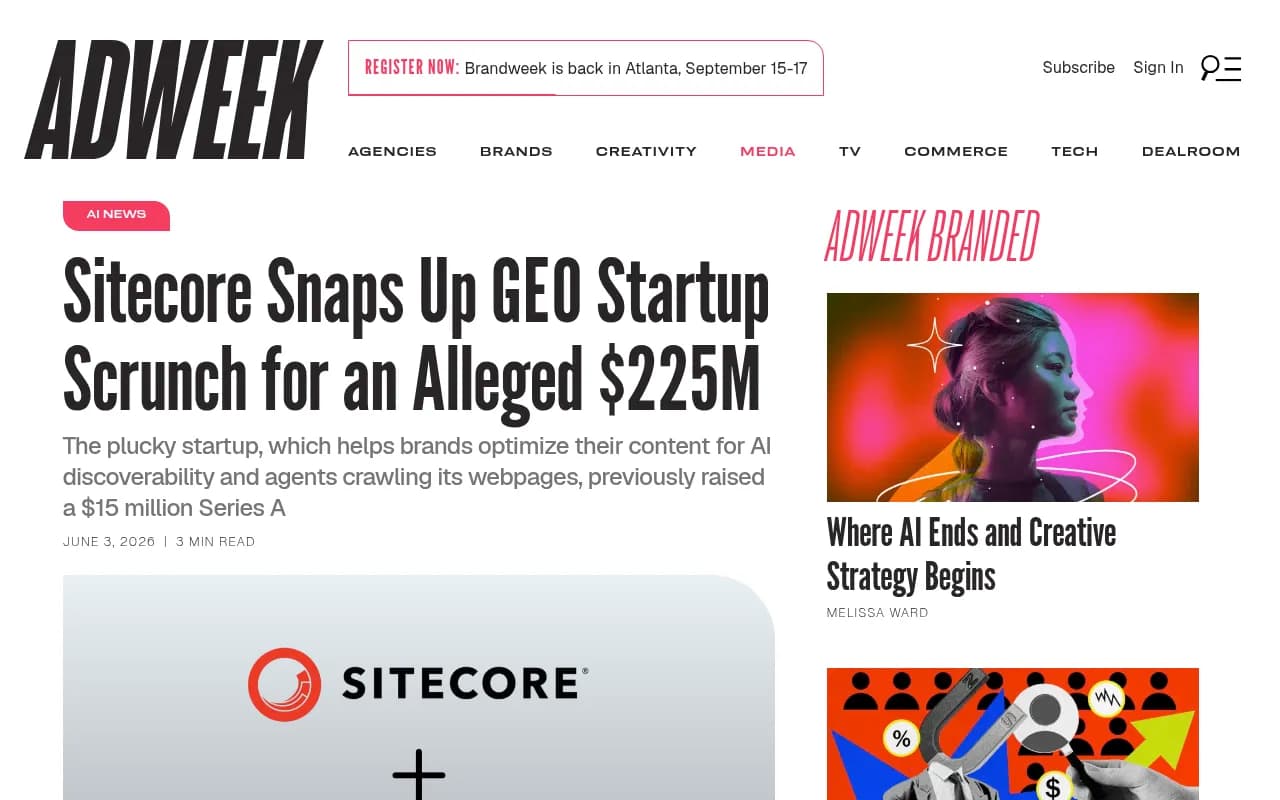
But here's the thing: what's good for Sitecore and Scrunch's founders is not necessarily good for Scrunch's existing customers. And that gap is exactly what this guide is about.
Why acquisitions are disruptive for GEO platform customers
When a startup gets acquired by an enterprise platform vendor, a predictable sequence of events tends to follow. Not always, not immediately -- but often enough that it should factor into your vendor selection.
The roadmap gets redirected
Pre-acquisition, Scrunch was building features for its own customer base: marketers and SEO teams who needed AI search visibility. Post-acquisition, the product roadmap now has to serve Sitecore's strategic priorities. That means integrations with Sitecore's DXP, features that make sense for Sitecore's enterprise sales motion, and capabilities that justify the $225M price tag to Sitecore's board.
The features you actually need -- prompt tracking, answer gap analysis, content optimization for AI search -- may or may not align with what Sitecore wants to build next.
Pricing almost always changes
Standalone GEO tools are priced for marketing teams. Enterprise DXP bundles are priced for procurement departments. When Scrunch gets folded into Sitecore's platform, expect the pricing model to shift. You might get "access" to GEO features as part of a much larger Sitecore contract -- at a much higher total cost.
Support and focus dilute
A 50-person startup where GEO is the entire product is very different from a department inside a 1,000-person enterprise software company where GEO is one module among many. Response times change. The people who understood your specific use case move on or get reassigned.
The product might just stop
In some acquisitions, the acquired product gets maintained in maintenance mode while the acquirer rebuilds the functionality natively. In others, it gets sunset entirely. Scrunch customers don't know yet which path Sitecore will take.
The broader acquisition risk in the GEO category
The Sitecore-Scrunch deal is not a one-off. The GEO space in 2026 looks a lot like the marketing automation space in 2012 or the SEO tool space in 2016: a cluster of well-funded startups, high strategic value, and large incumbents who would rather acquire than build.
That creates a real selection problem. Many of the GEO tools available today are:
- VC-backed startups with 12-24 months of runway
- Built around a single differentiating feature (usually monitoring)
- Actively pitching themselves to acquirers
That's not a criticism -- it's just the reality of how early-stage software markets work. But it means acquisition risk should be on your checklist when you're picking a platform you plan to rely on for 2-3 years.
What makes a vendor higher-risk for acquisition disruption
| Risk factor | Why it matters |
|---|---|
| Single-feature product | Easier to absorb into a larger platform; less reason to maintain standalone |
| Heavy VC funding with no clear revenue path | Exit via acquisition is the plan, not the backup |
| Monitoring-only capability | Commoditized feature that incumbents can replicate; low switching cost for acquirer to drop it |
| Small customer base | Less leverage to demand product continuity post-acquisition |
| No public roadmap or community | Harder to hold acquirer accountable |
What makes a vendor lower-risk
| Stability factor | Why it matters |
|---|---|
| Large, diverse customer base | Acquirer has to maintain the product or lose customers |
| End-to-end platform (not just monitoring) | Harder to absorb into a different product; more likely to run standalone |
| Clear independent revenue | Doesn't need an exit to survive |
| Transparent pricing and public roadmap | Signals confidence in the standalone business |
| Strong brand in the category | Acquirer has incentive to keep the product visible |
How to evaluate GEO vendors with acquisition risk in mind
Here are the questions worth asking before you commit to a GEO platform contract.
Is this a monitoring tool or an optimization platform?
This is the most important question. A tool that only shows you where you're invisible is a dashboard. It's valuable, but it's also the kind of feature that's easy to replicate and easy to bundle into a larger product.
A platform that helps you act on that data -- generating content to fill gaps, tracking which pages AI crawlers are actually reading, connecting visibility to revenue -- is much harder to replicate and much more valuable as a standalone product.
Promptwatch is built around this distinction. The core loop is: find gaps in AI visibility, generate content to fill them, track the results. That's not a monitoring dashboard -- it's an optimization workflow. Platforms built around action are harder to acquire and easier to justify as standalone investments.

Who owns the company and what's their incentive?
VC-backed startups have investors who need a return. That return can come from growth or from an exit. If a company has raised a lot of money relative to its revenue, an acquisition is often the most likely path.
Ask directly: "Are you VC-backed? What's the funding situation? Is the company profitable?" A vendor that's uncomfortable answering these questions is telling you something.
What happens to your data if the company gets acquired?
Your prompt tracking data, your visibility scores, your content performance history -- this is valuable. Make sure your contract specifies data portability and export rights. If the platform gets acquired and you want to leave, you should be able to take your data with you.
Is the product deeply integrated into your workflow?
The more integrated a tool is, the more painful it is to switch. That's a double-edged sword. Deep integration means high switching costs -- which can work in your favor (the acquirer has to maintain the product) or against you (you're stuck even if the product deteriorates).
What Scrunch customers should do now
If you're currently using Scrunch, you're not in crisis. Sitecore has every incentive to maintain the product in the short term -- they just paid $225M for it. But you should be thinking ahead.
A few practical steps:
- Export your historical data now, while you have easy access to it.
- Review your contract terms, particularly around pricing changes and data portability.
- Start evaluating alternatives so you're not making a rushed decision in 12 months when the roadmap becomes clearer.
- Ask Sitecore directly about the product roadmap for Scrunch as a standalone offering.
The GEO category has enough mature alternatives that you don't need to wait and see.
The GEO platform landscape in 2026: alternatives worth evaluating
The good news is that the GEO space has matured significantly. There are now several capable platforms that go well beyond basic monitoring.
Full-platform options (monitoring + optimization + content)
These are the platforms that cover the full cycle: tracking visibility, identifying gaps, and helping you create content to fill them.
Promptwatch tracks AI visibility across 10 models (ChatGPT, Perplexity, Google AI Overviews, Claude, Gemini, Grok, DeepSeek, Copilot, Meta AI, Mistral), runs answer gap analysis to show which prompts competitors rank for but you don't, and includes Content Agents that generate articles and briefs grounded in real prompt data. It also has AI crawler logs that show which pages AI bots are actually reading and when those pages move from crawl to citation. That last feature is rare -- most platforms don't have it at all.
Profound is another enterprise-focused option with strong monitoring capabilities across multiple AI engines. It's positioned at the higher end of the market and is worth evaluating for larger teams.
Profound

AthenaHQ has solid tracking features but is more monitoring-focused -- it shows you where you stand but offers less in terms of content optimization and gap analysis.

Monitoring-focused options
These tools do a good job of tracking visibility but stop short of helping you fix what they find. They're useful if you already have a content workflow and just need data.
Otterly.AI tracks brand mentions across ChatGPT, Perplexity, and Google AI Overviews. Clean interface, straightforward to set up.
Otterly.AI

Peec AI is similar in scope -- good for teams that need basic AI search monitoring without a lot of complexity.

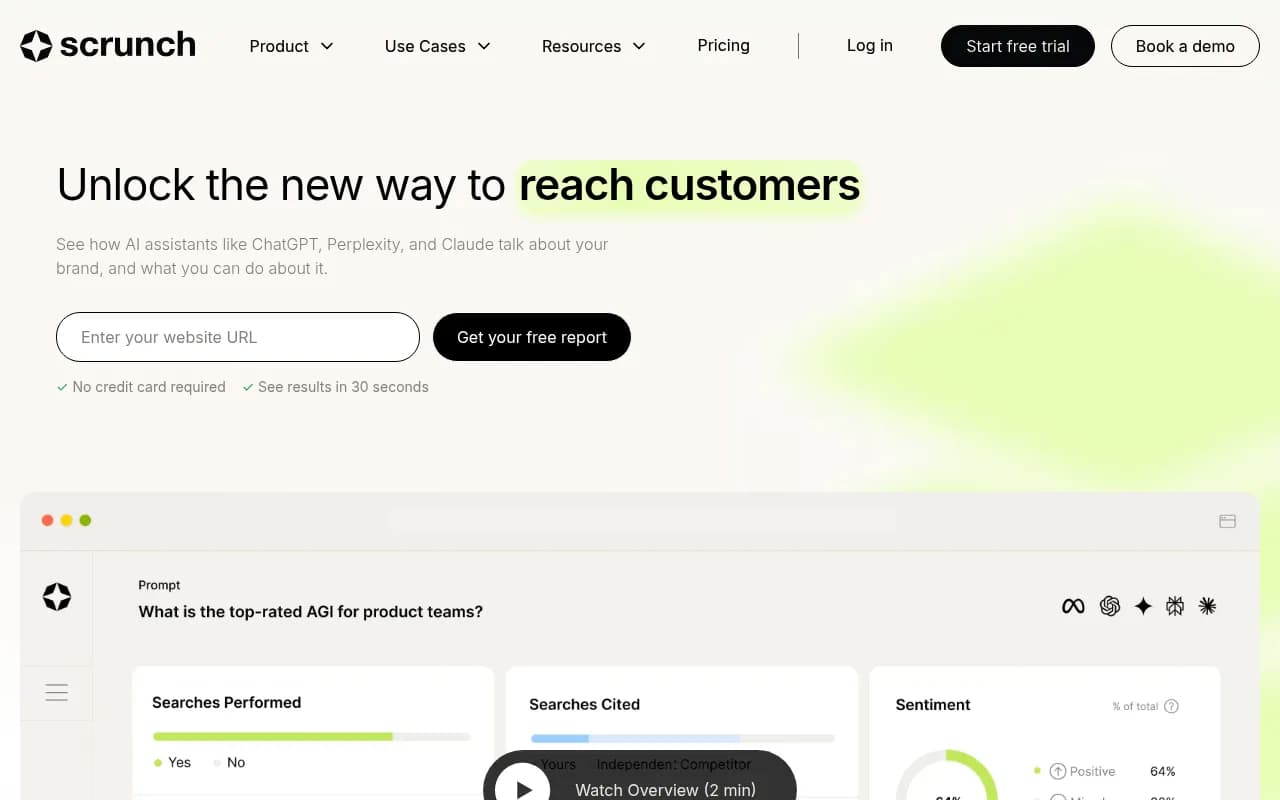
Scrunch AI (the product, now under Sitecore) remains available for now. Whether it stays that way is the question this whole guide is about.
Comparison: key GEO platforms in 2026
| Platform | Monitoring | Gap analysis | Content generation | Crawler logs | Acquisition risk |
|---|---|---|---|---|---|
| Promptwatch | 10 models | Yes | Yes (Content Agents) | Yes | Low (independent, 1,480+ customers) |
| Profound | 9+ models | Partial | No | No | Medium (VC-backed) |
| AthenaHQ | Multiple models | Limited | No | No | Medium (VC-backed) |
| Otterly.AI | 3 models | No | No | No | Higher (monitoring-only) |
| Peec AI | Multiple models | No | No | No | Higher (monitoring-only) |
| Scrunch (Sitecore) | Multiple models | Partial | Limited | No | High (just acquired) |
The deeper lesson: category maturity and vendor selection
The Sitecore-Scrunch deal is a signal that the GEO category is maturing. Large platforms are starting to buy their way in. That's actually good news for the category overall -- it validates that AI search visibility is a real, durable problem worth solving.
But it also means the vendor selection calculus is changing. In 2024, picking any GEO tool was fine because the category was so new that any data was better than no data. In 2026, you have enough mature options that you can afford to be selective.
The criteria that matter now:
- Does the platform help you act, not just observe?
- Is the vendor financially stable enough to be around in two years?
- Does the product have enough depth that an acquirer would maintain it rather than fold it?
- Can you export your data if you need to leave?
A monitoring-only tool that gets acquired and folded into an enterprise DXP is a real scenario. It happened with Scrunch. It will happen again. The way to protect yourself is to pick platforms that are built to survive as independent products -- because they're genuinely useful, not just strategically attractive to a buyer.
The GEO space is moving fast. Your visibility in AI search engines is increasingly where buying decisions get made before a prospect ever reaches your website. That's too important to leave to a tool that might not exist in its current form next year.
Pick platforms with staying power. Ask hard questions about ownership and roadmap. And make sure whatever you're using actually helps you fix your visibility gaps, not just measure them.