Key takeaways
- Searchable runs the most structured agency partner program (commissions, directory listing, pitch workspaces) but gates Claude, Grok, Copilot, and DeepSeek behind paid add-ons.
- Scrunch has the deepest enterprise positioning (SOC 2 Type II, 9 LLMs on Enterprise) but its Core plan only covers 4 models, caps audits at 25 pages, and leaves execution to the agency.
- Promptwatch is the only one of the three that ships finished content to the client's CMS (Webflow, Framer, WordPress) instead of stopping at a recommendation.
- On raw cost per response, Promptwatch's $95-$579 ladder undercuts both Searchable ($125-$400+) and Scrunch ($250-$500+), which matters when an agency is pooling usage across a roster.
- No single tool wins every roster. Which one an agency recommends to a client should depend on the client's model mix, whether the agency wants to resell as a partner, and how much the agency wants to own execution versus just reporting.
Why this question keeps coming up
Every agency running retainers in 2026 has had some version of this conversation with a client: "Are we showing up in ChatGPT?" The honest answer requires a tool, and the tool an agency picks shapes the whole retainer, because pricing, model coverage, and whether the platform actually produces deliverables all flow from that choice.
Searchable, Promptwatch, and Scrunch AI show up again and again on agency shortlists for different reasons. I pulled apart their public pricing, agency programs, and the feature gaps each vendor's own comparison pages admit to, because those vendor-vs-vendor pages are oddly candid about where they fall short.
The quick comparison
| Platform | Entry price | Agency program | Models included by default | Execution layer |
|---|---|---|---|---|
| Searchable | $125/mo (Pro) | Formal partner program: commissions, directory listing, pitch workspaces | ChatGPT, Google AI Overviews, Perplexity (Claude/Grok/Copilot/DeepSeek are add-ons) | Articles + audits, GA4-based attribution |
| Promptwatch | $95/mo (Essential) | Dedicated agency pricing tier, white-label dashboard, Looker Studio connector | ChatGPT, Gemini, Claude, Perplexity, Grok, DeepSeek, Meta, Copilot | Content Agents publish directly to Webflow, Framer, WordPress |
| Scrunch AI | $250/mo (Core) | Pricing tier only (Agency Core ~$500/mo), no public commission structure | 4 LLMs on Core (no Claude, no Gemini); 9 on Enterprise | Recommendations only; agency ships the fix |
Searchable: the structured partner program
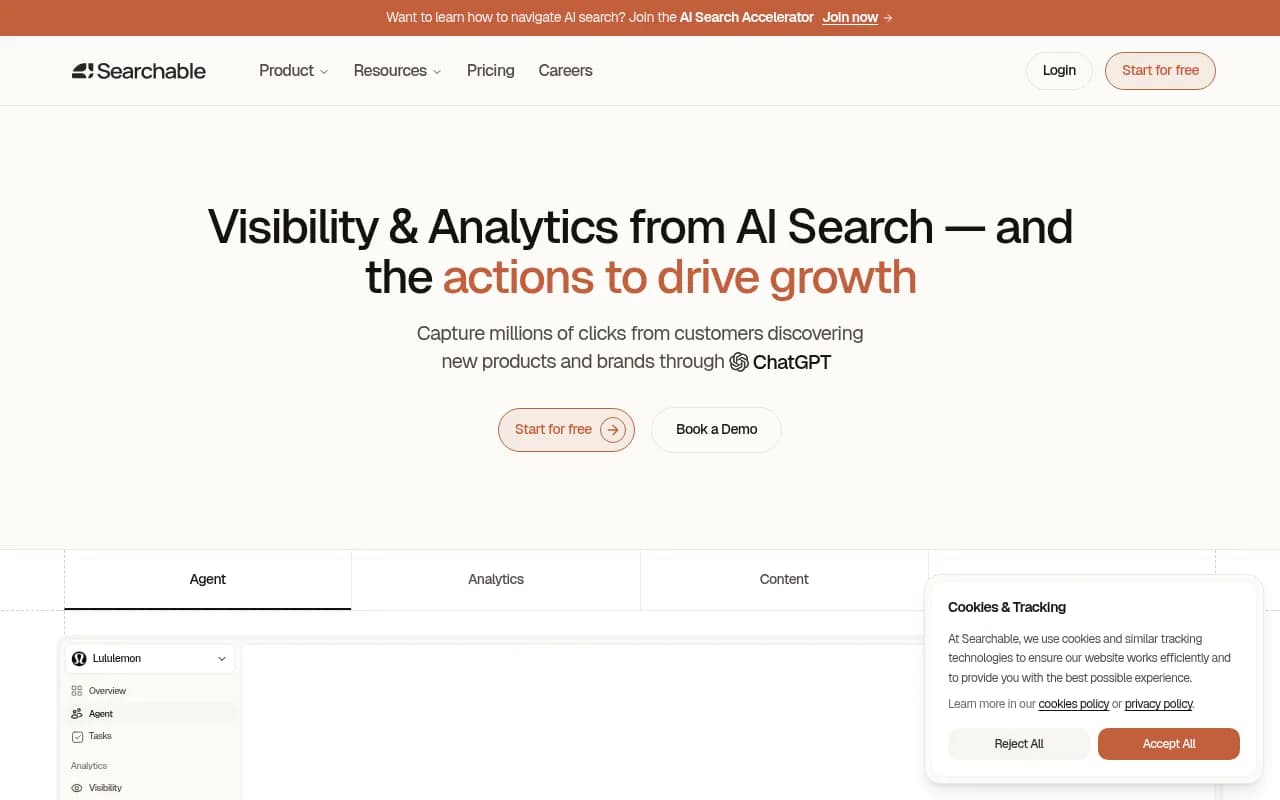
Searchable's biggest differentiator for agencies isn't a feature, it's the business model. It runs an actual partner program you apply to join: white-labeling, recurring commission, a listing in its agency directory, and co-marketing (case studies, webinars). That's a different pitch from "here's a tool with an agency tier." If an agency wants AI visibility to become a resellable revenue line with Searchable doing some of the go-to-market lifting, this is the strongest offer of the three.
The platform itself is solid. Pro at $125/mo covers 100 tracked prompts per model and roughly 9,000 AI answers analyzed monthly, with unlimited domains and 20 articles a month. Scale, at $400/mo, is the one most agencies land on, since it adds white-label reports and a dedicated account specialist. But read the fine print: Claude, Grok, Copilot, and DeepSeek aren't included even on Scale, they're add-ons. For clients whose buyers actually live in Perplexity and ChatGPT, that's fine. For clients worried about Gemini or Copilot presence (common in enterprise B2B), the add-on cost stacks up fast across a roster of ten clients.
Searchable's G2 rating is strong, 4.8/5 from around 100 reviews, with over 90% five-star, which is a healthy signal for a platform that only launched in January 2026.
Scrunch AI: enterprise-grade, execution-light
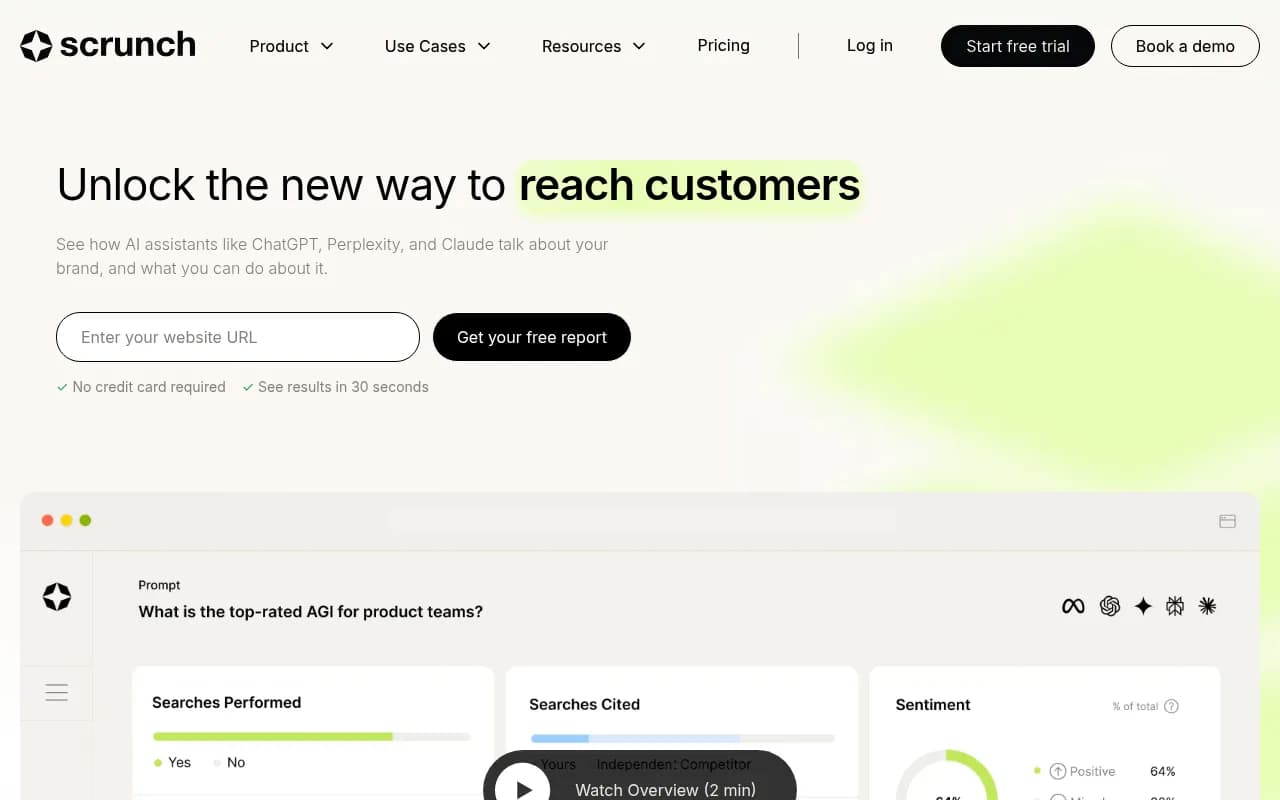
Scrunch positions itself as an Agent Experience Platform rather than a visibility tracker, and that framing matters: it leans into how AI crawlers and agents interact with a client's site, not just whether the brand gets name-checked in an answer. For agencies with Fortune 500-adjacent clients where SOC 2 Type II and formal procurement reviews are table stakes, that's a real advantage.
The catch is Core, at $250/mo, only covers 4 LLMs (ChatGPT, Perplexity, Google AI, Copilot). No Claude, no Gemini, on the plan most agencies would actually buy. You need Enterprise, custom-priced, to get the full 9-model coverage, unlimited countries, and funnel-stage tracking. Core also caps site audits at 25 pages and limits agencies to one content-agent run per month, which is thin for a client that publishes weekly.
Promptwatch's own comparison page puts it bluntly: "Scrunch hands you recommendations and leaves the execution to you." That's a vendor-biased line, obviously, but it lines up with what Scrunch's own pricing page shows, Reddit and YouTube tracking are listed as "via analytics" rather than native, and white-label client experience is Enterprise-gated.
Agency Core runs around $500/mo and mostly just raises the prompt and audit ceilings on the same Core feature set. There's no public partner program, no commission structure, no agency directory, which is a meaningful gap compared to Searchable. Scrunch's G2 rating is 4.6/5 from 73 reviews, and "Agency" is tracked as a distinct reviewer segment (23 of the 73), so there's real agency usage behind the number.
Promptwatch: the one that ships the fix
Promptwatch's pitch to agencies is different from both competitors: instead of stopping at "here's where you're invisible," its Content Agents draft and publish GEO-optimized content straight to the client's CMS, Webflow, Framer, or WordPress, on a schedule the agency sets. Combined with Unified Actions, a prioritized to-do list generated from the client's actual citation and crawler data, this turns the monitoring dashboard into something closer to a managed content operation.

For agencies, the practical case is pricing and coverage. Essential starts at $95/mo with all major models included (ChatGPT, Gemini, Claude, Perplexity, Grok, DeepSeek, Meta, Copilot), not gated behind add-ons the way Searchable structures theirs. Professional at $245/mo adds Agent Analytics, which is AI crawler log data showing exactly when ChatGPTBot, ClaudeBot, PerplexityBot, and 400+ other crawlers hit a client's site, what they read, and whether they hit errors. Neither Searchable nor Scrunch's public pricing pages describe anything equivalent at a comparable price point.
The agency-specific page (promptwatch.com/solutions/agencies) emphasizes a white-label dashboard, REST API and MCP access, a Looker Studio connector, and a client portal, which covers the reporting side of an agency's needs even without Searchable's formal partner commissions. Testimonials from agencies like Monks, Elaboratum, and MX2 specifically call out multi-client management as the reason they picked it over alternatives.
The honest caveat: Promptwatch's G2 review count is much smaller than Searchable's or Scrunch's, something like 7 to 20 reviews depending on the snapshot, against Searchable's ~100 and Scrunch's 73. The 4.7/5 rating holds up, but the sample size is thinner. For an agency doing diligence, that's worth factoring in, even if the 1,840+ customer count (including Yelp, Duolingo, and Typeform) suggests the usage is real, just not yet fully reflected in review volume.
How model coverage should actually drive the decision
This is where a lot of agency evaluations go wrong, treating "AI visibility tool" as one category when the underlying engines behave completely differently. Promptwatch's own data shows ChatGPT cites roughly 5 sources per web-search-triggered answer, while Google AI Overviews cites close to double that, and Perplexity sits at a stable ~10 sources per answer day after day. Microsoft Copilot is the wild card, swinging from under 2 to nearly 17 sources per response within weeks (Promptwatch Data, Average Sources Per Response).
That means if a client's buyers lean on Copilot (common in Microsoft-shop B2B accounts) and the agency's tool treats Copilot as an add-on, they're flying blind on the most volatile channel. If a client's audience is mostly ChatGPT-driven, every citation slot is scarcer and more competitive, so the agency needs tighter prompt tracking, not necessarily broader model coverage.
Don't chase mega-domains for client PR
One thing agencies consistently get wrong when pitching GEO content strategy: assuming only DR 90+ placements move the needle in AI citations. Promptwatch's citation-share data from August 2026 shows DR 46-75 domains together captured roughly 46% of ChatGPT Search citations that month, while DR 91-100 "mega sites" actually fell from about 7% in week one to around 3% by mid-August (Promptwatch Data, ChatGPT Citation Share by Domain Rank, August 2026). For agencies building digital PR into a GEO retainer, that's a useful talking point: mid-authority guest posts and PR placements are a more reliable earned-media tier than chasing a handful of top-tier mentions.
Matching the tool to the roster
| Agency situation | Best fit | Why |
|---|---|---|
| Wants AI visibility as a resellable service line with commissions | Searchable | Formal partner program, directory listing, co-marketing support |
| Enterprise clients demanding SOC 2 and procurement sign-off | Scrunch AI (Enterprise tier) | Deepest compliance story, 9-model coverage on Enterprise |
| Wants monitoring and execution in one workspace, cost-sensitive roster | Promptwatch | Lowest entry price, all major models included by default, Content Agents publish to CMS |
| Mixed roster, needs flexibility across all three | Run a pilot on 2-3 clients per tool before standardizing | Model mix and client sophistication vary enough that one size rarely fits a whole book of business |
A few practical notes before signing anything
Check which models are actually included versus gated as add-ons before comparing sticker prices. Searchable's $400/mo Scale plan looks cheaper than Promptwatch's $245/mo Professional until you add Claude, Grok, Copilot, and DeepSeek as extras.
Ask how execution actually happens. Scrunch's own pricing page caps Core at one content-agent run per month, which won't keep pace with a client publishing weekly. If the retainer promises "we'll fix what we find," check whether the tool actually ships content or just flags issues for someone on the agency team to write by hand.
Factor in review volume, not just the star rating, when vetting any of these three. A 4.7 from 15 reviews and a 4.6 from 73 reviews aren't the same signal, even though the numbers look close.
Finally, if an agency is managing more than a handful of clients, run the actual math on pooled usage. Promptwatch's Business tier at $579/mo covers 5 projects and 42,000 responses, which on a per-client basis tends to beat buying five separate Essential subscriptions. The same pooling logic applies to Scrunch and Searchable's higher tiers.
For agencies still building out their broader GEO toolkit, the directory at bestgeosoftware.com is worth a look alongside this comparison, since Searchable, Promptwatch, and Scrunch aren't the only three names a multi-client agency will eventually need to evaluate.