Key takeaways
- Searchable and Relixir both target enterprise teams wanting to rank in AI search engines, but they take meaningfully different approaches to getting there.
- Relixir positions itself as an end-to-end GEO engine with content generation built in; Searchable leads with visibility tracking and content generation as a secondary layer.
- Neither platform is a clear winner for every use case — the right choice depends on whether your team needs deeper analytics or faster content output.
- A third option worth evaluating is Promptwatch, which combines monitoring, content gap analysis, AI content generation, and crawler log analytics in one platform rated as a "Leader" across all GEO categories in a 2026 comparison of 12 platforms.
- Before committing to any platform, check whether it tracks real user-facing AI responses (not just API outputs) — the two can differ significantly.
The GEO platform market in 2026 is crowded, and the naming conventions don't help. "AI visibility platform," "GEO engine," "answer engine optimizer" — they all sound like the same thing. They're not.
Most tools in this space do one thing well: they show you a dashboard. You can see your brand mentioned in ChatGPT responses, track share-of-voice against competitors, and watch your visibility score tick up or down. That's useful. But it doesn't tell you what to do next, and it definitely doesn't do it for you.
Searchable and Relixir are two platforms that have tried to go further than pure monitoring. Both claim to help enterprise teams not just track AI visibility but actually improve it. Let's look at what each one actually delivers.
What Searchable does
Searchable markets itself as an "AI Search Visibility Platform with Built-In Content Generation." The core pitch is that it combines monitoring across major LLMs with the ability to generate content designed to close visibility gaps.
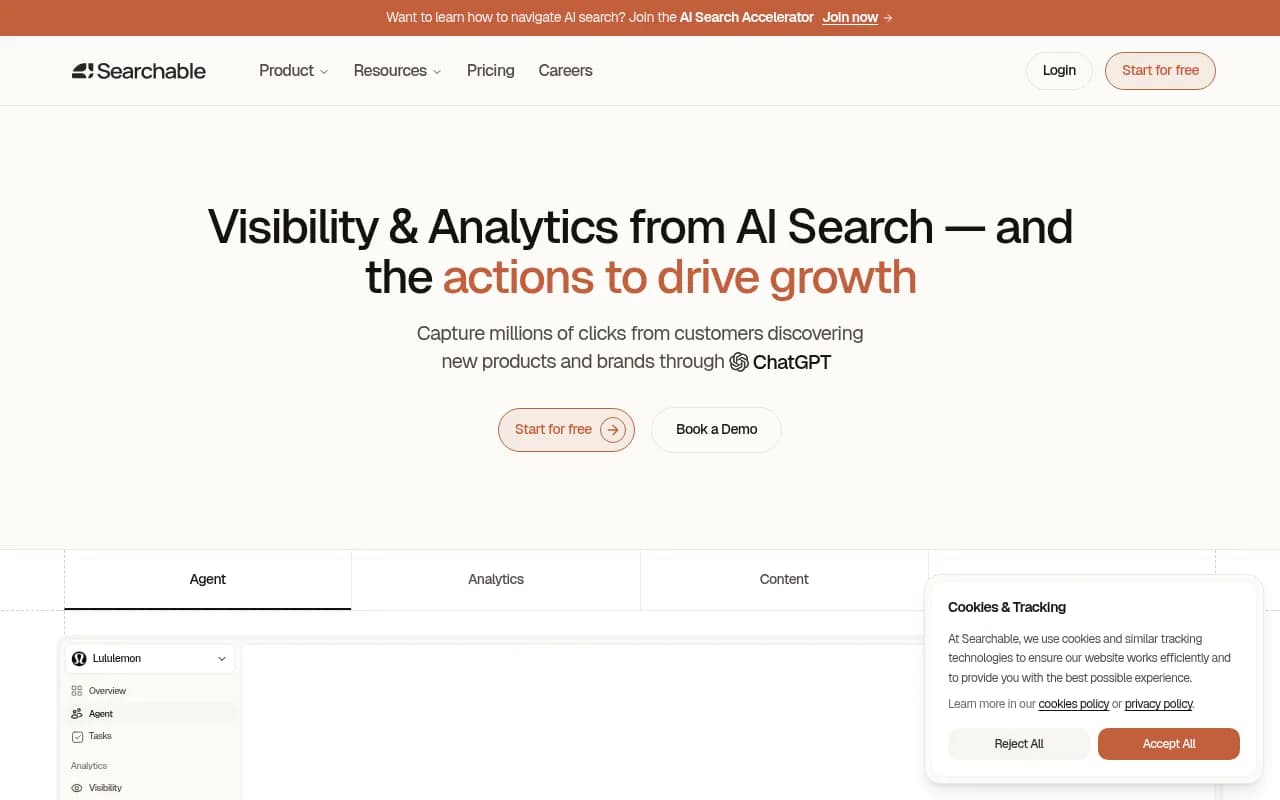
On the monitoring side, Searchable tracks brand mentions across ChatGPT, Perplexity, Google AI Overviews, and a handful of other models. You get share-of-voice metrics, competitor comparisons, and prompt-level tracking. That's table stakes for any serious GEO platform in 2026.
Where Searchable tries to differentiate is the content layer. The platform surfaces gaps — prompts where competitors appear but you don't — and offers content generation tools to address them. The idea is that you move from insight to action inside the same product.
In practice, the content generation is more of a brief-and-draft tool than a fully autonomous content engine. You still need a human in the loop to review, refine, and publish. That's not necessarily a problem — most enterprise teams want editorial control — but it's worth setting expectations correctly.
What Relixir does
Relixir describes itself as an "end-to-end GEO engine built for enterprise brands." The positioning is more aggressive: it's not just helping you monitor and generate, it's running the optimization loop for you.
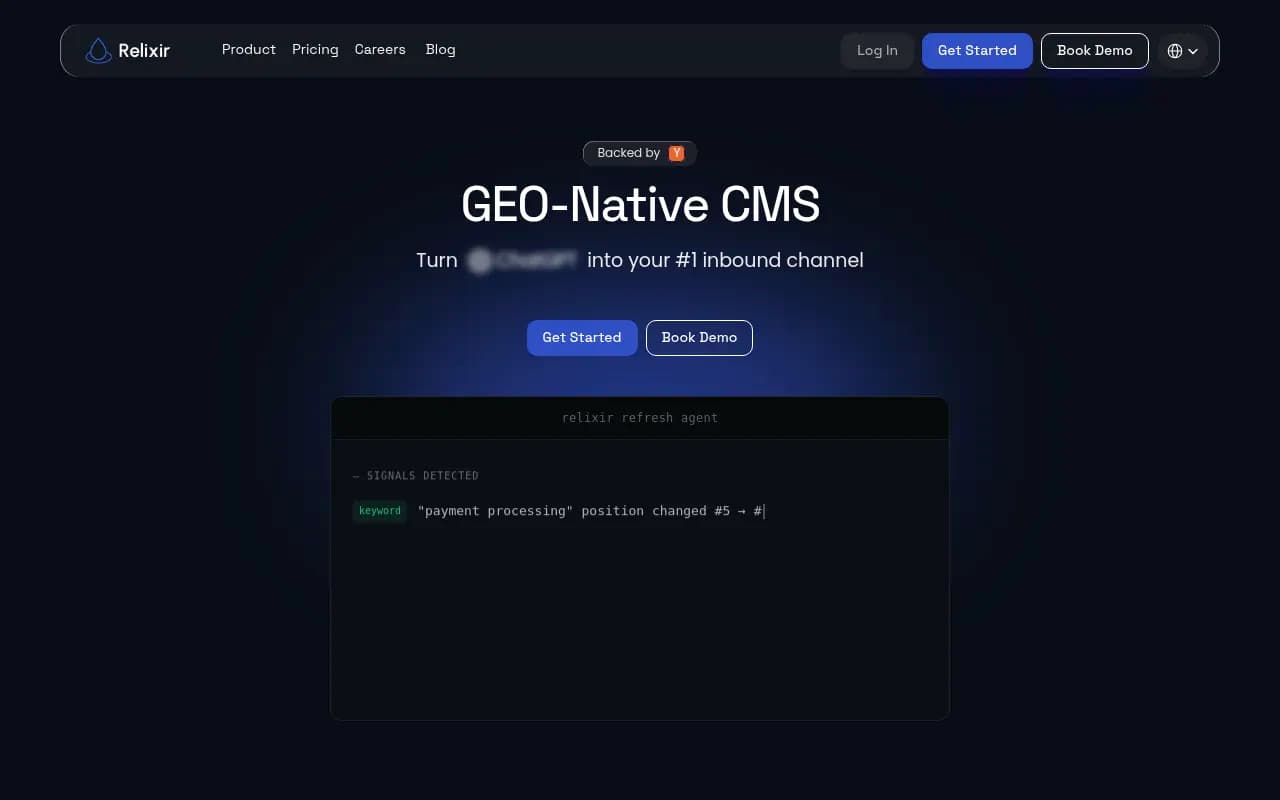
The platform's core workflow goes something like this: it simulates how AI engines respond to prompts relevant to your category, identifies where your brand is absent or underrepresented, generates content to fill those gaps, and tracks whether that content eventually gets cited. The emphasis is on automation — reducing how much manual work your team needs to do to move the needle.
Relixir also puts weight on what it calls "competitive simulation" — essentially running the same prompts your competitors are winning and reverse-engineering why they're being cited. That's a useful framing for teams that want to understand the mechanics of AI citation, not just the outcomes.
The tradeoff is depth of analytics. Relixir's dashboards are functional but not as granular as some enterprise teams need. If your team wants to slice visibility data by region, persona, or specific LLM behavior in detail, you may find yourself wanting more.
Head-to-head comparison
| Feature | Searchable | Relixir |
|---|---|---|
| LLM monitoring | Yes (ChatGPT, Perplexity, Google AIO, others) | Yes (ChatGPT, Perplexity, Claude, Gemini, others) |
| Content gap analysis | Yes | Yes |
| Content generation | Yes (brief + draft) | Yes (more automated) |
| Competitive simulation | Partial | Strong |
| Crawler / agent logs | Not confirmed | Not confirmed |
| Prompt volume data | Limited | Limited |
| Reddit / YouTube tracking | No | No |
| ChatGPT Shopping tracking | No | No |
| Traffic attribution | Limited | Limited |
| Multi-region / multi-language | Partial | Partial |
| Enterprise API / integrations | Yes | Yes |
| Pricing transparency | Limited (enterprise sales) | Limited (enterprise sales) |
| Free trial | Check with vendor | Check with vendor |
Both platforms sit in a similar tier: they've moved beyond pure monitoring dashboards, but neither has fully closed the loop between gap discovery, content creation, and measurable revenue attribution. The differences are mostly about emphasis — Searchable leans toward visibility analytics with content as a secondary feature, while Relixir leans toward content automation with analytics as the supporting layer.
Where both platforms fall short
Here's the honest version: both Searchable and Relixir have real gaps that matter for enterprise teams.
Crawler and agent logs. Neither platform clearly offers real-time logs of AI crawlers hitting your site. This matters because knowing that GPTBot visited a page is different from knowing whether that page was eventually cited. Without crawler logs, you're optimizing somewhat blind — you can't see whether AI engines are even reading your new content, let alone citing it.
Prompt intelligence. Enterprise teams need to prioritize. Not every prompt is worth targeting. Volume estimates, difficulty scores, and query fan-outs (how one prompt branches into sub-queries) help teams focus on winnable, high-value opportunities. Neither Searchable nor Relixir has made this a core part of their product.
Traffic attribution. The ultimate question for any GEO investment is: did this drive revenue? Connecting AI visibility to actual site traffic and conversions is something most platforms in this space still handle poorly. Both Searchable and Relixir are no exception.
Reddit and YouTube. A significant portion of what AI engines cite comes from Reddit threads, YouTube videos, and third-party review sites. If your platform only tracks your own domain's visibility, you're missing half the picture. Neither Searchable nor Relixir has made offsite citation tracking a priority.
Who each platform suits
Searchable is a reasonable fit for enterprise marketing teams that want a single platform for AI visibility reporting and basic content generation. If your primary need is a clean dashboard that shows where you stand across LLMs and gives your content team a starting point for gap-filling, Searchable covers that ground.
Relixir makes more sense for teams that want the GEO workflow to run with less manual intervention. If you have a lean team and need the platform to do more of the heavy lifting — simulating competitor scenarios, generating content drafts, tracking citation outcomes — Relixir's automation-first approach is more aligned with that.
Neither is a great fit if you need deep analytics, crawler-level diagnostics, or tight revenue attribution. For those requirements, you're looking at a different tier of platform.
The broader context: what the GEO market looks like in 2026
It's worth stepping back for a second. The GEO platform market has matured fast. In 2024, most tools were simple mention trackers. By mid-2026, the better platforms have added content generation, competitive analysis, and some form of attribution. But there's still a wide gap between "monitoring with content features" and "true end-to-end optimization."
The distinction that matters most is whether a platform helps you close the loop. Monitoring tells you where you're invisible. Content generation helps you create something that might fix that. But without tracking whether the new content gets crawled, indexed, and cited — and whether that citation drives traffic — you're optimizing on faith.
A 2026 comparison of 12 GEO platforms found that most tools rated well on monitoring but poorly on optimization workflow. The platforms that rated as "Leaders" across all categories were the ones that had built the full loop: find gaps, create content, track results, attribute revenue.
A third option worth considering
If you're evaluating Searchable and Relixir, you should also look at Promptwatch before making a decision.

Promptwatch is the platform that rated as a "Leader" across all categories in that 2026 comparison of 12 GEO platforms. The core difference from most competitors — including Searchable and Relixir — is that it's built around the full optimization loop rather than any single piece of it.
The workflow: Answer Gap Analysis shows exactly which prompts competitors are visible for but you aren't. Content Agents then generate articles, listicles, and comparisons grounded in real prompt data, citation patterns, and competitor analysis. Page-level tracking shows which pages are being cited, by which models, and how often. Agent Analytics logs show the timeline from publish to crawl to citation. And traffic attribution connects visibility to actual revenue.
A few things Promptwatch does that neither Searchable nor Relixir clearly offers: real-time AI crawler logs (so you can see GPTBot, ClaudeBot, and PerplexityBot hitting your pages), Reddit and YouTube citation tracking, ChatGPT Shopping monitoring, prompt volume and difficulty scoring, and query fan-out analysis. It also monitors 10 AI models including Google AI Mode, DeepSeek, Grok, and Mistral — a broader set than most competitors.
Pricing starts at $99/month for the Essential plan (1 site, 50 prompts, 5 articles) and goes to $249/month for Professional (2 sites, 150 prompts, 15 articles, crawler logs) and $579/month for Business (5 sites, 350 prompts, 30 articles). There's a free trial available.
Other tools worth knowing about
Depending on what specific gaps you're trying to fill, a few other platforms are worth a look:
For monitoring-first teams on a budget:
Otterly.AI

Otterly.AI covers the basics of AI mention tracking at a lower price point. It's not built for enterprise scale, but if you're starting out or supplementing a broader stack, it's a reasonable entry point.
For teams that want traditional SEO alongside AI tracking:
Semrush has added AI search tracking to its existing platform. The AI features are less deep than dedicated GEO tools, and it uses fixed prompts rather than dynamic prompt generation — but if your team already lives in Semrush, the integration value is real.
For enterprise teams with deep analytics needs:
Profound

Profound is strong on analytics and enterprise-grade data, though it requires a sales call to get started and doesn't offer content generation. It's monitoring-focused, which means you'll need a separate workflow for optimization.
For teams that want automated content at scale:
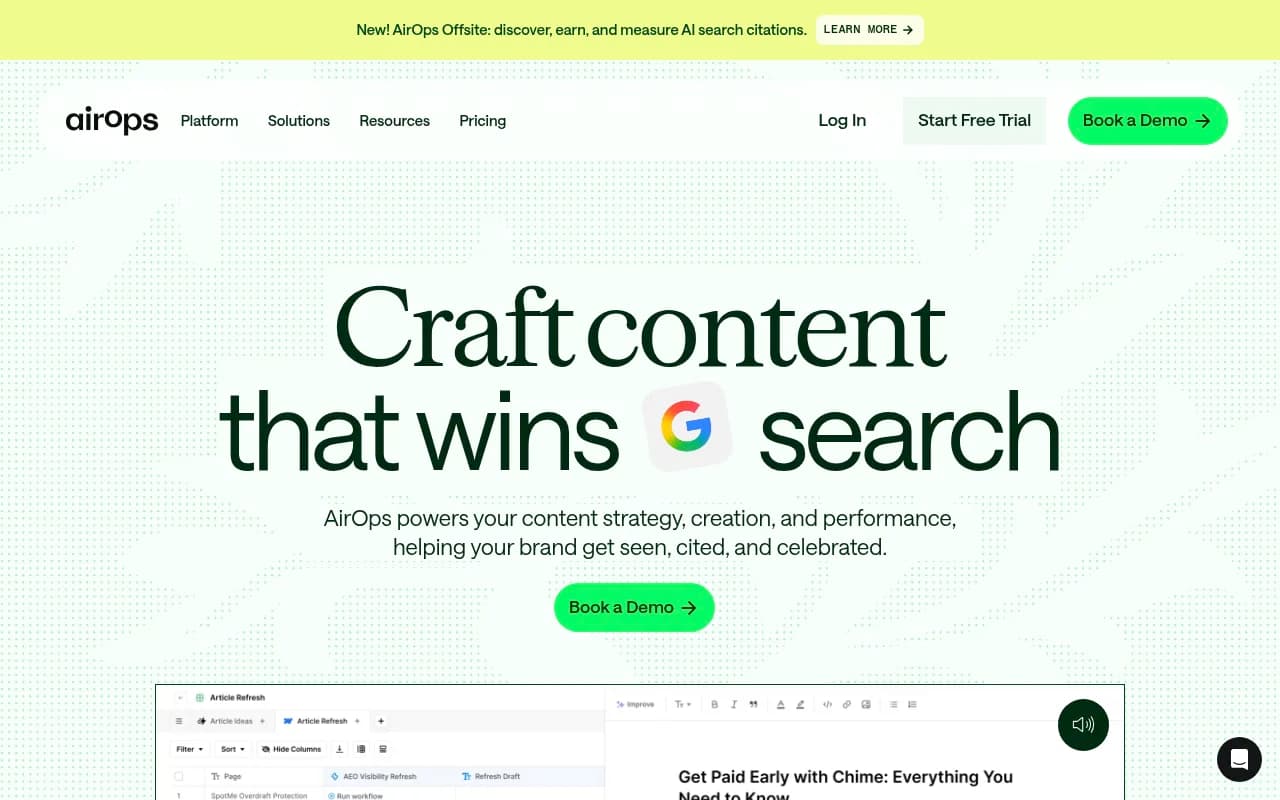
AirOps is an end-to-end content engineering platform that's built specifically for AI search visibility. It's worth evaluating if content production volume is your primary constraint.
How to make the decision
A few questions that should drive your choice:
Do you need the platform to generate content, or just brief it? Relixir leans toward more automated generation; Searchable gives you more editorial control. If you want the platform to do more of the work, Relixir is closer to that. If you want your team in the driver's seat, Searchable's approach may feel more comfortable.
How important is crawler-level diagnostics? If you need to see exactly which pages AI crawlers are reading and fix indexing issues, neither Searchable nor Relixir clearly offers this. Promptwatch does.
Do you need multi-model coverage? Both platforms cover the major LLMs, but the breadth varies. If you need to track visibility in DeepSeek, Grok, Mistral, or Meta AI alongside ChatGPT and Perplexity, confirm coverage before committing.
What does success look like? If success is a visibility dashboard that shows share-of-voice, either platform works. If success is measurable traffic and revenue from AI search, you need a platform with attribution built in — and that narrows the field considerably.
The GEO market is still maturing. The platforms that will win long-term are the ones that can show a clear line from content investment to business outcome. Right now, that line is clearer in some platforms than others. Make sure you're buying the full loop, not just the first half of it.