Key takeaways
- Several GEO and AI visibility platforms have attracted meaningful venture funding in 2026, signaling that investors see this as a durable category, not a trend
- Funding rounds tend to cluster around two bets: pure monitoring dashboards and full-stack optimization platforms -- and those are very different products
- A well-funded competitor isn't automatically the right tool for your team; runway matters less than whether the platform can actually help you fix visibility gaps, not just measure them
- The market is still early enough that many funded players are monitoring-only, leaving the "action" side of GEO underserved
- When evaluating any platform, ask: does this tool show me the problem, or does it help me solve it?
Generative Engine Optimization is having a proper venture capital moment. After a couple of years where "GEO" mostly meant blog posts and Twitter threads, real money is now moving into the space. Platforms are raising seed rounds, Series As, and in a few cases, growth rounds that suggest investors think this category is sticking around.
That's worth paying attention to -- not because funding equals quality, but because it tells you something about where the market is heading, which bets are getting validated, and which gaps still exist.
This guide breaks down the GEO funding landscape in 2026: who's raised, what the patterns suggest, and what it actually means when you're trying to pick a platform for your team.

Corporate Ink surveyed 150 B2B tech marketers and found that only 34% have a defined AI visibility strategy -- even as 88% of CMOs are being asked about it by their boards.
Why investors are paying attention to GEO right now
The numbers make the case pretty clearly. By early 2026, BrightEdge's data showed AI Overviews appearing on 48% of all tracked queries -- up 58% from a year earlier. The AI search market is now valued at $43.6 billion and projected to capture 62.2% of total search by 2030. ChatGPT alone handles a volume of queries that would have been unthinkable for a non-Google product three years ago.
For investors, that trajectory creates an obvious question: who helps brands navigate this? Traditional SEO tools weren't built for it. Google Search Console tells you nothing about what ChatGPT says about your brand. Ahrefs and Semrush are retrofitting AI features onto platforms designed for a different era of search.
That gap is what's attracting capital. The pitch is simple: every brand that cares about organic visibility will eventually need to care about AI visibility, and right now most of them have no idea where to start.
Corporate Ink's 2026 research backs this up. Only 34% of B2B tech marketers have a defined AI visibility strategy. Only 26% know which media outlets AI engines actually crawl in their market. 88% of CMOs are being asked by their boards what they're doing about AI visibility. That's a massive, urgent, underpenetrated market -- exactly what investors look for.
The two types of platforms getting funded
Before looking at specific companies, it helps to understand that GEO funding is flowing into two pretty distinct product bets.
Monitoring-first platforms
These tools track how your brand appears in AI-generated answers. You get dashboards showing mention rates, sentiment, share of voice across ChatGPT, Perplexity, Gemini, and others. They're genuinely useful for understanding your current position.
The problem is that most of them stop there. You get a number -- "you're ranking 37th against competitors" -- and then you're on your own to figure out what to do about it. Several funded players fall into this category, and it's worth knowing that before you commit to one.
Optimization platforms
A smaller group of platforms are building toward the full loop: find the gaps, create content that fills them, track whether it worked. This is harder to build, requires more data, and takes longer to get right -- which is probably why fewer companies have gotten there. But it's also where the real value is.
The distinction matters when you're evaluating tools. A monitoring dashboard might be fine for quarterly reporting. If you're trying to actually move the needle on AI visibility, you need something that goes further.
Notable platforms and their funding context
The GEO space has attracted a mix of venture-backed startups and bootstrapped tools. Here's how the landscape breaks down.
Profound
Profound has positioned itself as an enterprise-grade AI visibility platform and has attracted meaningful investor attention. It tracks brand mentions across 9+ AI search engines and has built out analytics that go reasonably deep. The platform is well-regarded for its data quality.
Profound

Where Profound has historically been strong is in monitoring and reporting. Where it's been less differentiated is on the "now what?" side -- helping teams actually create content that improves their scores. It's also priced at the higher end, which makes sense for enterprise buyers but can be a barrier for mid-market teams.
AthenaHQ
AthenaHQ has raised funding and built a following among marketing teams that want structured AI visibility tracking. It's monitoring-focused, with solid dashboards and prompt tracking. Like several others in this space, it hasn't yet built out the content generation and optimization layer that would make it a true end-to-end platform.

Otterly.AI
Otterly.AI is one of the more widely-known names in the GEO monitoring space. It tracks brand mentions across ChatGPT, Perplexity, and Google AI Overviews, and has a clean interface that's easy to get started with.
Otterly.AI

The honest assessment: Otterly is a good monitoring tool. It doesn't have crawler logs, doesn't offer content generation, and doesn't connect visibility to traffic or revenue. For teams that just want to see where they stand, that might be enough. For teams that want to improve where they stand, it's a starting point, not a destination.
Scrunch AI
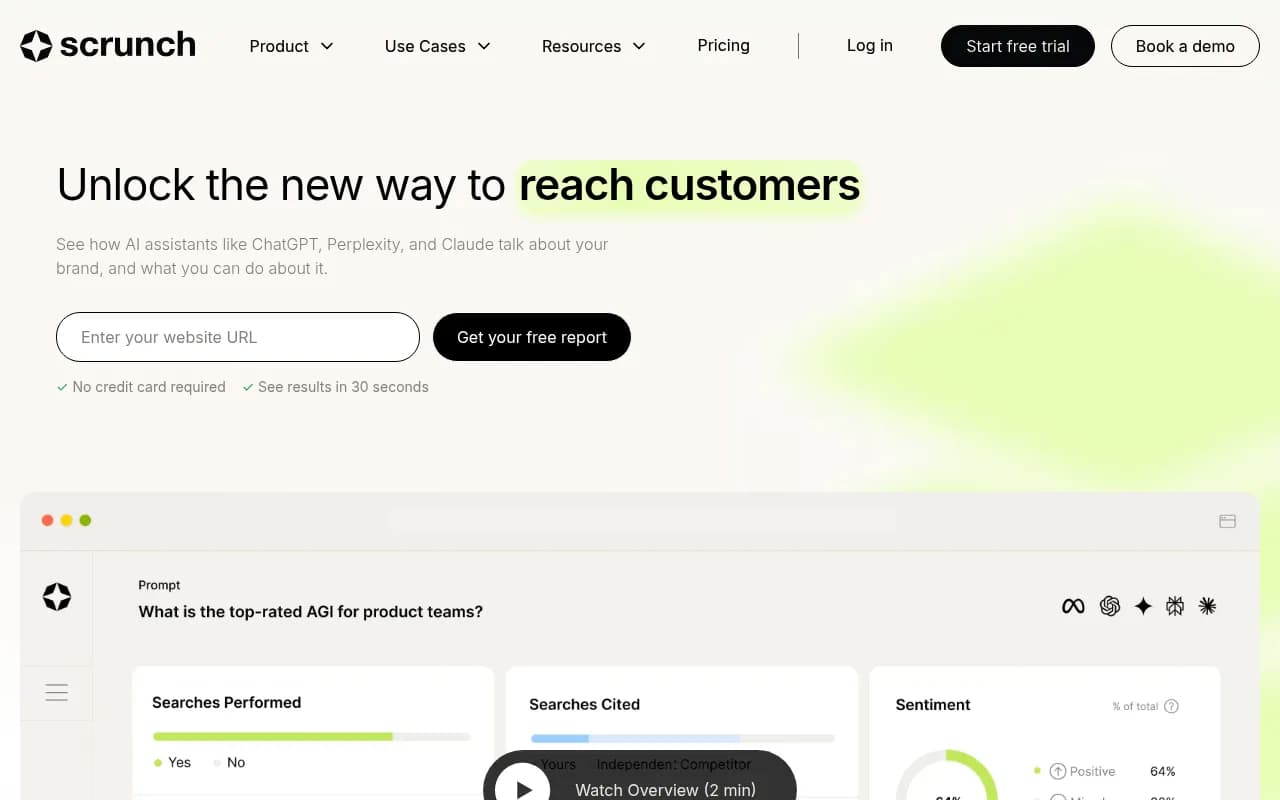
Scrunch AI has built an AI search visibility platform with tracking across LLMs. It's attracted attention in the agency space and has reasonable feature coverage for monitoring use cases.
BrightEdge
BrightEdge isn't a GEO startup -- it's an established enterprise SEO platform that has been aggressively adding AI search capabilities. It's worth mentioning here because it's one of the few players with both the data infrastructure and the enterprise relationships to compete at scale. Its AI Overviews data (the 48% figure cited earlier) comes from its own tracking infrastructure, which gives you a sense of the data depth it's working with.
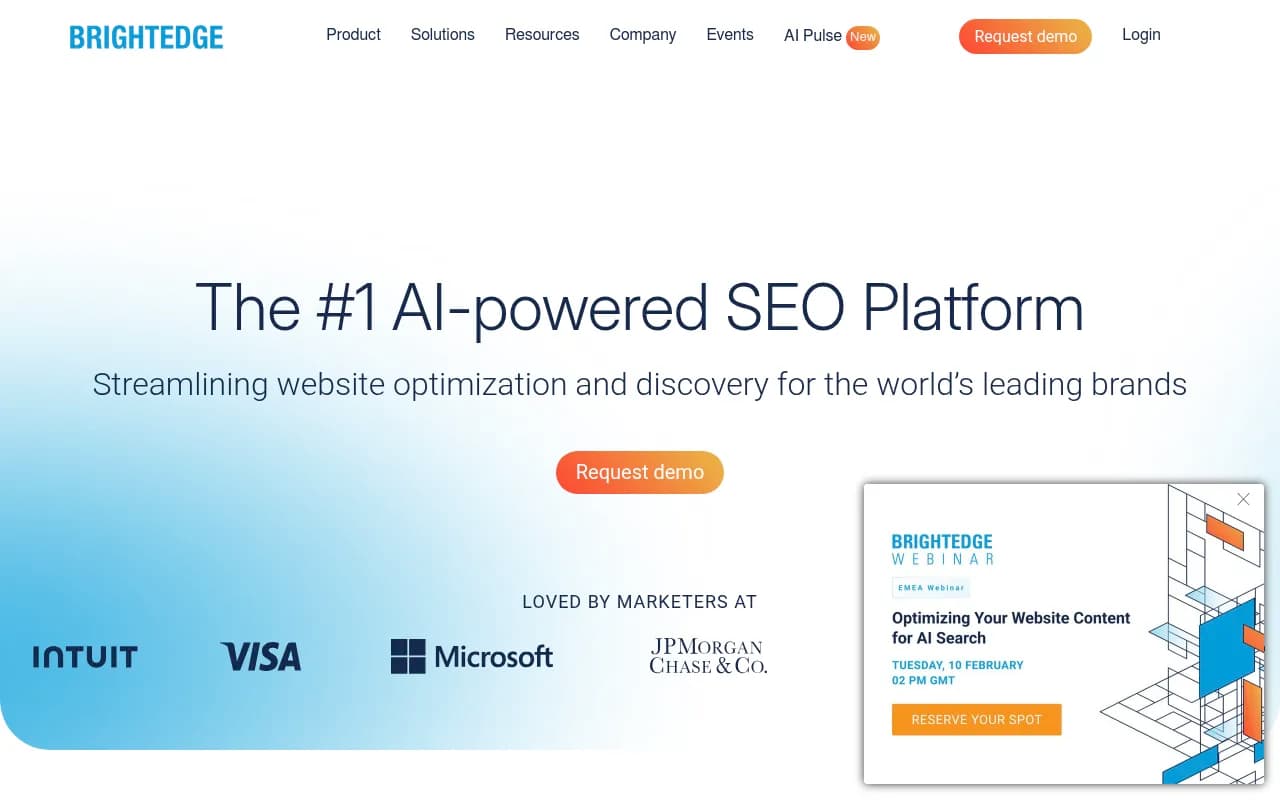
The tradeoff: BrightEdge is expensive, built for large enterprise teams, and its GEO features are layered onto an SEO platform rather than built from the ground up for AI search.
Conductor
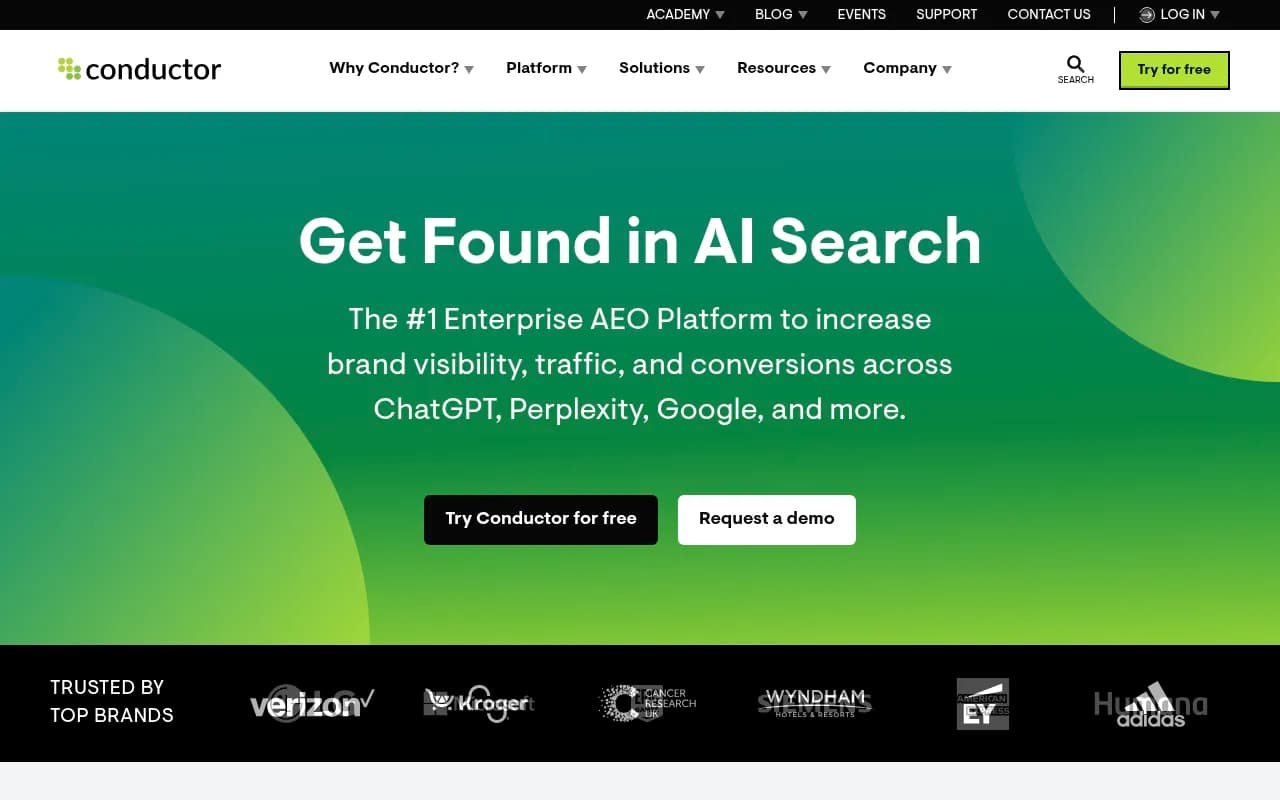
Conductor has published industry-specific GEO benchmarks for 2026 and has been building out AI visibility tracking alongside its traditional SEO capabilities.
Semrush and Ahrefs
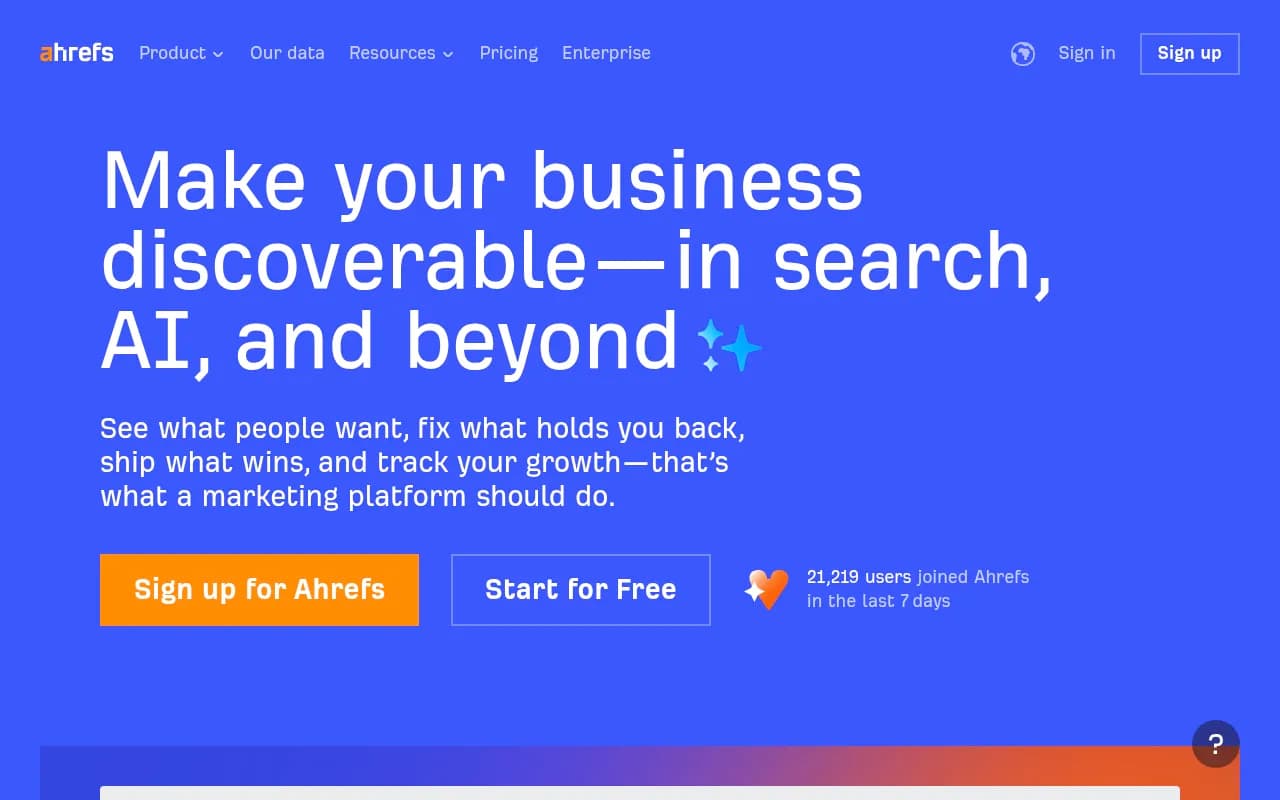
Both have added AI visibility features. Semrush's approach uses fixed prompts, which limits flexibility. Ahrefs Brand Radar has fixed prompts and no AI traffic attribution. Neither was built for GEO from the ground up, and it shows -- but their existing user bases give them distribution that pure-play GEO startups have to work hard to match.
What the funding patterns actually tell you
A few things stand out when you look at where money is going in this space.
Monitoring is easier to fund than optimization
Building a dashboard that queries AI engines and reports back on brand mentions is a tractable engineering problem. Building a platform that analyzes why you're not being cited, generates content to fix it, tracks AI crawlers hitting your site, and connects all of that to revenue -- that's a much harder product to build.
Most funded GEO platforms have taken the first path. That's not a criticism; it's just where the market is. The implication for buyers is that you should pressure-test any platform's claims about optimization. Ask to see the content generation workflow. Ask how they track whether new content gets cited. Ask whether they can show you which pages AI crawlers are actually reading.
Enterprise is getting more attention than SMB
The larger funding rounds in this space are going to platforms targeting enterprise and mid-market buyers. That makes sense from an investor perspective -- bigger contracts, longer retention, more defensible relationships. But it means SMB and mid-market teams often find themselves choosing between enterprise tools that are too expensive and lightweight tools that are too thin.
The "action gap" is still wide open
Here's the thing that stands out most when you survey the funded landscape: almost every platform is better at telling you where you're invisible than at helping you become visible. That gap -- between measurement and action -- is where the real opportunity sits, and it's still largely unaddressed by the funded players.
Codeword Agency put it well in their 2026 budget analysis: AI visibility is a cross-functional infrastructure investment, not a reporting exercise. Brands that are seeing pipeline growth from AI visibility are doing fundamentally different things than brands that are just monitoring their scores.

Codeword Agency's 2026 analysis argues that AI Visibility requires a proactive, strategic effort -- not just monitoring dashboards.
How Promptwatch fits into this picture
Promptwatch takes a different approach from most of the funded players. Rather than building a monitoring dashboard and stopping there, it's built around what it calls the action loop: find the gaps, create content that fills them, track whether it worked.

The gap analysis piece is genuinely differentiated. Answer Gap Analysis shows you exactly which prompts competitors are being cited for that you're not -- not as a vague "you're behind" signal, but as specific topics, questions, and content angles that AI models are looking for answers to but can't find on your site.
The content generation layer uses that prompt data to generate articles, listicles, and comparisons grounded in real citation data, prompt volumes, and competitor analysis. This isn't generic AI content -- it's content engineered around the specific gaps the analysis surfaces.
The tracking side goes deeper than most: AI crawler logs show which pages ChatGPT, Claude, and Perplexity are actually reading, how often they return, and when a crawled page moves to an actual citation. That's data most monitoring-only platforms don't have at all.
Promptwatch monitors 10 AI models (ChatGPT, Perplexity, Google AI Overviews, Google AI Mode, Claude, Gemini, Meta/Llama, DeepSeek, Grok, Mistral, Copilot) and is used by 1,480+ brands including Booking.com and Center Parcs. Pricing starts at $99/month for the Essential plan.
How to evaluate any GEO platform, funded or not
Funding is a signal, not a guarantee. Some of the most useful GEO tools are bootstrapped. Some well-funded platforms are still figuring out their product-market fit. Here's what actually matters when you're evaluating options.
The feature comparison that matters
| Capability | What to look for | Why it matters |
|---|---|---|
| Prompt tracking | Custom prompts, not just fixed templates | Fixed prompts miss the queries your actual customers use |
| AI model coverage | 5+ models including ChatGPT, Perplexity, Gemini | Different models cite different sources |
| Content gap analysis | Shows specific missing topics, not just scores | Scores without context don't tell you what to do |
| Content generation | Built on real prompt and citation data | Generic AI content won't close GEO gaps |
| Crawler logs | Real-time logs of AI crawlers hitting your site | Understand how AI engines discover your content |
| Traffic attribution | Connects AI visibility to actual site traffic | Proves ROI, not just vanity metrics |
| Reddit/YouTube tracking | Surfaces third-party content influencing AI | Most platforms ignore this entirely |
| Pricing | Transparent, scales with usage | Hidden costs kill adoption |
Questions to ask before signing up
Ask any platform you're evaluating: what happens after I see my visibility score? If the answer is "you can export the data and figure it out," that's a monitoring tool. If the answer involves content recommendations, gap analysis, and a workflow for creating and tracking new content, you're looking at something closer to an optimization platform.
Also ask: how do you track AI crawlers? Most platforms query AI engines through APIs and report on what comes back. That's useful but incomplete -- user-facing AI answers can differ from API outputs, and you won't know which pages AI engines are actually reading unless someone is tracking the crawlers themselves.
Finally, ask about prompt volume data. Knowing that you're not being cited for a prompt is one thing. Knowing that the prompt gets 50,000 queries a month versus 500 changes how you prioritize. Platforms with prompt volume estimates and difficulty scoring let you focus on winnable, high-value gaps instead of guessing.
The broader market signal
The fact that venture capital is flowing into GEO platforms tells you something important: this isn't a feature that's going to get quietly absorbed into existing SEO tools and disappear. Investors are betting that AI search visibility is a durable, standalone problem that requires dedicated tooling.
That's probably right. The 62.2% projected share of total search that AI is expected to capture by 2030 isn't a number that makes traditional SEO sufficient. Brands that aren't building AI visibility strategies now are going to find themselves in the same position as brands that ignored mobile search in 2012 -- technically fine today, structurally disadvantaged tomorrow.
The more interesting question isn't whether GEO platforms will matter. It's which ones will still be around and worth using in two or three years. Funding helps with runway, but the platforms that survive will be the ones that can actually show marketing teams a path from "here's where you're invisible" to "here's how you became visible, and here's the traffic it drove."
That's a harder product to build. It's also the one worth waiting for -- or finding now, if it already exists.
Bottom line
The GEO funding landscape in 2026 reflects a market that's real, growing fast, and still figuring itself out. Most of the capital has gone into monitoring platforms that are genuinely useful but incomplete. The action side of GEO -- content gap analysis, AI-native content generation, crawler tracking, traffic attribution -- is where the category needs to go, and where fewer platforms have arrived.
When you're evaluating tools, look past the funding announcements and ask what the platform actually does after it shows you the problem. The answer to that question tells you more about whether it's worth your budget than any press release about a Series A.